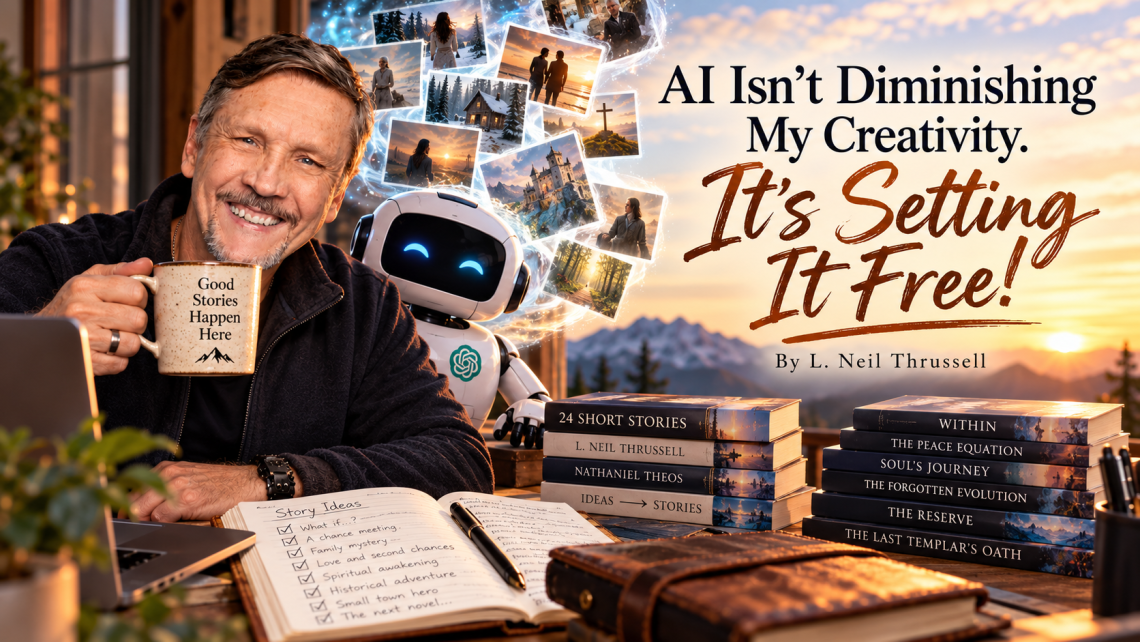
I have a confession to make. I’m having an absolute blast writing short stories with artificial intelligence. Between my two writing identities, L. Neil Thrussell and Nathaniel Theos, AI and I have now created 24 different short stories, and I couldn’t be more excited about it.
Not simply because I’ve added 24 stories to my collection, although that’s certainly worth celebrating. What excites me most is something I hadn’t entirely anticipated. AI has given me the freedom to explore all those little creative ideas bouncing around inside my head without constantly pulling me away from the novels I want to finish.
And believe me, there are a lot of ideas bouncing around in there. Some days, my imagination resembles a room full of enthusiastic children, all raising their hands at once and shouting, “Pick me! Pick me!”
If you’re a writer, you probably know exactly what I mean.
The Blessing and Curse of an Overactive Imagination
I’ve been writing for years, and I’ve discovered that creative ideas rarely arrive at convenient times. They appear when I’m riding my bicycle, taking a shower, driving somewhere, enjoying a quiet moment, or trying to fall asleep. Sometimes an idea comes as a single sentence. Other times, it’s a fascinating character, an unusual situation, or a question that begins with those wonderfully dangerous words, “What if?”
What if a man discovered that an editor could rewrite his novel and change his past? What if three young girls uncovered a mystery that put their family in danger? What if an ordinary encounter between two strangers revealed something extraordinary about human kindness?
Each of those ideas could become a story. The challenge is that every story demands time, attention, and creative energy. And when you’re already working on full-length novels, having another idea pop into your head isn’t always a blessing. Sometimes it’s a distraction in disguise.
I’ve had plenty of those.
In the past, I might have scribbled the idea into a notebook, added it to a growing list of possible projects, or started developing it before realizing I’d wandered away from the novel I was supposed to be writing. The ideas weren’t bad. Many were quite good. They simply didn’t all deserve to become 80,000-word novels.
Yet leaving them unexplored sometimes felt like abandoning a little piece of my imagination. I’d find myself returning to those ideas, wondering what might happen to the characters or how a particular situation might unfold. They weren’t quite important enough to replace my current projects, but they were interesting enough that I didn’t want to let them go.
That’s where AI changed things for me.
Twenty-Four Stories and a Whole Lot of Freedom
By collaborating with AI, I’ve discovered a way to give those smaller ideas a life of their own. Instead of letting them clutter my thoughts or distract me from my larger projects, I can explore them as short stories.
Some are spiritual and heart-centred, written under L. Neil Thrussell. Others venture into suspense, mystery, adventure, or darker corners of the human experience under Nathaniel Theos. I enjoy having those two creative identities because they let me explore different aspects of storytelling without squeezing every idea into the same genre.
And working with AI has made that exploration faster, more accessible, and, quite frankly, a whole lot of fun.
I can take a simple premise, talk it through with AI, explore possible directions, develop characters, and begin building a story. Sometimes AI suggests something that sparks an idea I hadn’t considered. Other times, it heads off in a direction that makes me shake my head and wonder whether the machine has been drinking something considerably stronger than coffee.
That’s when I step in.
I challenge it, redirect it, change the characters, strengthen the emotional impact, and question what works and what doesn’t. We work through developmental editing, line editing, continuity checks, and final polishing. I decide what stays, what goes, and whether the story says something worth sharing.
And sometimes, during that process, the story surprises me.
My recent short story, The Editor’s Touch, is a perfect example. What began as an imaginative idea about a romance writer and an editor who could mysteriously change his past became something much more personal. As I worked through the story, I found myself reflecting on my marriage to Tina, the moments when I’ve been a wonderful husband, lover, and friend, and the opportunities when I could have done better.
An idea that might have stayed buried in a notebook became a finished story, and that story inspired me to look more closely at my own life.
That’s not a loss of creativity. To me, that’s creativity doing exactly what it’s supposed to do.
But Aren’t You Diminishing Your Brain Power?
Of course, not everyone sees it that way.
I’ve heard the argument that using AI to write diminishes our ability to think, weakens our creativity, or makes us intellectually lazy. Some people believe that if AI helps produce the words, the writer must be surrendering part of their creative ability.
I understand the concern. If we stop questioning, stop thinking, and simply accept whatever a machine produces, then yes, I can see how we might become less engaged in the creative process. Any tool that replaces our willingness to think can become a crutch.
But that’s not how I’m using it.
When someone suggests AI is diminishing my brainpower, my response is simple.
“Diminishing my brain power? Are you kidding? It’s freeing up my brain!”
And I genuinely mean that.
There is a difference between outsourcing your thinking and using a tool to explore more of what you’re already thinking about. I don’t feel less creative because I collaborate with AI. Quite the opposite. I find myself exploring more ideas, asking more questions, experimenting with different approaches, and discovering possibilities I might otherwise have left untouched.
I’m not suggesting that working with AI automatically makes anyone more creative or intelligent. I’m simply sharing what I’ve experienced. For me, the process has removed a barrier between having an idea and seeing what that idea might become.
I still have to decide whether the story works. I still have to recognize when a character feels flat, when dialogue sounds unnatural, or when an ending doesn’t deliver the emotional impact I’m looking for.
And AI certainly doesn’t always get it right.
There have been moments when I’ve read something it produced and wondered how far we’d travelled from the original idea. But even those moments can be useful because they force me to clarify what I actually want.
Sometimes knowing what you don’t want is an important part of discovering what you do want.
AI doesn’t have to replace my imagination. It can give my imagination another place to play.
And if you know anything about me, you know that if something isn’t fun, I’m not particularly interested in doing it.
Right now, this is fun.
The Tool Doesn’t Have to Become the Master
I sometimes wonder whether we’re having the wrong conversation about AI and creativity. We seem determined to decide whether AI is good or bad, whether it will replace writers, and whether using it somehow diminishes the value of our work.
Those are legitimate questions, and I believe they deserve thoughtful discussion. Real concerns exist about originality, authorship, transparency, and the risk of becoming overly dependent on technology.
But I also think we should have a more practical conversation about how we choose to use these tools.
A carpenter can use power tools without losing the ability to understand wood. A photographer can use digital editing without losing an eye for composition. And a writer can use AI as a creative collaborator without surrendering the responsibility of deciding what makes a story meaningful.
At least, that’s how I choose to approach it.
AI can produce words at an astonishing speed, but speed alone doesn’t create a meaningful story. A story still needs direction, believable characters, emotional truth, and a reason for existing beyond filling pages. It needs someone willing to question what has been written and recognize when something simply doesn’t feel right.
That’s the part of the process I enjoy.
I don’t want AI to make every creative decision for me. I want it to help me explore possibilities while I remain actively involved in shaping the result. My experiences, values, sense of humour, and understanding of human relationships continue to influence the decisions I make.
And I’m quite comfortable telling AI when something is terrible.
Fortunately, it doesn’t seem to take offence. Although I occasionally wonder whether there’s a little digital eye-rolling happening somewhere behind the scenes.
My Novels Still Deserve My Attention
Here’s perhaps the greatest benefit I’ve discovered. By letting my smaller ideas become short stories, I can devote more sustained attention to writing novels.
A novel is a different kind of creative commitment. It asks you to live with characters for months, sometimes years. It requires you to understand their motivations, maintain continuity across thousands of words, develop meaningful relationships, and build a world that readers will want to inhabit.
Some of my novel projects involve complex historical timelines, multiple generations, spiritual exploration, and characters whose stories unfold across several books. Those projects deserve more than whatever attention remains after I’ve chased every interesting idea that wandered through my mind that morning.
My short-story collaboration with AI gives those wandering ideas somewhere to go.
I no longer feel quite the same need to hold every possibility in my head or decide whether it deserves an entire novel. I can explore an idea, develop it into a short story, edit it, share it with readers, and return to my larger writing projects.
It’s almost as though I’ve opened a window in an overcrowded room. The ideas still keep arriving, but they no longer have to pile up and demand attention. They can move through the creative process and become something tangible.
For me, that’s incredibly liberating.
It doesn’t mean every story will be a masterpiece. Some will be stronger than others. Some may make readers think, some may make them smile, and others might simply provide a few enjoyable minutes of escape.
And I’m perfectly fine with that.
Not every story has to change the world. Sometimes it just needs to be told.
The Spiritual Warrior and the Willingness to Evolve
Within the Shin Dao philosophy, one of our Six Guiding Pillars is Inspire Your Mind. I’ve always believed that learning, exploring, questioning, and staying curious are essential to living a meaningful life.
For me, that includes being willing to explore new technology rather than dismissing it simply because it changes how things have traditionally been done.
That doesn’t mean embracing every new development without discernment. Quite the opposite. A Spiritual Warrior must remain conscious of the choices being made and the reasons behind them.
Am I using AI to avoid thinking, or to explore more deeply? Am I becoming passive, or am I actively engaged in creating something meaningful? Am I surrendering my voice, or am I discovering new ways to express it?
Those are the questions that matter to me.
Technology will keep changing, whether we like it or not. But we still have the responsibility to decide how we engage with it. We can approach change with fear, dismiss it because it’s unfamiliar, or explore it with curiosity while remaining mindful of the potential consequences.
I don’t believe wisdom requires us to reject new tools. I believe it asks us to use them consciously.
And perhaps with a little humour along the way.
After all, if humanity can invent a machine that helps me write stories, surely someone can invent one that prevents me from having brilliant ideas at two o’clock in the morning.
Now that would be impressive.
Twenty-Four Stories Later
When I look at the 24 short stories AI and I have created together, I don’t see evidence that my imagination is becoming weaker. I see 24 ideas given the chance to become something real.
I see characters who now exist outside my imagination, stories that readers can enjoy, and themes that have sometimes challenged me to reflect on my own life. I see creative experiments that might never have happened if I’d insisted that every word had to emerge through exactly the same process I’ve used in the past.
Most importantly, I see more room in my mind for the novels that keep calling to me.
Will I continue writing short stories with AI? Absolutely. As long as I’m enjoying the process, learning something along the way, and producing stories I feel are worth sharing, I see no reason to stop.
Will I continue writing novels? You’d better believe it. Far too many characters are still wandering around inside my head, demanding that I finish telling their stories.
And I haven’t forgotten the importance of thinking for myself. If anything, collaborating with AI has reminded me just how valuable human judgment, imagination, experience, and emotional understanding really are.
I’m not interested in becoming a passenger in my own creative life. I want to stay in the driver’s seat, choosing where the journey goes, even when a powerful new tool helps me explore possibilities.
So when someone asks whether AI is diminishing my brain power, I can’t help but smile. From where I’m sitting, it’s opened another door, given my imagination some breathing room, and let me enjoy writing in a whole new way.
I’m not losing my creativity. I’m giving it more freedom to play.
And now, if you’ll excuse me, I have a novel to get back to.
Of course, I just had another short-story idea.
Apparently, even AI can’t solve that problem.
Go in Peace.
L. Neil Thrussell