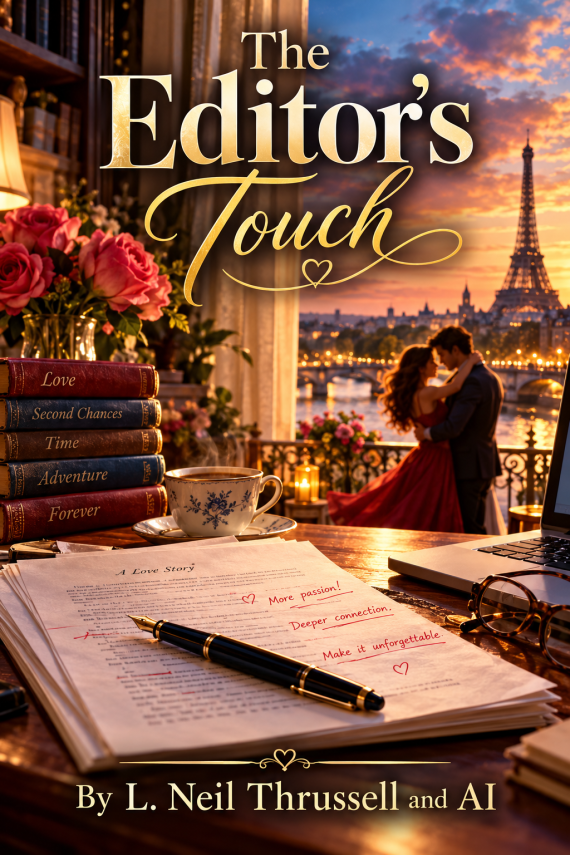
The Editor’s Touch
By L. Neil Thrussell and AI
Chapter One: The Man Who Forgot Romance
Thomas Graves had spent twenty-three years writing about love, and somewhere along the way he had forgotten how to make it interesting. He sat at his desk on a Thursday afternoon, reading the final paragraph of his latest manuscript for the fourth time. Daniel and Sarah, the married couple at its centre, had celebrated their anniversary with steak, salmon, and a discussion of parking. Then they had driven home to watch the evening news. Thomas put down his fountain pen and sighed. “I’ve written a love story about two people waiting for a bus.”
His novel, The Love We Lived, was meant to be a triumphant return. His first books had sold well, and a reviewer had once called him a master of modern romance. That had been fifteen years ago. Lately his fictional lovers had grown more concerned with household repairs than desire. His previous novel included an entire chapter about renovating a kitchen. His publisher, with admirable restraint, had suggested that the next book might benefit from an actual kiss.
At fifty-seven, Thomas lived by a comfortable schedule. Coffee at seven, writing until noon, a walk when the weather cooperated, and quiet evenings with his wife. Tanya Brooks, fifty-five, had been married to him for twenty-seven years. She had kept her surname partly because she liked it and partly because, as she once observed, Tanya Graves sounded like a television detective. She possessed a sharp wit, an instinct for kindness, and auburn hair that had begun to gather silver at the temples. Thomas loved her with a steadiness he considered one of his finest qualities. He had not recently considered whether steadiness might sometimes resemble inattention.
A knock sounded at the study door. Tanya entered carrying tea and a plate with two biscuits. “Still saving the literary world?” she asked. “More like boring it into submission.” She set the plate beside his keyboard and peered at the manuscript. “How’s the great romance coming?” “Finished.” “Wonderful. Does anyone fall in love?” “They’re already married.” “That wasn’t my question.” She tilted her head. “Do they kiss?” “Of course.” “Passionately?” “Define passionately.” “Thomas.” He sighed. “There’s a kiss in chapter fourteen.” Tanya stared at him. “What are they doing for the first thirteen chapters? Filing their taxes?”
He laughed, and she kissed his cheek. It was a familiar kiss, warm and unhurried, the sort exchanged by people who knew the other would still be there tomorrow. Thomas appreciated it. He also scarcely noticed it. Tanya straightened and glanced at the window. “Remember when you used to surprise me?” “I still do.” “Yes. Last Tuesday you took out the recycling without being asked. I nearly fainted.” Her smile was teasing, but something in her eyes lingered after the joke had passed.
When she left, Thomas remembered their early years. They had once driven into the countryside simply because the moon looked enormous. They had stopped for chips at a roadside café and returned home at two in the morning, shivering and delighted. They had once waited through an entire cloudy night for a meteor shower they never saw. Tanya had made up constellations while he pretended to recognize them. There had been impromptu flowers, kisses in grocery-store aisles, and mornings when breakfast waited until afternoon. None of those moments had required money. They had required attention.
That evening Tanya suggested trying a little Italian restaurant across town. Thomas glanced at the clock and said the parking was terrible. She stopped laying out plates. “Of course. We wouldn’t want an adventure involving parking.” She spoke lightly and took the leftover lasagna from the refrigerator, but he noticed that she did not ask again. Later, as the television murmured, he watched her reading beside him. She tucked one foot beneath the other leg, as she had done when they were dating. He knew how she liked her tea, which knee troubled her after long walks, and which songs made her cry. He wondered when knowing her had stopped inspiring him to discover more.
“Tanya?” he said. She looked up. “Would you like to try that restaurant tomorrow?” “The one with the dreadful parking?” “That’s the one.” She smiled cautiously. “Really?” “Really. I may even walk an extra block.” “Should I call a doctor?” “Only if I suggest dancing.” Her laughter came quickly, and she reached for his hand. He held it a little longer than usual.
The following morning he printed the manuscript and tucked his original paper copy into the bottom drawer of his filing cabinet. He had always worked this way, keeping his first drafts marked with handwritten notes even after sending a digital copy to an editor. On the last page he wrote, When did we stop having adventures? He sent the electronic file to Charlotte Richardson, a respected editor who had agreed to take a fresh look at his work. His marriage did not need rescuing, he told himself. It was good, loving, and secure. Yet he could not shake the feeling that something beautiful had been left unattended, like a garden that still bloomed but no longer surprised anyone.
On the evening before he sent the manuscript, Thomas stood at the bedroom door while Tanya searched for an earring she had dropped. He knelt to help, discovering it beneath the dresser beside a theatre ticket from years earlier. They had seen a terrible comedy that night and laughed harder afterward over how terrible it had been. Tanya took the ticket and smiled. “I wore those ridiculous red shoes. You told me I looked like I was escaping from a circus.” “I said you looked like the star attraction.” “You were much better at compliments then.” He wanted to protest, but the old ticket in his hand was proof that even an unremarkable evening could become precious. They put it back in the drawer together, not because it was valuable, but because it belonged to them.
Chapter Two: A Woman Who Believed in Fireworks
Charlotte Richardson believed a proper love story should occasionally make a reader forget to breathe. At forty-three, she had edited historical romances, contemporary love stories, and one spectacularly earnest novel in which a man confessed his love by rebuilding a greenhouse. She loved unexpected kisses, handwritten letters, and the idea that two people could fall in love with each other more than once. What she did not love was Thomas Graves’s latest manuscript.
“An anniversary dinner,” she murmured, “and he spends three paragraphs describing the parking.” She scrolled farther. “And then they watch the news?” Charlotte removed her glasses and addressed the ceiling. “Thomas, what happened to you?” She had read his early books when she was young. His characters had been brave enough to say foolish things and foolish enough to do brave ones. The people in this book seemed pleased when the dishwasher finished its cycle.
On her desk stood a photograph of her parents dancing at their fortieth anniversary. Her father had forgotten the steps, her mother had laughed, and he had whispered something that made her blush. Charlotte had never learned what he said. She hoped she never would. Some private mysteries deserved to stay private. That was the romance she wanted to find in Thomas’s manuscript, not perfection, but the ability to look at a familiar face and see something wonderful.
She opened the first chapter. Daniel was browsing travel guides when Sarah asked for the history section. He pointed. They talked. Eventually they exchanged numbers. “That’s not a romantic encounter,” Charlotte declared. “That’s customer service.” She deleted the scene and began again. A summer storm swept across the town. A young woman reached for a book on the highest shelf. A man offered assistance and risked looking ridiculous. Lightning flashed beyond the windows. Their conversation grew teasing and unexpectedly honest. When the shopkeeper announced an early closing, the man shared his umbrella, and the two strangers kissed beneath the awning while rain drummed around them.
Charlotte read the new scene aloud. The dialogue sounded alive. The characters had choices, and their choices mattered. She adjusted a line, then another. She gave Sarah a fondness for travel and Daniel an awkward, appealing sincerity. She let their first conversation stretch just long enough to make the kiss feel daring. Then she pressed Save.
Across the city, Thomas Graves dropped his fountain pen. The room tilted, and for one terrifying instant he felt as if the floor had disappeared beneath his feet. The smell of paper and summer rain filled his lungs.
Charlotte, meanwhile, stretched her arms above her head and went to the kitchen for fresh coffee. Her spare bedroom had become an office with books stacked in improbable towers, a small desk lamp, and a window overlooking a maple tree. She was the sort of editor who left encouraging comments in the margins but could also cut twenty pages without hesitation. She considered her work an act of loyalty to the story. If a passage was beautiful, she protected it. If it was hiding its own heart, she went looking.
The next chapter featured a trip to the cinema. Daniel and Sarah watched a film, enjoyed it, and went home. Charlotte sighed, made a note to revisit the scene, and closed her laptop. She had no idea that a man across the city was standing in a bookstore that had closed years earlier, or that her ordinary computer had just done something impossible. As far as Charlotte knew, she had improved a manuscript. That was quite enough to make it a good afternoon.
Charlotte’s workday had begun with a message from a younger author thanking her for leaving a scene untouched. She treasured that note. Editors were often praised for what they changed, but knowing when to leave something alone required its own discipline. Thomas’s novel contained flashes of his old gift: a description of Sarah quietly mending Daniel’s coat, a moment when he recognized her footsteps before she entered the room, a conversation about a lost pet that revealed their shared tenderness. Charlotte highlighted those passages in green. She would not replace the marriage with a collection of postcards. She wanted the grand gestures to grow from the small kindnesses already present.
Chapter Three: The Kiss That Never Happened
Thomas stood in a bookstore. He recognized the brass bell above the door, the dark shelves, and the narrow aisle where travel books stood beside atlases. He also recognized the young woman reaching for a volume on the highest shelf. Tanya. Twenty-six years old, wearing the green dress she had worn when they met twenty-nine years earlier. Her auburn hair fell loosely over her shoulders. She was exactly as he remembered, except that rain hammered the windows and thunder rolled outside. On the actual day they had met, the sun had been shining.
“Excuse me,” she said, turning. “Are you going to stare or help?” Thomas opened his mouth. “That depends. Are you always so demanding with strangers?” “Only the handsome ones.” Heat rushed into his face. He remembered falling in love with that smile, but he had never heard those words before. His hands looked young. His knees did not ache. Yet he remembered being fifty-seven, remembered his study, and remembered the cup of tea Tanya had brought him that morning. Two versions of himself occupied the same astonished body.
He reached for the book. Their fingers brushed, and a thrill travelled up his arm. “Thank you,” she said. “Thomas.” He blinked. “How do you know my name?” She pointed to the volume tucked under his other arm. A slip of paper protruded from it, marked Reserved for Thomas Graves. “You’re not much of a detective,” she observed. “I leave the detective work to my future wife.” Tanya laughed. “You sound remarkably confident for someone who hasn’t introduced himself.” He tried again. “Thomas. As you’ve deduced.” “Tanya.” She offered her hand. He shook it, reluctant to let go.
She had been searching for travel essays. “Where would you go,” he asked, “if you could go anywhere?” “Paris,” she said without hesitation. “Why Paris?” “Because I want to sit at a café and eat pastries while pretending I speak French.” “Your French is terrible?” “Spectacularly.” “Mine too.” “Then we’d make a wonderful pair.” Thomas laughed. In the life he remembered, he had learned about her dreams slowly, across months of telephone calls and walks. Here the details arrived differently, yet the woman before him was unmistakably Tanya: curious, playful, and unafraid of saying what she wanted.
The shopkeeper announced that the storm had knocked out the lights in the rear storeroom and that the shop would close early. Tanya glanced toward the window. “I haven’t brought a coat.” Thomas held up an umbrella he did not remember owning. “I appear to have come prepared.” “How suspiciously convenient.” They stood beneath the awning, shoulder to shoulder, watching the rain turn the street silver. Thomas could smell wet pavement and the faint floral perfume she used to wear. He wanted to tell her they would marry in two years, that she would be his closest friend, that they would laugh and quarrel and forgive each other for nearly three decades. Instead he asked whether she would let him call her.
“Perhaps,” she said. “You haven’t made much of an impression yet.” He turned toward her. “May I kiss you?” Her smile softened. “I was beginning to wonder whether you’d ever ask.” He kissed her, first hesitantly, then with the wonder of someone rediscovering a language he had forgotten he spoke. Her fingers curled around his jacket. The umbrella tilted and rain soaked his shoulder. Neither moved to correct it. When they parted, she laughed quietly. “I think you should ask for my number now.” “I was just getting to that.”
The bookstore vanished. Thomas staggered against his desk, his pen rolling across the floor. The clock read 3:17, the same minute he had last seen. He touched his face, expecting rain. His skin was dry. “What in God’s name was that?” he whispered. Before he could answer himself, Tanya appeared in the doorway holding a photograph. “I found this in the old albums. Remember?” The picture showed two young people under an umbrella outside the bookstore. The woman wore green; the man looked hopelessly smitten. Thomas had never seen the photograph before.
“That storm was something,” Tanya said. “The storm?” “The day we met, darling. You were so nervous when you kissed me.” He swallowed. “Was I?” “I thought you might faint. And then you walked me to the bus stop with half your jacket soaked.” She studied his expression. “Are you all right?” “Just remembering.” She kissed his cheek and returned to the kitchen. Thomas searched the albums. More photographs had appeared, all yellowed and creased with age. There were notes on the backs in Tanya’s handwriting. The past had not merely changed in his mind. It had left evidence.
That evening he sat beside Tanya on the sofa. “What do you remember most about the day we met?” he asked. She closed her book. “The way you looked at me.” “How was that?” “Like you’d found something you didn’t know you were searching for.” Thomas felt his throat tighten. She leaned against him. “And I felt safe. Which was ridiculous, because I hardly knew you.” He put an arm around her. He remembered a sunny afternoon and a telephone number scribbled on a receipt. He remembered a thunderstorm and a kiss. Both histories felt true, but Tanya knew only one. For now, he decided, he would not burden her with the impossible. He would simply hold her a little closer.
Before going to bed, Thomas found himself staring at the old photograph again. He examined the edge of the awning, the reflection of the shop sign in a puddle, the crooked umbrella. He could remember the weight of its handle and the cold water creeping down his collar. His original memory was no less detailed: the warm pavement, the travel guide under his arm, the bus pulling away as Tanya waved. He tried to decide which memory deserved to be called real. Then he heard Tanya laughing at something on television and put the photograph away. Both memories had led him home to her. For one night, that answer would have to be enough.
Chapter Four: Paris Was Never in the Budget
Three days later Charlotte reached the twentieth-anniversary chapter. Thomas had described a pleasant dinner, an argument over the wine list, and an early night. She read it twice, walked to the kitchen for coffee, and returned with a decision. “Twenty years of marriage, and the poor woman gets salmon?” A mountain weekend might work. A surprise cruise might work. But Charlotte remembered her parents’ photograph and smiled. “Paris.” She rewrote the chapter around a surprise trip planned over six months, a hotel above a flower-filled courtyard, wandering streets, a boat ride on the Seine, and a kiss beneath the Eiffel Tower. She gave Daniel a speech about choosing Sarah again in every possible life. Then she pressed Save.
Thomas had been eating a sandwich. Suddenly the kitchen vanished, replaced by a Paris evening fragrant with rain, warm bread, and perfume. The Eiffel Tower glittered above him. Tanya stood before him in a midnight-blue dress, her hair pinned up, a silver necklace resting at her throat. “Thomas? Are you all right?” He stared. He had never been to Paris. They had always talked about it, but bills and work and practical obligations had intervened. Now he could remember three days in the city, as vividly as he remembered the anniversary dinner at home.
The new memories rushed in around him. Tanya opening the hotel window and exclaiming at the rooftops. A waiter mistaking them for newlyweds. Their laughter when Thomas ordered something entirely different from what he intended. A tiny shop where she had protested that a silk scarf was too expensive, then worn it all afternoon. They had walked until their feet hurt and returned to the hotel carrying pastries in a paper bag. In one memory Tanya fell asleep against his shoulder on a riverboat. In another she had taken his hand outside a bookshop and said, “This is better than any gift you could have wrapped.”
“You’re beautiful,” he told her now. Tanya laughed. “That’s the fourth time tonight.” “Then clearly I haven’t said it enough.” She moved closer. “What’s gotten into you?” He wanted to say that time itself had become unreliable. Instead he held her hands. “Twenty years ago I promised to love you for the rest of my life.” She smiled. “I remember.” The words came from somewhere inside the scene and somewhere inside him. “If I had the chance to live those years again, I’d choose you every single time.” Her eyes shone. “You’ve been practising that speech, haven’t you?” “Apparently.” “Then stop practising and kiss me.”
He kissed her beneath the lights, slowly enough to notice the softness of her hair against his cheek and the way her fingers tightened around his. They were no longer young, but the moment held the same delicious uncertainty as the bookstore. Tanya rested her forehead against his. “Still glad you married me?” “More than you could possibly know.” She laughed and kissed him again. Nearby, tourists passed with cameras and shopping bags. The city continued without noticing that a man’s entire understanding of his marriage had changed.
They walked toward the river. Tanya confessed she had always wanted to be kissed in Paris, the kind of kiss people wrote about in novels. “Did I manage it?” Thomas asked. “The setting was excellent,” she said. “Thank you.” “The lighting was quite impressive.” “I arranged it personally.” “And the gentleman involved was reasonably attractive.” “Reasonably?” She pulled him close. “Very attractive.” When they separated, he was grinning so broadly that she laughed. “You look twenty-five again.” “You make me feel twenty-five.” “Your knees might disagree tomorrow.” “Then we should enjoy tonight.”
At the river she stopped to admire the reflections of lamps on the water. Thomas watched her instead. He had forgotten how animated she became when travelling, how she noticed small details, how she could talk to strangers without hesitation. In the old anniversary memory they had discussed the price of salmon. There had been nothing cruel about that evening, nothing wrong with a familiar restaurant. But he had given the woman beside him no chance to be surprised. “Thank you for coming,” he said. “Darling, you bought the tickets. I was hardly going to refuse.” “I mean thank you for every time you’ve said yes to something I was too sensible to suggest.” She squeezed his hand. “You can still suggest things.”
The scene dissolved. Thomas found himself back at the kitchen table with his untouched sandwich. Tanya sat opposite, turning the pages of a photo album. “Look at us,” she said. There they were beneath the Eiffel Tower. He recognized every detail. That night he searched old emails and found airline confirmations, hotel reservations, and a message from Tanya thanking him for the most wonderful anniversary of her life. The photographs were real. So was the silk scarf folded in her drawer. He held it for a moment, breathing in a faint trace of her perfume.
For the first time he considered whether he should be frightened. Something had changed his history without asking permission. He could remember a life in which Paris remained a promise and another in which the promise had been kept. What else might change? Yet the evidence around him was tender rather than threatening. Tanya hummed as she brushed her hair before bed, and when he joined her she smiled as though nothing in the universe had shifted. He kissed her goodnight with unusual care. “What’s that for?” she asked. “For Paris.” “We should go back someday.” Thomas smiled into the darkness. “We should.”
The next morning he asked Tanya what she had liked best about Paris. She thought for a while. “The little bakery on the corner,” she said. “Not the tower?” “The tower was lovely. But you got up early, brought coffee and pastries back to the room, and sat with me while the city woke up. We didn’t have to be anywhere.” Thomas remembered that morning only in the revised history. He remembered butter flaking onto the bedspread and Tanya laughing as she brushed crumbs from his shirt. He had expected her to choose the grandest spectacle. Instead she chose an hour of being together. He carried that answer with him for the rest of the day.
Chapter Five: The Most Romantic Man in the Neighbourhood
Over the next two weeks Thomas began to suspect reality had developed an extravagant sense of humour. One Tuesday he found himself sitting at an Italian café in Florence, arguing with Tanya about cappuccino. He remembered the original argument in a grocery store, where they had disagreed over coffee brands. Now Tanya wore sunglasses and a flowing dress, and a waiter had brought two tiny cups of espresso. “You cannot claim to understand Italian coffee culture after three days,” she said. “I’ve done extensive research.” “You’ve ordered six coffees and complained none were large enough.” “That’s research.” She laughed, and he leaned across the table to kiss her.
A passing waiter grinned. “Ah, amore!” Tanya blushed. “Thomas, people are watching.” “Let them.” He kissed her again. An elderly man at the next table applauded, and soon several people joined in. Thomas, who generally disliked being the centre of attention, discovered he didn’t care. Tanya was laughing. That was enough. They wandered Florence for the rest of the afternoon, admiring shop windows and stone buildings. Tanya bought a small leather journal. “For our adventures,” she said. “You know I write for a living.” “Exactly. You should be very good at it.”
She made him write the first entry before they left the café. Thomas held the pen over the page, then wrote, Today I remembered that love should occasionally make a fool of you. Tanya read it over his shoulder. “That’s lovely. Although you were already a fool.” “And yet you married me.” “One of my more daring decisions.” When the scene ended, Thomas found the journal on his desk in the present. The entry was there, in his own handwriting. He touched the paper as if it might be warm from the sun in Florence.
Another afternoon carried him to a rooftop restaurant where a string quartet played beneath the stars. He remembered the birthday he had forgotten in his original life, the hurried flowers from a petrol station, and Tanya’s gracious insistence that it didn’t matter. In this new history he had arranged a surprise dinner and written a letter listing twenty things he loved about her. He heard himself reading it aloud: her generosity, her courage, the way she sang while cooking, the way she reached for his hand crossing a busy street, the way she made people feel welcome. The final line said, After all these years, my favourite place in the world is still wherever you are.
Tanya pressed the letter to her heart. “Oh, Thomas.” He kissed her across the table, then returned to the present with tears in his eyes. The letter hung framed beside her bed. Every word was true. He had simply never thought to say the words out loud. He read the list again and realized that the best details were not the dramatic ones. They were the small observations that could only belong to this woman, the person he had shared breakfasts and bad days and thousands of ordinary hours with.
The strangest visit came during a summer rainstorm. Thomas had been watching a documentary when the room dissolved and he found himself in their garden. Tanya stood barefoot beside the patio, soaked to the skin. Music drifted through an open window. “Come on!” she called. “It’s pouring!” “I noticed!” She held out her hands. He remembered falling asleep during that documentary in the original history. Now he stepped into the rain and let her pull him close. They danced badly, nearly tumbling into the flowerbed when his shoe slid on the grass. Tanya laughed until she could barely stand. “You always said you had two left feet.” “I was being modest. I have at least three.”
He watched her laugh, rain clinging to her eyelashes. He had missed that unguarded expression, though perhaps the truth was that he had stopped doing things that brought it out. He kissed her while water ran down their faces. The scene ended, leaving him standing in the living room with Tanya beside him. “You’re smiling like a fool,” she said. “Perhaps I am one.” She studied him. “You’ve been different lately.” He felt a flutter of concern. “Different how?” “More affectionate. Flowers for no reason. Kisses while I’m trying to cook. You even asked me to dance last night.” “Is that a complaint?” “Don’t you dare stop.”
Thomas began to notice the difference between remembering romance and creating it. The magical journeys gave him extraordinary experiences, but they did not decide what he would do in his kitchen on an ordinary morning. He woke early the next day, made coffee, and assembled breakfast on a tray. He was not an accomplished cook. The eggs were slightly overdone, and one piece of toast had an unfortunate encounter with the grill. Tanya opened one eye as he entered the bedroom. “What’s this?” “Breakfast.” “In bed?” “Unless you’d prefer to eat it in the garage.” She laughed and sat up.
She tasted the eggs and regarded him thoughtfully. “You don’t have to keep trying to impress me.” “I’m not trying to impress you.” “Then what are you doing?” He considered the question. “Paying attention.” Her expression softened. “I rather like that.” She reached for his hand. There were no string quartets or monuments outside the window, just their familiar bedroom and a tray with imperfect breakfast. Yet the warmth in his chest was every bit as strong as it had been beneath the Eiffel Tower. This moment belonged to him alone. No mysterious revision had arranged it.
Later, Tanya found him in the garden with the leather journal from Florence. He had written about breakfast, including an apology to the eggs, and about the pleasure of surprising someone who knew him well enough to expect nothing unusual. Tanya read it slowly. “You know what I’ve always loved about your books?” she asked. “The way you notice things. The tiny moments people forget until they realize those were the moments that mattered.” Thomas looked down at the page. “I thought I’d lost that.” “Perhaps you just got distracted.” She kissed his cheek. “It happens to the best of us.”
He put the journal aside and kissed her properly. Tanya smiled against his lips. “Careful. You’ll give the neighbours something to talk about.” Thomas laughed. “Let them.” He began making plans in his head, none particularly extravagant: a walk through the park, lunch somewhere unfamiliar, a Sunday afternoon without the television. He understood now that the romance in a marriage was not measured by how far the couple travelled. It was measured by how willingly they kept turning toward one another.
That weekend Thomas suggested they visit the little Italian restaurant across town, the one he had dismissed because of parking. Tanya looked up from her book. “You’re serious?” “Entirely. I’ve even researched the bus route.” “Who are you and what have you done with my husband?” “He’s trying to improve.” They went, shared a dessert, and walked home through a light drizzle. There was no sudden transportation, no photograph changing in an album. The evening happened only once. At the front door Tanya squeezed his arm. “This was lovely,” she said. “We should do it again.” Thomas realized that the best part of the night was knowing they could.
Chapter Six: The Greatest Love Story
Charlotte Richardson reached the final chapter on a bright Wednesday morning. She had spent nearly three weeks bringing Thomas’s manuscript back to life. Daniel and Sarah now laughed, quarrelled, travelled, and kissed with enthusiasm. Yet the final paragraph remained stubbornly flat: They had lived a good life together. They were content. Charlotte tapped her pencil against the desk. Content was not a bad word. It was simply too small to carry the weight of a whole marriage. She thought of her parents dancing and realized the ending needed no more spectacle. It needed truth.
She rewrote the scene on an ocean balcony at sunset. Sarah asked Daniel what he would change if he could live their life again. He remembered the years when money was tight, the arguments, the missed chances, and the countless unremarkable days that had somehow become a life. Then he answered, I would have loved you more boldly. Sarah told him he still could. Charlotte reread the exchange, adjusted a few sentences, and pressed Save. “There you are, Thomas,” she whispered.
Thomas found himself seated beside Tanya on a balcony overlooking the ocean. The air smelled of salt and flowering shrubs. Below them, a child laughed on the beach, and a seabird called over the surf. Tanya rested her head on his shoulder, their fingers intertwined. He could remember arriving at the little coastal inn, the winding road, and the afternoon they had spent walking beside the water. He could also remember being in his study only a heartbeat earlier. This time he did not fight the contradiction. He listened to the waves and waited.
“Can I ask you something?” Tanya said. “Anything.” “If you could go back and change one thing about our life together, what would it be?” Thomas looked at her. The question reached beyond the evening and beyond the revised memories. He remembered the bookstore in sunshine and in rain, the ordinary anniversary and Paris, the forgotten birthday and the rooftop dinner. He remembered a thousand days that Charlotte had never touched. Some had been joyful, some exhausting, some difficult enough that he and Tanya had gone to bed without speaking. They had endured those days together. He would not trade their marriage for a perfect one, even if perfection could be written into existence.
“Only one thing,” he said. Tanya lifted her head. “What?” “I would have loved you more boldly.” The words were already waiting for him, yet he meant them. “I would have kissed you more often, held your hand more, taken you dancing when you didn’t expect it. I would have told you every day how extraordinary you are.” Tanya’s eyes filled. “You’ve always loved me, Thomas.” “I know.” “Even when you weren’t particularly good at showing it.” He smiled. “Especially then.” She brushed his cheek with her fingers. “For the record, I never got tired of hearing it.”
He looked out at the ocean. “I thought that once you knew, I didn’t need to keep saying it.” “And I thought perhaps you were simply tired.” “I was tired sometimes.” “So was I.” She leaned against him. “We still found our way.” He turned back to her. “I don’t want us to spend the next twenty-seven years only finding our way. I want us to enjoy the journey.” Tanya laughed softly. “Then you’ll have to be willing to stop worrying about parking.” “I may need professional help with that.” “We’ll take it one adventure at a time.”
They sat together as the sun lowered. Tanya reminded him of their first apartment, where the kitchen barely held one person and the bedroom window refused to close properly. He remembered the neighbours upstairs moving furniture at midnight, the second-hand sofa, and the thrill of buying their first matching dinner plates. “We didn’t have much,” she said. “No.” “But we were happy.” “We were.” She rested her head against him. “We still have each other.” He kissed her forehead. “Yes, we do.” The waves continued, indifferent to the miracle unfolding on the balcony.
“Promise me something,” Tanya said after a while. “Anything.” “Don’t wait another twenty-seven years to become romantic again.” He laughed. “I promise.” “Good. I enjoy being swept off my feet.” “My back isn’t what it used to be.” She burst out laughing. “Metaphorically, darling.” “Ah. That’s a relief.” He kissed her as the last light faded, and for a moment there was no manuscript, no mysterious force, and no need to decide which memory was original. There was only the woman he loved.
The balcony disappeared. Thomas sat in his study with tears in his eyes. He heard Tanya humming in the kitchen and went to find her. She was drying a dish when he wrapped his arms around her from behind. “Well, hello,” she said. “Hello, beautiful.” He kissed her neck. “What’s this for?” “Absolutely nothing.” She turned in his arms. “Nothing?” “Nothing at all.” He kissed her again, not because any editor had written the moment, but because he wanted to. He had spent weeks receiving gifts from the past. Now he understood that the future was still his to make.
The ocean scene stayed with Thomas after he returned. At dinner he asked Tanya whether she ever thought about the years ahead. She said she wanted to travel a little, read more, and finally learn to paint without apologizing for the results. “What about you?” she asked. He considered mentioning a new book, another contract, another deadline. Instead he said, “I’d like to be the man who comes along when you paint, even if I spend the whole afternoon carrying your supplies.” Tanya smiled. “I might paint you.” “Be kind to my hairline.” “No promises.” He laughed, and they began discussing a weekend art class as though the future were a place they could visit together.
Chapter Seven: Two Versions of One Life
Charlotte’s email arrived on Thursday morning with the subject line The Love We Lived, Final Edited Manuscript. She wrote that she had found the heart of the story beneath its ordinary details and hoped Thomas loved what they had created. He opened the attachment and began reading. The first chapter described a bookstore, a storm, and a young woman reaching for a book. He stopped breathing. The dialogue, the umbrella, and the kiss matched his impossible experience. He scrolled to the anniversary chapter. Paris. The hotel. The river. The Eiffel Tower. Every detail was there.
Thomas rose so quickly his chair struck the wall. He opened the bottom drawer of his filing cabinet and pulled out his original paper manuscript. He had printed it before sending the digital version to Charlotte, as he always did. The pages were marked with his fountain pen and held together with a heavy clip. He opened the first chapter. No storm, no umbrella, no kiss. Only a travel guide and a woman asking for directions. He checked the anniversary chapter. Steak, salmon, and the evening news. On the screen, the couple stood beneath the lights of Paris.
He turned pages, comparing the two versions. The grocery-store disagreement had become Florence. The forgotten birthday had become a rooftop dinner. The rainy afternoon in front of the television had become dancing in the garden. The original final line said they had been content. Charlotte’s version said, I would have loved you more boldly. Thomas lowered himself into his chair. “Charlotte,” he whispered. For a moment he could only stare. Then he began to laugh, first quietly and then with such delight that tears ran down his face.
Across the city, a woman had rewritten his marriage without knowing she was doing it. He glanced around the study at photographs, souvenirs, and the framed letter beside Tanya’s bed. He picked up the small ceramic Eiffel Tower she had brought home. The object was solid and cool in his hand. He could remember choosing it with her. He could also remember an anniversary when neither of them had left town. His original pages had remained unchanged, a record of the life that had been replaced. He understood at last why his memories had doubled while Tanya’s had not.
He considered telephoning Charlotte. He imagined explaining that her edits had become real and that his wife now remembered journeys they had never taken in his first history. Charlotte would think he had lost his mind. Perhaps she would suggest a holiday, which seemed particularly unnecessary. He considered a simple note: Your edits have changed my life. It would be accurate, but not nearly accurate enough. He saved the email for later and opened the leather journal from Florence instead.
He found his entry about love making a fool of him, followed by one about breakfast in bed. The first had arrived with the revised past. The second he had written himself. He read them side by side. Charlotte had given him magnificent memories, but she had not forced him to make coffee, cook eggs, or ask Tanya about her day. Those choices belonged to him. He realized that the distinction mattered more than the explanation for the magic. An edited past could be a gift. It could not replace the daily work of loving someone.
At the beginning of his original manuscript he found the question he had written in the margin: When did we stop having adventures? He studied the words. He had assumed adventures were things that happened far from home, beneath famous monuments or across foreign streets. Now he remembered Tanya laughing in their garden and smiling over imperfect eggs. He remembered her suggesting a restaurant and his reflexive complaint about parking. He could not erase every moment when he had disappointed her. He did not need to. He could become more attentive now.
From the kitchen came the familiar sound of Tanya humming. It was a French song they had heard on their first evening in Paris, a city he had both visited and not visited. Thomas closed the manuscript. For twenty-seven years her voice had been part of the music of his life. He had simply stopped listening closely enough. He looked from the original pages to the glowing screen. One contained the life he remembered first. The other contained the life he remembered now. Both had brought him to the same woman, and he knew which part of the story he wanted to keep.
He eventually replied to Charlotte’s email with the kind of note he wished every editor could receive. He told her she had restored the warmth, humour, and courage he had once brought to the page. He thanked her for respecting the ordinary tenderness at the centre of the book. He did not mention the impossible trips. When he pressed Send, nothing happened. The room remained solid. The clock advanced by one minute. Thomas smiled at the normality of it. Some messages changed a life because of what they said, not because of any magic attached to them.
Chapter Eight: Keep This
Thomas remained at his desk while afternoon sunlight crossed the floor. The computer displayed Charlotte’s final page. Beside it lay his original paper manuscript, with its crossed-out phrases and the faint stain from a long-ago cup of coffee. Two versions of one story, two versions of one life. He thought of the years he had spent inventing passionate declarations and impossible coincidences for fictional couples. Somehow he had forgotten that the most important love story was unfolding in his own home, in the small gestures he had begun to take for granted.
Charlotte had given him Paris and Florence, music beneath the stars, and kisses in the rain. But her greatest gift was the reminder that Tanya was still the woman who could make his heart race. He picked up his fountain pen, opened the original manuscript to the last page, and beneath the sentence about being content wrote two words: Keep this. He looked at them for a moment and smiled. He did not mean to keep the old manuscript instead of the new one. He meant to keep the truth they both contained: love was not a finished story.
“Thomas?” Tanya called from the kitchen. “Are you coming?” He turned. She stood in the doorway with her auburn hair touched by silver and a smile he had loved for nearly three decades. “Are you finished working?” she asked. He glanced at the manuscripts. “Yes,” he said. “I believe I am.” She held out her hand. “Good. Dinner can wait.” He crossed the room and took it. Music drifted from the kitchen, their song from Paris. He drew her close. “May I have this dance?” Tanya smiled. “You may have every dance, darling.”
They moved slowly between the table and the kitchen counter, laughing when Thomas bumped a chair. He could smell dinner warming in the oven and feel Tanya’s hand resting against his shoulder. There was no grand audience, no spectacular skyline, no need to prove anything. He kissed her, and she answered with the same warmth she had given him in a bookstore twenty-nine years before, whether the weather had been sunny or wet. “What are you smiling about?” she asked. “You,” he said. “That’s a good answer.” “I’ve been practising.” She laughed and leaned closer.
Somewhere across the city, Charlotte Richardson closed her laptop, poured herself a glass of wine, and smiled with the quiet satisfaction of a woman who had rescued a love story. She had no idea what she had done. Thomas did. As he danced with Tanya in the fading light, he silently thanked the editor who had reminded him that the greatest love stories were not merely written. They were lived.
The End
Authorship & AI Collaboration Note
This work was created by L. Neil Thrussell with assistance from artificial intelligence. AI contributed to drafting, developmental editing, line editing, copyediting, proofreading, and cover-image generation. The author approved the cover graphic.