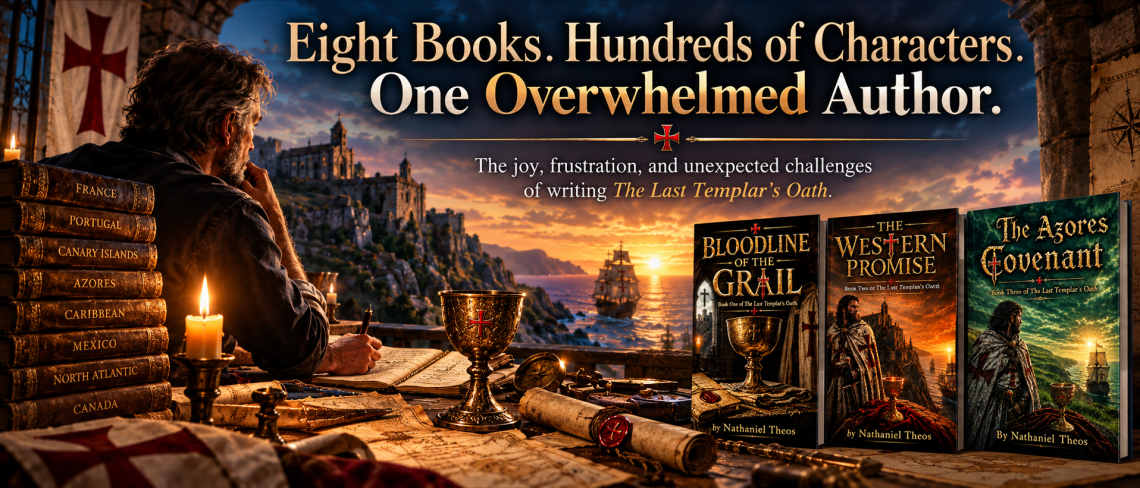
The joy, frustration, and unexpected challenges of writing The Last Templar’s Oath.
By L. Neil Thrussell, writing as Nathaniel Theos
I’ve written many books over the years. I’ve created characters, built fictional worlds, explored complicated relationships, and occasionally written myself into corners that required a fair amount of creative thinking to escape.
But nothing, and I mean nothing, has prepared me for The Last Templar’s Oath, my eight-book historical fiction series.
Eight books.
Spanning centuries, crossing oceans, moving through different countries, cultures, political landscapes, and generations of families.
Hundreds of characters. Countless relationships. Secrets passed from one generation to the next. Promises made by people whose great-great-grandchildren may not even understand why those promises matter.
And somewhere in the middle of it all is one slightly overwhelmed author trying to keep everything straight.
What the hell was I thinking?
Actually, I know exactly what I was thinking.
This is going to be an incredible story.
And it is.
But I may have underestimated just how much work an incredible story requires.
I Thought I Knew How to Write a Series
My earlier series, A Warrior’s Heart, eventually grew to four books.
Four books felt like a substantial accomplishment, and it was. I was immensely proud of the journey, the characters, and the spiritual messages woven throughout those stories.
But the entire series had fewer than twenty significant characters.
I knew those people. I understood their motivations, relationships, fears, and dreams. Their voices became so familiar that writing their dialogue often felt like listening to old friends talk.
Now imagine replacing those twenty characters with hundreds.
Then imagine those characters living in different centuries.
Then imagine that something a character says in Book Two may have consequences that don’t become apparent until Book Seven.
Welcome to my current writing adventure.
I sometimes think I need a historian, a genealogist, a cartographer, and a very patient personal assistant living in my office.
Preferably one who makes excellent coffee.
The Devil Is in the Details
One thing I’ve learned over the years is that readers notice things.
Especially observant readers.
They remember that a character had blue eyes in an earlier chapter. They remember that a particular sword was passed from father to son. They remember someone’s age, an important conversation, or a promise made during a stormy evening in a distant country.
And when something doesn’t line up, they notice.
Now multiply those details across eight books.
A character born in one generation cannot suddenly appear fifty years later looking remarkably youthful unless I’ve accidentally wandered into writing vampire fiction.
A family heirloom cannot mysteriously change hands without an explanation.
Someone who has never been told about it cannot know an ancient secret.
Even geography becomes a challenge.
How long would it take a ship to sail from Portugal to the Canary Islands? What routes were available? What would sailors have known about the oceans during that period? What political or religious pressures would have shaped my characters’ decisions?
And here’s another complication. Just because something is historically possible doesn’t necessarily mean it is believable to a modern reader.
I have to balance historical accuracy with the story’s needs.
These aren’t merely interesting little details.
They are the threads holding the entire series together.
Pull the wrong one, and I risk unravelling something three books down the road.
Keeping Characters Alive Across Generations
One of my greatest challenges has been keeping my characters’ voices consistent.
Every character needs to feel real.
Each has their own fears, beliefs, mannerisms, ambitions, and way of speaking.
A battle-hardened Templar knight shouldn’t sound like a modern-day motivational speaker. A young woman raised in a wealthy medieval household won’t necessarily interpret the world the same way as someone raised in poverty.
But the challenge goes deeper than dialogue.
In this series, values are passed from one generation to the next.
A grandfather’s sense of honour may influence his grandson, but that grandson must still have his own personality. He cannot simply become a younger version of the man who came before him.
The same is true of courage, faith, loyalty, love, and betrayal.
I want readers to recognize the family legacy without feeling as though they’re reading the same character with a different name.
And I have to remember that people change.
A young man who begins his journey confident may become more cautious after loss. A woman who once believed wholeheartedly in a particular cause may begin questioning everything she was taught.
Their voices must reflect those experiences.
It’s a delicate balancing act.
Sometimes, after several hours of writing, I find myself asking:
Wait a minute. Would he actually say that? Or am I remembering his great-grandfather?
That usually means it’s time to check my notes.
Again.
When One Small Detail Becomes a Very Big Problem
Perhaps the most intimidating part of writing a series this large is realizing how much depends on what has already been written.
In a standalone novel, I can sometimes change a character’s history, adjust a timeline, or rethink an important event.
In an eight-book series, those decisions have consequences.
A small change in Book Three might affect a character’s motivations in Book Five.
A seemingly insignificant conversation could become the foundation of a major revelation in Book Eight.
And once a book has been published, I can’t simply pretend those earlier details never existed.
I have to honour them.
Sometimes I spend more time checking what I’ve already written than creating something new.
I might be in the middle of an emotionally powerful scene when a thought suddenly interrupts me.
Didn’t someone already explain this secret two generations earlier?
And off I go, searching through manuscripts, timelines, character notes, and outlines.
There goes my beautifully flowing creative moment.
What’s particularly challenging is that sometimes the inconsistency isn’t obvious.
A character might know something they couldn’t possibly know. An inherited belief that doesn’t match an earlier generation’s experiences. A journey that takes too little time. Or an object appearing somewhere it has no logical reason to be.
It’s almost like conducting a criminal investigation into my own imagination.
Occasionally, I discover the prime suspect is me.
The Strange Relationship Between Joy and Overwhelm
Here’s the part that surprises me most.
I am finding this writing experience extraordinarily fulfilling.
And at times, almost overwhelming.
Both feelings exist together.
Some mornings, I sit down at my computer, excited to discover where a scene will take me. I become immersed in the lives of people who exist only in my imagination, yet somehow feel remarkably real.
I see the ships. I hear the conversations. I can almost smell the salt air and feel the cold stone walls of an ancient chapel.
I become so involved in the story that hours pass without my noticing.
Those are magical moments.
Then there are other mornings.
Mornings when I open my notes and stare at the intricate family histories, timelines, historical events, and character relationships I’ve created.
And I wonder whether I’ve finally bitten off more than I can chew.
Not because I doubt the story.
But because I understand just how much care it deserves.
I don’t want to rush it. I don’t want to take shortcuts that weaken the reader’s experience. And I certainly don’t want someone finishing Book Seven only to discover that I somehow resurrected a character who died in Book Three.
Unless, of course, I intended to.
Which I didn’t.
Probably.
Spending so much time with these characters also comes with a strange emotional responsibility.
I grow attached to them.
I celebrate their victories, feel their disappointments, and sometimes struggle when the story demands that something terrible happen to someone I’ve come to care about.
Then, because this series spans generations, I have to say goodbye to characters I’ve spent countless hours bringing to life.
And introduce their descendants.
People who may carry their names, values, or responsibilities, but will never know the full story of those who came before them.
There’s something beautiful and a little heartbreaking about that.
The Tools Have Changed, but the Responsibility Hasn’t
One thing helping me tackle this enormous undertaking is technology, particularly AI.
I know some writers have strong opinions about using AI in the creative process.
I respect that.
But for me, AI can serve as a research assistant, an organizational partner, and another set of eyes when I’m examining the intricate connections between stories.
It can help me examine timelines, compare character details, question historical plausibility, and identify possible inconsistencies.
That doesn’t mean it gets everything right.
Far from it.
Sometimes AI confidently provides an answer that sounds wonderful until I realize it has invented a detail that never appeared in the manuscript.
Or worse, it has confused two characters who lived a hundred years apart.
So even the assistant needs supervision!
And I still have to verify the historical research. A convincing answer isn’t necessarily accurate.
The story, creative vision, emotional direction, and final decisions remain mine.
AI doesn’t replace my imagination.
It helps me manage the enormous amount of information my imagination has created.
And if that frees up more of my mental energy to focus on the actual storytelling, I’m all for it.
Quite frankly, I don’t need to prove my creativity by remembering every character’s third cousin’s name.
I would rather use that energy to make the reader feel something.
Why Eight Books?
That’s a fair question.
Why not three?
Why not four, like A Warrior’s Heart?
Because as I developed The Last Templar’s Oath, I began to understand that the story was much bigger than I’d originally imagined.
This wasn’t simply a tale about the Knights Templar and the Holy Grail.
It became a story about legacy.
About promises that survive the people who make them.
About the burden of protecting something sacred, and the sacrifices those who accept that responsibility must make.
About fathers and sons, mothers and daughters, loyalty and betrayal, love and loss.
About how one generation’s decisions can shape the lives of people centuries later.
And perhaps most importantly, about what happens when ordinary people are entrusted with extraordinary responsibilities.
Those themes resonate deeply with me.
They touch on many of the ideas I’ve explored throughout my writing life.
Honour. Courage. Responsibility. Love. Service.
The belief that what we do today matters, even when we never get to see the full consequences of our actions.
I couldn’t tell this story properly in three books.
At least, not the story I wanted to tell.
So eight books it became.
And here I am.
The Challenge I Didn’t Know I Needed
There is something rather wonderful about being an experienced author and suddenly discovering that I still have so much to learn.
I’ve written books before.
I understand storytelling.
I know the satisfaction of typing the final words of a manuscript.
But this project is stretching me in ways my previous books never did.
It’s demanding greater discipline, more patience, deeper research, and a different level of organizational thinking.
It’s forcing me to become not only a storyteller but also the keeper of an entire fictional history.
And despite the occasional frustration, I love that.
I’ve always believed we grow when we challenge ourselves to move beyond what is comfortable and familiar.
Apparently, I decided to take that philosophy a bit more seriously this time.
Eight books seriously.
But I’m also learning something about myself.
I don’t have to keep the entire eight-book series in my head every time I write.
I don’t have to solve every future problem today.
And I don’t have to let the sheer size of the undertaking steal the joy that made me begin writing in the first place.
Sometimes I have to remind myself that I’m an author, not an accountant auditing six hundred years of Templar family records.
Some days, though, the difference feels remarkably small.
One Book, One Chapter, One Sentence at a Time
I don’t have every detail perfectly figured out.
I still have relationships to untangle, timelines to verify, and character voices to refine.
I will undoubtedly question a decision I made several books earlier.
And I’m sure there will be occasions when I sit back, rub my forehead, and wonder why I didn’t simply write a nice little standalone novel about a man who goes fishing.
But I also know something else.
I am creating a story I genuinely believe in.
A story that challenges me, excites me, frustrates me, and occasionally keeps me awake at night as I work through another unexpected complication.
And perhaps that is part of the joy of being a writer.
We don’t always choose the easy stories.
Sometimes the stories choose us, and they demand that we become better writers in order to tell them.
The Last Templar’s Oath is doing exactly that for me.
So I’ll keep writing.
I’ll keep researching.
I’ll keep checking those dates, family connections, and little details that observant readers are so good at finding.
And every so often, I’ll remind myself to stop worrying about all eight books and simply enjoy the chapter I’m writing today.
Because ultimately, that is how any great adventure unfolds.
One step at a time.
Or in my case, one knight, one ship, one secret, one generation, and one very complicated family tree at a time.
And to those readers who will travel this eight-book journey with me, I hope you enjoy the adventure as much as I’m enjoying creating it.
Even if it occasionally drives me a little crazy.
After all, if writing an epic historical series were easy, everyone would be doing it.
And I suspect the Knights Templar themselves might have taken one look at my character notes and decided that protecting the Holy Grail was the easier assignment.
With gratitude and a slightly overworked imagination,
L. Neil Thrussell
Writing as Nathaniel Theos
Author of The Last Templar’s Oath series