There comes a season when the sword grows heavy, not because the arm is weaker, but because the soul has learned the weight of consequence.
If your work has long been devoted to the Warrior, then you already know what the Warrior is. The Warrior is not simply a fighter, but a vow in motion. A person who draws a line, who holds it, who pays for it. The Warrior wakes early, carries responsibility like a pack, and measures life in duties completed, threats neutralized, ground gained. The Warrior is made for the first half of life because it often demands proving, building, protecting, and earning the right to exist in the world.
But the second half asks a different question.
Not, “Can you win?” but, “Can you teach someone else to live without needing to win every day?”
This is the quiet threshold where the Elder appears.
Not as retirement, not as surrender, but as a new kind of authority, one that does not need the clang of battle to feel real.
In your fiction, power systems loom large, surveillance hums in the background, institutions demand obedience, and the individual wrestles with what it costs to remain a person. In The 51st State, we see the Warrior’s world at scale, strategic force, command, inevitability, and the moral intoxication of “necessary” decisions. In An Unregistered Male, we see a different battlefield, intimate, social, bodily, a world where dignity is rationed, and control hides behind ritual and etiquette. Both stories orbit the Warrior’s core dilemma: What do you do when the world insists that violence, whether physical or structural, is the only language that counts?
The Elder’s answer is not naïve peace. It is something sharper than peace.
It is discernment.
The Elder is not a softer Warrior, but a different element entirely
The Warrior’s gift is clarity under pressure. The Warrior sees what must be done and does it. This is sacred. It saves lives. It builds families, companies, nations, and novels.
Yet the Warrior also carries a private wound, one few speak aloud. The Warrior becomes so skilled at confronting external threats that he begins to suspect every inner uncertainty is also an enemy. He mistakes rest for weakness, tenderness for risk, doubt for disloyalty. Even love can start to feel like a distraction from the mission.
So the Warrior wins, and wins, and wins, then one day looks up and realizes he has trained everyone around him to need his winning.
That is when the Elder arrives, not with a louder voice, but with a longer view.
The Elder does not ask, “What must I defeat?” The Elder asks, “What must I outgrow?”
A parable of the sword and the lantern
A village had a renowned swordsman who guarded the mountain pass. Bandits came, wolves prowled, storms broke wagons, and the swordsman was always there, steady as iron. The village praised him, and he became the village’s certainty.
One winter, the swordsman noticed something. The boys who watched him trained their bodies but not their judgment. They learned the flourish, the stance, the shout, but not the restraint. They were eager for danger, hungry for the identity danger granted them.
So the swordsman did a strange thing.
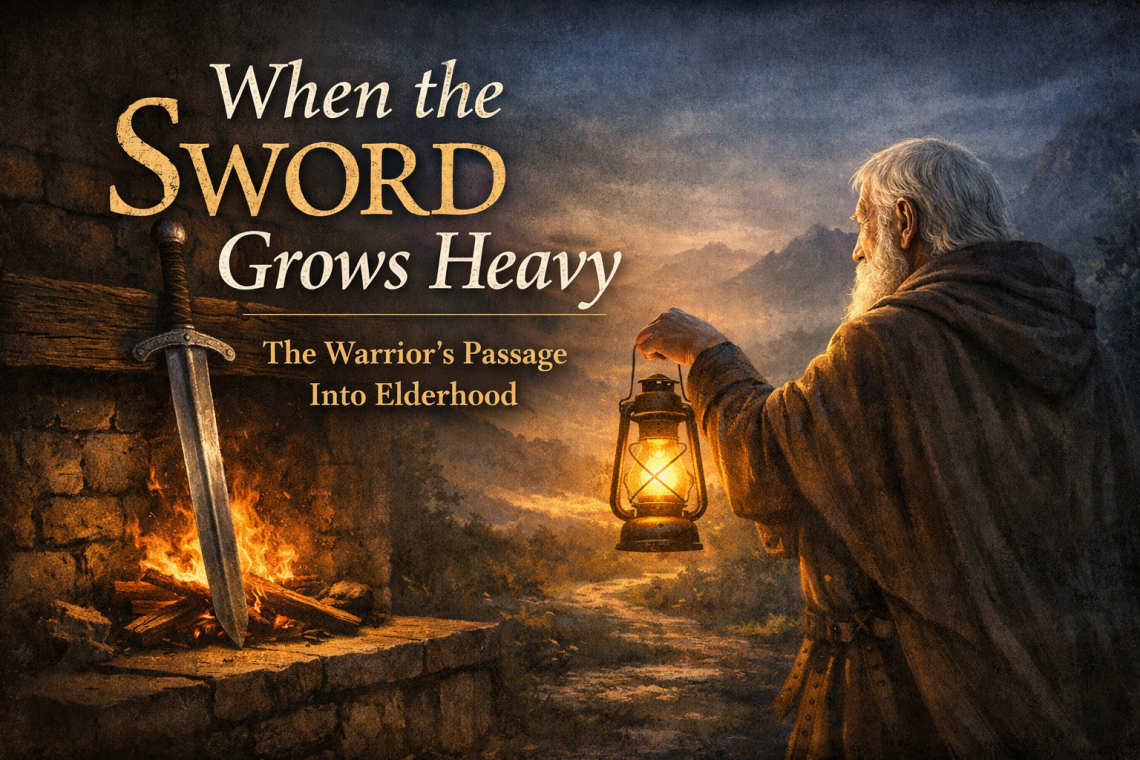
He hung his sword above the hearth and walked the pass at night with a lantern instead.
At first the villagers were furious. “Where is the blade,” they demanded, “when the wolves come?”
The swordsman lifted the lantern. “If the wolves come,” he said, “I will do what I have always done. But tonight I am here to see what keeps summoning wolves in the first place.”
He walked the pass for many nights. He found where the fences were broken, where food was left out, where frightened animals were chased into corners and made savage. He taught the boys how to repair, how to watch, how to listen, and how to escort a traveller without humiliating them.
The wolves came less often.
And one day, when the wolves did come, a boy raised the lantern, not the sword, and the wolves turned away, startled by a light they did not understand.
The swordsman smiled, not because the boy was brave, but because the boy was becoming wise.
From Warrior to Elder, the inner transition
The Elder archetype is often romanticized as a calm man in a chair dispensing advice like coins. Real Elders are rarely that tidy. The transition is messy because it involves grieving an identity that once kept you alive.
Three shifts tend to mark the passage.
1) From proving to initiating
The Warrior proves. The Elder initiates.
Initiation is not applause; it is passage. The Elder’s presence quietly says, “You can survive the change.” In story terms, the Warrior is the protagonist who acts, the Elder is the figure who turns action into meaning.
2) From control to stewardship
The Warrior controls outcomes. The Elder stewards people.
Stewardship requires allowing others to be clumsy, slow, and wrong, while still protecting what is truly fragile. This is far harder than doing it yourself.
3) From sword to mirror
The Warrior’s weapon faces outward. The Elder’s tool faces inward.
The Elder becomes willing to look at what he avoided: grief, fear, vanity, and the hunger to be needed. Not to self-criticize, but to become honest. This honesty is what makes an Elder safe to follow.
Mentoring without the need for the sword
Many Warriors struggle with mentoring because mentoring looks like standing still. It looks like watching someone else do the work you could do faster. It can feel like being replaced.
But the Elder does not mentor to remain relevant. The Elder mentors to reduce dependency. He measures success by whether people can stand without him.
Mentoring, in the Elder sense, is less instruction and more transmission:
- Transmission of posture: calm under pressure, humility in victory, dignity in loss.
- Transmission of story: “Here is what this cost me, so you do not have to pay twice.”
- Transmission of restraint: teaching someone when not to strike, when not to speak, and when to wait.
In your thematic world, where systems attempt to swallow individuality, this becomes revolutionary. Because an Elder who teaches discernment creates people who are harder to program.
That is the Sage’s quiet rebellion.
The unwritten evolution in your work
Your narratives already understand the machinery of power, and they already honor the cost of resistance. What feels “unwritten” is the next movement, what happens after the Warrior survives the ordeal?
The second half of life is not a victory lap. It is the long task of turning scars into wisdom rather than bitterness. It is learning to protect others without needing to be the center of the protection. It is learning to lead without feeding on crisis.
In story craft, it is the moment when the hero becomes a threshold character, not the one who crosses, but the one who holds the door open.
That is Elderhood.
Not the end of fire, but the beginning of light.
So here is the real question that sits at the edge of the page, waiting for you to write it into being:
When the Warrior sets the sword above the hearth, what is the first lantern he dares to carry, and who is he finally willing to walk beside, not as protector, but as guide?