An oath is easy to honour when the people around you still believe in it.
It is easy when the institution that received your loyalty behaves with integrity. When its leaders practise what they preach. When its rules protect the innocent, restrain the powerful and serve something greater than themselves.
But what happens when the institution changes?
What happens when the leaders begin serving themselves? When obedience becomes more important than truth? When the sacred language remains, but the sacred purpose quietly disappears?
Does your oath still bind you?
Or does keeping it make you part of the corruption?
These are not comfortable questions. They are not meant to be.
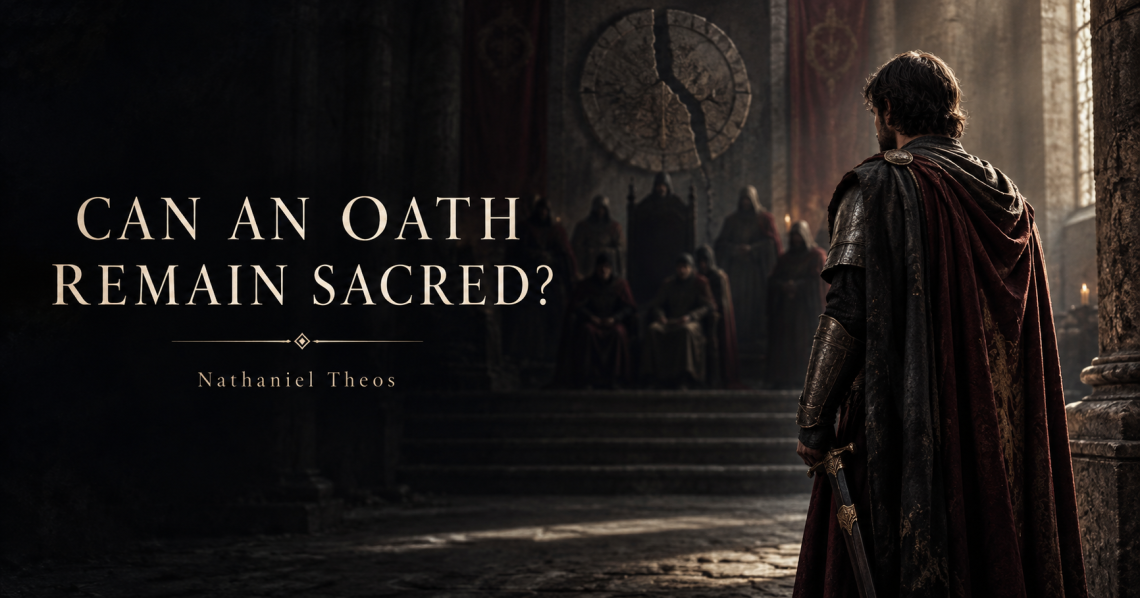
They sit at the heart of The Last Templar’s Oath series, but they also reach far beyond the world of knights, hidden bloodlines and sacred relics. They confront anyone who has ever given his word to a church, government, company, organization, marriage, brotherhood—or even to a version of himself he no longer recognizes.
Because eventually, every serious oath is tested.
Not when everything is working.
When everything falls apart.
The Institution Is Not the Oath
We often confuse the institution with the ideals it was created to protect.
A church is not faith.
A government is not justice.
A military order is not courage.
A business is not service.
A marriage certificate is not love.
An institution is a structure built by people to carry certain principles into the world. At its best, it protects those principles and gives them form. It gathers individuals around a shared purpose and reminds them that they belong to something larger than themselves.
But institutions are operated by human beings.
Human beings become afraid. They become ambitious. They crave status, security and control. They begin protecting the structure instead of the purpose for which it was created.
Eventually, the institution may continue speaking the language of its original values while behaving in direct opposition to them.
The symbols remain.
The ceremonies continue.
The titles are still spoken.
But the soul has left the room.
When that happens, the person who took the oath faces a terrible choice: remain loyal to the institution or remain loyal to the truth that made the oath sacred.
Those are not always the same thing.
Obedience Can Become a Form of Betrayal
We are taught to admire obedience.
The loyal knight follows orders. The good employee supports the organization. The faithful member does not question authority. The committed man keeps his promises, no matter the cost.
There is honour in steadfastness. There is strength in refusing to abandon a commitment merely because it becomes difficult.
But obedience is not automatically virtuous.
Obedience without conscience is surrender.
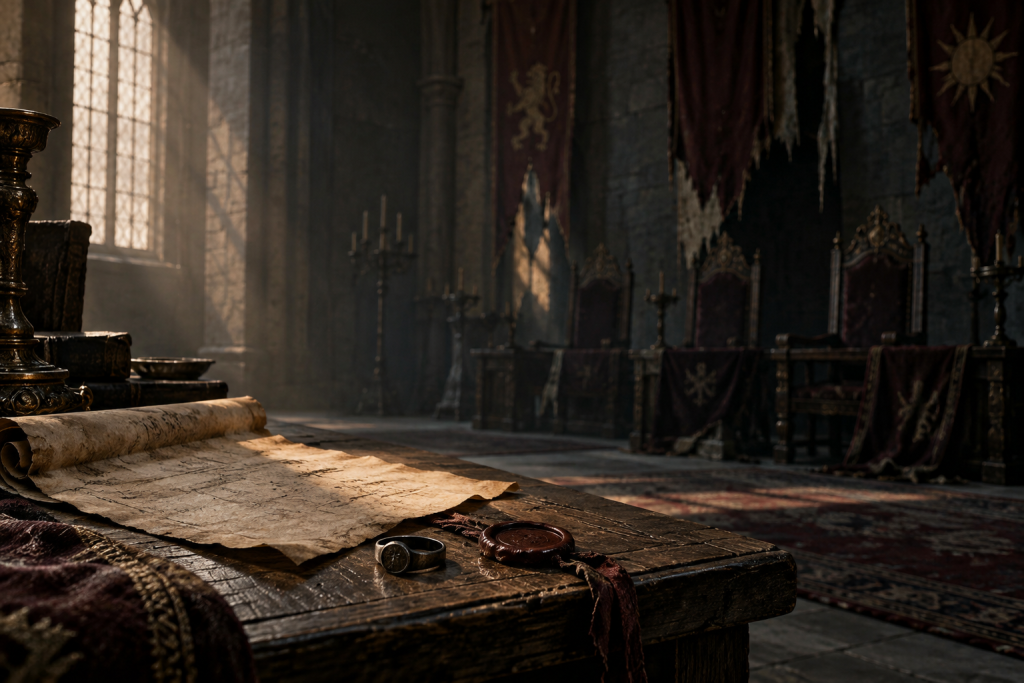
If an institution commands a person to violate the very principle he swore to protect, obeying may become the deepest form of betrayal.
Imagine a knight who vows to defend the helpless, only to discover that his commanders are exploiting them.
If he obeys the commanders, has he kept his oath?
Or has he merely protected the uniform?
Imagine a man who promises to provide for his family, but becomes so consumed by work that his wife no longer feels known and his children experience him mainly as an absence.
Has he honoured his promise because the bills were paid?
Or has he mistaken one part of the oath for the whole of it?
This is where simple morality becomes difficult.
We like our heroes clean and uncomplicated. We want the righteous path marked clearly. We want corruption to announce itself with black banners and sinister laughter.
It rarely does.
Corruption usually arrives wearing familiar colours.
It uses the right words.
It asks for one small compromise in the name of unity, safety, necessity or the greater good.
Then another.
And another.
Until one day, a person realizes he is defending the very thing he once promised to resist.
What Was the Promise Really Made To?
Every oath contains at least two promises.
The first is spoken aloud.
“I will serve this order.”
“I will obey this authority.”
“I will protect this nation.”
“I will remain faithful.”
But beneath the spoken promise is a deeper one.
I will serve justice.
I will protect life.
I will honour truth.
I will not use my strength only for myself.
The spoken promise attaches the person to an institution or relationship. The deeper promise attaches him to a principle.
When the institution remains faithful to that principle, the two promises stand together.
When the institution becomes corrupt, they split apart.
That is when the oath-taker must decide what he truly promised—and to whom.
This does not grant permission to abandon every commitment the moment it becomes inconvenient. We have become far too skilled at calling discomfort “misalignment” and selfishness “authenticity.”
A sacred oath should cost us something.
It should challenge our pride, test our endurance and demand more from us than convenience ever would.
But sacrifice and corruption are not the same.
Sacrifice asks us to surrender something lesser in service of something greater.
Corruption asks us to surrender the greater thing so the institution can preserve itself.
That distinction matters.
The Courage to Stand Outside the Walls
There is a particular kind of loneliness that comes with refusing a corrupt command.
The institution may label you disloyal.
Friends may distance themselves.
People who once praised your commitment may accuse you of betrayal. They may say you have abandoned the cause when, in truth, you may be one of the few still serving it.
This is why moral courage is more difficult than physical courage.
Physical courage may require someone to face a visible enemy.
Moral courage may require him to stand against his own people.
It may require him to risk reputation, livelihood, belonging and identity. It may force him to admit that the organization he loved has become something he can no longer defend.
And sometimes it demands an even harder admission:
The institution may not have changed as much as he believed.
Perhaps he simply began to see it clearly.
That realization can break a person. But it can also free him.
Leaving the walls does not necessarily mean abandoning the oath.
Sometimes leaving is how the oath survives.

The Oath Must Also Judge the Oath-Taker
There is another danger hidden in this question.
It is easy to point toward a corrupt institution and declare ourselves righteous. It is much harder to examine the compromises we made while benefiting from it.
Did we remain silent because the system rewarded us?
Did we ignore harm because acknowledging it would have cost us our position?
Did we call ourselves loyal when we were actually afraid?
Did we condemn corruption only after it stopped serving us?
An oath cannot be sacred if it is used only to judge others.
It must also judge the person who carries it.
That means confession.
Accountability.
Restitution where possible.
It means refusing to hide personal failure behind the failures of the institution.
A guardian who exposes corruption but refuses to confront his own dishonesty is not yet free of it. He has merely changed uniforms.
Perhaps that is why the truest oath is not a promise of perfection.
It is a promise to return.
To return to truth after deception.
To return to service after selfishness.
To return to courage after fear.
To return to the original purpose whenever ego, power or comfort leads us away from it.
What Makes an Oath Sacred?
An oath does not become sacred because it is spoken before an altar, a flag, a sword or a room filled with witnesses.
Those things give the moment weight, but they cannot create integrity.
An oath becomes sacred through the life that follows it.
It becomes sacred each time a person chooses truth when deception would be easier.
Each time strength protects rather than dominates.
Each time wealth serves more than itself.
Each time someone accepts accountability instead of hiding behind rank.
Each time the suffering directly in front of us matters more than the glory of the institution behind us.
No title can do that work for us.
No symbol can excuse us from it.
No ancient tradition can make an unjust action righteous.
The oath survives only when someone continues living its deepest meaning—even after those who administered it have forgotten why it existed.
Perhaps the Oath Is All That Remains
Institutions rise, fracture and disappear.
Orders are dissolved.
Governments fall.
Companies collapse.
Names are erased from history, sometimes deliberately.
Yet an oath can travel quietly through generations.
It can survive in a story told beside a fire. In a letter hidden beneath a floorboard. In a family teaching passed from parent to child. In a single act of courage performed by someone whose name will never appear in a history book.
Perhaps that is the final test of whether an oath was truly sacred:
Can it survive without the institution?
Can it still guide a person when there is no uniform to wear, no title to claim and no superior left to offer approval?
Can the oath live when keeping it brings no recognition—and may bring punishment?
If it can, then perhaps the institution was never the source of its sacredness.
Perhaps the sacredness lived in the principle itself.
And in the human being willing to carry it.
So, can an oath remain sacred after the institution becomes corrupt?
Yes.
But only if we are brave enough to separate the eternal principle from the failing structure that once carried it.
Only if we refuse to use loyalty as an excuse for cowardice.
Only if we hold ourselves accountable for the compromises we made along the way.
And only if we are willing to protect the heart of the promise—even when doing so requires us to walk away from everything built around it.
Sometimes the person who appears to break the oath is the one who finally keeps it.
– Nathaniel Theos