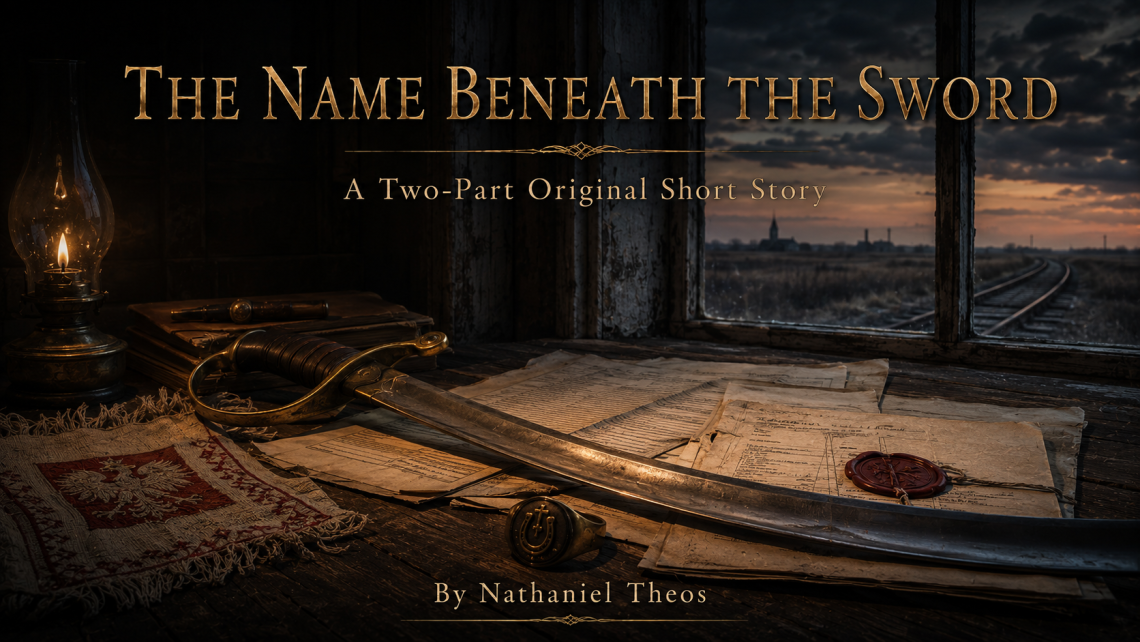
Part One: The Vault
Daniel Green found the second will sewn into the lining of his father’s suitcase.
He had spent three days emptying the farmhouse after Peter Green’s funeral. Eighty-one years of living had been reduced to boxes marked KEEP, DONATE and DISCARD. His father had preserved everything from bent nails and baling twine to expired warranties for appliances he no longer owned. Yet he had left almost nothing that explained who he had been beneath the silence.
Daniel was angry with him for that.
The anger felt disrespectful so soon after the funeral, but grief had not arrived alone. It had brought resentment, unanswered questions and the memory of every conversation his father had ended by walking out of the room.
The suitcase stood at the back of the bedroom closet. Its brown leather had cracked, one brass clasp was missing and the initials P.G. had nearly worn away. Daniel remembered it from childhood. His father had packed it whenever the family drove to Regina, although Daniel could not recall seeing it used after his mother died.
Inside, he found a black wool coat, a leather belt and a small embroidered cloth stained yellow with age.
He lifted the suitcase toward the discard box.
Something shifted beneath the faded blue lining.
Daniel lowered it onto the bed and pressed his palm against the fabric. A hard edge pushed back. He cut three stitches with his pocketknife and reached inside.
His fingers closed around an envelope.
It had been sealed with dark red wax. A brass key was tied around it with black thread. The envelope was brittle, but the handwriting remained clear.
For Piotr Zieliński, known as Peter Green, and for the descendant willing to recover our true name.
Daniel read the words again.
A chill travelled across his shoulders.
His father had always been Peter Green. His grandfather had been Alexander Green. Green was the name on the farmhouse mailbox, the family headstones and Daniel’s birth certificate. It was the name he had carried for sixty years.
He had never heard the name Zieliński.
Daniel sat on the edge of the bed and opened the envelope. Inside was a copy of his grandfather’s original will, dated October 4, 1979. Most of it concerned property Daniel knew about. The farm had gone to his father. Money had been divided among the children. Tools, livestock and a battered Chevrolet had been distributed through precise instructions.
The final paragraph made Daniel’s breath catch.
To my eldest son, Piotr, I leave the Zieliński sword and that which has been concealed with it. The inheritance will pass to the first of my descendants who finds it and understands why it could not simply be given.
Beneath it, his grandfather had added one instruction.
Begin where your father ended his journey.
Daniel read the paragraph three times. The word inheritance seemed to change with every reading. It might mean money, land or nothing more than the sword itself. Yet the phrase that which has been concealed with it suggested something more.
A faded receipt had been folded inside the will. It came from Bell’s General Store in St. Casimir, Saskatchewan, and was dated November 17, 1979. Someone had purchased six gallons of gasoline and a cup of coffee.
His father’s signature appeared at the bottom.
Daniel carried everything to the kitchen and spread it across the table. His father had visited St. Casimir less than a month after his grandfather’s death. He had kept the will, receipt and brass key hidden for forty-seven years.
The deception hurt more than Daniel expected. His father had not merely refused to speak about the family past. He had cut open a suitcase lining, hidden the evidence and stitched the fabric closed.
Daniel remembered asking about Poland when he was twelve. His grandmother had owned an embroidered cloth similar to the one in the suitcase, and Daniel had wondered why the family possessed nothing else from the old country.
“There was a sword once,” his father had said.
“What happened to it?”
“My father turned it into one of his damned lessons.”
Daniel had laughed, expecting more. His father had stared at him with an expression Daniel had not understood and left the room.
Now Daniel understood the fear in that expression.
Or perhaps it had been shame.
He searched online for St. Casimir. It had been established by Polish immigrants shortly after the railway arrived in 1906. At its height, the town had supported three hundred residents, two stores, a school, a grain elevator and a Catholic church. The railway abandoned the line in 1986. The school closed six years later.
The most recent census listed nine permanent residents.
Daniel called the rural municipality the next morning. The administrator confirmed that the old station and church were municipal heritage properties. Neither was maintained, but family researchers could enter after signing a liability waiver.
“Watch the floors,” the administrator warned. “Don’t climb the bell tower. We haven’t inspected it in years.”
Two days later, Daniel drove north.
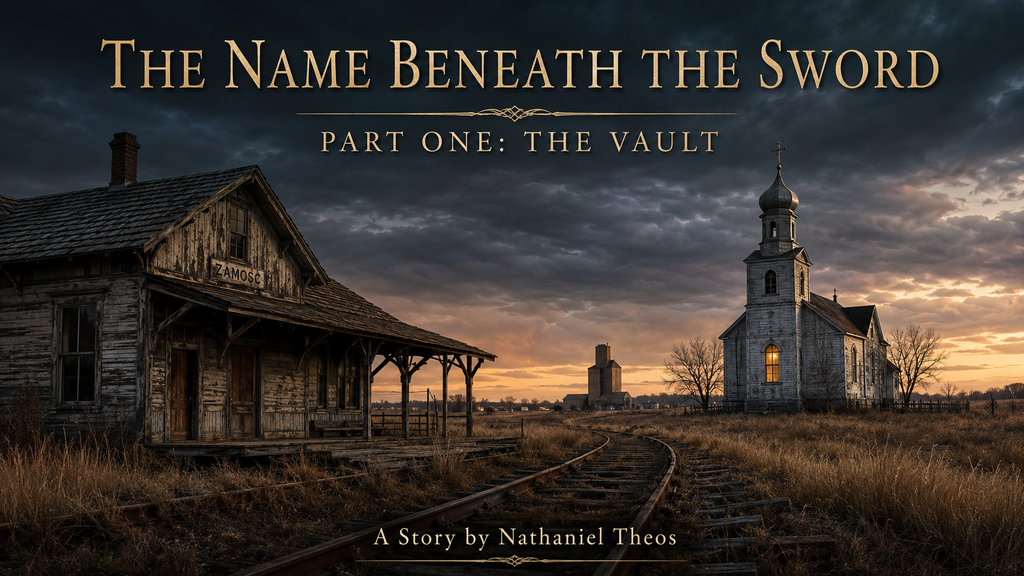
St. Casimir appeared beneath the immense prairie sky like something the wind had failed to carry away. Its weathered sign leaned into the ditch. Beyond it stood empty houses, a boarded community hall and a grain elevator with sheets of metal missing from its roof.
Daniel slowed as he entered town.
The place unsettled him. Curtains still hung inside some of the houses. A rusted bicycle leaned against one porch as if its owner might return for it. The town did not feel abandoned. It felt interrupted.
The Catholic church stood at the eastern edge. Its white paint had weathered grey, and the cross above its bell tower leaned toward the cemetery. Headstones rose from the tall grass behind it.
Daniel drove through town twice before finding Bell’s General Store. The lettering above the entrance had faded until only the word BELL remained visible. Newspapers covered the windows, and a rusted chain held the doors closed.
He compared the address with the one printed on the receipt. The numbers matched.
His father had stood here forty-seven years earlier.
Daniel tried to imagine him at thirty-four, younger than Daniel’s own son was now. Had he been excited when he arrived? Angry? Had he believed he was about to inherit something valuable?
Behind the store stood the remains of an old gasoline pump. Its glass cylinder had shattered, and birds had filled the metal housing with straw. Daniel examined the receipt, hoping to discover a message he had missed.
There was nothing except the purchases and the signature.
His father’s journey had ended at the store, according to the receipt, but it must have begun somewhere else.
Daniel turned toward the railway station.
The station stood beyond the grain elevator, partly concealed by poplar and willow. The municipality had placed a chain across the platform steps and a sign warning that entry was at the visitor’s risk. Daniel unlocked the side door using the temporary key provided by the administrator.
Inside, part of the ceiling had collapsed over the waiting room. Pigeons burst from the rafters, startling him badly enough that he struck his shoulder against the doorframe. His curse echoed through the building.
A railway schedule from 1984 remained pinned behind the ticket counter. Its edges were curled and brown. A child’s mitten lay beneath a bench, preserved beneath decades of dust.
Along the rear wall stood a row of iron baggage lockers.
Daniel removed the brass key from his pocket. His hand trembled as he tried it in the first locker.
It did not fit.
He moved down the row, testing each surviving lock. The key entered locker seventeen.
Daniel hesitated before turning it.
Until that moment, the contents of the envelope might still have been an old man’s elaborate joke. If the key opened the locker, his grandfather had planned this. His father had known about it.
The key turned.
A sharp thrill passed through Daniel, followed almost immediately by dread. He pulled the door open.
The locker was empty.
Rust covered the bottom. Mouse droppings filled two corners. There was no sword, no letter and no treasure. Daniel stared at the bare compartment as disappointment hardened into anger.
“Of course,” he said aloud. “Another damned lesson.”
He slammed the door. The sound thundered through the station.
For several minutes, Daniel stood with both hands pressed against the locker. He felt foolish for driving across Saskatchewan to chase a family story his father had abandoned almost half a century ago. Perhaps the empty locker was the entire point. Perhaps his grandfather had wanted his descendants to understand that inheritance was an illusion.
Daniel opened the door again and searched more carefully. He ran his hands along the walls, checked beneath the rust and shone his flashlight into the corners.
The beam caught a shallow line stamped into the rear wall.
2W014230EN
Daniel leaned closer.
The letters and numbers ran together without spaces or punctuation. He assumed they were a manufacturer’s serial number until he noticed a separate factory plate inside the door.
He touched the characters. They had been hammered into the metal one at a time. Several sat higher than the others.
Excitement returned, quieter now but stronger.
Daniel copied the sequence into his notebook. He tried separating it into dates, measurements and railway designations. Nothing made sense.
He stepped outside and sat on the platform. Wind moved through the grass growing between the tracks. The sequence seemed to mock him from the page.
2W014230EN
The final letters bothered him. He knew of no serial number ending in EN.
Daniel read the sequence from right to left.
His pulse quickened.
He wrote it backward.
NE032410W2
He recognized the pattern from the land documents he had sorted after his father’s death. Adding the missing divisions produced a Saskatchewan legal land description.
NE ¼ 3-24-10-W2
The northeast quarter of Section 3, Township 24, Range 10, west of the Second Meridian.
Daniel entered it into the land-location application on his phone. When the coordinates appeared, he laughed from a mixture of surprise and relief.
The description identified the abandoned church.
For the first time, Daniel felt his grandfather’s presence in the mystery. The old man had trusted that someone in the family would recognize the language of prairie land. He had written the description backward so that a stranger who opened the locker would see only meaningless characters.
Daniel’s satisfaction faded when he thought about his father.
Had he solved it too?
The church door opened with the second municipal key.
Inside, the air smelled of wet wood, dust and birds. Coloured fragments of stained glass lay across the floor. The pews and altar had been removed, leaving pale rectangles where they once stood. Water stained the plaster beneath the broken roof.
Daniel paused inside the entrance.
His grandparents had worshipped here. His father might have been baptized here. Generations of Polish families had prayed, married and buried their dead within sight of the bell tower.
Nobody had told Daniel.
He began searching the northeast corner. He checked loose floorboards, wall cavities and the remains of the altar rail. The legal description had brought him to the property, but it gave him no precise location.
After an hour, his hands were grey with dust. His knees hurt, and a nail had torn the sleeve of his jacket. The excitement he had felt at the station began to dissolve into frustration.
A narrow door behind the sanctuary opened into the sacristy. Metal filing cabinets lined one wall. Most were empty, but the bottom drawer of the last cabinet held parish ledgers swollen with moisture.
Daniel carried them beneath one of the unbroken windows.
The earliest volume began in 1907. Its pages recorded baptisms, marriages, deaths and donations in Polish, Latin and English. Daniel recognized few words, but the names were legible.
Near the beginning, he found Aleksander Jan Zieliński and Zofia Maria Zielińska.
His grandfather and grandmother.
A later notation identified them as Alexander and Sophie Green.
Daniel sat very still.
Seeing the names written in ink made the change real in a way the hidden envelope had not. Zieliński was not a family legend or a spelling error. It was the name his grandparents had carried when they entered the church. Green was the name they had chosen afterward.
Daniel suddenly felt as if someone had removed a section of his life and replaced it with an unanswered question.
Why had they changed it? Had they wanted to sound Canadian? Had someone been searching for them? Had the old name carried danger or disgrace?
He turned the pages more carefully.
A burial ledger from 1956 recorded his grandmother’s death. Her resting place was listed as Section Four, Row Two, Grave One.
Another entry appeared near the back of the volume. It was dated October 17, 1979, three weeks before his grandfather’s death.
One unused concrete burial vault transferred to A. Green. No interment recorded.
Daniel reread the line.
A burial vault had been transferred, but nobody had been buried in it.
A cold sensation settled in his stomach. For the first time, he wondered whether the inheritance might involve human remains. Perhaps the sword had been buried with someone. Perhaps the family secret was not wealth or nobility but a death hidden from the records.
He photographed the entry and returned the ledger to the cabinet.
The cemetery contained more than a hundred graves. Many markers leaned at severe angles, and several had disappeared beneath wild roses. Daniel counted the sections and rows until he reached the plot described in the ledger.
His grandmother’s headstone bore the name:
SOPHIE GREEN
1881–1956
BELOVED WIFE AND MOTHER
Daniel knelt and pulled grass from its base. Soil and lichen concealed another inscription carved in smaller letters.
ZOFIA MARIA ZIELIŃSKA
The sight struck him with unexpected force.
He had known his grandmother only as Sophie. She had baked bread in a farmhouse kitchen, sung hymns while peeling potatoes and slipped peppermints into Daniel’s hand after church. Now, kneeling before her grave, he realized that he had never known her full name.
“I’m sorry,” he whispered.
He did not know precisely what he was apologizing for. Perhaps it was for the years her true name had lain beneath the soil. Perhaps it was for belonging to a family that had allowed silence to become tradition.
Behind the headstone, he found a narrow metal tag secured with two rusted bolts. It resembled a cemetery marker, although no other grave carried one.
Stamped into it was another uninterrupted sequence:
2W013241EN
Daniel’s fatigue vanished.
He reversed it.
NE142310W2
He added the divisions.
NE ¼ 14-23-10-W2
The original family homestead.
Shock rolled through him. The trail was real. The empty locker had led to the church, the church had led to his grandmother and her grave now pointed toward the land where the family’s Canadian life had begun.
Daniel examined the tag more closely. Deep scratches surrounded one bolt. Someone had tried to remove it using a tool too large for the narrow slot.
Beneath the tag, almost hidden against the granite, were three characters:
PG79
His father’s initials. The year of the journey.
Daniel lowered himself into the grass.
His father had stood at this grave. He had uncovered his mother’s Polish name and deciphered the legal description. He had known where the next clue led.
Yet he had gone home.
Daniel felt anger rise through the shock. His father could have told him. He could have explained their name, the sword or why his own journey ended in St. Casimir. Instead, he had hidden everything inside a suitcase and left Daniel to discover it after the funeral, when no questions could be answered.
“What were you afraid of?” Daniel asked the headstone.
Only the prairie wind replied.
The road to the old homestead had nearly disappeared beneath grass. Daniel followed it until he reached the remains of a stone foundation and a depression where the farmhouse cellar had once been. Nothing survived except a wind-bent poplar and several strands of barbed wire embedded in rotting fence posts.
The legal description covered 160 acres.
Daniel searched the collapsed cellar and walked around the foundation. He found broken jars, rusted hinges and the remains of a cast-iron stove. None carried the family crest or another sequence.
The afternoon light began to fade.
He returned to the truck and studied the description. The letters NE identified the northeast quarter, but perhaps they also contained a more precise instruction.
Daniel took a compass from the glove box and began walking.
The northeast corner lay beyond a field that had returned to prairie. Grass caught around his boots, and low branches pulled at his jacket. After twenty minutes, he reached the remains of a boundary fence.
Near the corner post stood a mound of fieldstones.
Prairie farmers had cleared rocks from their fields for generations. The pile should not have seemed unusual, but its shape was too deliberate. The stones formed a rough horseshoe around a pale piece of granite.
Daniel brushed away the moss.
A cross had been cut into its surface.
A surge of excitement tightened his chest. He began removing stones.
The first layer came away easily. Those beneath were larger and packed with soil. Daniel worked until his shoulders burned and the palms of his gloves wore thin. Each stone exposed another, and with each one he became more certain that something had been deliberately concealed.
Then doubt returned.
What if he found a grave?
The church ledger had recorded an unused burial vault, but records could be wrong. The phrase no interment recorded did not mean no one had been placed inside. It meant only that nobody had written it down.
Daniel stopped and looked across the darkening field. He considered returning to town and contacting the authorities. Yet the thought of leaving felt unbearable. His father had reached this point in the mystery and walked away. Daniel could feel the weight of that unfinished decision pressing upon him.
He removed another stone.
His fingers struck something flat.
Daniel cleared the soil with both hands.
Beneath the last stone lay a rectangular concrete lid. An iron ring had been set into its centre. This was not a box someone had pushed into the earth and hoped the prairie would spare. It was a vault built to outlast the man who had buried it.
Daniel stared at it, unable to move.
The notation from the church ledger returned to him.
One unused concrete burial vault transferred to A. Green. No interment recorded.
His grandfather had brought the vault here.
For forty-seven years, his father had known that something waited beneath these stones. He had protected it through silence, fear or shame. Daniel still could not decide which.
He wrapped both hands around the iron ring and pulled.
The ring rose, but the concrete lid did not move.
Daniel released it and listened.
For one irrational moment, he expected to hear something from beneath the concrete. A movement. A scrape. A voice that had waited nearly half a century to be heard.
There was only silence.
The sun slipped below the horizon, and darkness gathered across the field. Beneath Daniel might lie a Polish sword, a forgotten inheritance or the remains of someone whose name had never entered the church ledger.
Whatever waited inside had already buried one family name and silenced two generations of men.
Daniel rested his hand on the concrete.
His father had turned away.
He would not.
Part Two: Inside the Vault
Daniel remained beside the concrete vault until darkness swallowed the field.
The iron ring moved when he pulled it, but the lid did not. He dug around its edges with his hands, breaking away soil and roots until his fingers cramped. The concrete remained fixed in place.
Part of him was relieved.
The failing light gave him a reason to stop. He could return in the morning with proper tools and a clearer mind. He could also climb into his truck, drive home and leave the vault exactly as his father had left it.
Daniel stood and brushed the dirt from his trousers.
The thought of leaving made his stomach tighten.
For forty-seven years, his father had known that the legal description on the grave pointed toward this land. He had hidden the will and key rather than destroy them, but he had never returned to finish the search.
Daniel looked down at the concrete lid.
“What did you know?” he whispered.
The prairie offered no answer.
He slept badly in his truck near the old foundation. Every sound pulled him awake. Grass scraped against the doors. Wind moved through the broken fence. Once, near midnight, something struck the side of the truck hard enough to make him sit upright.
A white-tailed deer stared through the windshield before bounding into the darkness.
Shortly before dawn, Daniel dreamed of his father standing beside the vault. Peter looked younger than Daniel remembered, but his expression was the same one he had worn whenever questions became too personal.
In the dream, Daniel asked what was inside.
His father placed one hand on the concrete and said, “Something that knows our real name.”
Daniel woke with his heart pounding.
Morning arrived cold and colourless. He drove to the municipal equipment yard and purchased a length of chain, a heavy pry bar and a farm jack from a small hardware counter attached to the fuel station. The clerk asked what he intended to lift.
“Family history,” Daniel said.
The clerk stared at him.
“A concrete lid,” Daniel added.
“That makes more sense.”
Daniel was not certain it did.
Back at the property, he cleared the remaining stones and soil from around the vault. The rectangular lid was smaller than a coffin cover, but thick enough to require more than muscle. He worked the pry bar beneath one corner and leaned against it.
The lid shifted less than an inch.
A stale breath escaped from below.
Daniel released the bar and stepped back. The air carried the smell of concrete, metal and something faintly oily. It did not smell like decay, but he had no idea what forty-seven-year-old human remains would smell like inside a sealed chamber.
The church ledger had stated that no interment was recorded. That did not mean the vault was empty.
He considered calling the police. If the chamber contained a body, opening it alone would be foolish and possibly illegal. Yet nothing in the family documents mentioned a death. The will referred to a sword and an inheritance.
Daniel returned to the lid.
He slid the chain through the iron ring, anchored the farm jack against a thick fence post and slowly increased the tension. The chain tightened. The ring groaned against the concrete.
For several seconds, nothing happened.
Then the seal broke.
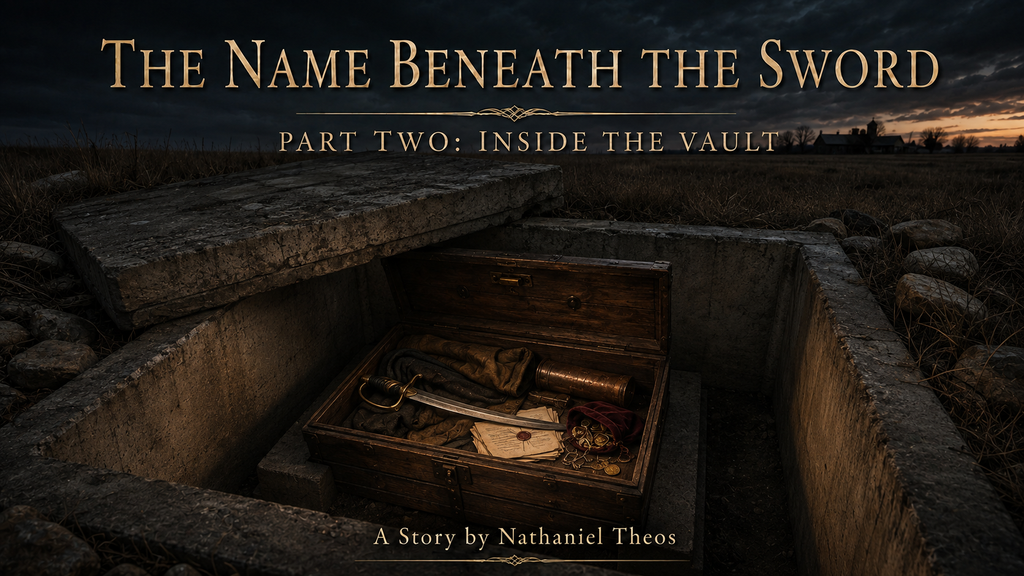
The lid rose with a grinding sound that travelled through the ground and into Daniel’s boots. He worked the pry bar into the opening, inserted two blocks of wood and raised the lid far enough to slide it sideways.
Cold darkness waited beneath it.
Daniel aimed his flashlight into the chamber.
There was no coffin.
A long wooden chest rested on concrete blocks several inches above the floor. Its corners were reinforced with tarnished brass, and a dark green horseshoe surrounding a cross had been painted on its lid.
Daniel lowered himself through the opening.
The chamber was too small for him to stand. He crouched beside the chest, conscious of the concrete lid above him and the weight of earth pressing against every wall. The air felt unnaturally still.
A sealed tin container sat beside the chest. Its lid had been punctured with small holes, and charcoal filled the interior. His grandfather had used it to absorb moisture. Wax had been worked into the chest’s seams, and strips of tarred canvas protected its base.
Nothing had been left to chance.
Daniel ran his hand over the painted crest.
His grandfather had not buried the chest in a moment of fear. He had planned the chamber, obtained the burial vault, protected the contents and constructed a path that only a member of the family was likely to complete.
Daniel found no lock. Two brass latches held the lid closed.
He released the first.
The sound seemed far too loud inside the vault.
His hand rested on the second latch.
For a moment, he saw his father sitting at the farmhouse kitchen table, refusing to answer questions about Poland. Daniel had spent years believing the old man simply did not care. Now every silence felt deliberate.
He released the latch and lifted the lid.
A long object wrapped in dark waxed canvas lay across the top. Beneath it were several smaller packages, a copper cylinder and a wooden case bearing the same horseshoe-and-cross crest.
Daniel reached for the wrapped object.
The canvas crackled as he unfolded it. Underneath was a layer of oiled wool, darkened by protective grease. He peeled it away slowly until his flashlight reflected from a curved metal blade.
The sword existed.
Daniel stopped breathing.
He had expected rust, decay or another disappointment. Instead, the Polish cavalry sabre appeared almost untouched by time. Its grip was dark horn bound with brass wire. The guard curved toward the blade, and the family crest had been engraved into the pommel.
Daniel lifted it carefully.
The weight surprised him. It was not a ceremonial ornament. It had been made to be carried and used. Tiny marks along the blade suggested sharpening, travel and perhaps violence.
Near the hilt, a Polish inscription had been cut into the steel. Beneath it, his grandfather had added an English translation.
Nobility is a choice.
Daniel felt an unexpected ache rise into his throat.
The sword had crossed an ocean. It had survived two world wars, the Depression and a family determined to forget it. His grandfather had held it. Perhaps his great-grandfather had carried it through Poland.
Daniel turned the blade toward the light.
A second inscription appeared on the reverse.
ZIELIŃSKI
His name had been waiting beneath the sword all along.
Daniel lowered the sabre across his knees and opened the wooden case. Inside were rings, necklaces, unset stones and gold coins wrapped in velvet. A silver seal carried the family crest. One ring bore a deep green gemstone surrounded by diamonds.
The jewels were not the contents of a poor immigrant’s suitcase. They belonged to a family that had once possessed wealth, land and power.
Daniel sat motionless.
He imagined selling a single ring and paying off his mortgage. The remaining jewels could secure his children’s futures. The coins alone might be worth more than his father’s entire farm.
Excitement surged through him, bright and intoxicating. His grandfather had not left a symbolic inheritance. This was real wealth.
Then guilt followed.
Daniel had not yet read the documents.
The copper cylinder had been sealed with solder. A small tool rested beside it, its sharpened edge designed to break the seam. Daniel worked it beneath the lid until the metal lifted.
Inside were deeds, birth records, letters and a rolled sheet of parchment tied with a faded red ribbon. The paper remained dry and surprisingly well preserved.
The first document traced the Zieliński line through six generations. The family had belonged to the Polish szlachta, a noble class whose privileges had once included land, political influence and military service.
Another document was a deed to an estate south of Kraków. It described a manor, farmland and a large tract of forest. The deed bore official seals and named Aleksander Jan Zieliński as the surviving male heir.
Daniel felt the same rush of possibility.
The sword, jewels and deed formed a story grander than anything he had imagined. His grandfather had not been an ordinary immigrant who changed his name to fit into Canada. He had descended from Polish nobility.
Daniel Green was Daniel Zieliński.
He reached deeper into the cylinder and found two envelopes.
The first was addressed:
To the descendant who opens the vault.
The second carried his father’s handwriting.
Daniel stared at it.
His fingers began to tremble.
Peter had been inside the vault.
Daniel opened his grandfather’s letter first.
If you have come this far, you have recovered the name I buried. Before you decide whether to carry it, you must understand why I abandoned it.
The Zieliński family called itself noble because kings granted our ancestors land and the right to carry a sword. We preserved the deed, the jewels and the stories of our courage. We did not preserve the stories of those who paid for our comfort.
Daniel unrolled another document. It contained thirty-two family names followed by descriptions of fields, homes and livestock.
During years of failed harvests, my great-grandfather lent money to the families who worked our land. When they could not repay him, he took their farms. Some were driven away in winter. Two homes were burned after their owners refused to leave. The estate described in the deed was enlarged through their suffering. The jewels were purchased with the wealth that land produced.
Daniel looked at the velvet case. The green gemstone no longer seemed to shine as brightly.
My father taught me that our blood made us superior. He ordered me to preserve our claim until Poland became free and the estate could be recovered. I brought these things to Canada because I believed obedience was honour.
Then I broke Saskatchewan soil with my own hands. I watched families lose farms during drought and debt. I understood what had been done in our name.
I changed Zieliński to Green because I was ashamed. I told myself I was protecting my children from the past. In truth, I was protecting myself from having to answer for it. A man does not correct a wrong by hiding his connection to it.
Daniel paused. He could almost hear his grandfather speaking, not as the stern man of his childhood but as someone confessing at last.
The deed may still carry legal value. The jewels belong to you by inheritance. That does not make keeping them right. Enclosed are the names of the families whose land was taken. If their descendants can be found, use what remains of our wealth to begin restitution.
If you claim the estate because our blood once held it, you will inherit our title and our shame. If you use these records to return what can still be returned, you will give the Zieliński name an honour it has never earned.
The sword grants you nothing. The choice is yours.
Daniel lowered the letter.
The inheritance had changed again. First it had been a mystery, then a fortune. Now it was a debt passed through generations.
He looked at the second envelope.
His father’s handwriting made him hesitate more than his grandfather’s confession had.
He opened it.
Daniel,
The use of his name struck him like a hand against his chest. His father had known he might be the one to open the vault.
If you are reading this, then you know I lied by saying I never completed my father’s quest. I found the vault in November 1979. Your mother was sick, the farm was failing and I owed more money than I could repay. I believed whatever waited here would save us.
Daniel’s vision blurred.
He remembered that winter. His mother had spent weeks in Regina receiving treatment. He remembered neighbours leaving food at the farmhouse and his father sitting alone in the dark after Daniel was supposed to be asleep.
When I saw the jewels, I thought God had answered me. I did not care where they came from. I did not care what my father wanted. I was ready to take everything.
Then I read his letter.
I wish I could tell you that I made a noble choice. I did not. I put everything back because I was frightened of what taking it would make me. I was also frightened of what returning it would cost. I could refuse the wealth, but I was not brave enough to expose our family’s shame.
I closed the vault and buried it again. I scratched my initials beneath your grandmother’s marker so I could not later convince myself that I had imagined any of it.
Daniel wiped his eyes with the back of his hand.
For years, he had judged his father for refusing the quest. The truth was more painful. His father had completed it, opened the vault and faced the same temptation now sitting before Daniel.
I kept the will because destroying it would have stolen your choice. I hid it because giving it to you while I lived would have forced me to admit my cowardice. For that, I am sorry.
You may be stronger than I was. You may not be. Whatever you choose, do not lie to yourself about why you chose it.
Your father,
Piotr Zieliński
Daniel pressed the letter against his chest.
A sob escaped him before he could stop it. It was not only grief. It was anger, love and the sudden collapse of the simple story he had told himself about his father.
The old man had not been indifferent. He had been afraid.
He had refused the wealth, but he had also refused the responsibility attached to it. He had protected Daniel from the choice until death made silence easier than confession.
Daniel remained inside the vault until his legs cramped.
The jewels waited in their case. The deed rested beside the sword. Nothing prevented him from carrying them away and saying he had found only rusted documents.
Nobody else knew.
The realization frightened him.
This was why his grandfather had created the quest. Not to test intelligence or persistence, but to bring each descendant alone before a choice no witness could influence.
Daniel imagined his children receiving the money. He imagined the security it could purchase and the relief of never worrying about bills again. He also pictured the thirty-two names recorded in the document, families reduced to ink because a noble ancestor had possessed the legal power to take what they could not protect.
He picked up the sabre.
The word beneath the blade caught the light.
ZIELIŃSKI
Daniel had spent the previous day believing Green was the false name and Zieliński the true one. Now he understood that neither name guaranteed anything. One had been hidden in shame. The other had been worn without understanding.
He wrapped the sword and returned it to the chest. He placed the jewels beside it, then removed the copper cylinder containing the confession, deed and list of families.
Those documents would not return to the darkness.
Daniel climbed from the vault as evening light spread across the prairie. He sat on the concrete lid with both letters in his hands.
For the first time since the funeral, he spoke to his father without anger.
“You should have told me.”
The wind moved softly through the grass.
Daniel looked toward the road leading back to St. Casimir. He could not repair what had happened in Poland generations earlier. He did not know whether the estate still existed, whether the deed remained valid or whether the descendants of the displaced families could be found.
But he knew where to begin.
He would contact Polish historians and land-record authorities. He would have the documents authenticated and trace the thirty-two families. The jewels would be appraised, not for his benefit, but to determine what could be returned. The sword and confession would eventually be displayed together so the family name could be remembered without being cleansed of its history.
Daniel stood and looked down at the vault.
His grandfather had placed the Zieliński inheritance inside something built for the dead. His father had opened it, faced its truth and buried it again.
Daniel would not.
He carried the copper cylinder toward his truck. Tomorrow, he would return with help to remove and preserve the remaining contents. For now, the most important part of the inheritance was already in his hands.
The truth had been given air.
Months later, a registered letter arrived from an archive in Kraków. The deed was authentic. The Zieliński estate no longer existed as a single property, but portions of its forest remained under a dormant family claim. Researchers had also located descendants of seven families named in the confession.
Daniel read the letter twice before placing it beside the restored sabre.
He had chosen to use his full family name in the correspondence:
Daniel Green Zieliński.
Not because he wished to claim nobility.
Because accountability required a name.
The sword now hung in a glass case above his father’s final letter. Beneath them, Daniel had placed a small engraved plaque:
Honour is not inherited. It is chosen.
For more than a century, the men in his family had treated silence as protection. His grandfather had buried the truth. His father had found it and buried it again.
Daniel could not change what they had done.
He could only decide what happened next.
For the first time in three generations, the name Zieliński was no longer hidden beneath the sword.