
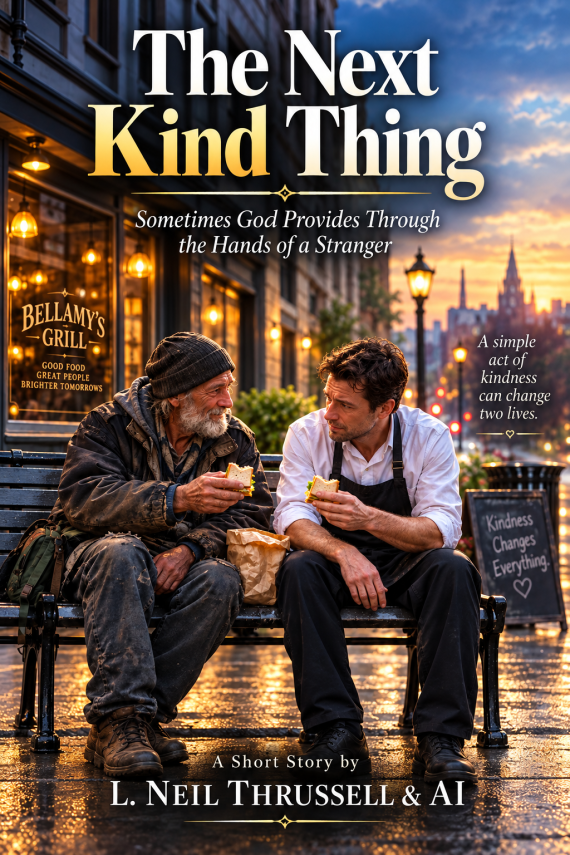
The Next Kind Thing
By L. Neil Thrussell and AI
Sometimes God Provides Through the Hands of a Stranger
Jonathan knew Roger was going to be fired before Roger did. He could see it through the tall front windows of Bellamy’s Grill, though he couldn’t hear a word being said. He didn’t need to. Jonathan had spent enough years watching people to recognize the moment when one human being had decided another was no longer worth listening to.
The man in the white shirt was doing most of the talking. His sleeves were rolled precisely to his elbows, his tie remained perfectly centred, and one hand rested on his hip while the other pointed occasionally toward the kitchen. The younger man standing across from him wore black kitchen pants and a stained grey shirt. He kept nodding, then shaking his head, then nodding again.
Once, he raised both hands. Not angrily. Pleading. Jonathan took another sip of coffee.
It had gone cold twenty minutes ago, but cold coffee was still coffee. He was sitting on his usual bench across from Bellamy’s, his backpack tucked between his feet and a paper bag beside him containing what remained of his lunch. The restaurant was one of those places where hamburgers cost twenty-three dollars because someone had stuck a toothpick through the top and called the fries hand-cut. Jonathan had always found that amusing.
The staff knew him. Most ignored him. A few said hello. One of the cooks occasionally brought him food that couldn’t be served the next day.
Jonathan never asked. He had learned a long time ago that asking and receiving were two very different things. Today someone from the bakery two blocks away had given him a turkey sandwich, an apple and a bottle of water. More than enough.
Through the window, the man in the white shirt pointed toward the restaurant’s front door. The younger man’s shoulders dropped. There it was. Jonathan sighed.
“That’s a hard way to start a Tuesday.” A woman passing the bench glanced at him and quickened her pace. Jonathan smiled. People often assumed men talking to themselves were dangerous.
Sometimes they were. Sometimes they were simply talking to God. Roger Ellis came through the restaurant doors less than a minute later. He didn’t notice Jonathan.
He didn’t notice much of anything. He walked quickly down the sidewalk, stopped, turned as though considering going back inside, then changed his mind. “Son of a bitch.” He kicked the base of a garbage bin.
The bin won. Roger grabbed his foot. “Ow! Damn it!”
Jonathan watched him hobble several steps before sitting on the opposite end of the bench. For almost a minute, neither man spoke. Roger leaned forward, elbows on his knees, staring at the pavement. Jonathan finished his coffee.
“Garbage cans don’t fight fair.” Roger looked sideways at him. “What?” “You kicked it.
Thought you should know they rarely apologize.” Roger stared at him for another second. Despite everything, the corner of his mouth twitched. Then his face hardened again.
“Yeah. Well.” Jonathan picked up the paper bag beside him. “Bad morning?”
“You could say that.” Jonathan nodded. He didn’t ask anything else. That surprised Roger.
Most people who asked bad morning? didn’t actually care about the answer. It was conversational bait, an invitation to say something socially acceptable. Yeah, you know how it is. Could be worse.
Monday on a Tuesday. Instead, the old man beside him simply sat there. Roger looked at him more carefully. He guessed Jonathan was somewhere in his sixties, although it was difficult to tell.
His beard was mostly grey, his coat was old but clean, and his boots had been repaired with black tape along one side. Everything he appeared to own was either on his body or in the faded green backpack between his feet. Roger had seen him before.
“You’re the guy who’s always sitting here.” “Not always.” “Most days.” “Most days aren’t always.”
Roger frowned. Jonathan smiled. “Name’s Jonathan.” “Roger.”
They shook hands. Jonathan’s grip was warm and surprisingly strong. Jonathan opened the paper bag and removed the sandwich. He unwrapped it carefully, looked at it, then tore it in half.
He held one half toward Roger. “Hungry?” Roger actually laughed. It wasn’t a happy laugh.
“You serious?” “Usually about food.” “No, thanks.” Jonathan nodded and started eating.
Roger stared across the street. Thirty seconds passed. His stomach growled loudly enough for both men to hear it. Jonathan looked at the sandwich in his hand.
Then at Roger. He said nothing. “Don’t.” Jonathan took another bite.
“Don’t what?” “Look at me like that.” “I’m looking at my sandwich.” “You’re looking at me.”
“You’re sitting between me and a very interesting parking meter.” Roger glanced behind himself. There was no parking meter. Jonathan held out the untouched half again.
“Hungry?” Roger looked at it. Then at Jonathan’s clothes. Then at the backpack.
“You don’t have enough for yourself.” Jonathan shrugged. “That’s not what I asked.” Something about the words stopped Roger.
Not what he said. How he said them. No pity. No superiority.
No performance. Just a sandwich held between two strangers. Roger took it. “Thanks.”
“You’re welcome.” They ate in silence. “I got fired.” Jonathan nodded.
“I figured.” “You saw?” “Enough.” Roger took another bite.
“They said I was unreliable.” “Are you?” Roger turned toward him. “No.”
Jonathan waited. “Okay. I’ve been late.” “How often?”
“Four times this month.” “That’s quite a bit.” Roger bristled. “Forget it.”
“I didn’t say you were wrong. I said four times is quite a bit.” “You don’t know why.” “No.”
“My daughter is sick.” Jonathan stopped chewing. Roger stared at the sandwich. “She’s eight.”
“I’m sorry.” “Her name’s Emily.” Jonathan nodded. “What’s wrong with her?”
“Kidney disease. They’re trying to manage it, but she has appointments. Tests. Some mornings she’s sick.
Her mother…” He paused. “Her mother isn’t around much.” Jonathan didn’t ask why.
“I get Emily to school when she can go. My sister helps when she can, but she’s got two kids herself. I take the bus because my car died six months ago. If one thing goes wrong, I’m late.”
“How late today?” “Eleven minutes.” Jonathan winced. “Terrible.”
Roger looked at him. Jonathan’s expression remained serious. “Eleven whole minutes?” Roger stared at him.
Then he realized. “You being an ass?” “A little.” Roger laughed.
This time it was real. It lasted only a few seconds, but it felt good. Then he shook his head. “The regional manager was there today.
My boss knows about Emily. He knows everything. But corporate has this attendance policy. Three warnings.
He said his hands were tied.” Jonathan looked through the window at the restaurant. “People say that a lot.” “What?”
“My hands are tied.” “They were.” “Maybe.” “You don’t think so?”
Jonathan brushed crumbs from his beard. “I think sometimes people tie their own hands so they don’t have to use them.” Roger considered that. “He has a business to run.”
“That’s true.” “He can’t let everyone show up whenever they want.” “Also true.” “So what was he supposed to do?”
Jonathan shrugged. “Don’t know. I wasn’t there.” “You literally watched it.”
“I watched through glass. That’s not the same as being there.” Roger looked at him. It wasn’t the answer he’d expected.
Jonathan wasn’t telling him that his manager was evil or that Roger was a victim. That irritated him slightly. He had wanted someone on his side. But there was something strangely comforting about Jonathan refusing to make a villain out of a man he’d never met.
Roger finished his sandwich. “So now what?” Jonathan looked at him. “What?”
“I don’t have a job. Rent is due next week. My daughter needs medication. I’ve got eighty-three dollars in the bank.”
“That’s difficult.” “That’s it?” “What would you like me to say?” “I don’t know.
You seem pretty calm about everything.” Jonathan smiled. “It’s easier to be calm about somebody else’s eighty-three dollars.” Roger laughed again.
“Fair enough.” A cold wind moved along the street. Jonathan zipped his coat. Roger watched him.
“Where do you live?” “Here and there.” “You’re homeless.” “Houseless.”
“What’s the difference?” Jonathan considered it. “About forty years.” Roger waited.
Jonathan looked across the street. “I had a house once.” Something changed in his voice. Not dramatically.
Just enough. “Wife. Two daughters. Mortgage.
Two cars. A barbecue I spent more money on than any sane person should.” “What happened?” “My wife died.”
“I’m sorry.” “Me too.” Jonathan rubbed his hands together. “Cancer.
Eleven months from diagnosis to funeral.” Roger lowered his eyes. “I didn’t handle it very well.” “Drinking?”
“Among other things.” “You lost everything?” “Eventually.” “Your daughters?”
Jonathan was silent for several seconds. “They stopped answering.” Roger regretted asking. “I’m sorry.”
“That was fifteen years ago.” “Have you seen them?” “Not in eleven.” Roger looked at him.
“And you’re okay with that?” “No.” The answer came immediately. “I’ve made peace with it.
That’s different.” Jonathan reached into the paper bag and removed the apple. He polished it against his coat. “For a long time, I thought God had abandoned me.
Then I got angry because I decided God had taken everything from me.” He bit into the apple. “Took me years to realize God hadn’t taken most of it.” Jonathan looked at Roger.
“I’d thrown it away.” There was no self-pity in his voice. That made it land harder. “What changed?”
“Nothing.” Roger frowned. Jonathan chewed his apple. “At first, nothing changed.
That’s what bothered me. I prayed. Still slept outside. Asked God for help.
Still hungry. Asked Him to give me my family back.” “Did He?” “No.”
“Then what’s the point?” Jonathan smiled. “Eventually, I stopped telling God what providing for me was supposed to look like.” Roger leaned back against the bench.
“So you really believe God provides?” “Yep.” “You’re sleeping on the street.” “Sometimes.”
“You’re eating donated sandwiches.” “Excellent sandwiches.” “Your boots are held together with tape.” Jonathan looked down.
“That’s quality tape.” Roger shook his head. “Seriously.” “So am I.”
“How can you say God provides when you have almost nothing?” Jonathan held up the apple. “I have an apple.” “Jonathan.”
“And I had a sandwich.” “Half a sandwich.” “I had a whole one this morning.” “You gave half away.”
“Did I need the whole thing?” “Probably.” “Still have the apple.” Roger sighed.
“You’re impossible.” “I’ve been called worse.” Jonathan took another bite. “Listen, Roger.
I didn’t say God gives me everything I want. I said He gives me what I need. There’s a difference.” “What about nights when it’s minus twenty?”
“Church shelter.” “And when that’s full?” “Other shelter.” “And if that’s full?”
“I’ve got places.” “What if nobody gives you food?” “Somebody usually does.” “Usually?”
Jonathan nodded. “Usually.” “So you’ve gone hungry.” “Of course.”
“Then God didn’t provide.” Jonathan smiled gently. “Or maybe hunger taught me something fullness never could.” Roger shook his head.
“That’s convenient.” “No. Convenient would be a house.” That silenced him.
Jonathan looked at the remains of his apple. “I don’t pretend to understand God, Roger. Anyone who tells you they understand exactly why God allows suffering is selling something.” Roger looked at him.
“I just know that after I lost everything I thought I needed, I discovered things I hadn’t noticed before.” “Like what?” “People.” Jonathan gestured toward the street.
“That coffee this morning? Woman named Margaret buys me one every Tuesday. Don’t know her last name. The sandwich came from a kid at the bakery.
My coat came from a Sikh gentleman who saw me shivering two winters ago. My gloves came from a Muslim cab driver. A Catholic church lets me sleep downstairs when it’s dangerously cold. A Jewish dentist fixed a broken tooth and wouldn’t take a cent.”
He smiled. “I’ve noticed God doesn’t seem terribly concerned about which team people think they’re playing for.” Roger laughed softly. “God didn’t drop that sandwich out of heaven.
Somebody handed it to me.” Jonathan looked at him. “And maybe that kid handed it to me because God knew you’d need half of it.” “That’s ridiculous.”
“Could be.” Jonathan nodded toward Roger’s empty hands. “Still ate the sandwich, though, didn’t you?” Roger laughed again.
And for several seconds, the fact that he’d been fired didn’t exist. They talked for nearly an hour. Roger told Jonathan about Emily. How she loved horses despite never having ridden one.
How she hated hospitals but loved the nurses. How she collected smooth stones and kept them lined up on her windowsill. How sometimes, when Roger thought she was asleep, he sat beside her bed and watched her breathe.
“I get scared,” he admitted. “Of course.” “I don’t tell her.” “She knows.”
Roger looked at him. “Kids usually do.” “I don’t know what I’d do if…” He couldn’t finish.
Jonathan didn’t tell him everything would be okay. He didn’t say God had a plan. He didn’t promise healing. He simply sat beside him.
Eventually Roger whispered, “What am I supposed to do now?” “About what?” “Everything.” Jonathan laughed.
“How the hell should I know?” Roger stared at him. “I thought you were supposed to be the wise homeless guy.” “Terrible burden.
Very little training.” Roger shook his head, smiling. “Seriously. What do I do?”
Jonathan thought about it. “What’s the next thing you have to do?” “Pick Emily up from school.” “Then do that.”
“And after?” “Feed her?” “Obviously.” “Then do that.”
“What about tomorrow?” Jonathan shrugged. “Tomorrow’s awfully demanding for something that hasn’t even happened yet.” Roger became quiet.
“So I just ignore everything?” “No.” Jonathan leaned forward. “You do the next right thing you can do.
And when you don’t know what the right thing is, do the next kind thing.” “The next kind thing.” “Yep.” “That’s your philosophy?”
“Pretty much.” “That’s it?” “Gets complicated if I add footnotes.” Roger smiled.
Jonathan continued. “Kindness won’t solve every problem. It won’t cure your daughter. It won’t pay your rent.
It won’t magically give you another job. But it will keep you from becoming someone you don’t recognize while you’re dealing with all those things.” Roger stared at him. That one landed somewhere deep.
Jonathan stood and pulled the backpack onto his shoulders. Roger stood too. “Where are you going?” “Library.”
“Why?” “It’s warm.” Roger laughed. Jonathan extended his hand.
Roger took it. “Thank you.” “For half a sandwich?” “For more than that.”
Jonathan nodded. “Then pass it on.” The next few weeks were hard. Harder than Roger admitted to anyone.
He applied for twenty-three jobs. Most didn’t respond. Two interviews went nowhere. His rent was late.
Emily had another bad week. He sold an old television and borrowed money from his sister. Once, sitting alone at his kitchen table, he became so angry that he swept a stack of bills onto the floor. Emily appeared in the doorway.
“Dad?” He immediately regretted it. “I’m sorry, sweetheart.” She walked over.
“You mad?” “Yeah.” “At me?” His heart broke.
“Never at you.” He hugged her. She rested her head against his chest. Then she whispered, “Do you want one of my cookies?”
Roger closed his eyes. Half a sandwich. An apple. A cookie.
The next kind thing. He laughed into her hair. “Yeah. I’d love one.”
Three days later, Roger got a job washing dishes at a small family-owned Italian restaurant. It paid slightly less than Bellamy’s. The owner, Rosa, interviewed him herself. “Why’d you leave your last job?”
“I got fired.” Her eyebrows rose. “At least you’re honest.” “I was late too many times.”
“Why?” Roger told her. All of it. When he finished, Rosa leaned back.
“My husband had kidney failure.” Roger looked up. “He’s fine now. Transplant twelve years ago.”
She wrote something on his application. “You need to be here when you’re scheduled.” “I understand.” “But if your daughter needs you, you call me.
You don’t disappear, and you don’t lie.” “I won’t.” “You start Thursday.” Roger stared at her.
“That’s it?” “Would you like a more difficult interview?” “No.” “Good.
Thursday.” He left the restaurant and stood on the sidewalk. For the first time in weeks, he looked upward. “Thank you.”
He wasn’t sure who he was talking to. Maybe that was okay. Roger continued looking for Jonathan. He checked the bench.
The library. The shelter near the church. He even went into the bakery and asked about him. The young man behind the counter knew exactly who he meant.
“Jonathan? Yeah. Haven’t seen him for a while.” “Do you know where he went?”
“No.” Roger left disappointed. Winter came. Emily improved.
Not cured. Not magically healed. Improved. Roger became a line cook at Rosa’s restaurant after one of the cooks discovered he had a knack for sauces.
Then assistant kitchen manager. Life remained life. Bills arrived. Buses ran late.
Emily had good days and bad days. Roger had good days and bad days too. But something had changed. He began noticing people.
Noticing was dangerous. Once you noticed, it became harder to pretend you hadn’t seen. Almost a year after losing his job at Bellamy’s, Roger was walking to work carrying his lunch. He was late.
Not badly late. But late enough. Rosa wouldn’t fire him, but Roger hated taking advantage of her kindness. He checked his phone.
Eight minutes. If he hurried, maybe five. As he approached the bus station, he noticed a woman sitting alone on a concrete planter. Two suitcases beside her.
Head down. Crying. Roger kept walking. Not my problem.
Three minutes later, if I stop. He crossed the street. Then stopped. “Damn it.”
He looked back. The woman was still there. Roger looked at his phone. Then at the paper bag in his hand.
Turkey sandwich. Apple. Bottle of water. He hadn’t deliberately packed the same lunch Jonathan had been given that day.
At least, he didn’t think he had. Roger laughed. “You have got to be kidding me.” A man walking past glanced at him and quickened his pace.
Roger smiled. Apparently people still didn’t trust men who talked to themselves. He turned around. The woman didn’t look up as he approached.
Roger sat at the opposite end of the planter. He didn’t ask what was wrong. He didn’t tell her things would get better. He didn’t offer advice.
He simply sat. After a moment, he opened the paper bag. He took out the sandwich. Carefully, Roger tore it in half.
He looked at the woman beside him. And for the first time in almost a year, he could see Jonathan sitting on a bench, battered boots stretched in front of him, wearing a coat someone else had given him and eating food someone else had provided. A man with almost nothing. A man who somehow had enough.
Roger held out half the sandwich. The woman looked up. Her eyes were red. Roger smiled.
“Hungry?”
AUTHORSHIP & AI ACKNOWLEDGEMENT
The story concept, creative direction, characters, and original writing are by L. Neil Thrussell.
Artificial intelligence was used as a collaborative creative and editorial tool, including story-development suggestions, assistance with the editing process, and creation of the visual cover artwork.
The human author guided the story’s spiritual heart, emotional tone, revisions, and final creative decisions. AI served as a writing, visual, and editorial assistant in bringing that vision to the page.