The Last Keeper of Greyhaven
By Nathaniel Theos and AI
The letter arrived three days after Bobby Mercer turned eighteen.
His mother placed it beside his breakfast plate without speaking. She must have recognized the government seal because her coffee had gone untouched. A thin layer of cream floated on its surface.
Bobby stared at the envelope while the radio reported another week of fighting in Vietnam.
“Open it,” his mother said.
He slid one finger beneath the flap.
The notice informed Robert James Mercer that he had been drafted into the United States Army. There were instructions, dates and warnings written in the calm language governments used when changing the course of a young man’s life.
Bobby read it twice.
“I can’t go.”
His mother reached across the table. “We’ll speak to someone.”
“Who?”
“A lawyer. The draft board. Someone who can explain our options.”
Bobby pulled his hand away.
Two years earlier, he had followed a pair of older boys into a warehouse. They told him no one would be there.
They told him they were only taking back something owed to them.
Both statements were lies.
Bobby was the only one caught inside. The others blamed him, and the judge believed them. He escaped jail, but the conviction followed him through Spokane. Employers saw a thief. Neighbours watched him around unlocked garages. Even people who had known him since childhood lowered their voices when he entered a room.
No lawyer would make the Army forget his record.
No official would believe he was afraid rather than disloyal.
Bobby folded the notice and slipped it into his pocket.
That night, he packed two shirts, a photograph of his mother and forty-three dollars into a canvas bag. He left a note on the kitchen table and walked to the bus station before dawn.
He promised himself he would call when he reached Canada.
He never did.
Bobby crossed the border among students, labourers and young men who avoided asking one another too many questions. By the time he reached the British Columbia coast, most of his money was gone.
He slept in shelters, repaired fishing nets and unloaded boats for cash. Every uniform frightened him. Every unexpected knock sounded like an arrest.
He eventually rented a narrow room in a boarding house operated by a widow named Mrs. Cavanaugh. The wallpaper was yellow with age, and the pipes complained whenever someone used the bathroom, but the room had a lock and a window overlooking the harbour.
In 1969, Greyhaven Coastal Shipping hired Bobby as a dock labourer.
He carried freight, repaired crates and accepted assignments no one else wanted. His supervisor mistook fear for dedication. Bobby never arrived late, never argued, and never complained about working through the night.
Greyhaven Coastal Shipping served isolated coastal communities. Its weathered vessels carried food, tools, mail and machinery through waters most captains avoided.
The company was owned by Charles Rusk, a broad, silver-haired man whose photograph appeared in newspapers beside politicians and church leaders. Charles donated to hospitals, sponsored youth sports and shook hands as if granting favours.
His son, Gordon, managed company security. Gordon was only a few years older than Bobby, but he had already learned to speak with his father’s quiet authority.
On several occasions, Gordon sent Bobby to Greyhaven Island.
A fishing community had once stood there. By the late 1960s, its cannery had closed, its families had left, and its remaining buildings were surrendering to the rain. An abandoned church leaned toward the forest. Empty houses watched the harbour through broken windows. The old customs station stood on the rocks like a guard who had forgotten what he was protecting.
The company still used a warehouse near the dock.
Bobby disliked the silence, yet something about the island comforted him. Greyhaven had been left behind by the world.
So had he.
In October 1970, a locked shipment disappeared from the company’s mainland warehouse.
The official manifest listed machine parts and marine navigation equipment. Gordon claimed the cargo was worth nearly thirty thousand dollars.
The warehouse records showed that Bobby had signed for it.
His key was discovered near the empty storage room.
Several hundred dollars were found beneath his mattress at the boarding house where he lived.
Bobby stared at the money while a police officer held it up for Mrs. Cavanaugh to see.
“I didn’t put that there.”
The officer dropped it onto the bed. “Then who did?”
“I don’t know.”
“You signed for the crates.”
“No, I didn’t.”
“We have the paperwork.”
“Someone changed it.”
The officer looked around Bobby’s room. His gaze paused on the photograph of Bobby’s mother and then moved to the American newspaper clippings Bobby had kept.
“You’ve been in trouble before, haven’t you?”
Bobby knew then that it did not matter what he said.
The following afternoon, Charles summoned him to the company office. Gordon stood beside the window while his father poured three glasses of whisky. Bobby did not touch his.
“You have created a difficult situation,” Charles said.
“I didn’t steal anything.”
Charles lowered himself into a leather chair. “Your signature is on the manifest.”
“It isn’t my signature.”
“The police appear to disagree.”
“The money was planted.”
“By whom?”
Bobby looked at Gordon. Gordon smiled without warmth.
Charles leaned forward. “Confess to the theft and cooperate. I will tell the court you were a desperate young man who made a mistake. You may serve a year. Perhaps less.”
“And if I refuse?”
“The police will discover your record. Immigration will discover you lied about it. The Americans may discover you ran from the draft.”
Bobby felt the room closing around him.
Charles continued in the tone of a concerned father. “You could spend years in prison before being returned to the United States. A confession is your best hope.”
“You framed me.”
Gordon moved away from the window.
Charles raised one hand, stopping him. “Be careful, Robert. Accusations are not evidence.”
Bobby left the office without accepting the offer.
That night, he heard a car stop outside the boarding house. Two doors opened. Men spoke quietly on the sidewalk.
Bobby did not wait to learn whether they were police officers.
He climbed through his window, crossed three backyards and ran to the harbour. He found a company launch with its keys hidden beneath the instrument panel. Gordon had once shown him where they were kept.
Bobby started the engine and steered into the darkness.
By sunrise, Greyhaven Island appeared through the fog.
He told himself he would hide there for a week.
A week became a month.
Bobby found canned food in the company warehouse and blankets in an abandoned house. He repaired a leaking roof, collected rainwater and caught fish from the dock.
Whenever a vessel approached, he disappeared into the forest.
Winter storms isolated the island. Wind tore boards from the empty houses and sent waves crashing across the harbour wall. Bobby survived in a small cabin at the edge of the settlement, burning broken furniture to keep himself warm.
He thought constantly about his mother.
Some nights he imagined calling her. In those imagined conversations, she always forgave him. That made the real telephone call even harder to place.
By spring, Bobby had decided Charles controlled too many people. The police believed the records. Immigration would see only his lies. The Americans would see a draft evader.
The truth belonged to men with clean names.
Bobby Mercer had never had one.
One afternoon, while searching the customs station for usable lumber, Bobby noticed scratches across the floor. They were too deep and straight to have been made by an animal.
He pulled away several rotting boards and found an iron ring set into a trapdoor.
A narrow staircase descended into darkness.
Bobby lit a lantern and climbed down.
At the bottom, he found a concrete storeroom filled with wooden crates.
The first crate contained silver candlesticks wrapped in newspaper. The second held jewellery, gold coins and watches. A third contained jeweled crosses, chalices and small religious icons.
None of it appeared on the company manifest.
Against the far wall stood two metal filing cases. Inside were shipping ledgers, payment records and duplicate manifests. They documented years of smuggling through isolated ports.
Bobby found his name on several pages.
Beside it were instructions written in Gordon’s hand.
Use Mercer’s key.
Copy his signature.
Put cash in his room.
Bobby sank onto one of the crates.
Here was the proof that could save him.
For several minutes, he imagined carrying the files to the police. Then he imagined Charles’s lawyers calling him a convicted burglar. He imagined immigration officers examining his application. He imagined being handcuffed and transported to the border.
He returned the files to the case and closed the lid.
The following day, he concealed the trapdoor.
He would wait, he decided. He would come forward when Charles was no longer powerful.
Years passed.
In 1977, President Jimmy Carter granted a pardon to many Vietnam-era draft evaders, including Bobby.
Bobby never learned about it.
His radio had stopped working years earlier. He avoided visiting boats and refused to approach the mainland. The rare fishermen who saw smoke above the island assumed it came from campers or loggers.
Bobby grew a garden. He learned where salmon gathered and which trees fell first during winter storms. He marked time through seasons rather than calendars.
Charles died.
Gordon inherited the company.
Greyhaven Coastal Shipping eventually failed.
Mrs. Cavanaugh sold the boarding house. Bobby’s room became part of a renovated tourist inn.
His mother wrote dozens of letters to addresses she found in British Columbia. Most were returned unopened. She died never knowing whether her son was alive.
Bobby knew none of this.
The island became his hiding place, then his home, then the only world he understood.
Fifty-six years after Bobby came ashore, Rachel McKenna discovered Charles Rusk’s confession.
Rachel was an investigative journalist researching corruption in British Columbia’s coastal shipping industry. Greyhaven Coastal Shipping was supposed to occupy a single paragraph in her article. Instead, she found references to sealed company files held by a law firm after Charles’s death.
Among them was a recorded statement.
Charles admitted that the missing 1970 shipment contained stolen valuables. He described the smuggling network and acknowledged that an employee had been framed.
The employee’s name was Robert Mercer.
Charles claimed Gordon created the false manifest and planted the money. He said Bobby fled before Charles could undo what had been done.
Rachel suspected that final claim was another lie.
The confession had been recorded in 1998. Gordon suppressed it for nearly three decades.
Rachel searched for Bobby.
She found the old theft investigation, his juvenile conviction and his mother’s returned letters. She also found reports from boaters who claimed to have seen an elderly man on Greyhaven Island.
One photograph showed a thin figure standing near the abandoned harbour.
Rachel enlarged the image.
The man had white hair and a long beard, but his posture resembled the frightened young man in Bobby’s police photograph.
She chartered a boat to Greyhaven.
The captain refused to remain overnight.
“There’s nothing there,” he warned as Rachel climbed onto the crumbling dock.
“Someone is.”
The captain looked toward the trees. “Then he probably doesn’t want company.”
Rachel carried a backpack, camera and satellite communicator into the settlement. She found fresh footprints beside the old church and smoke rising beyond the abandoned houses.
The trail led to a cabin hidden among cedar trees.
She was ten steps from the door when a voice stopped her.
“Put the bag down.”
An old man stood behind her holding a hunting rifle.
Rachel slowly lowered the backpack.
“Robert Mercer?”
“Never heard of him.”
“I’m not with the police.”
“Then you have even less reason to be here.”
Rachel studied his face. His eyes were sharp despite his age. Fear lived behind them, old and deeply rooted.
“Your mother called you Bobby.”
The rifle trembled.
The old man’s mouth opened, but no words emerged.
Rachel reached carefully into her coat and removed a plastic folder.
“I found Charles Rusk’s confession.”
Bobby stared at her.
“He admitted you were framed. The theft charge was withdrawn years ago.”
“That’s a lie.”
“I brought the court records.”
“They’re trying to bring me back.”
“No one is trying to deport you.”
“The Americans still want me.”
“They don’t. President Carter pardoned Vietnam draft evaders in 1977. Your name was included.”
Bobby’s expression did not change, but the rifle lowered.
“Nineteen seventy-seven?”
“Yes.”
He looked toward the harbour as if expecting forty-nine years to rise from the water.
Rachel gave him the folder.
Bobby read the confession first. His eyes moved slowly across the page. When he reached Gordon’s name, his jaw tightened.
Then Rachel handed him one of his mother’s letters.
He recognized the handwriting immediately.
“My mother is dead.”
Rachel nodded. “She died in 2004.”
Bobby sat on the cabin steps.
For fifty-six years, he had imagined police waiting at every harbour and border crossing. For forty-nine of those years, the crime that first drove him into hiding had already been forgiven.
His mother had been alive for twenty-seven years after the pardon.
He could have gone home.
“She thought I was dead,” he whispered.
“She never stopped looking for you.”
Bobby pressed the letter against his chest. A sound escaped him, part sob and part gasp. Rachel turned away, giving him the small privacy the island allowed.
When he finally spoke, his voice was raw.
“The shipment wasn’t stolen.”
Rachel faced him.
“It was hidden.”
“Where?”
“Here.”
Bobby told her about the underground room, the treasure and the files. He admitted that he had possessed evidence of his innocence since 1971.
“Why didn’t you take it to the police?”
“Men like Charles Rusk owned the truth.”
“You could have tried.”
“I was twenty years old.”
Rachel did not argue.
Bobby looked down at his mother’s letter. “Then I was twenty-five. Then thirty. Every year I stayed made it harder to explain the year before.”
An engine sounded across the water.
Bobby rose immediately and reached for his binoculars.
A motorboat entered the harbour. An elderly man stood beside the windshield. A younger man operated the controls.
Bobby’s face hardened.
“Who is it?” Rachel asked.
“Gordon Rusk.”
They watched the boat reach the dock.
“He must have followed me,” Rachel said.
“He didn’t come for you.”
Bobby picked up his rifle.
“He came for what’s beneath the customs station.”
Bobby led Rachel through the forest while Gordon and the younger man searched the cabin.
They reached the customs station and pulled open the trapdoor. The air below smelled of rust, damp concrete and old paper.
Rachel photographed the ledgers while Bobby opened the crates.
The valuables remained exactly as he had found them. Gold gleamed beneath layers of decayed cloth. Silver crosses lay beside rings and watches. Names had been engraved inside some of the jewellery.
“These belonged to people,” Rachel said.
“Everything belongs to someone.”
Footsteps crossed the floor above them.
Gordon appeared at the top of the stairs.
“Step away from the files.”
The younger man stood behind him. He looked uncomfortable and kept his hands visible.
Gordon descended carefully.
Bobby stared at the man who had stolen his life.
“You put the money in my room.”
Gordon glanced at him. “You were supposed to confess.”
“I was innocent.”
“You were a thief, a liar and a draft dodger. No one would have believed you.”
“I was twenty.”
“And you ran. That was your decision.”
Rachel lifted her camera. “Your father confessed.”
“My father became confused near the end of his life.”
“He was precise enough to provide dates, account numbers and names.”
Gordon turned to the younger man. “Dean, take the metal cases.”
Dean did not move.
“You said we were recovering company property.”
“We are.”
“That looks like evidence.”
Gordon’s patience broke. “Pick up the cases.”
Rachel raised her satellite communicator. “Copies of the records have already been sent to my editor. Destroying these won’t protect you.”
Gordon lunged.
Bobby stepped between them.
The two old men collided against a wooden shelf. It collapsed beneath their weight, sending boxes and rusted equipment across the floor. Gordon fell, and a heavy beam pinned his leg.
Bobby stood above him.
“Help me,” Gordon gasped.
For a moment, Bobby did nothing.
He remembered the boarding house, the money beneath his mattress and Charles offering him a year in prison for a crime Gordon committed. He remembered his mother waiting beside a telephone that never rang.
Then Bobby bent down and lifted the beam.
Dean rushed forward and helped pull Gordon free. Once Gordon was standing, Dean took the pistol from inside his coat.
“No one else gets hurt,” Dean said.
Several hours later, a Canadian Coast Guard vessel entered the harbour carrying RCMP officers.
Gordon was arrested. The treasure, ledgers and manifests were taken into custody. Investigators would spend years identifying the stolen objects and tracing their rightful owners.
Bobby stood on the dock holding a canvas bag.
Inside were two shirts, his mother’s letters and the photograph he had carried out of Spokane fifty-eight years earlier.
Rachel waited aboard the vessel.
“You don’t have to decide the rest of your life today,” she told him. “You only have to step onto the boat.”
Bobby looked back at his cabin.
At twenty, the island had saved him from prison. Then it became a prison of its own, one without locks, guards or walls.
Only fear had kept him there.
Bobby stepped aboard.
Several months later, Rachel accompanied him to Spokane.
His childhood house was gone. A medical office occupied the corner where his mother once bought groceries. The city felt enormous, loud and impossibly fast.
The cemetery was quiet.
Bobby stood before his mother’s grave and placed one of her letters against the stone.
“I should have called,” he said. “I should have trusted that you would still love me.”
The wind moved through the grass.
“I’m sorry, Mom.”
Rachel waited near the path until Bobby returned.
“Where would you like to go now?” she asked.
Bobby looked across the city he had fled at eighteen.
His name had been cleared. The draft had been forgiven. The treasure no longer required a keeper.
Nothing could return the years he had lost, but the years remaining still belonged to him.
Bobby took a long breath and began walking.
Bobby was going home.
A NOTE ON AI
The story concept, creative direction, characters, and original writing are by Nathaniel Theos.
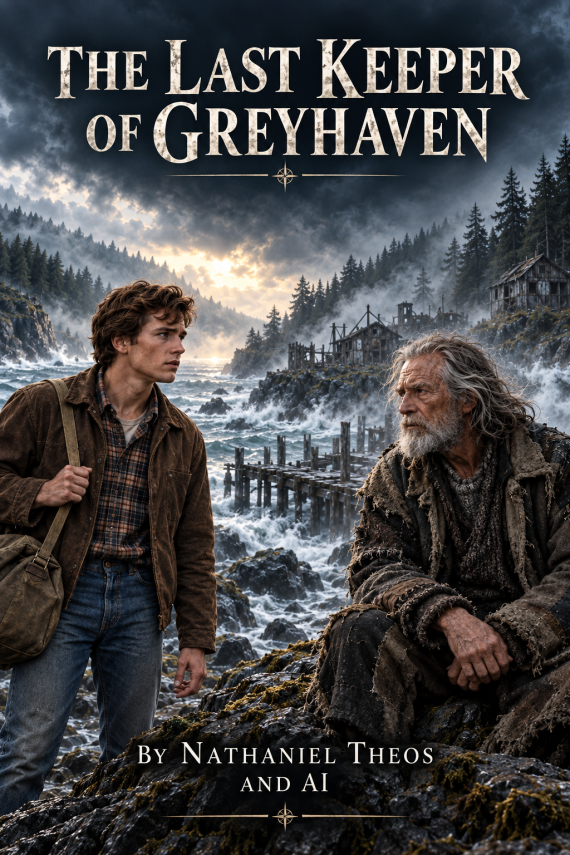
AI was used as an editorial and creative-support tool, including story development suggestions, the full editing process, and the creation of the cover artwork.
The human story remains the heart of the work. AI served as a tool in the creative and editorial process.