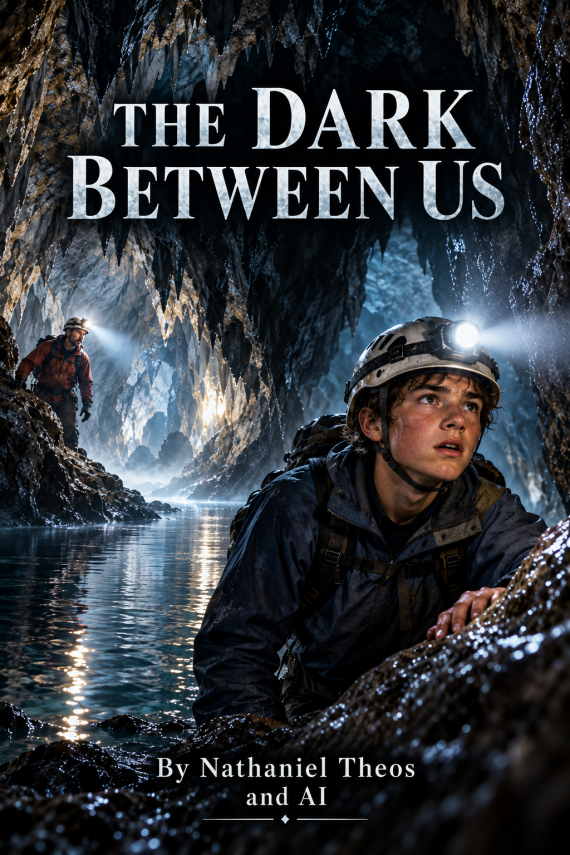
The Dark Between Us
By Nathaniel Theos and AI
The first time Étienne Bouchard admitted that he was afraid, his father mistook it for a request to be persuaded.
They stood beside Philippe Lake in Gatineau Park, their packs resting on the damp ground as a fine August rain touched the water. Across the lake, low clouds had swallowed the tops of the hills. Jean-Pierre Bouchard tightened the strap of his helmet and looked toward the trail leading to Lusk Cave. He had planned this trip for three months, ever since Étienne had chosen to spend most of the summer behind a closed bedroom door, communicating through shrugs and single syllables.
“Everyone gets nervous before doing something new,” Jean-Pierre said. “That is part of the adventure.”
Étienne pulled at the sleeves of his rain jacket. At fourteen, he already stood nearly as tall as his father, although his narrow shoulders and unfinished face still belonged to a boy. “I didn’t say I was nervous. I said I don’t know if I want to go inside.”
Jean-Pierre heard the distinction, but he did not honour it. He had planned the entire day around something they could do together. In his mind, turning back would confirm everything he feared about their relationship. He had become a man his son tolerated from the far side of a dinner table.
“Let’s hike out there and look,” he said. “If you still don’t want to enter, we won’t.”
It sounded like a compromise, but Étienne knew his father well enough to recognize a campaign.
The trail followed the shoreline before entering the woods. Rain ticked against leaves and gathered in drops along the ferns. Jean-Pierre tried to make conversation about school and hockey, but each answer was short enough to end the subject. Twenty minutes into the hike, he stopped beside a fallen cedar and handed Étienne a chocolate bar.
“You used to tell me everything,” Jean-Pierre said.
Étienne peeled back the wrapper. “I was nine.”
“So fourteen means you no longer speak?”
“I speak.”
“When absolutely necessary.”
Étienne looked into the trees. “You turn everything into advice.”
The words landed harder than their volume suggested. Jean-Pierre almost defended himself. He wanted to explain that advice was what fathers offered when they could not protect their children from every consequence. Instead, he bit into his chocolate bar and nodded as though Étienne had commented on the weather.
They resumed walking. The trail grew muddy, and the rain strengthened enough for water to run from the brim of Jean-Pierre’s helmet. When they finally reached the cave entrance, it appeared less like a doorway than a wound in the earth. A shallow stream slid between pale walls and vanished beneath an overhang. Cold air moved from the opening and carried the mineral smell of wet stone.
Étienne stopped several metres away. “That’s smaller than the pictures.”
“It opens farther in.”
“How do you know?”
“I read about it.”
Étienne stared at the black space beyond the entrance. “Did you read about the water?”
Jean-Pierre had. He had also read warnings about changing conditions, cold temperatures and the need to turn back if water levels became unsafe. The stream looked shallow enough, only reaching the ankles of two hikers emerging from the cave. They were laughing, soaked to their waists and exhilarated.
“It’s manageable,” Jean-Pierre said. “We will go slowly, and if either of us is uncomfortable, we come out. No argument.”
Étienne gave him a long look. “Either of us?”
“Either of us.”
They switched on their headlamps and entered.
Within a dozen steps, daylight weakened behind them. Their beams moved across marble walls smoothed by water. Boots scraping stone sounded like shovels, and their breathing returned from the darkness as though two other people were following them.
Jean-Pierre felt Étienne’s hand grip the back of his jacket. He pretended not to notice. The water rose from their ankles to their calves, painfully cold even through their clothing, and the passage narrowed until they had to turn sideways. Jean-Pierre tested every foothold before shifting his weight.
“Doing okay?” he asked.
“Yes.”
The answer was immediate and unconvincing.
They reached a chamber where the ceiling lifted, and the stream widened into a dark pool. Their headlamps revealed bands of white and grey stone. Water shone like black glass beneath them. Étienne released his father’s jacket and slowly turned in place.
“This is incredible,” he whispered.
Jean-Pierre smiled. For the first time that morning, they were looking at the same thing and feeling something neither needed to explain. “Worth the walk?”
Étienne nodded. Then he caught himself and added, “So far.”
They continued deeper. At one bend, the passage divided around a pillar of marble before joining again. Étienne chose the tighter side, lowering himself beneath a shelf and emerging ahead of his father with a grin. Jean-Pierre felt a rush of relief. This was the boy he remembered, curious and quick, before adolescence had installed locked doors inside him.
The passage narrowed again. Ahead, the stream disappeared through an opening no wider than a kitchen cupboard. A smooth ledge ran along the right wall, leaving a gap above the water large enough for a person to squeeze through.
Étienne stopped. “I don’t like that.”
“We can turn around.”
His father meant it this time, but Étienne heard the challenge hidden inside the permission. He crouched and shone his light through the opening. “Can you see where it comes out?”
“There’s another chamber just beyond it.”
“How long?”
“Three or four metres.”
Étienne removed his backpack and passed it to his father. He lowered himself to his hands and knees, then crawled onto the ledge. Halfway through, he stopped.
“Keep going,” Jean-Pierre said. “You’re almost there.”
Étienne’s boots disappeared around the bend. A moment later, his voice echoed back. “I’m through.”
Jean-Pierre pushed Étienne’s backpack into the opening, keeping one hand on its shoulder strap as he knelt. That was when he heard the sound.
At first, he thought it was wind. Then the cave floor vibrated beneath his knees. A deep rushing noise grew somewhere behind them, filling the passage with a roar that did not belong to the narrow stream they had followed inside.
Jean-Pierre twisted around. His headlamp caught water surging through the previous bend, brown with mud and carrying leaves and broken branches. The shallow stream rose over the rocks in seconds.
“Étienne, move higher!” he shouted.
The first wave struck Jean-Pierre from the side. His hand tore free of the backpack, and his shoulder slammed against the wall. Pain exploded across his chest. He tried to stand, but the current swept his feet from beneath him and drove him backwards. His helmet hit stone. Light spun across the ceiling, vanished beneath the water and returned at a crooked angle.
“Dad!”
Jean-Pierre reached for the ledge, but his injured arm would not obey. The current carried him around the bend and dropped him hard against a cluster of rocks. His left leg folded beneath him. Something cracked, sharp and unmistakable, and the cave disappeared behind a field of white.
When his vision returned, he was wedged between two stones with water hammering his waist. His headlamp still burned, although the beam pointed at the ceiling. He tried to move his leg and nearly vomited from the pain.
“Étienne!”
No answer came through the water.
Jean-Pierre shouted again until his throat burned. He heard nothing except the relentless roar. He tried to pull himself free, but his shoulder failed, and the movement sent another bolt through his leg. The current had carried him perhaps fifteen metres, yet it felt as if the entire mountain now stood between him and his son.
Beyond the narrow opening, Étienne had been knocked onto his stomach as water burst into the chamber. His backpack struck his shoulder and vanished into the pool. He grabbed at it, caught one strap and wrapped both arms around a stone projection while the current pulled at his legs.
He heard his father shout once. Then came the terrible sound of something heavy striking rock.
“Dad!” Étienne screamed.
His voice returned unanswered.
For several minutes he could do nothing except hold on. The water climbed from his knees to his hips. His muscles shook from cold and effort. Each time he tried to move, the current tugged at his boots and threatened to turn him sideways.
His mind filled the darkness with images. His father unconscious beneath the water. His father calling from somewhere Étienne could not hear. His father swept all the way out of the cave while Étienne remained trapped inside. The images came so quickly that he could no longer separate possibility from certainty.
He began to breathe too fast. The chamber seemed to shrink with every breath. His light trembled across the walls, and he understood with sudden clarity that he was going to die there.
Then he heard his father’s voice in his memory, not from the cave but from a winter afternoon years earlier when Étienne had fallen through thin ice at the edge of a pond.
Panic spends energy and solves nothing. Stop. Look. Think.
At the time, Jean-Pierre had repeated the phrase until it became irritating. Now Étienne closed his eyes and forced himself to say it aloud.
“Stop. Look. Think.”
His voice shook, but the words gave his fear edges. A problem with edges could be examined.
He stopped pulling against the current. He looked around the chamber. To his left, the wall slanted upward toward a shelf perhaps a metre above the water. He could not reach it from where he clung, but a narrow crack ran across the stone between him and the shelf. If he could place his boots inside the crack, he might work sideways without surrendering himself to the current.
Étienne shifted one foot. Water struck his thigh and twisted him away from the wall. He cried out and tightened his grip. For several seconds he remained frozen, ashamed that he had tried and terrified to try again.
“One thing,” he whispered. “Do one thing.”
He moved his foot again. This time the toe of his boot entered the crack. He tested it, shifted some weight, and found a second hold with his other foot. Slowly, he worked sideways. His fingers slipped once, tearing skin from two knuckles, but his boots held. When he reached the shelf, he threw his chest over it and kicked until the current released him.
The ledge was barely wide enough to sit on. Étienne pressed his back against the wall and pulled his knees to his chest. The water ran below him, carrying branches, foam and one of his gloves into the passage ahead.
He was safer, but he was not safe. The water had risen several centimetres while he climbed, and he had no way of knowing when it would stop.
His backpack still hung from one hand by a single strap. He dragged it onto the ledge and emptied its contents between his legs. A plastic bag held a dry sweatshirt, two energy bars, a compact first-aid kit and a whistle. His telephone was damp but functional, although it showed no service. A small flashlight clipped to the pack had survived. Jean-Pierre had insisted he carry it even though they both wore headlamps.
“Two lights are one,” his father had said. “One light is none.”
Étienne had mocked him for it. Now he switched off his headlamp and sat in absolute darkness for three seconds before panic forced him to turn it on again. He clipped the spare flashlight inside his jacket where it would remain dry.
He wanted to call for his father, but shouting would not carry over the water and would drain his strength. Instead, he blew the whistle three times, waited and repeated the signal. No answer came.
Outside, the hikers they had passed watched muddy water pour from the cave. Knowing people were still inside, one ran to call for help while the other remained near the entrance.
Jean-Pierre did not hear him. Wedged among the rocks, he fought to remain conscious. His lower leg lay at an unnatural angle, and every pulse drove pain through it. He feared moving it, but the water kept rising. If it reached his chest, the current could force him beneath the low ceiling behind him.
He removed his belt with his right hand and looped it around a projection above his head. His left shoulder would bear almost no weight. Using the belt as a handle, he dragged his body several centimetres higher onto the rocks. The movement made him scream. He rested, breathing through clenched teeth, then pulled again.
When he finally reached a shelf above the strongest current, he collapsed against the wall. His leg was useless, and his helmet was gone. His headlamp hung around his neck, casting weak light across the water.
“Étienne!” he shouted.
Nothing.
Jean-Pierre saw his son again at the narrow passage, looking back before crawling through. Étienne had told him he was afraid. Jean-Pierre had answered as though fear were an obstacle to be defeated instead of information to be respected.
He remembered his promise at the entrance. If either of us is uncomfortable, we come out. No argument.
He had broken it before they even entered. He had made Étienne responsible for disappointing him, then pretended the decision belonged to the boy.
“I’m sorry,” he said into the darkness.
The water accepted his apology and carried it away.
Nearly an hour passed before Jean-Pierre saw a different light moving through the passage behind him. It was brighter than a headlamp and swept the walls in a deliberate pattern.
“I’m here!” he shouted. “My son is farther in!”
Two rescuers reached him wearing helmets, flotation equipment and protective suits. The first introduced herself as Isabelle, although Jean-Pierre immediately forgot everything except the calmness of her voice. She examined his head, shoulder and leg while the second rescuer spoke into a radio.
“My son went through the narrow section before the water hit,” Jean-Pierre said. “He’s fourteen. His name is Étienne. You have to keep going.”
“Another team is preparing to search the far section,” Isabelle told him. “We need information from you first. Was he injured when you last saw him?”
“No. I don’t know. His backpack went through. I heard him call once.”
“What equipment does he have?”
Jean-Pierre listed everything he could remember. Helmet. Headlamp. Spare flashlight. Whistle. Dry shirt. Food. Telephone. First-aid kit. Each item sounded pitiful against the darkness.
“He’s smart,” Jean-Pierre said. “But he was scared before we went in.”
Isabelle tightened a splint around his leg. “Being scared does not make him less smart.”
Jean-Pierre closed his eyes as another wave of pain travelled upward. “I should have listened to him.”
“You can tell him that when we bring him out.”
“Do you believe he’s alive?”
She did not offer him a comfortable lie. “I believe we have a boy with light, equipment and a reason to keep thinking. That gives us something to work with.”
The rescuers secured Jean-Pierre above the current, wrapped him in insulation and left one person with him while another team advanced.
Time lost its shape. Jean-Pierre listened to clipped phrases buried beneath radio static. Water stabilizing. No visual contact. Possible whistle signal.
At the word whistle, he lifted his head. “That’s him.”
The rescuer beside him raised the radio. “Repeat last transmission.”
Static crackled. Then a voice said, “Three whistle blasts heard from the inner chamber. Continuing toward signal.”
Jean-Pierre covered his face with his good hand. His relief lasted only a moment before guilt returned with greater force. Étienne was alive somewhere beyond the flooded opening, blowing a whistle his father had packed for an adventure that never should have continued.
Farther inside, Étienne heard voices but could not make out words. He blew his whistle three times and waited. Three blasts answered from the passage.
The sound was the most beautiful thing he had ever heard.
When two rescuers entered the chamber, Étienne began laughing and crying at once. One climbed onto the ledge beside him and placed a gloved hand on his shoulder.
“My dad,” Étienne said. “Did you find my dad?”
“He is alive, and another team is with him.”
Étienne folded forward, pressing his forehead against his knees. The rescuer allowed him several seconds before continuing. “Your father injured his leg and shoulder. We will need to bring both of you out carefully.”
Étienne looked up. “How bad?”
“His injuries are serious, but he is stable.”
Stable was a word adults used when they did not want to promise anything.
“Where is he?”
“In the previous section, about thirty metres from us.”
Étienne pointed toward the water entering the chamber. “You can’t take that passage back. The strongest current is there. It keeps pushing branches into it.”
The rescuers exchanged a glance. “How long has it been doing that?”
“Since the water came up. But some of the water is leaving through the crack below that wall.” Étienne aimed his light across the chamber. “I dropped a stone in there and heard it hit twice before it splashed. I think there’s another space behind it.”
“You dropped a stone?”
“I was trying to tell how deep it was. I marked the wall too.” He showed them three muddy lines beside the ledge. “The water rose fast at first. The last mark is from maybe twenty minutes ago. It has barely moved since then.”
The second rescuer examined the marks and reported the information by radio. Étienne listened closely. They were using his observations to decide whether the water was stabilizing and whether the original route could be crossed safely.
“Do you know if my dad can hear a whistle?” Étienne asked.
“He should.”
Étienne raised it to his lips and blew three strong blasts.
Jean-Pierre heard them through the stone. He knew the signal could have come from a rescuer, but he also knew the rhythm. Two quick blasts, a pause, then one longer note. Étienne had used it while hiking when he was younger, their private answer to Are you there?
Jean-Pierre took the whistle Isabelle had left with him and returned the pattern.
Étienne heard the distant reply and closed his eyes. His father was not merely alive. His father had heard him.
The rescue team fitted Étienne with a flotation vest and safety line. Before moving him, they asked him to describe exactly what had happened. He showed them the crack he had used for his boots, the direction debris travelled and the point where the current weakened. His account helped them choose a route across the chamber.
“You did well,” the first rescuer said.
Étienne shook his head. “I cried.”
“Most people cry when they believe they might die. You still found higher ground, protected your light and tracked the water. Courage does not require you to enjoy being terrified.”
It took another hour for the water to recede enough to move him through the restriction. He crawled behind the rescuer with a line secured around his body. Brown water pressed against his chest, and the ceiling passed centimetres above his helmet. Halfway through, he froze.
The passage vanished from his awareness. He was back in the surge, hearing his father strike the rocks. His hands stopped moving, and his breath came in shallow bursts.
“Étienne,” the rescuer said from ahead. “Do not fight the whole cave. Find one place for your right hand.”
Étienne saw a pale ridge in the marble and gripped it.
“Good. Now one place for your left knee.”
He found it.
One thing, he thought. Do one thing.
He moved through the passage one decision at a time.
When he reached the next chamber, he saw his father lying beneath a silver emergency blanket. Jean-Pierre’s face was grey, his wet hair pasted to his forehead. One leg was secured inside a splint, and his left arm was strapped across his chest.
Étienne stopped breathing.
Jean-Pierre reached for him with his good hand. “Hey, buddy.”
Étienne crossed the chamber and dropped beside him. He wanted to throw both arms around his father, but the splint and shoulder restraint made every part of Jean-Pierre seem breakable.
“I thought you were dead,” Étienne said.
“I thought the same about you.”
“They said you were stable.”
Despite the pain, Jean-Pierre laughed. “A deeply unsatisfying word, isn’t it?”
Étienne touched his father’s hand. It was colder than he expected. “I should have waited before crawling through.”
“No.” Jean-Pierre tightened his fingers around Étienne’s. “This was not your fault. You told me you were afraid, and I made you feel as if saying no would disappoint me. I promised we would turn around if either of us felt uncomfortable, but I had already decided what I wanted your answer to be.”
Étienne looked toward the rescuers, embarrassed to have the conversation in front of strangers. “We don’t have to talk about it now.”
“I do. In case I become less brave when there isn’t a cave forcing me to tell the truth.” Jean-Pierre swallowed and fought through a wave of pain. “I’m sorry.”
Étienne stared at their joined hands. “I did want to see it. Part of me did.”
“You were allowed to want it and fear it at the same time.”
One of the rescuers approached. “We need to move your father first. Étienne, you’ll remain with our second team and follow once the route is clear.”
The boy’s grip tightened. “No. We just found each other.”
Jean-Pierre saw panic enter his son’s face and recognized the temptation to dismiss it with reassurance. This time he listened.
“Tell us what you need,” he said.
Étienne took several breaths. “I need to know where they’re taking you. I need someone to tell me when you reach the entrance. And I need your whistle.”
Jean-Pierre removed the whistle from his neck and placed it in Étienne’s hand. “Done.”
Rescuers transferred Jean-Pierre onto a compact stretcher and guided it through spaces never designed for an injured man. Every tilt sent pain through his leg. He tried not to cry out because Étienne might hear him, but silence required more strength than he possessed.
At the first restriction, they rotated the stretcher onto its side. Jean-Pierre’s injured shoulder pressed against the support, and a scream escaped him before he could stop it. The sound travelled backward through the cave.
Étienne heard it. His body began shaking again, but he did not chase after the stretcher or interfere with the rescuers. He sat where they had instructed him and wrapped both hands around his father’s whistle.
“He’s still moving,” the rescuer beside him said. “Pain does not mean we have lost him.”
Étienne nodded. “Can I signal?”
“Yes.”
He blew their pattern into the darkness.
Jean-Pierre heard it while the team repositioned his stretcher. Two quick notes and one long. Are you there?
He could not reach a whistle, so he raised his voice. “I’m here!”
The answer came faintly from behind him. “Me too!”
It took almost three hours from the first emergency call for rescuers to bring Jean-Pierre into daylight. The rain had weakened, but the clearing outside the cave was crowded with emergency personnel, equipment and people speaking into radios. An ambulance waited near the trail access, its rear doors open.
Jean-Pierre refused pain medication strong enough to cloud his awareness until someone confirmed that Étienne had begun moving toward the entrance. He lay beneath warm blankets, staring at the black opening while paramedics monitored him.
Then a helmet appeared beneath the stone overhang. A rescuer emerged, followed by Étienne on his hands and knees. The boy stood too quickly, stumbled and was caught beneath the arms. His face was streaked with mud and tears, and someone draped a blanket around his shoulders.
Jean-Pierre tried to sit up. Pain forced him back, but Étienne had already seen him. He crossed the clearing and knelt beside the stretcher.
For several seconds neither spoke. Their reunion did not resemble anything Jean-Pierre had imagined while waiting in the cave. There was no perfect embrace, no speech grand enough to contain what had happened. Étienne rested his forehead against his father’s good shoulder, and Jean-Pierre placed one hand on the back of his helmet.
“You found me,” Jean-Pierre whispered.
Étienne lifted his head. “The rescuers found you.”
“They told me you tracked the water and showed them where the current weakened. They said your information helped them move through safely.”
Étienne looked almost offended by the suggestion. “I was just trying things.”
“That is what resourcefulness is.”
“I was scared.”
“I know.” Jean-Pierre looked directly into his son’s eyes. “Being scared is not the opposite of being brave. You were terrified, and you kept thinking. I have never been prouder of you.”
Étienne’s mouth tightened. He looked away, but not before Jean-Pierre saw fresh tears gather beneath his eyes. “When they told me you were hurt, I thought I had to get out so I could help you.”
“You did help me.”
Paramedics placed Étienne on a second stretcher despite his insistence that he could walk. As they prepared to carry father and son toward the waiting vehicles, a reporter called from beyond the emergency barrier and asked Étienne how he had remained fearless inside the cave.
Étienne turned beneath his blanket. “I wasn’t fearless,” he said. “I was scared the whole time. I just kept doing the next thing.”
The reporter tried another question, but the paramedics moved them away.
Jean-Pierre required surgery to repair his leg and spent six weeks with his shoulder immobilized. Étienne suffered bruising, mild hypothermia and torn skin across his knuckles. His physical injuries healed first. For months afterward, running water in a dark room could send him back into the chamber. He slept with a flashlight beside his bed, and sometimes he woke believing stone pressed against his face.
Jean-Pierre did not tell him to conquer the fear. He did not turn recovery into a lesson, a challenge or another adventure. He listened when Étienne wanted to speak and remained nearby when he did not. Some evenings they sat together without conversation, which Jean-Pierre slowly learned was not the same as being shut out.
In November, Étienne found the mud-stained cave map among their equipment. Jean-Pierre had placed everything in a box and hidden it on a basement shelf, unable to look at it and unwilling to throw it away.
Étienne carried the map upstairs and spread it across the kitchen table. His father watched from the doorway, his weight still supported by a cane.
“Are you okay?” Jean-Pierre asked.
Étienne studied the blue lines marking the underground stream. “I think so.”
Jean-Pierre waited. He had learned that the empty space after a question belonged to the person answering it.
“I keep thinking about the ledge,” Étienne said at last. “When I was down there, I thought being scared meant I wasn’t ready. But maybe nobody is ready for something like that.”
“Probably not.”
“I’m proud of what I did,” Étienne spoke quietly, as though pride were something he needed permission to hold. “Is that weird?”
Jean-Pierre crossed the kitchen and sat opposite him. “No. You should be proud.”
“Even though we shouldn’t have gone farther?”
“A bad decision does not erase the strength you showed afterward. We can regret how we entered the trouble and still honour how you met it.”
Étienne traced the route with one finger, stopping at the chamber where they had been separated. “When they said you were hurt, I wasn’t only scared anymore. I knew things they needed to know. I had watched the water. I had tested the wall. For the first time, I wasn’t waiting for an adult to solve everything.”
Jean-Pierre felt pride rise beside something more difficult to name. His son had crossed a distance inside that cave and had not returned as the same boy. Part of fatherhood, he realized, was celebrating the strength that would one day make you less necessary.
“You were never responsible for saving me,” Jean-Pierre said.
“I know. But I helped.”
“Yes, you did.”
Étienne folded the map along its original creases. “I don’t ever want to go inside that cave again.”
“Neither do I.”
“But maybe someday I want to stand outside it.”
Jean-Pierre considered the difference. Returning would not be about defeating the cave or proving fear had vanished. It would be about choosing how close they wished to come and knowing either of them could say no.
“If you decide you want to,” he said, “we’ll go as far as you choose.”
The following summer, almost one year after the rescue, they returned to Philippe Lake. They carried no helmets or headlamps. They brought sandwiches, two chocolate bars and a pair of whistles.
The day was warm and clear. Sunlight moved across the lake, and families passed them along the trail. When they reached the turn leading toward Lusk Cave, Étienne stopped.
Jean-Pierre said nothing.
They stood together while the woods moved gently around them. Étienne’s breathing changed, and Jean-Pierre saw his fingers close around the whistle hanging from his pack. He waited without persuading, encouraging or preparing a speech.
After several minutes, Étienne stepped onto the trail toward the cave.
They walked until they could hear water moving among the stones. The entrance appeared through the trees, smaller than either remembered. People came and went beneath the overhang, their voices fading into the earth.
Étienne remained well back from the opening. He looked at it for a long time, then removed the whistle from his pack and placed it in his father’s hand.
“Are you there?” he asked.
Jean-Pierre closed his fingers around it. “I’m here.”
Étienne nodded. Together, they turned away from the darkness and walked back toward the lake.
AUTHORSHIP & AI ACKNOWLEDGEMENT
The story concept, creative direction, characters, and original writing are by Nathaniel Theos.
Artificial intelligence was used as a collaborative creative and editorial tool, including story-development suggestions, assistance with the editing process, and creation of the visual cover artwork.
The human author guided the story’s intent, emotional arc, revisions, and final creative decisions. AI served as a writing, visual, and editorial assistant in bringing that vision to the page.