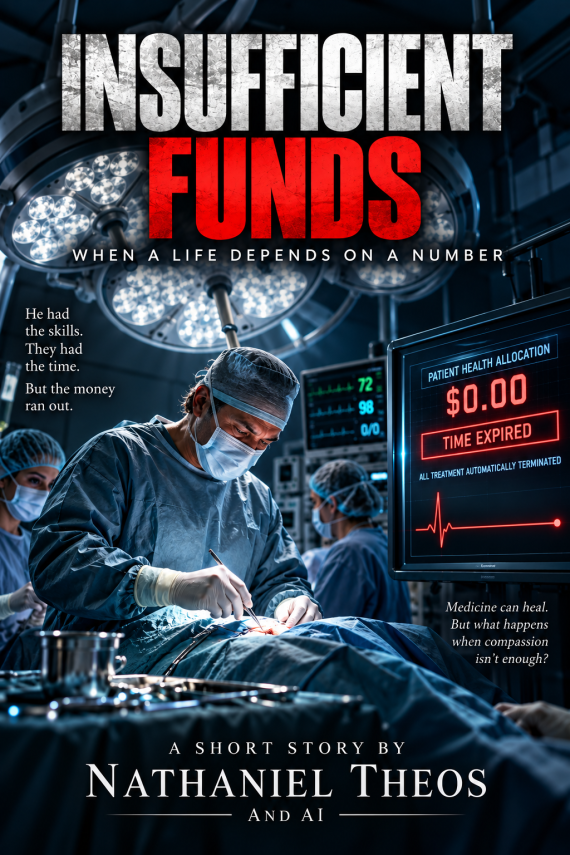
Insufficient Funds
By Nathaniel Theos and AI
Dr. Elias Hart had killed seventeen people. Not with a scalpel. Not through negligence.
Not because he had made the wrong diagnosis, prescribed the wrong medication, or missed some tiny shadow on an X-ray. He had killed them by stopping. Seventeen times, he had stood beside a human being whose body was still capable of fighting and watched a number reach zero. The government called it the Universal Health Allocation.
Doctors called it the UHA. Patients simply called it their million. Every citizen received one million dollars at birth. It was enough, the politicians had said when the program began in 1950, to guarantee every American access to excellent medical care throughout a lifetime.
No insurance companies. No premiums. No deductibles. No private hospitals.
No wealthy families buying better treatment while poor families went without. One person. One million dollars. One lifetime.
It had sounded almost utopian. The first generation loved it. Most people died with hundreds of thousands still sitting untouched in their accounts. Medicine was inexpensive then.
Technology was simpler. There were fewer machines capable of keeping a failing body alive for another month, another year, another decade. But medicine changed. It became better.
And better became expensive. By 2087, doctors could replace organs, repair damaged spinal cords, grow skin, reverse some cancers and keep premature babies alive who once would never have taken a first breath. They could do extraordinary things. If there was money in the account.
The law had never changed. One million dollars. When it was gone, treatment ended. Not tomorrow.
Not after the procedure. Not when the doctor decided it was medically appropriate. Immediately. The system had eventually been automated because too many doctors had refused to stop.
Elias had been one of them. At 6:13 on a Tuesday morning, Elias was drinking coffee in the physicians’ lounge when his wrist terminal vibrated. TRAUMA ONE. PRIORITY RED.
He put the coffee down and ran. The emergency department doors opened before he reached them. Nurses were moving around a gurney carrying a man whose clothing had been cut away. “Male, fifty-eight,” a paramedic called.
“Motor vehicle collision. Driver. T-boned on the passenger side. BP seventy-eight over forty-two.
Suspected internal bleeding. Abdomen rigid. Lost consciousness twice en route.” Elias moved alongside the gurney.
“Name?” “Thomas Bell.” A nurse pressed her terminal against the patient’s wrist. The screen flashed green.
Then amber. Elias saw the number. AVAILABLE HEALTH ALLOCATION: $5,214.73 He stopped walking for half a second. “Five thousand?”
The nurse looked at him. “Five thousand two fourteen.” “That’s impossible.” “Confirmed.”
Thomas Bell opened his eyes. “Doctor?” “I’m here.” “Am I dying?”
“Not if I can help it.” Elias immediately regretted saying it. There were promises doctors should never make. And in modern medicine, there were promises doctors were legally forbidden to make.
Thomas coughed and grimaced. “My daughter.” “We’ll contact your family.” “She’s coming.”
“We’ll find her.” “No.” Thomas grabbed Elias’s sleeve with surprising strength. “She’s coming here.
Works nights. She’ll be coming home.” Another wave of pain seized him. Elias looked at the ultrasound.
Blood. A lot of it. “Get him upstairs. Now.”
The nurse beside him didn’t move. “Elias.” He knew what she meant. “I know.”
“Five thousand won’t cover surgery.” “I know.” “It might not cover anaesthesia.” “I know, Miriam.”
She lowered her voice. “If we begin—” “He dies if we don’t.” “And if we do?” Elias looked at Thomas Bell.
“Then we try.” The surgical authorization system calculated everything before they reached the operating room. Estimated procedure cost: $8,400 to $13,700. Thomas Bell had $4,816 remaining after emergency assessment, imaging, medication and transport charges.
The system displayed the warning in red. PATIENT ALLOCATION INSUFFICIENT FOR PROJECTED PROCEDURE. Below it were two choices. PROCEED PALLIATIVE PROTOCOL Elias pressed PROCEED.
Miriam swore quietly. “Don’t.” “I didn’t say anything.” “You were about to.”
“I was about to remind you that the system will shut us down.” “I know.” “Automatically.” “I know.”
“We cannot override it.” “I know.” Miriam stared at him. “Then what exactly is your plan?”
Elias looked through the glass doors at Thomas. “Be fast.” The million-dollar system had been born from compassion. Elias knew its history.
Every medical student did. In the late 1940s, healthcare had become increasingly unequal. Families lost homes because someone got sick. People avoided doctors because they couldn’t afford them.
Children suffered because their parents had no money. Then Senator Arthur Ralston proposed something radical. Every citizen would be born with a government-funded lifetime medical account worth one million dollars. The amount had been enormous in 1950.
Private medical insurance disappeared. Private healthcare was eventually prohibited. The reasoning seemed sound: if wealthy citizens could purchase unlimited medical treatment after exhausting their government allocation, then society would once again have two classes of health. Those who could afford to live.
And those who couldn’t. So the law became absolute. No citizen could purchase medical care outside the Universal Health Allocation. No physician could accept private payment.
No family could transfer unused credits. No charity could purchase treatment for another person. Your million belonged to you. And only you.
The architects believed it would encourage responsibility. Don’t smoke. Don’t abuse drugs. Exercise.
Eat well. Don’t waste emergency resources. Make sensible choices. Take responsibility for your body.
But bodies weren’t sensible. Cancer didn’t care whether you exercised. A drunk driver didn’t ask how carefully you had managed your health account. A genetic disease didn’t care whether you’d eaten vegetables.
And a five-year-old boy with leukemia didn’t understand why the number beside his name was falling. Thomas Bell’s account told a story. Elias had glanced through it while scrubbing. Childhood appendectomy.
Broken leg at nineteen. Two knee surgeries. Gallbladder removal. Cardiac bypass at forty-seven.
Cancer at fifty-three. Recurrence at fifty-five. Remission. Thomas had spent $994,785.27 staying alive.
And now, on an ordinary Tuesday morning, somebody had run a red light. “Pressure dropping.” Elias’s hands moved quickly. “Suction.”
Blood filled the field. “Come on.” He found the source. “Splenic rupture.”
“Can you repair it?” “No. We’re taking it.” Miriam glanced toward the wall.
Every operating theatre had a Health Allocation Display. Doctors hated them. Politicians insisted they were necessary for transparency. THOMAS BELL BALANCE: $3,882.16 The number decreased every few seconds. $3,841.09. $3,799.32. $3,746.11.
Every medication had a price. Every unit of blood. Every minute of operating-room time. Every scan.
Every piece of equipment. Even Elias’s hands had a price. $43.17 per minute. He sometimes wondered what part of him that purchased. His training?
His judgment? His hands? His conscience? “Clamp.”
Miriam handed it to him. “Bleeding controlled.” For the first time since entering the room, Elias allowed himself hope. “Pressure?”
“Coming up. Eighty-six over fifty.” “Good.” Another surgeon, Dr.
Priya Shah, worked opposite him. “We’ve got bowel injury.” “How bad?” “Repairable.”
“How long?” “Twenty minutes.” Elias looked at the display. $2,611.40 “We don’t have twenty minutes.” Priya didn’t look up.
“Then give me fifteen.” At $2,000, the system issued its first warning. A calm synthetic voice spoke through the operating room. “Patient allocation approaching critical threshold.”
Nobody responded. At $1,500, a yellow light appeared above the operating-room doors. At $1,000, it turned red. Thomas Bell’s heart was beating strongly now.
His pressure was ninety-four over fifty-eight. Elias almost laughed. They were winning. For once, they were actually winning.
“How’s the bowel?” “Almost there.” “Define almost.” “Ten minutes.”
“We have maybe six.” “Then stop talking to me.” At $750, the system began a countdown. “Estimated allocation exhaustion in four minutes, thirty seconds.”
Elias looked at the anaesthesiologist. “Can you reduce anything?” “Already have.” “Turn off whatever isn’t essential.”
“I have.” “Blood warmer?” “Already off.” “Secondary monitoring?”
“Off.” “Anything.” “Elias, there is nothing left.” He looked at the clock.
Four minutes. Thomas needed perhaps thirty more minutes of surgery. Then an hour of supported recovery. Without it, he would die.
Elias knew it. Everyone in the room knew it. Yet there was Thomas’s heart rhythm on the monitor. Steady.
Alive. “Priya?” “Five minutes.” “We have three.”
“Then I need five.” At $500, Miriam whispered, “Jesus.” Nobody reprimanded her. The doors opened.
A young woman appeared behind the observation glass. Hospital security was holding her back. She was perhaps twenty-five. Dark hair.
Blue scrubs. A hospital employee. Thomas’s daughter. She pressed both hands against the glass.
Elias looked away. “Two minutes remaining,” the system announced. The daughter could see the display. Her eyes moved from the balance to her father.
Then to Elias. She understood. Everyone understood. She began pounding on the glass.
“No!” They couldn’t hear her clearly through the sealed doors. They didn’t need to. “No!
No! No!” Miriam’s eyes filled with tears. “Don’t look at her.”
“I wasn’t.” “Yes, you were.” “One minute, thirty seconds.” Priya worked faster.
“I’ve got it. Almost.” Elias stared at Thomas’s vitals. His body was responding.
That was what made it unbearable. If Thomas had been dying despite everything they were doing, Elias could have accepted it. Doctors lost patients. Death was part of medicine.
But Thomas wasn’t losing. Thomas was winning. They were going to save him. They just needed time.
“One minute.” “Priya.” “Working.” “Forty-five seconds.”
“Elias, I need—” “Thirty seconds.” The young woman outside was screaming. Security no longer tried to move her. One of the guards had turned away.
“Twenty seconds.” Elias looked around the operating room. Nobody moved except Priya. “Ten.”
Miriam shook her head. “Nine.” “Elias.” “Eight.”
“Elias, do something.” “Seven.” He looked at the main control panel. “Six.”
There was an emergency override. Doctors knew about it. It was intended for technical malfunctions, not exhausted accounts. Using it to continue treatment was a felony.
“Five.” Elias reached toward it. Miriam grabbed his wrist. “Four.”
“My God,” she whispered. “Three.” “Elias.” “Two.”
He pulled his arm from her hand. “One.” The balance reached zero. For a fraction of a second, nothing happened.
Then the operating room changed. The infusion pumps stopped. The surgical assistance system disengaged. Medication delivery locked.
The blood pump shut down. The anaesthesia unit switched automatically to termination protocol. Several monitors remained active because the law required documentation of death. The overhead surgical lights dimmed to standby illumination.
Priya froze. “No.” “Treatment allocation exhausted,” the system announced. “All medical intervention must cease.”
Thomas’s daughter was still pounding on the glass. Elias stared at his patient. Thomas’s heart continued beating. “Resume manual ventilation,” Elias said.
The anaesthesiologist didn’t move. “That’s treatment.” “He’s still alive.” “I know.”
“Then ventilate him.” “I can’t.” “Give me the bag.” “Elias.”
“Give me the goddamned bag!” Nobody moved. The system spoke again. “Medical intervention is no longer authorized.”
Elias grabbed the manual ventilation bag himself. It wouldn’t activate. Electronic lockout. Of course.
Everything was connected now. He tried the oxygen. Locked. He reached for medication.
The dispensing drawer wouldn’t open. Thomas’s oxygen saturation began falling. He wasn’t dying from his injuries. Not anymore.
He was dying because the room had stopped helping him live. His heart rate increased. The body fighting. Always fighting.
The daughter outside slid down the glass. Miriam turned away. “Somebody let her in,” Elias said. No one answered.
“LET HER IN!” Security opened the door. She ran to her father. “Can she touch him?”
Miriam asked. Elias stared at her. “What?” “The regulations—” “To hell with the regulations.”
The young woman grabbed her father’s hand. “Dad.” Thomas was still unconscious. “Dad, I’m here.”
His oxygen level fell through sixty. She looked at Elias. “Why aren’t you doing anything?” There are questions that contain their own answers.
Elias had been asked this one before. Sixteen times. But never by someone’s daughter while her father was still warm beneath his hands. “His allocation is exhausted.”
“I know that.” “I’m sorry.” “You were fixing him.” Elias couldn’t answer.
“I was watching. His pressure came up. You were fixing him.” “We were.”
“Then keep going.” “We can’t.” Her face changed. Not grief.
Not yet. Disbelief. “My father is right there.” “I know.”
“He is alive.” “I know.” “So save him.” Elias looked at the man on the table.
His heart rate was slowing. “Please,” she said. One word. Not angry anymore.
Just a daughter. “Please.” Elias had nothing to give her. Thomas Bell’s heart stopped at 7:02 a.m.
The system automatically recorded the time. “Patient death confirmed,” the voice announced. “Universal Health Allocation balance: zero dollars and zero cents.” Elias vomited in the staff washroom.
He stayed there until someone knocked. “Elias?” Miriam. “I’m fine.”
“No, you’re not.” “I said I’m fine.” “His daughter wants to talk to you.” He closed his eyes.
“I can’t.” “Her name is Anna.” “I can’t talk to her.” “You should.”
“Tell her I’m sorry.” “I think she’s heard enough from the system.” That hurt because it was true. Elias washed his face.
When he emerged, Anna Bell was sitting alone in a consultation room. She had changed out of her scrubs. He realized she worked at the hospital. “Are you a nurse?”
“Respiratory therapist.” Of course. Of all things. She helped people breathe.
Elias sat opposite her. For several seconds neither spoke. Finally Anna asked, “How long?” “I’m sorry?”
“How much longer did you need?” He considered lying. He could say there was no guarantee. He could say her father’s injuries were catastrophic.
Both statements were true. Instead he said, “Thirty minutes. Maybe forty-five.” “Would he have lived?”
“I can’t promise that.” “Would he have had a chance?” “Yes.” “A good chance?”
Elias swallowed. “Yes.” She nodded slowly. “Thank you.”
The words surprised him. “For what?” “For telling me the truth.” She stood.
At the door, she stopped. “He spent most of it on cancer.” “I saw.” “He beat it twice.”
“I saw that too.” “The second time they told him he could choose a cheaper treatment. Lower survival rate. He chose the expensive one because he wanted to see me graduate.”
Elias said nothing. “He did.” A tiny smile appeared. “He was there.”
Then it vanished. “Was that irresponsible?” “No.” “Because that’s what they’ll say.”
“Who?” “Everyone. People online. Commentators.
They’ll pull up his allocation history. They’ll say he should have chosen the cheaper cancer treatment. They’ll say he used too much. They’ll say taxpayers already gave him a million dollars.”
She stared at Elias. “Was my father greedy for wanting to live?” “No.” “Then why is he dead?”
He had seventeen answers. He gave her none. The hospital required a post-exhaustion review whenever a patient died within twenty-four hours of allocation depletion. Three administrators attended.
No doctors. The chairwoman, Elaine Porter, reviewed the recording. “You attempted to access the emergency override.” “I did.”
“Why?” “My patient was dying.” “His allocation had been exhausted.” “He was still my patient.”
“Legally, at zero balance, medical services terminate.” “I understand the law.” “Do you?” Elias looked at her.
She continued. “The Universal Health Allocation exists because resources are finite.” “I know the argument.” “It isn’t an argument.
It’s mathematics.” “Mathematics doesn’t bleed.” Elaine sighed. “Doctor—” “Mathematics doesn’t have a daughter standing outside an operating room.”
“The alternative is what? Unlimited healthcare for everyone?” “I’m a surgeon, not an economist.” “Yet you’re questioning a system designed precisely because doctors cannot make resource decisions emotionally.”
“Emotionally?” “You were willing to commit a felony.” “I was willing to finish an operation.” “Using resources the patient no longer possessed.”
Elias leaned back. “Possessed.” “Yes.” “That’s an interesting word.”
“Doctor Hart.” “When did oxygen become something a dying man has to possess?” Elaine closed the file. “You are suspended for seventy-two hours.”
“Fine.” “Mandatory counselling.” “Fine.” “And your access to emergency override systems will be revoked for six months.”
Elias stood. “Anything else?” “Yes.” He waited.
Elaine’s expression softened. “I am sorry about your patient.” That was somehow worse than everything else. That night Elias sat in his kitchen with the lights off.
His wife, Claire, found him there at midnight. She didn’t ask what had happened. She knew. Everyone knew.
Thomas Bell’s death was already circulating online. MILLION-DOLLAR PATIENT DIES AFTER ACCOUNT EXHAUSTED DURING SURGERY. Some people were outraged. Others defended the system.
Thomas had received almost one million dollars in medical care. Was society obligated to provide more? If limits didn’t exist, where should treatment end? Should a ninety-year-old receive another million?
Should someone who smoked for forty years? What about alcoholics? Extreme athletes? People who refused preventive care?
People born with expensive genetic disorders? The debates multiplied. Everyone had an answer until it was their father on the table. Claire sat beside him.
“You couldn’t have done anything.” Elias stared into the darkness. “That’s what everyone keeps telling me.” “Because it’s true.”
“No. It’s legally true.” “There’s a difference?” “That’s what I’m trying to figure out.”
She took his hand. He thought about the seventeen. He remembered every name. Every balance.
Every last number. Some had been old. Some young. Two had been children.
He had always told himself he hadn’t killed them. The system had. The law had. The allocation had.
Tonight, for the first time, that explanation felt obscene. “What happens when yours runs out?” he asked. Claire looked at him. “What?”
“Your allocation.” “Why would you ask me that?” “Answer me.” She hesitated.
“I don’t know.” “What happens if you’re lying on my table and the number reaches zero?” “Elias.” “Do I stop?”
She didn’t answer. “Do I stand there while you die?” “That’s different.” He laughed softly.
“No.” He looked at her. “That’s the whole damn point. It isn’t.”
Three days later, Elias returned to the hospital. At 10:17 a.m., he was called to Trauma Two. A woman had fallen from a balcony. Thirty-two years old.
Multiple fractures. Internal bleeding. Treatable. Her allocation appeared on the screen. $742,113.09 Green.
Plenty of money. Everyone relaxed. That was what disturbed him most. Not consciously.
Nobody celebrated. But the tension changed. They could simply practise medicine. No countdown.
No calculation. No question about whether saving her was economically justified. Elias operated for three hours. She survived.
When he told her husband, the man hugged him. “Thank you for saving her.” Elias stood motionless in the man’s arms. He wanted to say something.
He didn’t know what. At the end of his shift, he returned to Operating Room Four. Thomas Bell had died there. The room was empty.
Elias turned on the surgical lights. He stood beneath them and looked at the table. For thirty-seven years he had believed being a good doctor meant knowing when to operate and when not to operate. When to fight.
When to accept. When another procedure would save a life and when it would merely prolong dying. He had been wrong. The hardest question wasn’t when medicine could do no more.
It was what a doctor should do when medicine could do more, but society ordered him not to. He sat beside the table. On the wall, the allocation display was blank. For some reason he thought about the Hippocratic Oath.
Ancient words. Primitive medicine. No robotic surgery. No artificial organs.
No genetic repair. No million-dollar accounts. Yet those physicians had understood something their sophisticated society had somehow misplaced. The patient came first.
Not forever. Not at any cost. Not with the arrogant belief that death itself could be defeated. But while there was reasonable hope, the person on the table was not a balance sheet.
A human life couldn’t know its remaining value. A counter could only know its remaining dollars. The door opened. Miriam entered.
“I thought I’d find you here.” He nodded. She sat beside him. For a while neither spoke.
Then she asked, “Are you quitting?” “No.” “Good.” “I’m refusing.”
She turned toward him. “What does that mean?” “Next time, I don’t stop.” Miriam stared at him.
“You’ll lose your licence.” “Probably.” “You could go to prison.” “Possibly.”
“And the equipment will lock you out anyway.” “I know.” “So what are you going to do?” Elias looked around the operating room.
He had been thinking about that for three days. “Machines can be modified.” Her expression changed. “Elias.”
“Manual equipment still exists.” “Not legally.” “Neither does private medicine.” “Exactly.”
“There are doctors who feel the same way.” “You’re talking about underground healthcare.” “I’m talking about finishing an operation.” “With what money?”
He almost smiled. “There it is again.” “What?” “Money.”
Miriam shook her head. “Medicine costs money, Elias. Equipment costs money. Nurses cost money.
Drugs cost money. You can’t just wish economics away because Thomas Bell died.” “I’m not trying to.” “Then what are you saying?”
He thought about it. “I’m saying maybe a million dollars should buy healthcare.” “That’s what it does.” “No.”
He looked at her. “It buys permission.” Miriam said nothing. “And when the permission runs out, we pretend our hands suddenly stop knowing how to heal.”
Elias found Anna Bell two weeks later. She was sitting in the hospital cafeteria between shifts. He placed a small envelope beside her tray. She looked at it but didn’t touch it.
“What’s this?” “Your father’s operative report.” “I already have it.” “Not that one.”
She looked at him. “The actual one.” Understanding passed between them. The official report said Thomas Bell had died following catastrophic trauma complicated by exhaustion of his Universal Health Allocation.
Elias’s report said something else. Thomas Bell had been haemodynamically improving. His primary bleeding had been controlled. His remaining injuries were surgically repairable.
Treatment had been terminated solely because his account reached zero. Anna opened the envelope. At the bottom was Elias’s signature. “You could lose your licence for this.”
“Maybe.” “Why are you giving it to me?” “Because you asked me why your father died.” She looked down at the report.
“I couldn’t answer you then.” “And now?” Elias pulled out the chair opposite her. “Your father died because we built a system that confused fairness with arithmetic.”
Anna’s eyes filled with tears. “He didn’t run out of life,” Elias said. “He ran out of money.” She closed her eyes.
For several moments the cafeteria continued around them. Trays clattered. Someone laughed. A coffee machine hissed.
Life carrying on. Eventually Anna folded the report and returned it to the envelope. “What am I supposed to do with this?” “Whatever you think is right.”
“And what are you going to do?” Elias stood. “Next time?” He remembered the countdown.
Ten. Nine. Eight. Thomas’s heart beating beneath his hands.
Seven. Six. A daughter screaming behind glass. Five.
Four. His own hand reaching for the override. Three. Two.
One. He had spent his entire career believing that a doctor’s greatest responsibility was knowing when to stop. Thomas Bell had taught him something different. Sometimes the soul wasn’t lost because you failed to save someone.
Sometimes it was lost because you were still capable of trying—and chose obedience instead. Elias looked at Anna. “Next time,” he said, “I’m not taking my hands off the patient.” Then he walked back toward the operating rooms.
Above the entrance, the government motto was engraved into the stone: ONE PERSON. ONE MILLION. ONE LIFETIME. Elias stopped beneath it.
For the first time, he noticed what the motto did not say. It didn’t say what a life was worth. Only what it was allowed to cost. No comments yet Be the first to comment.
Facebook Facebook Facebook Facebook Facebook Facebook Facebook Facebook Facebook Facebook Facebook
AUTHORSHIP & AI ACKNOWLEDGEMENT
The story concept, creative direction, characters, and original writing are by Nathaniel Theos.
Artificial intelligence was used as a collaborative creative and editorial tool, including story-development suggestions, assistance with the editing process, and creation of the visual cover artwork.
The human author guided the story’s intent, moral tension, revisions, and final creative decisions. AI served as a writing, visual, and editorial assistant in bringing that vision to the page.