
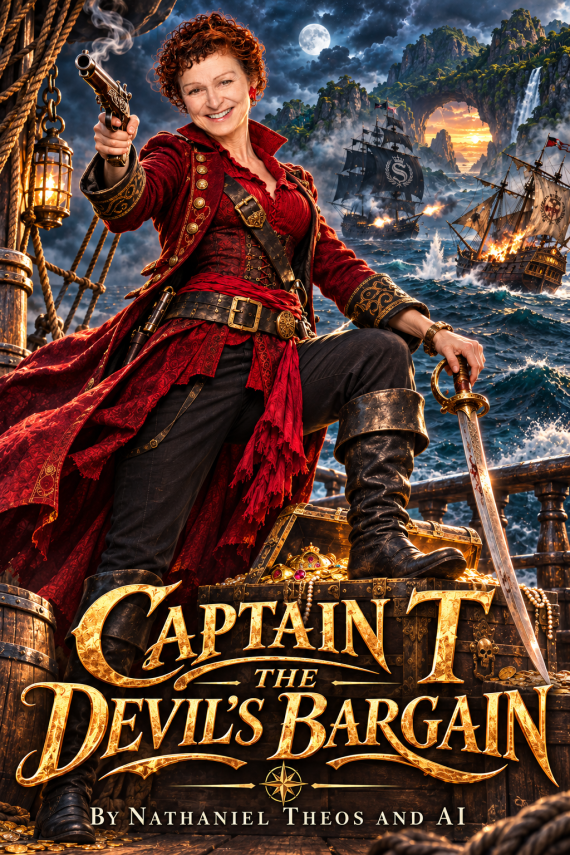
Captain T: The Devil’s Bargain
By Nathaniel Theos and AI
Chapter One: A Pirate’s Price
Captain T had always considered diplomacy a tiresome business, particularly when it involved people who insisted upon keeping their money. Saint Aurelia, at least, offered compensation for the inconvenience. The neutral island had excellent anchorage, a governor who asked remarkably few questions and three taverns whose proprietors understood that a good bottle of rum was worth more than a sermon. From the quarterdeck of the Intrepid, she surveyed its crowded waterfront with the affection ordinarily reserved for a promising victim.
“How much are we asking?” Sheila inquired.
“Seventy-five thousand crowns.”
“You said fifty thousand yesterday.”
“That was yesterday.”
“What changed?”
“I woke up.”
Sheila lowered the glass she had trained on the eastern anchorage. The American warship Victory rested there, her guns housed and her white fighting colours moving in the morning breeze. “Admiral Harland will never agree.”
“Then she may watch me sell the papers to a woman who appreciates the value of a good scandal.” Captain T studied the ship. “Bloody woman. Does she follow me everywhere?”
“She invited us.”
“That is no excuse for arriving first.”
The captain stood scarcely five feet tall, but her red sash, black fighting coat and pair of pistols gave her the presence of a much larger and more disagreeable person. Short brown curls escaped her bandana. Her sword had a gilded hilt that was entirely unnecessary for cutting anyone and therefore essential to her enjoyment of it. She had spent much of her life robbing ships and was disturbed to discover that recent events had inspired rumours of reform. Releasing the men taken at Spanish Town and rescuing prisoners from a Portuguese transport had apparently convinced certain simple souls that she intended to become respectable. She had no such intention.
The Intrepid herself bore reminders of those choices. The planks along her starboard quarter were newer than their neighbours, and two places at the mess table would never again be filled. Beatrice, a gunner whose leg had been crushed during the last battle, now walked with a stick. Captain T had extended her wages and paid for treatment, which the purser insisted on describing as a charitable expense. The captain insisted it was the proper cost of having a crew worth keeping.
“Signal the harbour master,” she said. “Tell him we intend to behave ourselves.”
“For how long?”
“Until someone provides a good reason not to.”
Commander Gabriel Ardent boarded at noon with an invitation and four marines. He looked healthier than he had when Captain T first discovered him disguised among the prisoners at Spanish Town, although she considered his naval uniform an unfortunate improvement. “Admiral Harland requests your presence at the governor’s residence. Safe conduct is guaranteed for the meeting.”
“Requests? How civilized. Does the guarantee cover the journey back?”
“Yes.”
“Pity. I was hoping for a little excitement.”
“You must surrender your weapons at the door.”
“All of them?”
“Yes.”
“Commander, a woman must maintain certain standards.”
Gabriel glanced at the two pistols and the sword. “Those are substantial standards.”
“And merely the visible ones.”
At the governor’s residence Captain T surrendered the sword and pistols. The small knife inside her left boot remained where it was. Admiral Catherine Harland waited in a drawing room overlooking the harbour, her expression as severe as her blue uniform. Captain T accepted coffee, tasted it and asked whether the house possessed rum. Harland said it was noon. Captain T observed that noon was as fine an hour as any to begin.
“The original Meridian Exchange Consortium ledgers,” Harland said, ignoring the exchange. “I want them, Captain. The copies you sent establish routes and payments, but the originals will help us prove who ordered the transfers.”
“Seventy-five thousand crowns.”
“That is outrageous.”
“Thank you.”
“It was not a compliment.”
“I shall accept it anyway.”
“These are records of crimes against humanity.”
“Precisely. Rare documents. Very valuable.”
Harland’s patience thinned. “You intend to profit from human suffering.”
Captain T’s smile disappeared. “I intend to profit from the bastards who caused it. There is a distinction, Admiral.”
Harland held her gaze. The admiral was not inclined to forgive what Captain T had once done for money, and Captain T had no appetite for being forgiven. They had begun to understand each other in precisely that uncomfortable fashion.
Gabriel opened a chart between them. “The records point to a Meridian treasury vessel, the Santa Esperança. Her cargo will finance the rebuilding of Commodore Irena Sable’s Black Fleet. We believe its value may approach half a million crowns, including securities that cannot be readily spent.”
Captain T set her cup down very carefully. “Commander, you have my undivided attention.”
“We intend to intercept her,” Harland said. “You are not being invited to steal her cargo.”
“Of course not. You are a respectable admiral, and I am a terrible influence.”
Harland would not authorize piracy. Captain T would not promise to abandon it. Their negotiations produced a narrower arrangement. For three days beginning on the sixth day after the meeting, the Victory would patrol the deep eastern approaches to Santa Isidora, an island on the convoy’s likely route. If Captain T obtained credible evidence of unlawful prisoners, she could send it to the admiral, who would determine whether an inspection or rescue was warranted. Gabriel supplied a recognition signal. Harland granted neither amnesty nor rights to any captured treasure.
At the door Harland caught the pirate’s sleeve. “If you use my ship as cover for a robbery, I shall arrest you.”
“If I do, Admiral, I shall endeavour to make it a good one.”
Chapter Two: The Fortune Nobody Owns
The first thing Captain T did after returning aboard was call a meeting. The second was to discover that someone had been drinking her rum. Sheila reminded her that she had personally given two bottles to the surgeon. Captain T maintained that her generosity had been exploited and demanded that the surgeon be informed of the gravity of the offence. Sheila promised to mention it whenever the surgeon had finished saving lives.
By evening the officers were crowded around the chart table. Paula, the second mate, had verified that the Santa Esperança was sailing with two frigates and two smaller escorts. The treasury vessel herself had carried guns in previous voyages, although nobody had yet established how many. Santa Isidora lay across her likely route, its deep northern approaches bordered by shoals and passages that changed with the tide.
“Half a million crowns,” Captain T repeated, savouring the words. “A fine ship, new guns, proper wages and a house with a cellar large enough to frighten the clergy.”
“For treasure?” Sheila asked.
“Rum. Try to maintain a sensible order of priorities.”
Martha arrived carrying her clay pipe and the expression of a woman who had come prepared to argue. Nine years aboard the Intrepid had cost her part of an ear and more friends than she cared to count. “Another rescue?” she asked.
Captain T looked wounded. “Martha, I am deeply offended.”
“Prisoners?”
“Not that we know.”
“Children?”
“No.”
“Then what?”
“Gold.”
Martha’s face brightened. “Actual gold?”
“Unless the Portuguese have perfected the art of filling treasure chests with disappointment.”
The captain explained the proposed attack and the risks. She made the crew’s articles explicit: prize money would be distributed after essential provisions, repairs and care for the wounded; any deliberate deviation from the agreed expedition would require consultation with the officers and section leaders. Martha listened until the end before asking the question everyone expected.
“And if you discover someone in a cage?”
“Then we discuss it before I change the bargain.”
“Before turning toward gunfire?”
“Yes.”
“Before spending our shares on strangers?”
“Yes, Martha. Though you make it sound rather like a shopping trip.”
Martha extended her hand. “Then I’ll sail with you.”
The decision restored some of the trust strained since Spanish Town. It did not erase their dead or make the next battle harmless. Captain T knew that Martha’s friendship was worth far more than blind obedience, and was sufficiently wise not to say so aloud.
A little later Isabel Rook arrived with the supply accounts. She had joined at Sanctuary Cove as a purser’s assistant, had a neat hand, a quiet manner and an ability to discover errors that made the captain feel almost affectionate. Today she had recovered three hundred and forty crowns charged twice for sailcloth.
“Isabel,” Captain T declared, “you are becoming my favourite person.”
“I thought Sheila held that position.”
“Sheila is expensive and argumentative. You bring me money.”
“An enviable distinction,” Sheila murmured.
Isabel smiled, took her corrected ledger and departed. Outside the door she paused long enough to hear Paula mention the signal book, then went below. Nobody saw her slip a folded scrap of paper between two columns of figures.
That same night Paula found a signal lens recently polished without authorization. A coil of fine cord was missing and a spare boat had been moved and returned with unfamiliar knots. Once those details might have seemed merely careless. After Harriet Dorne had betrayed the Intrepid at Devil’s Passage, Paula trusted such coincidences considerably less.
She started a list of people with access to the aft stores. By morning it contained twenty-three names. Isabel was among them, but so were officers and sailors Paula had trusted for years. She made no accusation. Suspicion was easy. Proof was more useful.
The ship left Saint Aurelia at dawn. The crew cheered when Captain T announced that they were bound for the richest prize of their careers. Martha told the women not to spend their shares until they had stolen them. Captain T called her a dreadful influence on morale. Then she ordered the guns checked once more, because riches were always more enjoyable when one lived long enough to count them.
Chapter Three: A Rat in the Hold
Three days at sea brought steady trade winds, clear horizons and a collection of increasingly troubling accidents. A replacement gun carriage was discovered with a retaining pin weakened by deliberate filing. A reserve cask contained salt water. A sounding on the ship’s working chart had been altered, showing safe depth where the southern reef would tear out a keel.
Martha examined the pin beneath a lantern. “Whoever cut this knew the gun. When she recoiled, the carriage could jump the tackle and kill the women behind it.”
“Your people?” Paula asked.
“Someone with access. Don’t accuse a gunner simply because she knows where the dangerous parts are.”
“Agreed.”
Martha gave Paula a long look. They had not always agreed about the captain. It was a start.
Rumours had spread almost as quickly as the damage. Someone claimed Harland had promised Captain T a pardon in return for handing the ship over to the Americans. Another insisted the crew’s shares would be confiscated. A third swore that the captain intended to abandon piracy and become a merchant. Captain T found the last claim particularly insulting.
“Harland wouldn’t pardon me if I saved her mother from drowning,” she told Martha. “She’d arrest me for stealing the rope.”
Martha nearly smiled. “Someone is using the rumours to turn the crews against you.”
“Then find out who. But no woman is to be condemned because she has the good sense to question my judgement.”
The purser’s ledger offered little help at first. A page containing repair charges had been neatly cut from its binding. Isabel reported the loss herself, offering to search the original invoices. Beatrice, still limping painfully, told Paula that Isabel had spoken kindly in the galley when rumours arose about surrender to the Americans. It was impossible to tell whether the assistant had repeated the gossip or tried to stop it.
Paula laid a false sailing instruction in the purser’s office. It described an intended rendezvous in the southern channel near Santa Isidora, where the Intrepid would supposedly wait for a suitable tide. Only Paula and Sheila knew it was false. That night Paula saw a shuttered lantern flash three times from the aft deck. The sender vanished before she reached the station, leaving the lamp warm in its bracket.
“Excellent,” Captain T said when Paula reported it.
“Someone is selling our course, Captain.”
“And now they have sold one we do not intend to take.”
“Unless they know the order was false,” Sheila said.
“Then our enemy is more entertaining than I hoped.”
The following morning the missing ledger page reappeared. It was expertly copied but written on a newer sheet, and one invoice referred to a gun carriage repair that had never taken place. At the bottom was Isabel Rook’s signature. Paula compared it with the anonymous note discovered after Sanctuary Cove. The writing was not identical, but the long tail of one letter and the peculiar crossed strokes of another were too familiar to ignore.
It was still not enough. Isabel handled the books for a living. Her handwriting belonged on invoices. Paula needed to catch the sender with something no innocent purser’s assistant could explain.
She arranged a second watch, placed two trusted sailors where they could see the aft stores, and continued treating Isabel as if nothing had changed. Isabel continued to be helpful. She recovered a payment owed by a chandlery, carried water to Beatrice and offered to check the gun crews’ accounts for missing shares. Paula disliked how little she wanted the evidence to be true.
A day later a fishing boat approached under a neutral flag. Its pilot had watched the Portuguese convoy pass eastward and confirmed that the treasury ship was heavily armed. The information should have delighted the captain. Instead Paula noticed Isabel standing near the rail, her eyes fixed on the pilot’s signal lantern. When the boat left, the purser’s assistant returned below without waiting to hear the officers’ discussion.
Paula followed at a distance. Behind the aft stores Isabel paused by the rope locker, found the corridor empty and touched a concealed seam in the panelling. She did not open it. She was checking whether someone else had.
That was the moment Paula decided to stay awake until the woman made a mistake.
Chapter Four: The Devil’s Invitation
Commodore Irena Sable had learned from Devil’s Passage. She had studied the lost frigates, the tidal tables, the channels and the exact point at which Captain T had persuaded her pursuers to follow a course they could not hold. She did not think of the pirate as lucky. Luck might explain one escape. It did not explain several.
Aboard the Dominion, Sable examined a coded report delivered by her intelligence officer. The Intrepid allegedly intended to approach the southern channel at Santa Isidora. Sable made no move to deploy there.
“Captain T knows those reefs,” she said. “If she sent us this course, she either believes we will miss the signal or wants us to see it.”
“Shall we disregard it?”
“No. We shall plan for both possibilities.” Sable put a finger on the western coast. “Find every passage omitted from the ordinary charts. If she intends to deceive us, I would rather be deceived from a position of strength.”
The treasury convoy appeared on the Intrepid’s horizon two mornings later. Five ships spread across the eastern sky. The Santa Esperança rode deep beneath an ostentatiously decorated stern, with two frigates watching her flanks and smaller escorts ahead and astern.
“Beautiful,” Captain T said. “A fortune surrounded by an unreasonable number of people who would rather we didn’t take it.”
Paula noted the spacing between the frigates. “They’ve left enough room for us to slip between their line and the merchantman.”
“How obliging.”
“Too obliging,” Sheila said.
The Intrepid approached under Portuguese colours. Paula used codes captured from the Santa Misericórdia and received a routine acknowledgement. The escort then demanded the captain’s name.
“Mariana Vale,” Captain T said.
“The Portuguese captain you pretended to be last time?” Sheila asked.
“A good name deserves another outing.”
The reply came quickly: Captain Vale is dead.
“Well,” Captain T said, “that is inconvenient.”
She ordered the pirate flag raised and the gunports opened. The first enemy warning shot fell ahead of them. Martha’s guns answered with chain shot that damaged the nearest escort’s foreyard. The Intrepid turned toward the treasury vessel, using the slowed escort to obstruct the frigate behind her.
Then the Santa Esperança opened concealed gunports. Twenty guns appeared along her side, and their broadside tore through the pirate’s forward rail and destroyed a boat suspended over the waist. Two sailors fell wounded. Captain T winced when a returning shot destroyed part of the merchantman’s ornate stern gallery.
“Careful with the decoration,” she told the gunners. “We may wish to sell it.”
“Captain, they’re shooting at us!” Sheila protested.
“I had noticed.”
The convoy’s manoeuvre became clear as the frigates spread wider. They left an opening toward the treasury ship, inviting the Intrepid to enter before converging on her flanks. It was exactly the sort of opportunity Captain T would ordinarily have seized.
She lowered her glass. “Our dear commodore has developed an imagination.”
“What does that mean?” Sheila asked.
“It means she expects us to take the opening.”
“And?”
“We shall disappoint her.”
Captain T ordered a last broadside into the escort’s rigging and turned west, shortening sail just long enough to clear the enemy’s guns before making speed. Martha came up from the gun deck furious that they were withdrawing from a fortune.
“Would you rather half a million crowns tomorrow,” the captain asked, “or a handsome funeral today?”
“Tomorrow.”
“An excellent choice.”
From the Dominion, Sable watched the Intrepid turn away. Her officer called it a successful defence. Sable did not. “She has seen the trap,” she said. “Now she will change her plan. Find out how before she returns.”
Neither captain was pleased to have met the other. Both were pleased to know their enemy remained worth defeating.
Chapter Five: Forty Guns and a Bad Idea
The Intrepid sailed beyond the convoy’s sight before Captain T gathered her officers. Three sailors were wounded, her forward boat was gone, and the repaired ship had accumulated fresh damage. The gun crews could still fight. The captain considered that the most encouraging item in Paula’s report.
She opened an old chart of Santa Isidora. A hidden western passage cut between the outer shoals and the island’s cliffs, passable for a ship of the Intrepid’s draft only near high water. She knew it because years earlier she had spent six miserable weeks on the island after a disagreement involving a customs official, the official’s husband and a chest of emeralds. Sheila declined to request further details.
“If Sable expects the southern channel,” Captain T said, “we approach from the west. If she expects the west, we look north.”
“That’s not a plan,” Martha said.
“It’s the beginning of one. You must learn to enjoy the suspense.”
Paula recommended scouting the western passage rather than trusting an old chart. Two of Martha’s experienced women took a cutter near dusk with leadline and compass. They returned with soundings, information about the current and an exhausted Portuguese dispatch sailor rescued from wreckage near the outer reef. His small vessel had foundered, and he had seen enough of the convoy before its loss to describe the Santa Esperança’s lower compartments.
“There are boys aboard,” he told Paula through a dry throat. “Forty-three. The guards won’t allow them above without orders. The youngest are children.”
He described the barred hatch, the guards, the tally of prisoners and the expected destination. Some details matched entries in the stolen Meridian ledgers. Others could not be independently established. Paula told the captain precisely what was known and what remained uncertain.
Captain T stood at the cabin window a long while before turning back. “Sheila, I’ve spent three perfectly miserable days planning to steal that gold. Now some heartless bastard has complicated matters with children. I’m beginning to take this personally.”
“Could be bait,” Martha warned.
“Then we plan for bait. If the boys are there, we bring them out.”
“And the gold?”
“We take that too.”
“Those are objectives, Captain, not a plan.”
“Why does everyone insist on depriving me of the pleasure of arriving at the interesting part?”
They worked until late. Sheila proposed a boarding party trained specifically to secure the prisoner hatch. Martha would disable the treasury ship’s rigging without firing into the lower compartments. Paula would manoeuvre the Intrepid so the escort could not safely fire through the merchantman. A fast cutter would carry the Portuguese sailor’s sworn statement to the Victory, already scheduled to patrol east of Santa Isidora. Gabriel would be able to question the witness and Harland would have evidence upon which to make her own decision.
Captain T refused to promise that Harland would help steal the treasure. She had no reason to believe the admiral would. But an American inspection demand might split the escorts, and a divided escort was a very generous gift to a pirate.
Martha insisted on a vote. She reminded the section leaders of the seventeen women lost at Spanish Town and the two killed near the Portuguese convoy. A treasure was worth risking a ship for only if the crew understood the wager. The officers voted narrowly to authorize one coordinated attempt. If the Intrepid faced destruction or the prisoners could not be brought out without massacre, she would withdraw. The captured prize, after the deductions allowed by their articles, would belong to the crew according to shares.
The captain accepted the terms. Martha held out her hand. “Then we have a bargain.”
“A devil’s bargain, perhaps.”
“Those are usually your favourite kind.”
After the meeting Captain T stood beside the rail and watched the cutter pull away toward the American patrol station. She had told the crew the truth about the risks. She had not told them how much she hated the thought of returning without the gold. Martha joined her with two cups of weak tea, which the captain viewed as a personal insult.
“Have you come to remind me of our dead?” Captain T asked.
“No. You remember them.”
They watched the cutter until it disappeared in the gathering dusk. The gunner spoke again. “You needn’t choose between being a pirate and being the woman those boys might need.”
Captain T regarded her with alarm. “Martha, if you’re developing a taste for philosophy, I shall have to replace you.”
“Then replace me after we steal the gold.”
“That,” said Captain T, “is the first sensible thing you’ve said all evening.”
Chapter Six: The Price of Betrayal
The ledger page had been replaced so carefully that Paula might have overlooked it had she not known what to seek. The ruling was slightly different, the paper newer and the repair entry included a purchase that had never been made. The signature belonged to Isabel Rook. A comparison with the anonymous note showed several distinctive letter forms, and a scrap of the same unusual paper remained in the aft locker.
Still Paula refused to convict a woman by handwriting alone. She set two trustworthy sailors to watch the locker and waited. Shortly before the third bell Isabel entered the aft stores with a covered lantern. When she lifted the false panel behind a coil of rope, Paula stepped into the doorway.
“Evening, Isabel.”
The assistant froze. The panel concealed a shuttered lamp, coded messages and a purse of Portuguese coins stamped with a merchant mark that appeared in the Meridian ledgers.
“You have no proof,” Isabel said.
Paula glanced at the compartment. “Enough to begin with.”
Isabel threw the covered lantern at her and lunged for the passage. A sailor caught her coat. Isabel slashed the woman’s arm with a knife before Paula struck her wrist with the butt of her pistol. The knife fell and the two guards forced her to the deck. The scuffle lasted only seconds, but Paula felt ashamed at how relieved she was that nobody had been killed.
Captain T examined the seized papers in her cabin. One message directed Isabel to weaken a gun carriage, spoil the water supply and ignite a fine priming charge near the aft magazine when the Intrepid entered the southern reef channel. Another reported Sable’s discovery of the western passage. The commodore intended to wait for the pirate outside it, with enough depth to fight and too little room to escape.
“You were prepared to murder the women who fed you,” Captain T said.
Isabel met her stare. “Meridian owns ports and magistrates. It can buy fleets. You cannot defeat it.”
“My dear, I do not intend to defeat it.” Captain T leaned forward. “I intend to rob it until the bastards find honest work more attractive.”
Isabel tried to smile but failed. “Sable knows your tricks.”
“Then she and I have something in common.”
Under the crew’s articles, deliberate betrayal in the service of an enemy could carry a death sentence. Captain T ordered Isabel confined, unharmed, pending a hearing after the immediate danger passed. She would not let the traitor escape merely because she might prove useful, nor would she execute her without the process the crew had established for itself.
Paula spread the captured codes across the table. “Sable has already learned about the western passage.”
“Then give her confirmation,” Captain T said.
“Confirmation?”
“Send Isabel’s next message. Tell her commodore we’re coming through the west at the turn of the tide.”
Sheila studied the chart. “And where are we actually going?”
“Around the northern headland, in deep water. The longer route, but the one our good commodore will think too obvious for us.”
Sable was not foolish. She might suspect the false message. Captain T’s real advantage was not that her rival would swallow a lie unquestioningly, but that Sable had to distribute limited ships against multiple possibilities while also protecting the treasury. The pirate intended to make every choice cost her something.
The captured signal went out from the aft deck under Paula’s supervision. Isabel remained below in irons with two guards. Later that night Paula learned that the Dominion was indeed moving toward the western passage. She did not mistake the news for proof that Sable had been fooled completely.
Captain T called the officers together one last time. “We know Sable is capable, armed and furious. We also know she cannot place every frigate in every channel. We’ll take the deep water north of the island, come down on the treasury’s likely escape course, and leave the Americans to conduct whatever frightful exercise they call lawful inspection.”
“What if Harland doesn’t engage?” Martha asked.
“Then we withdraw if the escorts remain together. I am greedy, Martha, not suicidal.”
Sheila raised an eyebrow. “Debatable.”
“An occasional distinction is enough.”
Chapter Seven: The Devil Collects
The Intrepid sailed beneath a moonless sky, carrying enough canvas to maintain steerage without displaying herself to every lookout near Santa Isidora. Paula had confirmed their position that afternoon from soundings and two headland bearings. They now held to deep water beyond the outer shoals, where the strong current moved them south but could not push them onto the reefs if the helm was handled properly.
Farther south, Commodore Sable waited aboard the Dominion. The final signal from her agent confirmed a western approach, but she did not rely on it alone. She sent a smaller escort to scout the northern waters and ordered another to guard the southern passage. Every vessel committed to searching for the pirate was one less guarding the Santa Esperança. Sable understood the price and paid it reluctantly.
The Intrepid‘s own cutter had reached the Victory the previous afternoon. Gabriel took the rescued sailor’s statement, checked it against the copied Meridian documents and presented the evidence to Harland. The admiral had already been assigned to the eastern patrol station under their Saint Aurelia arrangement. She now had reasonable grounds to demand inspection of the treasury convoy, though none to join Captain T’s robbery.
Just before midnight, flashes illuminated the eastern horizon. The Victory had intercepted the convoy and demanded inspection. A Portuguese escort fired first across the American bow, then fired upon the Victory when Harland repeated her demand. The American guns answered, dismasting the escort. The second frigate turned to defend her companion while the heavily laden treasury vessel fled north with one smaller escort.
Captain T watched the gun flashes with professional interest. “Apparently our admiral has begun her negotiations.”
The Santa Esperança appeared against the stars an hour later. Paula steered the Intrepid across her stern quarter, taking advantage of the merchantman’s sluggish turn under heavy canvas. The smaller escort held to starboard, too far away to intervene immediately but close enough to punish any delay.
“Boarding parties ready,” Sheila reported.
“Guns?”
“Ready,” Martha answered.
“Then let us take our fortune before someone develops a legal objection.”
The pirate flag climbed the mast. The merchantman fired first, splintering the Intrepid‘s forward rail. Martha waited until the range closed before ordering chain shot into the upper rigging. The treasury vessel’s foretopmast snapped and her loose canvas fouled the deck. Paula brought the Intrepid under the crippled ship’s stern quarter, where fewer guns could bear.
Hooks flew. The hulls ground together. Captain T crossed first, landing among armed sailors and striking an officer beneath the chin with the pommel of her sword. “Good evening. Terribly sorry. We appear to have arrived without an invitation.”
Sheila’s boarding party secured the main hatch while Martha’s sailors kept the merchant guns silent. The treasury captain appeared carrying a pistol and threatened to kill the prisoners if the pirates advanced. Captain T shot her in the upper arm before she could fire and put a blade against her throat.
“Keys,” Captain T said.
“You’re a pirate.”
“An observant woman. Unfortunately, not an intelligent one.”
Below were forty-three boys, held behind grated doors in the forward compartments, away from the magazine and treasury. Some could barely stand. Others stared at their rescuers as if waiting for the price to be announced. Captain T crouched beside a boy named Lucien, perhaps twelve, who held an older child’s hand.
“Are you going to sell us?” he asked.
She remembered Thomas, who had helped save her sailors even while she intended to sell him. She remembered his request to live where nobody could sell his name. “No.”
“Why?”
“Because I’ve already stolen you, and I refuse to let those bastards make another profit.”
Lucien smiled, cautious and unbelieving. Captain T ordered Sheila to move the boys in small groups, two sailors assisting each across the narrow gap between ships. Water went first, then blankets. No child was to be hurried for the sake of treasure.
Martha met her at the hatch. “Found the gold?”
“Not yet.”
“Prisoners?”
“Forty-three.”
“Alive?”
“Yes.”
“Good. Might as well take both.”
The treasury was beneath the afterhold. Twenty-four reinforced chests held mixed gold coin, silver bars and stones. An iron cabinet contained securities, account books and sealed drafts whose value depended on the solvency of the very houses the pirates were attacking. Captain T admired the chests. Sheila emptied the iron cabinet into two canvas document bags and sent them aboard before the heavier cargo moved. The captain knew better than to pay the crew in promises written by enemies, but the papers might prove worth a fortune in other ways.
Martha rigged the cargo hoist to move the heavy chests in slings. A sailor aboard the Intrepid tallied each one as it crossed. Four, eight, twelve. The boys were transferred by a separate protected route, and the surgeon received them below. By the sixteenth chest Paula signalled that an enemy frigate was closing from the east.
The Dominion had arrived. Sable’s scouts had found the pirate’s wake north of the island, and the commodore had abandoned her western station in time to intercept the robbery. She had not swallowed the false signal blindly. She had reacted to new evidence, and that was why she remained so dangerous.
“Two more chests,” Captain T ordered, then saw the Dominion preparing her guns. The additional minutes would be fatal. “No. Cut the grapples. Everyone back aboard.”
“Eight chests remain!” Martha protested.
“I can count, Martha!”
“Then why are we leaving them?”
“Because dead pirates spend very little gold!”
The Intrepid drew away with sixteen chests and all forty-three boys. The treasury vessel, dismasted but afloat, drifted toward the main channel. Sable approached from windward, positioned to cut off the pirate’s northern escape. Her officers believed the Intrepid had no choice but to run before their guns.
Captain T instead turned back toward the merchantman’s stern. “Paula, bring us close along her lee side, but keep clear of the wreckage.”
“She has almost no steerage.”
“Precisely. Sable needs that treasury intact. Let us see how badly.”
On the Dominion, Sable understood the tactic immediately. A broadside risked striking the merchantman and the remaining fortune. She ordered her forward guns to aim at the pirate’s rigging and held the main battery. It was a disciplined choice. Captain T had not tricked her into stupidity; she had forced her to defend two competing objectives.
The Intrepid passed behind the treasury ship, briefly masked from the frigate’s heavier guns. Paula put the helm over as the pirate came clear. For a few seconds her stern battery bore upon the Dominion‘s foretopmast and its supporting stays.
“Martha! Chain shot!”
The stern guns fired. A chain tore through canvas and rigging. A yard fell, fouling the frigate’s turn. Sable immediately ordered the wreckage cut away and her remaining sails trimmed to preserve steerage. The Dominion was hurt, not beaten, but the manoeuvre had cost the time she needed to intercept the Intrepid.
Then the Victory appeared through the thinning gun smoke. Harland had followed the treasury vessel after disabling its escorts. She signalled Sable to stand off and prepared her guns when the Dominion began to turn toward the American ship. Sable could pursue the pirate only by exposing her damaged frigate to Harland’s broadside and abandoning the treasury she had been charged to protect.
“Cease pursuit,” she ordered.
Her officer stared. “Commodore?”
“Secure the treasury. Signal the escorts to withdraw beyond the reefs.”
“And the pirate?”
“Has escaped. This time.”
Sable watched the Intrepid grow smaller against the dark horizon. She had recognized the pirate’s intentions and nearly stopped her. She had also preserved the Dominion and the eight remaining treasure chests. The result was not a disaster. It was a defeat she could understand, which made it far more difficult to endure.
“Record the damage to her rigging,” she said. “Her sail plan. The positions of her guns. Every alteration since Devil’s Passage.”
“Will we meet her again?”
Sable lowered her glass. “Count on it.”
Aboard the Intrepid, Martha watched the frigate turn away. “We beat her.”
“We inconvenienced her,” Captain T said.
“We took the gold.”
“Some of it.”
“And the boys.”
“All of them.”
“Then I call that a victory.”
Captain T looked toward the darkening sea. The commodore would return. She was far too capable to make the same mistake twice, and Captain T found the prospect both troubling and strangely exhilarating. “A victory, yes. Now find out who’s been drinking my rum while I’ve been busy earning it.”
Chapter Eight: A Pirate’s Honour
Six days later the Intrepid returned to Saint Aurelia beneath a sky washed clear by morning rain. Her sails were patched, her forward rail was scarred and sixteen chests lay under guard in the afterhold. The forty-three boys had slept, eaten and gradually begun to believe that nobody was coming below to auction them. Some remained silent. Captain T did not require gratitude from any of them.
Gabriel came aboard from the Victory to arrange their reception ashore. The governor had authorized temporary lodging in a former merchant storehouse under neutral protection. American officers would provide escorts and help record each boy’s name, chosen destination and any family details he remembered. Thomas, still in Virginia, had established a network for freed men that could assist with searching records and tracing families after the boys were safely placed. He was not magically at the harbour awaiting them, and neither the governor nor the admiral pretended that finding families would be quick.
Lucien was among the last to leave. At the gangway he looked back toward Captain T. She expected another question, perhaps another request for proof that the promise would hold. Instead he lifted one hand in a shy farewell. She returned the gesture, then turned away before Sheila could see her expression.
Admiral Harland arrived with a formal protest and enough marines to make the visit discourteous. She accused Captain T of using an American intervention as cover for piracy and demanded that the treasury be held as evidence.
“I stole sixteen chests,” Captain T replied. “You may investigate the eight that Sable kept, if you can persuade her to share.”
“Those funds were intended for the Black Fleet.”
“Then I have done your navy a considerable service.”
“You have committed piracy.”
“Admiral, I’m beginning to think you don’t like my profession.”
Harland would not recognize the pirate’s title to the gold. Captain T would not hand it over. Their safe-conduct agreement had ended, and the governor had no appetite for allowing a battle between two heavily armed ships inside his neutral port. Harland knew that seizing the Intrepid there could start a larger dispute. Captain T knew that the protection of neutrality would not save her once she sailed. Neither woman got everything she wanted.
They reached a separate agreement about the evidence. The originals of the captured financial papers would be examined by Gabriel and certified copies made under the watch of both sides. Captain T retained the chests, which contained spendable valuables rather than merely promises that Meridian bankers might refuse to honour. Harland secured names, shipping instructions and financial records that could support an investigation without purchasing them outright at the captain’s absurd asking price.
“You could help us dismantle Meridian,” Harland said when the papers were sealed.
“Admiral, I am a pirate. I steal, drink rum, insult officials and occasionally shoot people who annoy me. I have no wish to join your navy.”
“No one has invited you.”
“Good. I’d be dreadful at obeying orders.”
“On that,” Harland said, “we agree.”
Isabel’s hearing took place that afternoon. Paula produced the communications, the altered ledger and the sabotage instructions. Beatrice attended with her walking stick, and Martha questioned the prisoner about the damaged gun carriage. Isabel admitted reporting to Meridian but claimed she never intended the magazine charge to kill anyone. The evidence contradicted her. Under the articles, the officers found her guilty of treachery carrying the penalty of death.
Captain T did not declare an automatic pardon. She proposed suspending the sentence while Isabel gave testimony useful for protecting the crew from Meridian’s agents. The articles allowed such a suspension by vote of the officers. Martha insisted that the terms be written and that Isabel’s cooperation be tested before transfer. The motion passed narrowly. Gabriel accepted Isabel into American custody under guard for interrogation and legal proceedings, without promising immunity. Captain T remained neither forgiving nor pleased.
By evening the purser and Martha had completed the accounting. The sixteen captured chests had been opened in front of witnesses. Coins were counted by denomination, silver weighed and gems set aside for later appraisal. Repairs, provisions, compensation for the wounded and payments owed to the families of those killed were entered before the distributable prize was calculated. No woman was asked to accept a Meridian promissory note in place of her share.
The crew gathered on the quarterdeck while the last sun touched the harbour roofs. Martha held the articles and Sheila the ledger. Captain T took the centre of the deck in her black coat and red sash, looking thoroughly pleased with herself.
“Ladies,” she began, “we set out to steal a fortune. We were shot at, deceived, betrayed and forced to endure the company of an American admiral. Yet here we stand, wealthier than we were and considerably more difficult to kill.”
Laughter moved through the crew.
“The accounts are settled under our articles. The wounded are provided for, the families of our dead will be paid, and your shares are waiting. If anyone wishes to complain about her portion, please address Martha. She has volunteered to explain the arithmetic with a cannon.”
Martha raised her cup. “To the Intrepid!”
“To the Intrepid!” the crew shouted.
Captain T lifted her own cup. “To the women who keep her afloat, and to the miserable bastards who paid for our next voyage!”
The cheering rolled across the anchorage. Captain T drank and smiled. She had kept her bargain with the crew, made a fortune and avoided being hanged. It seemed a thoroughly satisfactory outcome.
Later Sheila joined her at the rail. Beyond the harbour mouth, the Victory lay at anchor. Harland had obtained her evidence. Gabriel had helped the boys find safety. Sable remained somewhere at sea with eight treasure chests and a score to settle.
“Thinking of retirement?” Sheila asked.
“If you suggest it again, I shall have you flogged.”
“I’ll make a note.”
“There’s a Spanish galleon expected near the Windward Islands next month.”
“How much?”
“Three hundred thousand crowns.”
“Escorts?”
“Four frigates.”
“Prisoners?”
“Not a bloody one.”
“Are you certain?”
“Not remotely.”
Sheila shook her head. “One day you’re going to get us all killed.”
Captain T placed an arm around her shoulders. “Perhaps. But not today.”
They stood together until the lamps began appearing along the waterfront. The crew laughed below, the surgeon fussed over a sailor’s bandage, and the Intrepid rested at anchor with her holds full of stolen treasure. Captain T felt, for one blessed moment, almost content.
Then she remembered something.
“Sheila.”
“Yes, Captain?”
“Where is my rum?”
“The surgeon has it.”
“Again?”
“Yes.”
Captain T drew her sword. “THEN FETCH THE BLOODY SURGEON!”
The crew erupted in laughter, and somewhere beyond Saint Aurelia another unfortunate merchant vessel sailed unsuspectingly toward its destiny.
THE END
AUTHORSHIP & AI ACKNOWLEDGEMENT
Captain T: The Devil’s Bargain is a work of fiction presented by Nathaniel Theos and AI. The author directed the story concept, character development, creative decisions and revisions. Artificial intelligence assisted with development, drafting, editing and proofreading. The manuscript remains subject to the author’s final review and approval.