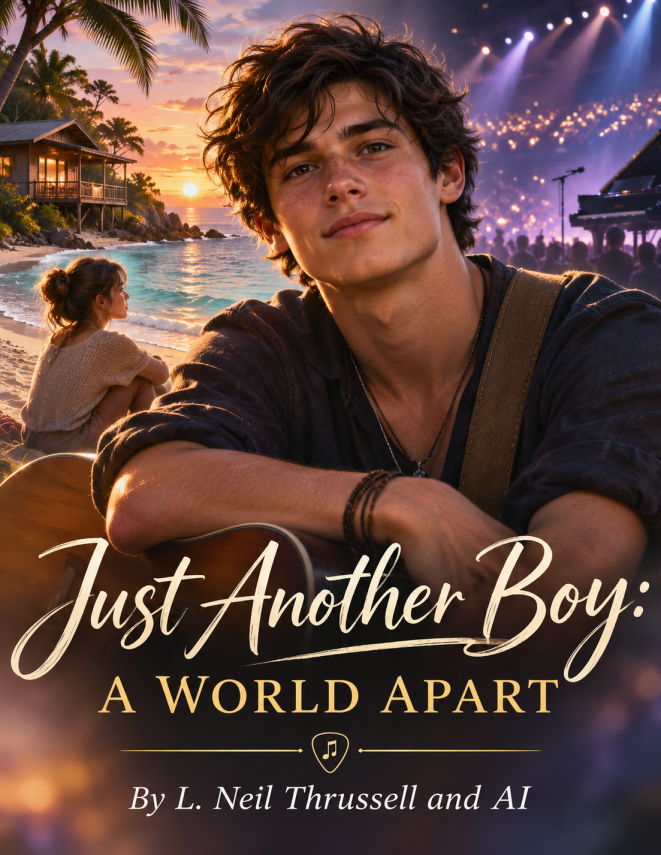
Just Another Boy: A World Apart
By L. Neil Thrussell and AI
Chapter One: The Promise
Kathy MacDonald had discovered something peculiar about falling in love with a famous musician. Most of the time, she forgot he was famous.
Jarrah Brown, known to the rest of the world as Jarrah Williams, was sitting cross-legged on her parents’ living room carpet in Stony Plain, arguing with her father about pineapple on pizza.
“You’re confusing dinner with dessert,” Robert MacDonald declared.
“Mate, you haven’t lived until you’ve had a proper Hawaiian pizza.”
“You’re Australian. What would you know about Hawaiian pizza?”
“More than a Canadian who thinks ketchup-flavoured potato chips are a national treasure.”
Susan laughed from the sofa. Kathy watched Jarrah with a smile she made no effort to conceal. They were both sixteen, and the months since they had met had transformed the ordinary geography of her life. School corridors, familiar streets, even the MacDonalds’ kitchen table now held memories that made her happy when she least expected it.
Jarrah could make an arena tremble with a single song. He could also lose an argument about pizza to a man wearing slippers and a Calgary Flames sweatshirt. She loved both truths about him, but she especially loved the boy sitting on the carpet.
David Brown came in carrying his laptop. He was Jarrah’s stepfather and, in Canada, the person who had helped create a life in which the boy could go almost anywhere without being recognized.
“Before everybody gets too comfortable, there’s something we need to discuss.”
Jarrah looked up. “Now?”
“Now. Before the trip.”
Robert set aside his plate. David connected the computer to the television and sat down facing the family.
“Leah and I are delighted you’re coming to Australia. Jarrah’s been talking about it constantly. But there are things you should understand before we leave.”
The first video showed a concert. Thousands of people raised their arms beneath enormous lighting rigs as Jarrah crossed the stage with a guitar. Robert leaned forward, momentarily forgetting the pizza.
“Good grief.”
“Twenty-two thousand that night,” David said.
The next recording showed a hotel entrance. Security personnel struggled to clear a path while fans and photographers crowded toward a waiting vehicle. Jarrah emerged, younger than he looked now, his cap pulled low. Someone pushed a camera inches from his face. A guard placed an arm across his shoulders and hurried him inside.
“How old were you?” Susan asked.
“Fourteen,” Jarrah replied.
A third video showed Jarrah and his mother leaving a restaurant. Photographers called out questions about his private life. One shouted something at Leah, and Jarrah turned toward him before she caught his arm and guided him away.
When David stopped the video, nobody spoke for a while.
“Most of Jarrah’s fans are kind,” David said. “They’re excited about his music, and he enjoys meeting them. But there are people who think being famous means forfeiting the right to have a private life. It only takes a few.”
Robert turned toward Jarrah. “Is that why you came to Canada?”
“Partly. I wanted to go to school, ride my bike, get coffee, do normal things. I didn’t want every conversation to start with someone recognizing me.”
“Well, Stony Plain would do the trick,” Robert said. “We’re more likely to talk about potholes than pop stars.”
Jarrah smiled, though it didn’t quite reach his eyes.
David looked at Kathy and her parents. “If someone discovers where Jarrah has been living, people will begin looking for the house, the school, his friends. And if they discover he and Kathy are together, she’ll be drawn into it. So will you.”
Susan’s hand found Kathy’s. “What would that look like?”
“Photographs outside your home. Questions at school. Strangers trying to contact her friends. Once a connection is made, it’s difficult to put that information away again.”
Jarrah looked at Kathy. “That’s what frightens me. I know what it feels like. You didn’t choose any of it.”
“Neither did you,” she said.
He hesitated, caught by the observation.
David explained the plans. They would travel to Australia, spend several days on the private island Jarrah used as a retreat, and then separate. The MacDonalds would see the country as tourists while Jarrah returned to his professional commitments. They would attend his Brisbane concert through the ordinary public entrance, with no visible connection to his entourage, and reunite later on the island.
“We’ve arranged separate transfers and travel where it matters,” David said. “Not because we can guarantee nobody notices anything, but because we don’t want to give people a reason to connect you.”
Kathy looked at Jarrah. “I agree about keeping things private. But I want a say in how we do it.”
“Of course,” he answered.
“I don’t want us to be ashamed of being together.”
“I’m not ashamed of you,” he said at once.
“I know. That’s not what I’m saying. Privacy should be something we choose together, not something that happens to me.”
Susan nodded. Robert’s expression softened. David leaned back, pleased that Kathy had spoken for herself.
“Then that’s our agreement,” Robert said. “We protect what belongs to the two of you. No one outside the people who already know needs to hear anything about it.”
“Agreed,” Susan said.
“Agreed,” Jarrah replied.
David closed his laptop. “Good. Now perhaps we can return to the important question of what belongs on pizza.”
“Pineapple doesn’t,” Robert said.
“We’re going to have to work on you, mate,” Jarrah replied.
Later, when Jarrah walked Kathy to the front door, she noticed he was quieter than usual.
“Worried about taking me home?” she asked.
“A little.”
“Why?”
“I suppose I’m afraid you’ll see all that and wonder how the boy you know fits into it.”
Kathy slipped her hand into his. “I met you before I knew about the concert crowds. I know which parts of you matter to me.”
“Even the pineapple?”
“I’m still deciding about that.”
He laughed, and the tension eased. When he kissed her goodnight, the porch light caught the edge of his smile. He looked like any boy saying goodbye to a girl he loved. In a few days they would learn how difficult something so simple could become on the other side of the world.
Chapter Two: Welcome Home, Jarrah Williams
The first thing Kathy noticed about Australia was the light. Through the enormous windows at Brisbane International Airport, the sky looked sharper and bluer than the one she’d left behind in Alberta. The second thing she noticed was how quickly Jarrah grew watchful.
During the flight he’d joked with Robert about travel guidebooks and fallen asleep against Kathy’s shoulder. Now he pulled on a baseball cap, checked his phone and exchanged a look with David.
Two men in business clothes waited near the arrivals corridor alongside an airport representative.
“Welcome home, Jarrah,” one of them said.
“Thanks, Michael.”
“Your approved arrival assistance is ready. We’ll take care of the formalities and then move you to the vehicle.”
Jarrah turned to Kathy. “This is where we split up for a bit.”
“Already?”
“Just until we’re somewhere private.”
David explained that Jarrah would complete the required border procedures through coordinated VIP arrangements, while the MacDonalds followed the usual passenger route and left independently. The families wouldn’t meet at the public terminal.
Jarrah squeezed Kathy’s hand. “See you on the island.”
“Don’t let all that attention go to your head.”
“Far too late for that,” he said with a wink.
He followed his security team through an access-controlled corridor. Kathy watched the door swing shut, then joined her parents in the regular arrivals stream. Nobody looked twice at them. They waited their turn, collected their luggage and made their way toward the public concourse.
Robert stopped beneath a towering advertisement.
JARRAH WILLIAMS: LIVE IN BRISBANE.
The image showed Jarrah dressed in black, his guitar over one shoulder, looking straight into the camera. Kathy remembered him sleeping on the plane with his mouth slightly open.
“Well,” Robert said, “there’s our boy.”
Then the shouting began.
Beyond the glass, security had established a short controlled path from another exit to a waiting black SUV. Fans had gathered behind barriers, holding phones and posters. Several were calling Jarrah’s name. He stood among his security officers, smiling as he signed a photograph for a young girl. He leaned toward another fan for a quick selfie, then accepted a marker from a boy holding a guitar.
The boy’s astonished expression made Kathy smile. Jarrah signed the instrument carefully, returned it, and said something that made the boy laugh.
A security officer touched Jarrah’s shoulder. Jarrah nodded, signed one last photograph and waved.
“Thanks for coming out, everyone!”
Then the men moved him into the vehicle. The door shut, and he was gone. The whole encounter had taken scarcely two minutes.
A young woman passed Kathy, speaking breathlessly into her phone. “I saw him! He was right there!”
Kathy watched the SUV merge into traffic. Jarrah had smiled through every second of the encounter. Yet someone else had decided when it began and when it ended.
“That’s quite a welcome,” Robert murmured.
Susan glanced at Kathy. “Are you all right?”
“Yes. I just didn’t know it would be like that.”
An arranged driver approached the MacDonalds and confirmed their names. He escorted them to an ordinary pickup area, away from the fan crowd. There was no visible connection between their car and Jarrah’s convoy.
They travelled to an airfield for the next leg of the journey. Robert was charmed by the private transfer aircraft, although he carefully informed everyone that he wasn’t getting accustomed to such luxuries.
“Of course not,” Susan said as he accepted a cold drink and settled back comfortably.
Their destination lay among the islands off Queensland’s coast. From the air, the water was broken by streaks of pale reef and pockets of brilliant green land. Later, a small boat took them across a sheltered channel toward a crescent of white sand and a timber house tucked among the trees.
“Whose island is this again?” Robert asked the captain.
“Jarrah’s property, sir.”
Robert turned slowly toward Kathy. “The entire island?”
“Most of the private land,” the captain replied. “The ownership’s managed through a trust. There are conservation restrictions, of course.”
Robert looked at Susan. “I think we’ve entered a different tax bracket.”
Susan laughed. “Try not to embarrass your daughter before we’ve even docked.”
Jarrah stood at the jetty wearing shorts and a faded T-shirt, barefoot and waving. Beside him was a dark-haired woman with silver at her temples and eyes Kathy recognized immediately from her photographs.
Leah Williams stepped forward as the boat was secured.
“There’s my boy,” she said, first pulling Jarrah into a quick embrace. Then she turned to Kathy. “And you must be Kathy.”
“Hello, Mrs. Williams.”
“Leah, please.” She hugged her warmly. “I’m so glad you’re here.”
As Robert and Susan were introduced, Leah’s smile grew even wider. She thanked them for welcoming Jarrah into their home in Canada. Jarrah protested when she began to tell them about his childhood, but she ignored him with practiced ease.
“Come inside,” she said. “Your rooms are ready, and the family will be here for dinner.”
Kathy took Jarrah’s hand as they followed the path toward the house. The boat had already departed. There were no photographers on the jetty, no fans waiting by the trees, no security officers hurrying them along. For the first time since they had landed, he seemed to breathe normally.
Chapter Three: An Island Without an Audience
The island house was beautiful without feeling like a museum. Wide verandas overlooked the sea. Books leaned against one another on crowded shelves, comfortable chairs were arranged around low tables, and photographs of family gatherings stood beside framed awards that seemed to have been placed there almost as an afterthought.
Two guest cottages lay beyond the main building, connected by paths through the trees. A caretaker and a small maintenance crew kept the property running; during family visits they worked discreetly and left the household to itself. The island wasn’t entirely beyond the world, but the family could decide who came onto its private property.
Jarrah showed Kathy a music room overlooking the water. A piano stood beside the windows, surrounded by guitars and recording equipment.
“You have a piano here too?” she asked.
“I’d probably have one on a lifeboat if someone let me.”
She ran her fingertips along the instrument’s polished edge. “You write here?”
“Sometimes all week. Sometimes I play the same four notes for three hours and get nowhere.”
“That sounds painful.”
“Ask Mum.”
He sat and played a delicate phrase, then stopped. Kathy thought she recognized something in it, but he only smiled and closed the keyboard cover.
“Come on. You haven’t met the frightening part of the family yet.”
By dinner, Kathy understood what he meant.
Leah’s mother, whom everyone called Nan May, was small, sharp-eyed and entirely unimpressed by her grandson’s fame. Leah’s sister Rosie arrived with her husband, Michael, and their children, Ella and Noah. Other relatives joined them for an afternoon barbecue. The house filled with greetings, stories, overlapping voices and the kind of laughter that made introductions unnecessary after the first hour.
Nan May took Kathy’s hands and looked at her closely.
“So you’re Kathy.”
“Yes.”
“She’s prettier than you described,” she told Jarrah.
“Nan!”
“What? It’s a compliment to both of you.”
Robert laughed. Jarrah turned a shade of red Kathy had never seen before.
The relatives told stories about him falling into a creek, missing a school concert cue, and trying to impress his cousins by cooking a meal that nobody could eat. Aunty Rosie reminded him that having a number-one record didn’t excuse him from helping carry dishes into the kitchen.
Leah spoke about her family in the Northern Territory, about gatherings with relatives and the importance of listening to elders and keeping connections alive. She spoke of her own Aboriginal family history without turning it into a lesson for tourists. Kathy listened to the particular memories Leah chose to share: journeys made when Jarrah was little, people who had taught him, and songs sung in the company of family long before recording studios entered his life.
“Knowing where you come from gives you somewhere steady to stand,” Leah said.
Nan May nodded. “And family keeps your head from growing too big.”
“I haven’t said anything,” Jarrah protested.
“Good. Keep practicing.”
After dinner, the children persuaded Jarrah to play guitar on the veranda. He sang a ridiculous song about Noah’s disastrous fishing expedition, inventing verses as he went. Ella interrupted to correct his account of events. Everyone joined in the chorus, whether they knew the words or not.
Kathy watched Jarrah watch his family. He was relaxed in a way she hadn’t seen at the airport. When Noah demanded an encore, Jarrah put down his guitar and chased him across the lawn instead.
Later, Kathy found Leah sitting alone under the veranda lights.
“Mind if I join you?”
“Please do.”
They listened to waves breaking against the shore for a while.
“Can I ask you something?” Kathy said. “Does Jarrah ever get tired of being famous?”
Leah considered the question. “I don’t think he gets tired of music. I’ve never known him to stop loving that. But being recognized everywhere, having people expect him to be charming every minute, that’s another matter.”
She looked toward the house. “When he was little, he played for the joy of it. He’d repeat the same three notes until I threatened to throw the piano into the sea. Then people began paying attention. Soon everyone had an opinion about what he should sing, how he should dress, even who his friends should be.”
“That sounds exhausting.”
“When he was fourteen, he came home from a performance and went straight to his room. I found him sitting on the floor beside his guitar. He told me he didn’t feel like playing anymore.”
Kathy turned toward her. “He said that?”
“He wasn’t tired of the music. He was tired of being Jarrah Williams. I told him he didn’t owe the world every piece of himself.”
On the beach below, Jarrah and Noah were constructing something ambitious and unstable out of sand. Noah launched himself at Jarrah’s back, and both collapsed laughing.
Leah followed Kathy’s gaze. “I’ve heard him laugh like that more since he went to Canada. When he tells me about you, he talks about bike rides, school and dinners around your table. He doesn’t talk about being admired.”
“I haven’t done anything special,” Kathy said.
“Perhaps that’s the point.”
On the second morning, Jarrah insisted on making pancakes. The first burned, the second stuck, and the third folded over when he tried to flip it. Kathy leaned against the kitchen counter, laughing while Jarrah inspected the pan with theatrical suspicion.
“Terrible equipment,” he announced.
“You bought it,” Kathy reminded him.
“Then I owe myself an apology.”
Robert appeared in the doorway just as the smoke alarm sounded.
“Shall I call the fire brigade?”
Nan May marched into the kitchen, surveyed the blackened offerings and took the spatula from Jarrah.
“Those look like roofing tiles. Move aside.”
“Nan, I’ve got people who usually help with this sort of thing.”
“Well, they’re not here, are they? Set the table.”
Jarrah went without argument. Kathy followed him with the plates, still laughing.
“She’s wonderful,” she whispered.
“That’s because you’re not related to her.”
“I heard that!” Nan May called from the kitchen.
Jarrah closed his eyes. “See?”
For the next several days, the MacDonalds joined the family for swimming, fishing, walks around the permitted trails and long dinners that lasted until the sky darkened. Robert and David developed a friendship built around fishing and the mutual conviction that the other man was responsible for their lack of success. Susan and Leah grew close, trading stories about their children and discovering that they shared more than either had expected.
Kathy watched Jarrah help Ella with guitar chords and patiently listen to Noah’s account of a fish so enormous that its size increased with each retelling. She watched him carry groceries, wash dishes and accept teasing from people who had known him long before strangers began screaming his name.
One evening the four parents remained on the veranda while Kathy and Jarrah walked along the beach below. The younger children had gone to bed, and the house was finally quiet.
Susan followed the teenagers with her eyes. “They’re in love, you know.”
Robert nodded. “Yes. I believe they are.”
Leah smiled. “I haven’t seen Jarrah this happy for a long time.”
“He’s lighter,” David said. “He still takes music seriously, but he’s stopped behaving as though every minute has to be useful to someone.”
“Kathy’s the same way,” Susan said. “She talks about him making her laugh, or remembering something she told him weeks ago. She rarely mentions the fame unless somebody asks.”
Robert took a sip of coffee. “I worried about what kind of life she’d be stepping into. I still worry about the distance and the attention. But I don’t question what they feel.”
Leah nodded. “Neither do I.”
Susan smiled at Robert. “I remember being sixteen. Everybody told me I was too young to know anything about love.”
“And you were quite taken with a handsome young fellow,” Robert replied.
“Handsome might be stretching it.”
“Cruel woman.”
They laughed quietly.
“We can’t promise them an easy road,” David said.
“Nor should we,” Leah replied. “We can listen. Help when they ask. Let them decide what belongs to them.”
Robert looked toward the beach, where Jarrah had stopped to brush sand from Kathy’s shoulder. She said something that made him laugh; then he kissed her.
“We can respect what they have,” Robert said.
Nobody proposed that the teenagers were too young, or predicted that the relationship would end. The parents knew how much could change in a lifetime. They also knew that what their children felt now deserved respect.
That final night, after the extended family had gone back to the mainland, David invited the MacDonalds to sit with him, Leah and Jarrah. He opened his laptop and showed them a few more recordings of the relentless side of celebrity: photographers following a vehicle, fans finding a hotel from an innocent photograph, security helping a young child who had been pushed against a crowd barrier.
“I wanted you to see these after you’d had a chance to know this place,” David said. “Tomorrow you begin your own holiday. Jarrah goes back to work. The point of travelling separately is simple: there is no reason for anyone to link your family to his.”
Susan glanced at Kathy. The island had given them days when love and family could unfold without an audience. The videos showed how quickly that peace could be disturbed.
“We understand,” Susan said.
Robert nodded. “We’re not going to betray the trust you’ve given us.”
“And Kathy and I make decisions about us together,” Jarrah added, looking at her.
She smiled. “Exactly.”
Later, on the beach, Kathy asked him why he had really bought an island.
“Because for a while it was the only place in Australia where I didn’t have to be Jarrah Williams.”
Kathy looked at the stars above the water. “You know, you didn’t have to buy an island to find that.”
“What do you mean?”
“You found it in Stony Plain.”
Jarrah was quiet a long time before he answered. “Yeah. I guess I did.”
Chapter Four: Two Different Journeys
Robert MacDonald believed himself a practical man. He liked a good chair, a reliable vehicle and coffee served hot. Everything beyond that seemed to involve paying more for things that were basically the same.
Then he discovered premium airline travel.
After leaving the island privately, the MacDonalds took a boat and ground transfer to the airport, while Jarrah stayed behind before travelling to his rehearsals by a different route. Their onward tickets were booked in the best available cabin for each flight. On the longer domestic sector, Robert settled into a wide business-class seat and examined the controls as though someone had handed him the cockpit of a spaceship.
“Susan. Look at this.”
“It’s a reclining seat, Robert.”
“It’s a magnificent reclining seat.”
Kathy laughed. “Dad, please don’t spend the whole flight adjusting it.”
“If an engineer devoted years to designing this chair, the least I can do is appreciate the craftsmanship.”
He accepted a drink, stretched out his legs and declared the entire experience “rather civilized.” Susan informed him that he was becoming insufferable. Robert said he would try to endure her criticism in comfort.
Their holiday began in tropical North Queensland. They travelled by boat to the Great Barrier Reef, where Kathy drifted above coral gardens while bright fish moved through the clear water. Robert tried snorkelling, briefly put his mask on incorrectly, and maintained that the resulting photograph had been taken at an unfair angle.
Kathy sent it to Jarrah.
Please tell me he’s not planning to become a professional diver, came the reply.
He says he’s considering it.
I’ll pay him not to.
They visited rainforest lookouts and markets, spent afternoons exploring beaches and eventually flew south to Sydney. Kathy photographed the harbour from every possible angle. Her parents looked delighted by each new sight, and their ordinary freedom to wander made her think more often of Jarrah.
He called when rehearsal schedules allowed. Sometimes he sounded bright and excited, talking about arrangements and musicians. Other evenings his voice was rough with tiredness, and she could hear people asking him questions in the background.
One night he sent a photograph of an enormous rehearsal hall, with technicians adjusting lights beyond his guitar.
Wish you were here.
She answered with a photograph of Sydney Harbour.
Wish you were here too.
Anything exciting happening? he asked.
Dad has become obsessed with airline seating.
That’s what I like about him. A man of refined taste.
She laughed, then put down the phone and looked out from the hotel balcony. Tourists moved freely along the waterfront. Nobody recognized the MacDonalds, and Kathy could walk into a café without someone recording the moment.
She didn’t envy Jarrah’s fame. She was proud of his music, and she was beginning to grasp how deeply it mattered to people. What she wished for was the ability to give him some of this unremarkable freedom.
Robert joined her with a coffee.
“Something on your mind?”
“Do you think Jarrah and I can make this work?”
He didn’t answer immediately. The city lights shimmered across the harbour below them.
“I can’t tell you what happens next,” he said at last. “You’ve got distance, busy lives, a world of people interested in him. I used to worry that a boy with all that attention wouldn’t have room for anything ordinary.”
“And now?”
“Now I’ve seen him trying to make pancakes because he wanted to impress you. I’ve seen him listen when you speak. I’ve watched him with his mother and grandmother. He’s a good young man. Your relationship is important to both of you, and your mother and I respect that.”
Kathy leaned against him. “Sometimes I wish nobody knew who he was.”
“I understand. But music’s part of the boy too. We can’t wish away the good thing because some people behave badly around it.”
“I don’t want him to stop.”
“I know.”
Robert drank his coffee, then added, “And I confess his choice of airline tickets has done nothing to diminish my opinion of him.”
“Dad!”
“What? A comfortable father is a reasonable father.”
On the night before the concert, Jarrah called from rehearsals.
“How’s Sydney?”
“Beautiful. How’s rehearsal?”
“Tiring. Good, though. We’re trying something new tomorrow.”
“What something?”
“Can’t tell you.”
“Jarrah Williams, are you keeping secrets from me?”
“One. A good one.”
“That’s what people say about bad secrets.”
He laughed, and someone called his name. “Gotta go, Kath.”
“Go sing something wonderful.”
“I’ll try. Miss you.”
“Miss you too.”
She ended the call smiling. He could be playing for thousands tomorrow and still worry about whether she liked the music. She hoped the audience would be kind. She had no idea what he was planning.
Chapter Five: A Ticket Like Everyone Else
Brisbane was alive with anticipation on concert day. Jarrah’s photograph appeared on billboards and shop windows; fans wearing his T-shirts gathered around the arena hours before the doors opened.
Robert emerged from the hotel room wearing a new Jarrah Williams shirt beneath his open overshirt.
Kathy stared. “Dad.”
“What?”
“You’re not wearing that.”
“I’m supporting the arts.”
“You know the singer.”
“All the more reason.”
Susan looked at her husband with affection. “Please try not to ask him to autograph it at the dinner table.”
The MacDonalds took a taxi to the arena and joined the public line. David had supplied perfectly ordinary tickets, purchased and distributed without associating the family with Jarrah’s management. They had good seats, but no backstage passes, VIP badges or preferential entry. They were three Canadian tourists attending a concert.
A girl behind Kathy noticed her looking toward the huge poster above the doors.
“First Jarrah show?” she asked.
“Yes.”
“You’re going to love him. He’s brilliant live.”
Her friend sighed. “And gorgeous. I wonder if he’s got a girlfriend.”
“Nobody knows,” the first girl said. “He never talks about that.”
“Maybe he’s saving himself for me.”
They laughed. Kathy felt a blush rise in her face. Susan concentrated fiercely on the contents of her handbag.
Robert cleared his throat. “Well, I’m sure whoever she is would be a very lucky girl.”
“Dad,” Kathy whispered.
“What? I was being polite.”
They moved with the crowd through the main doors, had their tickets scanned, went through routine security screening and found their section. The enormous stage stretched beneath lighting towers and giant screens. Kathy could see rows of instruments, microphones and the piano at centre stage.
Her phone vibrated.
You made it? Jarrah asked.
Front doors. Mum’s handbag got searched. No limousine.
Terrible service. You should complain.
I plan to write the singer a strongly worded letter.
He’s probably nervous.
Kathy looked toward the stage, then typed: Tell him I’m proud of him.
There was a brief pause before his answer came.
That means more than you know.
The house lights dimmed. Robert leaned forward in his seat. Susan took Kathy’s hand. Then twenty thousand people began chanting Jarrah’s name.
Chapter Six: Twenty Thousand People, One Secret
The first notes hit like thunder. Blue and gold lights swept across the arena, and Jarrah appeared with his guitar, smiling into a roar so loud Kathy felt it beneath her feet.
“Brisbane!” he shouted into the microphone.
The answer was deafening.
“How are we feeling tonight?”
The crowd screamed again. Jarrah laughed, delighted, and led the band into the opening song.
Kathy had seen concert videos, but none conveyed the sheer scale of the performance. Jarrah moved between musicians and microphones with easy confidence. He invited the audience to sing choruses, acknowledged a young fan’s handmade sign, and thanked the crew after a complicated lighting sequence. His voice carried effortlessly above the band.
At home, she knew the boy who forgot where he’d left his shoes. Here, she watched the musician who could persuade an entire arena to fall silent or erupt in song with a gesture.
Robert leaned toward her after the third number. “He’s pretty good, isn’t he?”
“Pretty good?”
“All right, then. Extremely good.”
As the concert went on, Kathy found herself singing along with strangers. She heard them call out his name with such genuine affection that the airport scene took on another meaning. Not everyone who wanted a moment with Jarrah was demanding something unfair. Many loved him because his music had accompanied them through important parts of their lives.
Halfway through the show, the lights faded. The band withdrew into shadow, leaving a grand piano beneath a single warm spotlight. Jarrah rested one hand on it and waited for the noise to settle.
“I’ve got something special for you tonight,” he said. “A brand-new song. I’ve never performed it in public before.”
Cheers rolled through the arena.
“Sometimes you spend so much time trying to become somebody that you forget what it feels like to be yourself. You think happiness is waiting at the end of the road, maybe after the next success or the next big thing.”
He looked down briefly at the keys.
“Sometimes what you need most is somewhere you never expected to find it. Sometimes, if you’re lucky, you meet someone who sees you as you are, not as the world expects you to be.”
Kathy leaned forward.
“This one’s called Just Another Boy.”
She recognized the melody before he finished the first phrase.
She was suddenly back in Stony Plain, sitting beside him while he worked through the song on an old guitar. He had stopped halfway through, unhappy with a chord, and begun again. When she had asked what the song was about, he’d answered, “Finding somewhere you belong.”
Now those same notes filled an arena.
The arrangement had grown around them, beginning with piano before the strings entered softly. Jarrah’s voice was gentler than during the earlier songs. He sang of the loneliness that could hide beneath admiration, of quiet roads and winter evenings, of someone who asked for nothing except the truth. There were no names or places that could lead a curious stranger toward Kathy. Yet she knew the small moments tucked into the words.
Her eyes began to sting. Susan reached for her hand. Kathy turned toward her mother, wanting to explain and unable to speak.
“It’s our song,” she whispered.
Susan looked from her daughter to the stage. Her face softened as she understood. She put an arm around Kathy, offering no teasing or questions, only the comfort of being beside her.
Robert heard the whisper. He looked toward Susan, who touched his arm and quietly said, “Just listen.”
He did.
As the music grew, phone lights began appearing across the arena. Thousands of people lifted them until the audience resembled a field of stars. The couple ahead of Kathy held each other. A woman several seats away wiped her eyes. Somewhere above them, a voice joined softly with the chorus, learning the words as they were sung.
Kathy had thought of the song as hers and Jarrah’s. Watching the crowd, she realized that music could begin in one private life and become meaningful in thousands of others. They could hear the longing and tenderness without ever knowing where it came from.
Jarrah never looked toward her section. He gave the audience the music, not the identity of the person who had helped inspire it.
The last notes faded. For a heartbeat the arena was silent. Then applause erupted, and people rose to their feet. Jarrah remained at the piano a moment before standing to acknowledge them.
“Thank you,” he said, his voice rougher than before. “That one means a lot to me.”
Kathy wiped her cheeks. Susan was crying too, and Robert was blinking more than usual. When Jarrah smiled and launched the next upbeat number, the crowd roared back to life. Kathy remained seated for a few seconds, holding her mother’s hand.
She had come to see Jarrah Williams perform. She had just watched the boy she loved share something true without giving away what was theirs.
When the concert ended, they followed the crowd toward the main exit. Fans were already talking excitedly about the new song. A young woman walking beside Kathy raised her phone to record a message for her friends.
“Best concert ever!” she announced, turning the camera toward the departing crowd. Someone bumped her shoulder, and the phone slipped. Kathy caught it before it struck the floor.
“Oh, thank you!” the woman exclaimed. “Weren’t you sitting near us? You were crying during that new song.”
“Guilty,” Kathy said with a smile.
“I swear he wrote that about someone. Whoever she is, she’s lucky.”
“Maybe,” Kathy replied, handing back the phone. “Have a good night.”
“You too!”
The woman moved away. Susan glanced at Kathy with a small smile.
“Not a word,” Kathy whispered.
“I didn’t say anything.”
“You were thinking it.”
They laughed and continued toward their taxi. Nobody had recognized her or connected her to Jarrah. The video might show her face for a second, but she would be one more concertgoer in a crowd of thousands. The moment reminded her that privacy wasn’t invisibility. It depended on what people knew and what the people she trusted chose not to share.
Back at the hotel, her friend Cynthia had already sent a string of messages about the new song.
IT’S EVERYWHERE! DID YOU HEAR IT?
Kathy replied: I heard it live. It was beautiful.
Then her phone rang. Jarrah.
“Hello, superstar,” she answered.
“Don’t start. How was it?”
“The parking lot or the concert?”
He laughed. “You’re getting cheeky.”
“It was incredible, Jarrah. I’ve never seen anything like it.”
“Did it feel strange?”
“A little. In a good way. I understood something tonight about what the music means to people.”
“That’s the part I love,” he said.
There was a pause before he asked, “And the new song?”
“Jarrah.”
“What?”
“You know I loved it.”
“I hoped.”
“You worried about what I thought after twenty thousand people stood up for you?”
“I didn’t write it for twenty thousand people.”
Kathy closed her eyes. “Why didn’t you tell me you were going to sing it?”
“I wanted it to be a surprise. And I wanted you to hear what it had become.”
“Everyone online is asking who it’s about.”
“They can wonder.”
“You’re really not going to tell them?”
“Not without talking to you. I don’t want you to feel hidden, Kath.”
“There’s a difference between being someone’s secret and sharing something private with them,” she answered.
“You’re right.”
“And promise you’ll never decide for both of us just because you think you’re protecting me.”
“I promise. You promise to tell me if it ever gets too hard.”
“Deal.”
She told him about the girl with the phone. He listened, then agreed there was no reason to believe anyone had made a connection. They had done what they could without turning the evening into a security exercise.
“Tomorrow you’ll head to the island separately,” he said. “I’ll get there when the last meetings are done.”
“No special arrivals?”
“Just an extremely handsome boy with a bag.”
“I’ll judge that for myself.”
They laughed, said goodnight, and ended the call. Kathy opened a short recording of Just Another Boy once more. In the distance, through the thin hotel wall, she could hear tourists laughing in the corridor. Tomorrow she would be back where the noise couldn’t follow them.
Chapter Seven: The Journey Back
By breakfast, Robert had watched six recordings of the new song.
“I’m conducting research,” he insisted when Susan noticed the screen on his phone.
“Into what?”
“Musical excellence.”
Kathy shook her head. “You’re a fanboy, Dad.”
“I’m a discerning listener.”
The MacDonalds checked out of their hotel and travelled to the regional airport on their own booking. They took a scheduled flight north, then transferred to a driver and boat. Jarrah remained in Brisbane for rehearsals, interviews and discussions about the response to his new song. His travel home would be arranged separately by his security team.
Robert found the flight perfectly comfortable, although he informed Susan that he’d developed an appreciation for the finer points of cabin design.
“Three weeks ago you’d have been delighted with an extra packet of pretzels,” she reminded him.
“A man can grow.”
The island emerged from the afternoon haze exactly as Kathy remembered it. The crescent beach gleamed beneath the sun, the house stood partly hidden in the trees, and the familiar wooden jetty extended into the sheltered bay.
Leah greeted them when they arrived. Susan embraced her warmly, and Robert immediately asked whether David had made any progress with his fishing technique.
“Very little,” Leah said. “He’s blaming the tides.”
Kathy spent the afternoon helping Leah prepare dinner and looking out toward the water whenever a boat engine sounded. Her mother noticed but didn’t tease her.
“He’ll be here,” Susan said quietly.
“I know.”
“You’re allowed to miss him.”
Kathy smiled. “I know that too.”
Late in the evening, David checked a message and looked up. “His transfer’s arrived. He’s at the jetty.”
Kathy was moving before he finished speaking. She followed the lit path through the trees and reached the beach as Jarrah walked from the dock, carrying a small bag. He wore jeans and a faded T-shirt, his cap pulled low.
He stopped when he saw her.
“Hey, you.”
“Hey, yourself.”
He dropped his bag just in time to catch her. They held each other for several long moments, the kind of embrace in which neither person is counting the seconds.
“Missed you,” he murmured.
“It’s only been a few days.”
“Long days.”
She leaned back. “You look tired.”
“The concert was the fun part. It’s everything afterward that wears me out. Interviews, meetings, people deciding what I should do next.”
They walked along the beach before heading toward the house. Jarrah kicked off his shoes and carried them, letting the wet sand cool his feet.
“What do you want to do next?” Kathy asked.
“Right now? Absolutely nothing.”
“Ambitious.”
“Thought so.”
“Good news. I’ve got absolutely nothing planned either.”
They smiled at each other.
After a while he asked, “You really liked the song?”
Kathy stopped. “How many times must I tell you?”
“Once more?”
She shook her head, smiling. “It was beautiful.”
His expression softened. “Good.”
She kissed him. From farther up the beach came the sound of Robert laughing, probably describing a first-class seat to someone who hadn’t yet heard the story.
“Your dad having a good time?” Jarrah asked.
“He’s already planning another holiday, provided you guarantee premium seating.”
Jarrah laughed so hard he had to stop walking. Then he took Kathy’s hand, and together they followed the lights back toward the house.
Chapter Eight: The World Can Have the Music
The following evening, everyone gathered on the veranda. Leah had prepared a meal that kept them at the table long after the plates were empty, and the conversation returned again and again to the concert.
Robert praised the musicians, lighting and sound. Susan admitted that she’d cried during the new song. David reported that the record company was delighted with the response and already wanted to make plans for its release.
“What did you tell them?” Kathy asked.
“That we’d talk next week,” Jarrah said. “I wanted a couple of days here first.”
Leah smiled approvingly. “Good.”
Robert looked at him across the table. “Twenty thousand people screaming your name, son. Extraordinary.”
“It can get loud,” Jarrah said.
“And yet do you know what I kept thinking about?”
“Please don’t say the pancakes.”
“The pancakes.”
Everyone laughed. Jarrah covered his face.
“I’ll never live that down.”
“Not while I’m alive,” Kathy assured him.
When the laughter settled, Robert rested his hands on the table.
“There’s something else I wanted to say, Jarrah. Before we came here, I worried about how your career might affect Kathy. Not because I doubted her, or thought the two of you weren’t serious. I could see how much you cared for each other long before we booked this trip. I just didn’t understand what your world required of you.”
Jarrah listened carefully.
“Now I’ve seen the work, the crowds and the people who love your music. I’ve also seen you here with your family, and the way you treat my daughter. Susan and I aren’t going to tell you what your future must look like. But we do respect what you have together. And if you need our help protecting your privacy, you have it.”
Jarrah swallowed. “Thank you, Robert. That means a lot.”
Susan reached across to squeeze Kathy’s hand. Leah lifted her glass.
“To families looking after each other,” she said.
They raised their glasses. David cleared his throat theatrically.
“That’s enough of making everyone cry. Has anyone asked Robert about the airline seating?”
Susan groaned. “Don’t encourage him.”
Robert immediately sat straighter. “As a matter of fact, I have a question. I understand Jarrah’s arranged our flights home.”
“Everything’s confirmed,” Jarrah said. “Separate from my bookings. First class on the long international sectors where it’s available, with lie-flat sleeper seats.”
Robert lowered his fork. “Proper beds?”
“Proper beds.”
He took a moment to absorb this news, then turned gravely toward David.
“I think this relationship between our children has considerable potential.”
The table erupted.
“Robert MacDonald!” Susan exclaimed. “Our daughter’s boyfriend is not a travel rewards program.”
“Of course not, dear.” He lifted his coffee. “But I admire a young man who values a good night’s sleep.”
Jarrah was laughing so hard he could barely answer. Kathy watched the adults exchanging jokes and felt a deep, unexpected relief. They saw the love she and Jarrah shared. They respected it enough not to turn every conversation into a warning or prediction. Their affection made the evening feel like home.
Before sunrise the next morning, Kathy stepped quietly onto the veranda. Jarrah sat on the steps with two mugs of hot chocolate.
“How did you know I’d be up?” she asked.
“Didn’t. I was hoping.”
She sat beside him. The horizon was turning pink, and the water lay almost still. Their flight back toward Canada was the following day. That afternoon the MacDonalds would leave the island, travelling without Jarrah, who would remain in Australia with Leah and David.
“Good holiday?” he asked.
Kathy gave him a look. “Seriously?”
“Favourite part?”
She considered it. “The reef was incredible. Sydney was beautiful. I loved meeting your mum, Nan May and everyone else. And the concert was something I’ll never forget.”
He watched her expectantly.
“But my favourite part was breakfast.”
“Breakfast?”
“The morning you tried to make pancakes.”
He stared at her. “I own an island. You saw the Great Barrier Reef. You came to my concert. And your favourite part was burnt pancakes?”
“Yep.”
“You’re impossible. Why?”
She leaned against his shoulder. “Because that morning, you weren’t Jarrah Williams. You were just a boy trying to impress a girl he liked.”
“And failing miserably.”
“Spectacularly.”
He smiled and squeezed her hand.
After a while, he asked, “Do you think it’ll be harder now? Knowing everything?”
Kathy watched the light spread across the water. “Maybe. I think I understand better what we’re protecting. But I also understand why you love the music. I wouldn’t ask you to give that up.”
“I know.”
“There are going to be hard days. I won’t pretend otherwise. But I think we’ll be all right if we keep talking to each other.”
Jarrah looked relieved. “I want that too.”
She took a sip of hot chocolate. “I’ve been thinking about the song.”
“Again?”
“Again. When everyone started talking about it online, I felt strange for a moment. Like something that belonged to us suddenly belonged to everybody.”
Jarrah considered her words. “I hadn’t thought of it like that.”
“I’m not angry. It was wonderful seeing what it meant to all those people. I just hadn’t expected to feel that way.”
“When I wrote it, I wasn’t thinking about anyone else hearing it. I was thinking about you, and how different my life felt after we met.”
She smiled. “You stopped four times the first time you played it.”
“I thought it was three.”
“It was four. I was counting.”
“Brutal critic.”
“Then why did you want to share it?” she asked.
Jarrah looked out across the bay. “Because I thought other people might know the feeling. Wanting a place where they could be themselves. Wanting to be loved without having to prove anything. Maybe the song could help somebody feel less alone.”
Kathy remembered the woman wiping her eyes during the concert, the couple holding each other, her own parents quietly sharing the moment.
“I think it did.”
“But sharing the feeling doesn’t change where it came from,” he said. Then he turned to her. “The world can have the music, Kathy. But they’ll never know the story behind it.”
Her eyes filled. “Not unless you tell them.”
“Not unless we decide to tell them.”
We. Kathy leaned forward and kissed him. Their future wasn’t going to be dictated by record companies, fans or even the people who loved them most. They would decide, together, how to live it.
“I love you,” she whispered.
“I love you too.”
They watched the sunrise until the house began waking behind them.
Later that day, Leah embraced Kathy at the jetty and told her she was welcome whenever she could return. Susan held Leah’s hands and promised they would speak soon. David and Robert shook hands with the easy warmth of men who had become friends. Nobody delivered speeches about young love or instructed the teenagers to be sensible. The adults simply made room for a goodbye that mattered.
Jarrah and Kathy walked a little way down the beach, out of earshot.
“Wish I could come back with you,” he said.
“You will. When you’re ready.”
“And when I do?”
“We’ll make pancakes.”
“Not with that pan.”
“Especially with that pan.”
They laughed, then held each other quietly. When the boat captain signalled, Kathy kissed him once more and walked back toward her family. Jarrah stayed on the jetty beside Leah and David, waving until the boat turned into open water.
On the long flight home, Robert MacDonald pressed the control that transformed his first-class seat into a flat bed. He stared as the seat unfolded beneath him.
“Susan. It’s a real bed.”
“Yes, Robert.”
“At thirty-five thousand feet.”
“Yes, Robert.”
“I feel I’ve been travelling incorrectly for years.”
Kathy laughed from her seat across the aisle. Soon Robert was asleep beneath a blanket, looking like a man who had solved a lifelong problem.
Kathy looked out of the window as the lights of Australia disappeared below. Her phone contained photographs of reefs and cities, family dinners and beach sunsets, Jarrah laughing with his cousins, and Nan May telling him to wash the dishes. Her favourite showed him in the kitchen holding a plate of burned pancakes with an expression of injured pride.
Before switching to airplane mode, she read his latest message.
Already miss you.
She typed: Miss you too. Dad’s in love with his first-class bed.
Should I be worried he’s leaving Susan for the airline?
She smiled. Possibly.
A moment later another message arrived.
Love you, Kath.
Love you too, Jarrah.
She put away her phone. Ahead lay school, friends, familiar streets and the ordinary rhythms of Stony Plain. Jarrah would return when he could. Between visits there would be calls, missed moments and promises kept in small ways. None of it was guaranteed to be easy, but she no longer mistook difficulty for a reason to dismiss what they felt.
Somewhere across the ocean, people were listening to a new song called Just Another Boy. They would hear a melody about belonging and find their own stories inside it. They would never know about a cold Alberta evening, a badly cooked breakfast or two families quietly agreeing to protect something precious.
And that was all right.
The world knew Jarrah Williams.
Kathy knew Jarrah.
The End
AUTHORSHIP & AI ACKNOWLEDGEMENT
Just Another Boy: A World Apart was developed by L. Neil Thrussell in collaboration with artificial intelligence. The author originated the story concept, characters, creative direction, plot decisions and editorial choices. AI was used as a writing and editing partner to help draft, refine and polish the narrative through a four-stage editorial process. L. Neil Thrussell directed and approved the final story.