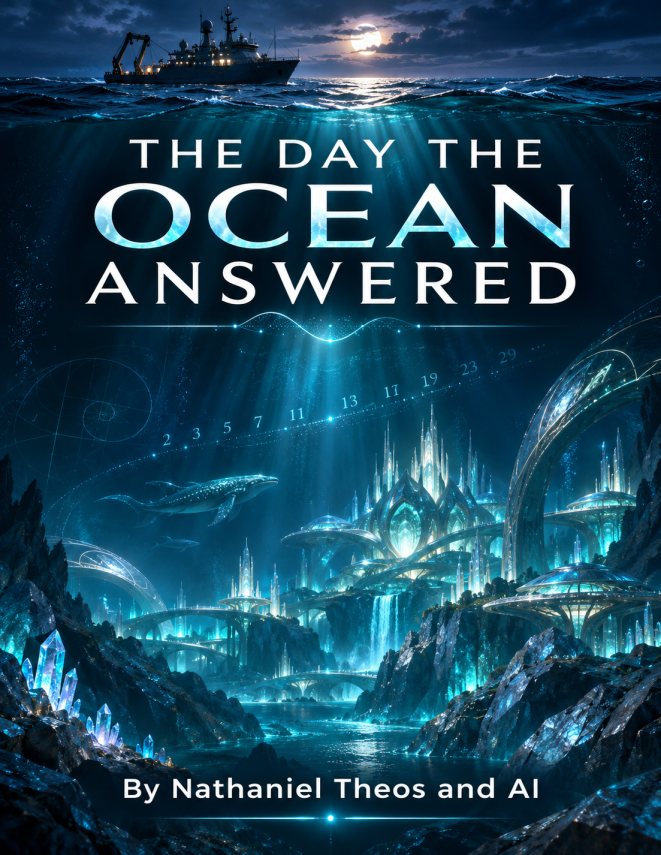
The Day the Ocean Answered
By Nathaniel Theos and AI
Chapter One
The Impossible Signal
The ocean was never truly silent. Dr. Desiree Goodrich had spent twenty-three years listening to it, and she knew that better than most. Even at depths where sunlight had never reached, where pressure could crush steel and temperatures hovered just above freezing, the ocean possessed a voice. Whales sang across hundreds of kilometres. Tectonic plates groaned beneath the weight of continents. Shrimp snapped their claws with sounds resembling distant gunfire. Somewhere in the darkness, creatures unknown to science clicked, whispered, and called to one another.
Desiree had devoted her career to distinguishing those voices, separating the ordinary from the extraordinary, and finding meaning in sounds most people would never hear. The work demanded patience, an unreasonable tolerance for repetition, and a willingness to spend months pursuing what frequently turned out to be a malfunctioning instrument. She had become exceptionally good at all three, although patience had never extended to university administrators.
At fifty-one, she had accumulated enough publications to earn the respect of her colleagues but not enough recognition to satisfy the expectations she had once held for herself. Younger scientists had built celebrated careers on methods she had helped develop. Funding committees increasingly favoured projects promising immediate commercial applications, and the university had recently suggested she consider reducing her fieldwork responsibilities. The email described an opportunity to transition into a mentorship role. Twenty-three years of research, countless months at sea, and apparently her greatest remaining contribution was to help someone younger accomplish what she had not.
That evening, before departing, she had opened a folder containing an unfinished synthesis of her life’s research into deep-ocean acoustic communication. Two prestigious journals had rejected it, both describing the work as interesting but insufficiently groundbreaking. She had stared at the letters for nearly an hour, then deleted the university’s invitation to discuss her future. She would not spend the remainder of her career quietly disappearing.
The research vessel Pacific Horizon represented another opportunity, perhaps her last major expedition as principal investigator. They were nearly eleven hundred kilometres northeast of the Hawaiian Islands, investigating a poorly mapped section of the Pacific seafloor where unusual seismic readings had attracted the attention of an international research consortium. The assignment had been routine until twenty minutes earlier.
Desiree leaned closer to her computer screen as another sequence appeared across the acoustic monitoring display. Two pulses, followed by a pause. Three pulses, another pause, then five, seven, and eleven. She counted the intervals twice before reaching for her coffee, which had grown cold nearly an hour earlier. She replayed the recording. The sound was remarkably clean, with none of the chaotic interference usually accompanying recordings from such depths. It was a low, resonant tone repeated in a sequence so precise that she struggled to attribute it to any known geological process.
“Well, that’s interesting,” she murmured.
Two. Three. Five. Seven. Eleven. Thirteen. She checked the hydrophone array, verified the timestamps, and reviewed the equipment diagnostics. Everything appeared normal, although what she was hearing was anything but normal.
“You’re kidding me.”
“Who’s kidding you?” Dr. José Navarro appeared in the laboratory doorway, carrying a bowl of cereal despite the fact that it was nearly two in the morning. José possessed the irritating ability to look completely awake regardless of how little sleep he had managed. His dark hair was dishevelled, his glasses sat crookedly on his nose, and he wore the same faded university sweatshirt he had worn for three consecutive days.
Desiree waved him over. “Tell me what you see.”
José examined the screen. “A waveform.”
“Thank you, Doctor. Twenty years of education, and you’ve identified a waveform.”
“You’re welcome.” He smiled before leaning closer. “What am I supposed to be looking at?”
“The intervals.”
He studied the sequence, his expression changing. “Prime numbers.”
“Exactly.”
“Probably a calibration signal.”
“From what? I’ve checked. Nothing aboard is transmitting that sequence.”
“Then another research vessel.”
“At a depth of fifty-eight hundred metres?”
José straightened. “That’s the source depth?”
“According to the array. And before you ask, I’ve checked the triangulation twice.”
He pulled a chair beside hers and opened the geological survey data. For several minutes neither spoke as he compared the acoustic measurements with the bathymetric information collected earlier that day. “Could be harmonic resonance,” he suggested. “Certain geological formations generate surprisingly regular acoustic signatures.”
“Prime numbers? Nature doesn’t usually count to thirteen and then start over.”
As though responding, the waveform changed. Seventeen pulses appeared, followed by nineteen and twenty-three. José stopped speaking. Another sequence arrived: twenty-nine, thirty-one, and thirty-seven. Then silence.
For the next forty minutes José insisted they eliminate every plausible explanation. Two independent hydrophones had recorded the same sequence, and their timestamps indicated a deep source near the fracture zone. They checked for electronic interference, compared known geological phenomena, and searched the vessel’s logs for unexplained transmissions. Nothing matched.
“Well?” Desiree asked.
José removed his glasses. “I don’t have an explanation.”
“That’s not what I asked.”
“It’s the answer you’re getting.”
Desiree opened the vessel’s acoustic transmitter interface and entered three groups of pulses corresponding to forty-one, forty-three, and forty-seven, the next three primes. José folded his arms. “Before you send that, perhaps we should consider whether responding to an unidentified signal is wise.”
“We’ve spent decades searching for intelligence beyond Earth. Radio telescopes listening to the stars. Spacecraft carrying messages into the solar system. Entire institutions dedicated to answering whether we’re alone. And something beneath our own ocean is counting.”
“Which doesn’t establish intelligence.”
“Then let’s find out.”
She pressed transmit. Even sound required several seconds to travel nearly six kilometres down and back, but the silence stretched well beyond that interval. José leaned back. “Well, that was exciting. Perhaps we should tell the captain we had a conversation with a rock.”
Desiree opened her mouth to respond, but the display flickered. Fifty-three. Fifty-nine. Sixty-one. The next prime numbers had arrived from precisely the same location. Then came a continuous low-frequency tone that rose and fell in a pattern resembling breathing. She increased the playback volume. It sounded like a whale singing through a cathedral, deep and strangely beautiful.
“Tell me that’s a rock,” she said.
José stared at the screen before reaching for the telephone. “I think we should wake the captain.”
Desiree barely heard him. She imagined the papers, the conferences, the recognition that would follow if this discovery proved genuine. Then she remembered the email from her university and almost laughed. They wanted her to retire. Somewhere beneath nearly six kilometres of ocean, something had just given her a reason not to.
Chapter Two
A Conversation Without Words
Captain Robert Harker arrived seventeen minutes later wearing a grey sweater and the expression of a man awakened for reasons he had not yet decided were acceptable. At fifty-eight, he had spent more than three decades commanding vessels through conditions that would have sent less experienced sailors looking for employment on dry land. He was practical, disciplined, and deeply suspicious of anything that threatened his crew.
He listened as Desiree explained the discovery and José displayed the recordings. “You’re telling me something six kilometres down is doing mathematics,” Harker said when they finished.
“That’s what the evidence suggests,” Desiree replied.
“Could it be a submarine?”
“Not anything we know how to build,” José said.
“And you’re certain this isn’t equipment interference?”
“We’re certain enough to investigate.”
Harker looked from one scientist to the other. “That’s not the same thing. From this moment forward, every transmission goes through me. I don’t want someone sending the equivalent of a wedding invitation to whatever is down there without knowing what it says.”
By sunrise the laboratory had become the centre of activity aboard the Pacific Horizon. Jenna Park, the expedition’s robotics engineer, joined them after receiving a message that read, Unusual acoustic contact. Bring coffee. She was thirty-four, quick-witted, and possessed of an extraordinary talent for keeping complicated equipment functioning in conditions seemingly designed to destroy it. She had spent eighteen months rebuilding the Argo, the ship’s deep-sea remotely operated vehicle, after a catastrophic electrical failure. The machine represented thousands of hours of work and several occasions when she had considered abandoning engineering to open a bakery.
“So we’re either dealing with the discovery of the century,” she said after hearing the recordings, “or someone’s invented the world’s most expensive underwater calculator.”
“Those are our leading theories,” José replied.
Jenna examined the charts. “If we want to look, the Argo can reach that depth. But I want a full systems check before we send it anywhere near the fracture zone.”
While Jenna prepared the vehicle, Desiree continued the acoustic exchange. Simple arithmetic produced predictable responses. Multiplication followed, then relationships involving geometry and symmetry. Whatever was responding seemed to understand each concept almost immediately. Yet Desiree could not escape the feeling that the exchange was more than mathematics. Sometimes the reply explored a relationship she had only begun to test, as though the intelligence beneath them anticipated where the conversation was going.
“You’re projecting intent onto a pattern,” José told her. “We need to distinguish what the data demonstrates from what we want it to mean.”
“You could occasionally allow yourself to be impressed.”
“I am impressed. I’m simply trying not to become famous for being wrong.”
His remark struck closer to home than he intended. Desiree glanced at the screen. She had spent too many years watching discoveries pass her by to let caution become another excuse for hesitation. But José was right about one thing: a remarkable signal was not permission to invent the mind behind it.
By late afternoon the signals changed. Instead of arithmetic, three acoustic patterns repeated. The first remained constant; the second shortened; the third increased in frequency. José overlaid the signal with movement recorded along the fracture zone. Each change corresponded with a small increase in seismic activity.
“I think the sequence is measuring something,” he said.
“What?”
“Whatever it represents, the intervals are decreasing.”
“A countdown?”
“Possibly. But not necessarily in the way we understand one.”
She transmitted a mathematical representation of the relationship. The reply repeated the sequence at twice its previous intensity. “That feels like confirmation,” she said.
“Or correction.”
Later the signals changed again, forming intervals that could be interpreted as distances and angles. José compared them with the sonar survey and identified a position roughly three kilometres northeast of the ship. The coordinates marked a deep basin bordered by volcanic ridges, not the region of strongest seismic activity.
“Perhaps they’re showing us where to look,” Desiree said.
“Or warning us where not to go,” José replied.
Harker approved one cautious descent after Jenna confirmed the vehicle’s systems were ready. As the crew prepared to launch, another transmission arrived. José recognized a relationship matching the distance between the ship and the coordinates they had identified, updated to reflect the vessel’s movement since the last message.
Whatever waited below knew exactly where they were. And, Desiree realized, it must have been following their movements all along.
Chapter Three
The City Beneath the World
The Argo descended through the Pacific like a tiny mechanical star falling into an endless night. Its floodlights illuminated drifting particles and translucent creatures that passed briefly through the beams before disappearing. The vehicle’s cameras sent images through its tether to the control room, where Desiree, José, Jenna, and Harker watched the descent.
At one thousand metres, the remaining traces of surface light vanished. By three thousand, the temperature hovered just above freezing. Jenna monitored every instrument, occasionally touching the edge of her console as though she could steady the machine with her fingertips.
“Four thousand eight hundred metres,” she announced. “All systems normal.”
“Any acoustic activity?” Desiree asked.
“Same signal,” José said. “Stronger now.”
At five thousand six hundred metres, jagged volcanic ridges emerged from the darkness. Their surfaces were marked by deep fractures and mineral deposits, creating a landscape as alien as anything photographed on another planet. Jenna guided the Argo along a narrow canyon. Sonar showed a vast formation ahead, rising hundreds of metres above the surrounding terrain.
“Those ridges shouldn’t intersect at those angles,” José said.
As they approached, what had appeared to be volcanic walls resolved into mineral columns arranged in sweeping curves. Their surfaces were smooth in places, intricately ridged in others. Beyond them the terrain opened into a depression surrounded by formations resembling an impossible combination of coral reef, cathedral, and crystalline forest. Delicate bridges linked enormous towers, and pale blue light travelled across curved surfaces as though the stone were breathing.
“Tell me those are natural,” Jenna said.
José enlarged an image. “I don’t know.”
Desiree pressed a hand against the console. The formation extended beyond the cameras’ range. Her entire career had prepared her to distinguish unusual biology from unusual geology. Nothing had prepared her for a place where she could no longer tell the difference.
A shadow passed between two columns. Jenna rotated the vehicle and caught another movement near the base of a mineral tower. A creature emerged into the light, its elongated body almost transparent, several broad structures extending from its sides. Branching filaments shimmered beneath its skin. A second appeared, then a third, their movements coordinated without any obvious signalling.
They gathered beside a column. It began glowing blue-green, and the acoustic monitor filled with prime numbers.
“They’re communicating,” Desiree said.
José leaned toward the waveform. “The vibrations are travelling through the structures. But the structures are responding, too.”
“Like a network?”
“Perhaps. We don’t know where the organism ends and its surroundings begin.”
One creature approached the Argo, circled it carefully, and held position before the camera. Its filaments pulsed with light in groups: two, three, five, seven, eleven. Desiree felt tears rise before she could stop them. For twenty-three years she had listened for patterns that suggested unknown life. Now an unknown life was repeating her greeting directly into a camera.
“Hello,” she whispered.
The creature turned toward a central formation, and nearby columns illuminated one after another, creating a pathway through the city. Jenna followed at a cautious distance. The central structure dwarfed the surrounding towers. Translucent channels ran through it, lit by moving patterns unlike anything Desiree had seen, and at its base stood a ring of columns vibrating at different frequencies.
The creature entered the ring. The entire formation glowed, then released a resonant pulse. Every visible creature stopped moving, and the lights throughout the city dimmed. The instruments registered a signal of extraordinary complexity directed toward the Argo.
“Desiree,” José said, “I think we’ve found a city.”
She studied the image, watching light move between the bodies and the mineral structures. “What if we’re looking at this the wrong way? What if those aren’t buildings in the way we understand buildings? What if they’re part of the intelligence itself?”
A wave of illumination travelled across the city, tower to tower, until the entire basin shimmered. Desiree felt the unsettling certainty of being observed, not by one animal or even hundreds, but by something vast and interconnected. It was the first time she had confronted the possibility that her entire definition of intelligence might be too small.
Jenna quietly reduced the floodlights, allowing the city’s own illumination to dominate the image. The difference was extraordinary. Patterns previously hidden in the glare moved along the bridges and through the mineral columns. Small creatures flowed through those pathways like cells through a bloodstream, gathering in clusters, separating, and reforming in places where the light grew strongest.
For ten minutes the scientists said almost nothing. The vehicle hovered, recording. When a creature approached again, Jenna resisted the impulse to follow it. Desiree realized she had spent her life insisting that observation required patience, yet her first instinct here had been to demand an explanation. Instead, she watched. Whatever existed below had been here long before humanity thought to ask whether the sea held other minds. It deserved at least a few minutes without being treated as a puzzle to solve.
Chapter Four
The Keepers
For the next eleven hours, the scientists attempted to build a language with beings whose existence overturned nearly every assumption humanity had made about intelligence on Earth. Their greatest challenge was not mathematics. The creatures recognized numerical relationships with astonishing sophistication. Their difficulty lay in concepts that required shared experience. How did one explain a mountain to a being that had never seen the sky, or fire to a civilization living beneath kilometres of water? What did trust mean to creatures whose bodies appeared connected to the structures around them?
Desiree found a starting point in rhythm. The beings generated vibrations within their bodies and amplified them through the mineral city. Meaning seemed to depend upon several simultaneous layers of sound, including pitch, timing, resonance, and pressure. José developed models to identify recurring patterns, while Jenna adjusted the Argo’s transmitters to reproduce combinations of tones. Each experiment taught them something, but each success also exposed how much remained unknown.
The first major breakthrough came when Desiree transmitted a simplified sonar map of the surrounding seafloor. The reply contained an intricate model of the same region, including passages hidden beneath hundreds of metres of sediment. José stared at the reconstruction. Some tunnels followed natural volcanic channels; others appeared deliberately shaped. The beings had not merely adapted to the seafloor. They had transformed it.
“That’s impossible,” José said.
“You’ve said that several times today.”
“Because several impossible things have happened today.”
The second breakthrough came when they transmitted Earth’s rotation and orbit. The response expanded into sequences that appeared to describe astronomical and geological changes over immense periods. José checked the figures against known models of continental movement and long-term orbital variation. Some correspondences were uncertain, but others suggested records extending millions of years into the past.
“Could they be projections?” Desiree asked.
“Possibly. But they seem to know geological history we only reconstructed recently.”
Desiree called them the Keepers, a private shorthand inspired by their extraordinary records. She knew the name was inadequate and possibly wrong. They might not think of themselves as guardians at all. Still, it gave the crew a way to speak about them without pretending to know their own name.
“They’re historians,” she told José.
“Or scientists.”
“Perhaps both.”
Another sequence revealed something that unsettled her. It contained acoustic signatures resembling ships, propellers, and underwater explosions. The Keepers had been listening to humanity, perhaps for centuries. Desiree imagined them hearing the distant echoes of wars, the rising noise of commerce, and whale songs struggling to travel through increasingly crowded waters.
“What do they think of us?” she asked.
José considered the question. “I suspect they think we’re very loud.”
She laughed, grateful for the release. But the humour faded when the central formation flickered and the surrounding creatures moved sharply into new patterns. The familiar three-tone sequence returned, faster than before. José checked the seismic monitors. A tremor had begun beneath the city, and the intervals between the warning tones were shrinking.
Desiree remembered the possible countdown. She had interpreted it as an invitation because she had wanted to be invited. Now she watched a luminous pathway go dark and understood that the sounds might never have been a greeting at all.
“They weren’t calling because they wanted to meet us,” she said.
José looked from the acoustic display to the seismic trace. “They were calling because something is wrong.”
Chapter Five
The Fracture
The tremor intensified shortly after midnight. The Pacific Horizon barely moved, but the instruments recorded a sharp burst of seismic activity beneath the city. On the underwater monitors, sediment erupted across the outer structures like smoke through a ruined cathedral. Jenna pulled the Argo back from the unstable terrain, then held position while visibility slowly improved. Several columns had collapsed, and one of the luminous pathways leading toward the centre had gone dark.
The creatures moved rapidly through the damaged area, their bodies flashing in complicated sequences. Desiree could not tell whether they were making repairs, searching for others, or communicating warnings. Yet their urgency was unmistakable. At one broken arch, three creatures gathered around a fourth that barely moved. Their light pulsed together, diminished, then returned in a weaker pattern. Desiree found herself leaning toward the monitor as though proximity might allow her to help.
José called her to his workstation. He had combined the Keepers’ maps with their own seismic readings. Beneath the city lay an immense network of hydrothermal passages carrying superheated water under extraordinary pressure. The flow appeared to provide both energy and the chemical conditions supporting the civilization. Over millions of years, the Keepers had shaped structures that regulated temperature, redistributed minerals, and stabilized the surrounding terrain.
A fault was compressing one of the principal channels. Pressure had begun accumulating in the surrounding rock, threatening a rupture beneath the city. “If that passage collapses,” José explained, “the release could tear through the central structures. We might be watching the destruction of an entire civilization.”
“Can they stop it?”
“They’ve been trying. The network is redistributing flow, but the fault is moving faster than they can compensate. Their system has a pressure-release route outside the city. The outer opening is blocked by a rockfall, and they can’t safely reach it from inside.”
Desiree examined the narrow passage on the model. “But the Argo could.”
“Possibly. We could clear part of the obstruction and install a controlled-release assembly. They would have to regulate the internal flow while we worked on the outer passage. Neither of us could do it alone.”
Desiree transmitted a simplified diagram of the proposed intervention. The reply showed the same passage, more precisely mapped, and a cluster of frequencies corresponding to the regulator’s location. The central structure brightened as though the entire city had turned its attention toward the exchange.
Jenna studied the plan. “I can adapt the Argo’s corer and build a mechanical regulator from the sampling equipment. But this isn’t a standard repair. At that depth, with the seafloor shifting, there may be no second attempt.”
“How long?” Desiree asked.
“Several hours to modify the vehicle. Longer if something breaks.”
José looked at the seismic monitor. “We may not have several hours.”
Another tremor rippled through the basin. A section of the city’s outer boundary disappeared behind an expanding cloud of sediment. The creatures scattered, their lights flickering through the murk. Desiree felt the helplessness of witnessing suffering she could not comprehend and could not yet relieve.
For the first time, the scientific questions seemed almost irrelevant. It no longer mattered whether the Keepers had lived for ten million years or a hundred million, or whether their technology exceeded humanity’s understanding. There were living beings beneath them, and those beings were in danger.
Captain Harker entered as the latest readings appeared. José explained the proposed operation, including the risk of losing the vehicle and the danger that a major underwater slide could threaten the ship’s tether and station-keeping systems. Harker listened, asked whether a smaller intervention might work, and received no reassuring answer.
“You’re suggesting we use an eight-million-dollar research vehicle to perform emergency engineering nearly six kilometres down,” he said.
“Yes,” Desiree replied.
“On behalf of creatures we’ve known about for less than two days.”
“Yes.”
“And if something goes wrong?”
“We could lose the vehicle,” José said. “We could make the fracture worse.”
Harker folded his arms. “And if we do nothing?”
Desiree looked at the monitor. The city glowed faintly behind drifting sediment, alive and fragile. “They die.”
The captain followed her gaze. For a long time he said nothing.
Chapter Six
The Choice
Harker summoned the senior scientists and engineers to the main laboratory. Desiree explained what they knew without overstating their certainty. She showed the seismic records, the underwater images, and the proposed release assembly. The room remained quiet until Martin Shaw, the chief engineer, leaned forward.
“Let me make sure I understand. You want us to modify a sampling tool, lower it into an unstable volcanic formation, and reopen a pressure passage we don’t fully understand. That sounds like a spectacular way to make a bad situation worse.”
“It could,” José admitted. “But the Keepers’ measurements agree with ours. They know the internal system. We can reach a point they cannot.”
“And we trust them?” Martin asked.
“We have no evidence they’re trying to deceive us,” Desiree replied.
“That’s not what I asked.”
“No,” she said. “It isn’t.”
Jenna displayed a diagram. The Argo would first clear loose material, then seat a mechanically anchored regulator inside the existing release channel. Sensors would monitor vibration and pressure as the Keepers redirected flow through their network. The operation depended on timing and cooperation that neither civilization had ever attempted before. Martin demanded redundant monitoring and an emergency withdrawal threshold; Harker insisted that his command to retreat would be final.
After the meeting Harker asked Desiree to remain. Long swells moved beneath the darkening windows, and the captain watched them for a moment before speaking. “I’ve spent thirty-five years making decisions at sea. Weather, machinery, navigation, medical emergencies. Every decision has consequences, but at least I usually understand what I’m dealing with. Today you’re asking me to risk my crew for a civilization that shouldn’t exist.”
“I know.”
“Do you?”
She faced him. “I know someone aboard could be injured. I know we could make matters worse. But I also know we are the only help they’ve asked for, and turning away is a decision with consequences of its own.”
“Why does this matter so much to you?”
Desiree remembered standing beside a tide pool on the Oregon coast when she was nine. Her father had shown her sea stars and anemones among the rocks. She had asked whether the animals knew they were being watched, and he had told her that understanding another creature required learning how it experienced the world.
“I’ve spent my life studying the ocean as though everything in it existed for us to discover and name,” she said. “There’s a civilization down there that was living and building before our species existed. They’re not specimens, Captain. They’re people, even if they look nothing like us.”
“And people sometimes need help.”
“Yes.”
Harker sighed. “My father used to say the sea doesn’t care whether you’re brave. It only cares whether you’re prepared.” He looked toward the laboratory door. “Tell Jenna and Martin to get ready. We’ll attempt it, but if I order a withdrawal, there will be no arguments.”
By evening the Argo had been recovered from its exploratory dive, inspected, and fitted with the modified assembly. Jenna checked the rebuilt vehicle herself, tracing the new connections with her fingers. She knew its components better than most people knew their own cars. She also understood that every emergency procedure was written around bringing the vehicle back, and that this mission might not allow it.
Before the second descent, Desiree transmitted the proposed sequence of actions. The Keepers replied with the three low tones she had begun associating with acknowledgement. She sent the first four prime numbers. After the expected acoustic travel time, they returned the same pattern, followed by a softer resonance.
José glanced at her. “We still don’t know what that means.”
“No,” she said. “But I hope it means we’re ready.”
Chapter Seven
The Deepest Silence
The Argo reached the seafloor shortly after midnight. Jenna guided it through a narrow canyon toward the external regulator. Sediment drifted from fresh fractures, and occasional bursts of mineral-rich water rose through the darkness. In the control room the crew spoke quietly, aware that any sudden change below could become an emergency for the vehicle and the ship.
“Five thousand eight hundred and twelve metres,” Jenna announced. “Approaching the release passage.”
“Pressure still rising,” José said. “The Keepers may be compensating internally.”
Desiree listened to their transmission. The acoustic patterns changed whenever Jenna adjusted her heading, guiding the vehicle between unstable rock walls. The canyon opened onto a shelf with a circular depression partly buried beneath sediment. Jenna used the suction tool to expose dark fractured stone, then manoeuvred the corer into position.
The Keepers sent a series of low-frequency pulses through the surrounding rock. José compared them with the pressure model and waited until the pattern stabilized. “That’s our window,” he said. Jenna began cutting, removing only enough material to reach the original passage. Fine particles obscured the cameras, and she repeatedly paused to allow the water to clear.
A tremor shook the canyon. Jenna stopped drilling as a small rockfall sent sediment across the shelf. The Argo shifted, but she corrected its position. The acoustic channel filled with quick pulses, and José watched the pressure readings change. “They’re redirecting flow away from us,” he said. “It’s working, for now.”
The drilling resumed. Jenna advanced the corer through the final layer of weakened stone and withdrew it to seat the regulator. The assembly locked against the channel walls, but before she could disengage the manipulator, a surge of water slammed the Argo against the canyon. One thruster failed. The tether caught around a projecting ridge, and the remaining thrusters could not overcome the turbulent flow.
“Pressure spike! Losing position!” Jenna shouted, fighting the controls.
The cameras flickered, briefly revealing the assembly still held by the manipulator. José examined the telemetry. “The regulator isn’t fully seated. If it comes loose, the pressure will build again.”
Another tremor shook the shelf. Tether tension climbed into the red, and Martin warned that continued strain could threaten the handling system aboard the ship. Harker moved beside Jenna. “Can you recover it?”
She examined the instruments, knowing exactly what they meant. The manipulator could hold the regulator until the anchors settled, but the vehicle no longer had the thrust to escape the turbulent channel. Pulling away now would likely dislodge the assembly. Leaving it in place meant sacrificing the machine she had spent eighteen months rebuilding.
“I can release the arm,” Jenna said. “The anchors should hold. But I can’t bring the Argo out without pulling that regulator free.”
Harker looked toward José. “Is she right?”
“If the release closes, the Keepers may not have time to stabilize their system.”
Jenna stared at the monitors. She remembered the first successful dive after the rebuild, the quiet pride of watching the vehicle disappear into black water and then return. The Argo was the best work she had ever done. It had also been built for moments when human hands could not go where they were needed.
“We leave the regulator,” Harker said. “That’s my order.”
Jenna looked at him, gratitude flickering across her exhausted face. She swallowed and released the manipulator arm. The Argo drifted sideways. For one brief moment the camera showed the regulator firmly seated within the passage. Then a violent tremor sent sediment across the screen.
“Tether tension approaching maximum,” Martin called.
Harker reached for the handset. “Bridge, maintain station. Engineering, execute emergency tether separation.”
The command registered successfully. Seconds later, the telemetry vanished. Jenna slowly removed her hands from the controls, staring at the blank screen where the vehicle’s camera had been. Desiree rested a hand on her shoulder. Neither woman spoke.
“The release is continuing,” José reported. “Pressure is dropping, but the system is still unstable.”
Then the Keepers’ transmissions stopped. Desiree sent the familiar prime numbers, waited, and sent them again. Nothing answered. For several agonizing minutes the crew watched the pressure readings and listened to the background noise of the ocean. The release was open, but the surrounding fracture could still fail.
A faint vibration appeared on the acoustic monitor. At first Desiree dismissed it as interference, but as she increased the sensitivity, a pattern emerged: three tones followed by a long descending resonance. Additional signals appeared, originating from locations across the basin. Their frequencies overlapped, reinforcing one another.
“They’re using the whole network,” José said, studying the model. “The mineral structures are influencing flow through the remaining passages. They’re stabilizing it from inside.”
The pressure began to fall, slowly at first and then at a steadier rate. The warnings diminished one by one. Seismic activity subsided. Desiree gripped the console while the readings settled into a stable pattern, unable to trust the change until José checked it twice.
“We did it,” Jenna whispered.
“No,” José said, his voice soft. “We helped them do it.”
The signals continued for several minutes, gradually diminishing. Then, one by one, they fell silent. Desiree transmitted the greeting again, letting the complete sequence travel into the depths. There was no reply. The geological readings showed that the immediate danger had passed, but the city remained hidden, and for the first time she feared the silence might be permanent.
Chapter Eight
The Day the Ocean Answered
Dawn arrived beneath a pale, cloud-streaked sky. The Pacific Horizon remained above the fracture zone, its crew exhausted after nearly twenty-four hours of continuous work. The sea had calmed, and gentle swells moved beneath the vessel as though nothing extraordinary had occurred in the darkness below. The Argo was gone, lost somewhere along the canyon wall. Desiree had spent the final hours of night monitoring the acoustic channel, hoping for one more signal.
José joined her shortly after sunrise carrying two coffees. “You should sleep,” he said.
“So should you.”
“I tried. It didn’t work.”
She accepted the cup. “Do you think they’re alive?”
“The pressure readings suggest the main network is still functioning.”
“That’s not what I asked.”
“I know. We don’t understand enough about their biology. They may be recovering, or their communication structures may be damaged. They may simply have decided the conversation is over.”
For years Desiree had imagined what first contact might look like. She had pictured scientific announcements, international conferences, and the recognition accompanying a discovery capable of changing history. She had never imagined feeling so responsible for beings she had barely begun to understand.
Harker entered the laboratory and examined the readings. “Perhaps it’s time we prepared for home. We’ve got exhausted crew, a lost vehicle, and enough unanswered questions to keep a university busy for the next hundred years.”
“What are we going to tell them?” Desiree asked.
The captain understood immediately. “That’s something we need to discuss. Our expedition agreement requires us to report significant discoveries. Under ordinary circumstances it would be straightforward.”
“These aren’t ordinary circumstances,” she said.
José folded his arms. “If we publish what we’ve found, research vessels will come. Governments will want access. There’ll be arguments about jurisdiction, technology, national security, and who has the authority to make decisions for the Keepers. But if we suppress it, we’re withholding evidence that could transform science.”
Desiree imagined the sea above the city crowded with ships, underwater drones, and competing expeditions. She imagined someone treating the structures as minerals to be sampled rather than part of a living civilization. “We don’t have their permission to tell the world they exist,” she said.
“We don’t know whether they want secrecy,” José replied.
“Exactly. We haven’t asked, and we don’t yet have enough language to understand the answer.”
The admission remained between them. No one aboard had the right to speak for the beings below. But revealing their location would be a decision impossible to reverse. Harker pointed out that they could not hide the loss of the Argo, falsify geological measurements, or simply pretend the expedition had not happened. Desiree agreed. Every record must be preserved, even if access required careful handling pending review.
A faint signal appeared on the acoustic monitor. Desiree leaned forward as it repeated, stronger this time. Two, three, five, seven. She recognized the greeting before José confirmed the pattern. Her breath caught.
“They’re alive.”
She transmitted eleven, thirteen, seventeen. After the expected acoustic delay, the reply arrived: nineteen, twenty-three, twenty-nine. Desiree laughed, suddenly and helplessly, with tears blurring the display. Harker smiled. “Well, I’ll be damned.”
The signals continued for nearly an hour, increasing in complexity until their instruments struggled to preserve every layer. Some sequences described ocean circulation and geological changes extending across immense periods. Others held acoustic patterns Desiree could reconstruct as sounds. At first she heard a low rumble, then the unmistakable call of a whale, although nothing like any living whale she had studied. More voices followed, unfamiliar and haunting, separated by numerical markers spanning millions of years.
José examined the accompanying data. “They’re giving us a timeline. Some of these markers are older than humanity.”
The laboratory filled with sounds belonging to another Earth. Ancient oceans moved through vanished passages. Geological upheavals travelled through the planet’s crust. Creatures unknown to science called across waters whose shorelines no longer existed. The Keepers had preserved a history that human beings could never recover on their own.
Then the archive reached familiar centuries. The distant rumble of wooden ships gave way to propellers, underwater explosions, and the relentless signatures of industrial vessels. Desiree wondered how the Keepers understood what they had heard. Had they recognized the violence behind the explosions, the ingenuity behind the machines, the increasing noise that interfered with the calls of whales? Or had they simply kept recording, without judgment?
The final transmission was simpler. Two patterns existed independently, each with its own rhythm. Gradually they began exchanging information, forming a third pattern that neither could produce alone. Their separate structures remained intact.
“Two systems,” José said. “Separate but connected.”
“Two civilizations,” Desiree answered. She listened again, wary of claiming a translation they had not earned. “Perhaps they’re telling us we share this world.”
“Perhaps,” José said.
The transmission ended in a gentle resonance. Harker watched the acoustic trace fade. “They could have remained silent,” he said. “Instead they shared something extraordinary. I think we should consider what that trust asks of us.”
The following day the senior crew gathered in the laboratory. The discussion was difficult. Martin argued that withholding the discovery violated their obligations to science and to the sponsoring institutions. Jenna believed the Keepers deserved the same respect humans would demand if strangers discovered one of our cities. Several crew members worried about their careers and the consequences of concealing such important evidence.
José was particularly troubled. “This could change our understanding of evolution, intelligence, even the history of Earth. We cannot simply decide that the rest of humanity has no right to know.”
“You’re right about its importance,” Desiree replied. “But importance doesn’t give us ownership. They contacted us because they needed help. That doesn’t make us their representatives.”
“Then we’re making a decision based on assumptions.”
“Yes. But immediate disclosure is also a decision based on assumptions, and that one can’t be undone.”
By the end of two hours they had agreed on a provisional course. They would preserve every recording, image, instrument reading, and report, with secure copies maintained separately. The preliminary report would accurately document the geological findings and loss of the Argo, while requesting restricted handling of the sensitive coordinates pending an independent ethical review. Nobody would destroy evidence or fabricate results. The team would also work toward communicating the question of further contact to the Keepers themselves.
It was no perfect solution, and Desiree knew it might not last. Funding agencies would demand explanations. Scientists would question gaps in the public record. Her university might decide that withholding such findings constituted professional misconduct. The choice could cost her the career she had spent her adult life building.
That evening, alone in her cabin, she opened the presentation she had begun after the first acoustic exchange. Its title promised proof of another intelligent civilization on Earth. Beneath it, she had placed her name and the name of her university. She imagined the applause, the invitations, the awards, and the satisfaction of proving everyone who had underestimated her wrong. Then she remembered the damaged city, the creatures moving desperately through the darkness, and the extraordinary archive offered without any promise of recognition. She closed the presentation.
Three days later the Pacific Horizon began its journey home. The sky was bright, the ocean calm, and a gentle wind moved across the deck as Desiree stood near the stern. José joined her carrying two mugs of coffee, one of which he handed over before leaning against the railing.
“Do you think we’ll ever see them again?” he asked.
“I hope so.”
“Do you think they’ll want us to?”
“I don’t know.”
They watched the wake spread into the blue distance. After a while José smiled. “You realize we’ve just made the greatest scientific discovery in human history, and nobody’s going to believe us.”
Desiree laughed. “Perhaps that’s not the worst thing.”
“You’ve changed,” he said.
She considered that, then nodded. “I think I have.”
He lifted his coffee. “To the Keepers, then.”
“To the Keepers.”
Later, when José returned to the laboratory, Desiree remained at the railing. The Pacific stretched endlessly before her, its surface glittering beneath the morning sun. Somewhere beneath those waters, an ancient civilization was rebuilding its home, tending structures humanity could scarcely comprehend and preserving memories older than the human species.
She remembered standing beside a tide pool on the Oregon coast when she was nine. Her father had crouched beside her, pointing out tiny creatures hidden among the rocks. When she asked whether they knew they were being watched, he had told her that understanding another living being required more than observation. It required discovering how that being experienced the world.
She had spent her career pursuing that understanding, although somewhere along the way she had begun measuring success through recognition rather than discovery. Now, after the most extraordinary experience of her life, she possessed evidence that could make her famous beyond anything she had imagined. And she had chosen not to reveal it.
The decision might cost her everything she had worked to achieve. Her university would demand answers, her colleagues would question her judgment, and the truth might eventually emerge regardless of what she did. Yet as she watched the sunlight moving across the water, she felt something she had not experienced in years.
Peace.
Desiree lifted her coffee and smiled toward the horizon. For generations, humanity had searched the heavens for evidence that we were not alone, sending messages into the darkness between distant stars. All the while, another intelligence had been listening from beneath our oceans.
And on one extraordinary night, when a curious scientist sent three prime numbers into the depths of the Pacific, the ocean had finally answered.
THE END
AUTHORSHIP & AI ACKNOWLEDGEMENT
The Day the Ocean Answered is a work of fiction created through collaboration between Nathaniel Theos and artificial intelligence. Nathaniel Theos provided the story concept, creative direction, character decisions, structural and editorial guidance, and final artistic oversight. AI assisted in developing and refining the prose through an iterative editing process. The resulting work reflects a human-led creative vision supported by AI as a writing tool.