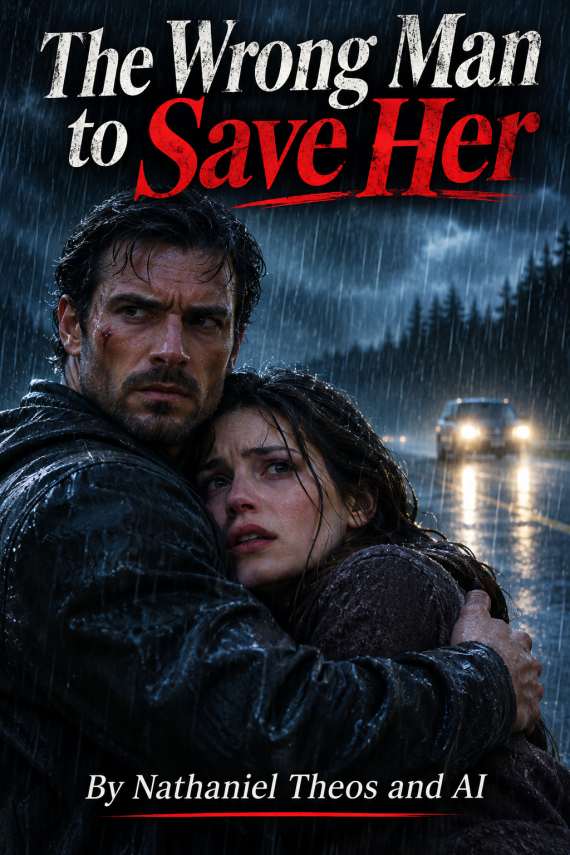
The Wrong Man to Save Her
By Nathaniel Theos and AI
Chapter One: The Woman on the Highway
Daniel Cross had been a civilian for three years, seven months, and twelve days. He knew the exact number because there were still mornings when he woke at 0430, reached for equipment that was no longer beside his bed, and needed several seconds to remember nobody was going to order him out of it.
At forty-three, he had become reasonably comfortable with civilian life. He taught paramedic trainees in Edmonton, drove a seven-year-old Ford F-150, and lived alone in a modest house where the lawn needed cutting and the refrigerator contained more mustard than actual food. It wasn’t the life he’d imagined while serving overseas. But it was quiet. And quiet, he’d discovered, was worth protecting.
October rain turned Highway 2 into a ribbon of reflected headlights. Daniel was driving north after visiting a former colleague near Red Deer. The radio murmured about a missing hiker somewhere in the Rockies. He had just passed a deserted service road when something moved near the ditch. A woman stumbled onto the gravel shoulder, waving both arms. Behind her, a man emerged from the darkness. He grabbed her by the hair and dragged her backward.
Daniel pulled over, activated his hazard lights, and stepped into the rain.
“Hey!”
The attacker turned. The woman twisted free, but he caught her again and drove a fist into her stomach.
“Let her go!”
The man reached beneath his jacket. Daniel recognized the movement. A pistol appeared. Twenty years of training took over. Daniel closed the distance before the weapon could be brought level. He struck the man’s forearm, then drove him backward against a black SUV. The pistol hit the gravel. The attacker swung wildly and caught Daniel across the cheek. Daniel stepped inside the next punch, hooked the man’s leg, and brought him down.
The man’s head struck the gravel. He stopped moving. Daniel knelt beside him.
“Can you hear me?”
No response. He checked the man’s breathing and pulse. Both were present. Blood seeped into the gravel beneath his head. Daniel checked his airway, assessed the injury, and looked for other obvious trauma. He avoided moving the man’s head or neck unnecessarily. A few metres away, the woman stood trembling.
“Is he dead?”
“No. But he needs an ambulance.”
“We have to leave.”
“Not yet.”
“You don’t understand.”
“Probably not. But I understand head injuries.”
Daniel took out his phone and dialled 911. He reported the assault, the location, and the injured man. He was about to give the dispatcher his name when the woman seized his arm.
“He’s not alone.”
Headlights appeared around the curve. A second black SUV slowed and pulled onto the shoulder some distance away. Its headlights went out. Daniel watched the passenger door open. A man stepped into the rain, holding something close against his leg. Daniel couldn’t identify the object. The woman tightened her grip.
“Please. They’ll kill me.”
Daniel looked at the unconscious attacker, then toward the approaching man. His duty as a medic told him to remain with the injured patient. His judgment told him another attack might be seconds away. He informed the dispatcher that a second vehicle had arrived and that he feared an immediate threat. He gave his truck’s registration, warned her about the pistol on the ground, and explained that he was moving the woman to a safer location.
Then he ended the call. He left the fallen pistol where it lay and helped the woman toward his truck. As Daniel accelerated onto the highway, two figures approached the injured man. Neither knelt beside him. One stood watching as Daniel’s taillights disappeared into the rain. The woman sat with her arms folded tightly across her chest.
“What’s your name?” Daniel asked.
She didn’t answer.
“Mine’s Daniel.”
“That’s nice.”
“Usually people give their name in return.”
“Samantha.”
“Samantha what?”
“Richards.”
“All right, Samantha Richards. Want to tell me what happened back there?”
“No.”
He drove another kilometre.
“Those men trying to rob you?”
“No.”
“Domestic dispute?”
“No.”
“Random attack?”
She turned toward him.
“Are you always this persistent?”
“Only when I find someone being beaten beside a highway.”
She looked away. Daniel retrieved a first-aid kit from behind his seat.
“You’re bleeding. Take this.”
Samantha opened the kit and began cleaning the cut above her eyebrow. Her movements were controlled and efficient. She handled the dressing like someone accustomed to treating injuries. Daniel noticed.
“Medical training?”
“Some.”
“What kind?”
She didn’t answer.
“How far to Edmonton?” she asked.
“Forty minutes.”
“There’s a motel off the next interchange.”
“You’re going to a hospital.”
“I can’t.”
“Then a police station.”
“Absolutely not.”
Daniel glanced at her.
“You’re eliminating all the sensible options.”
She reached into her coat.
“Easy,” he said.
Samantha froze, then slowly withdrew a cracked mobile phone.
“I need to call someone.”
“Go ahead.”
She stared at the dark screen.
“Battery’s dead.”
Daniel returned his attention to the road. He was beginning to suspect the worst part of the night was still ahead of him. Twenty minutes later, his phone rang through the truck’s Bluetooth system. Patrick Keane.
“You’re up late,” Daniel said.
Patrick’s voice was unusually serious.
“Tell me where you are.”
“Highway 2. Heading north.”
“Alone?”
Daniel glanced at Samantha.
“No.”
A pause.
“Daniel, pull over.”
“Why?”
“There’s a police bulletin about you.”
Daniel frowned.
“What kind of bulletin?”
“Kidnapping. Aggravated assault. Attempted murder.”
He stared at the road. Patrick continued.
“The alleged victim is named Samantha Richards.”
Daniel turned toward the woman beside him. She had closed her eyes.
“And the suspect,” Patrick said, “is you.”
Chapter Two: The Accusation
Daniel pulled into the abandoned forecourt of a gas station. The building was dark, its windows boarded shut. Weeds pushed through the cracked pavement. He left the engine running.
“Patrick, send me what you’ve got.”
“Already done.”
“Stay available.”
“Daniel?”
“Yeah?”
“Tell me you haven’t done something stupid.”
Daniel looked at Samantha.
“Not intentionally.”
He ended the call. The bulletin appeared on his phone. One photograph showed his truck. Another showed him apparently forcing Samantha into the passenger seat. He recognized the moment. She’d been doubled over in pain, and he’d supported her beneath the arm. The image had been cropped to remove the surrounding scene. Beneath it were his name, age, vehicle description, and registration. He was identified as armed and potentially dangerous. Daniel read the bulletin twice.
Then he turned toward Samantha.
“Explain.”
She stared at her hands.
“I’m sorry.”
“That’s not an explanation.”
“I didn’t know they’d move this quickly.”
“Who?”
She remained silent. Daniel held up his phone.
“According to this, I kidnapped you.”
“I know.”
“And attempted to murder the man who attacked you.”
“Yes.”
“Yet I distinctly remember saving your life.”
“You did.”
“Then why am I the criminal?”
Samantha took a breath.
“Because you weren’t supposed to involve the police.”
Daniel stared at her.
“What?”
“We need to disappear. I have contacts who can help.”
He gave a short, incredulous laugh.
“Disappear?”
“Daniel, please.”
“You’re sitting in my truck, carrying a mountain of trouble, and you want me to run from the police?”
“They won’t listen.”
“Perhaps.”
“They could kill you before you have a chance to explain.”
Daniel went still.
“Who are you?”
“Samantha Richards.”
“Try again.”
She hesitated.
“I worked for a private intelligence contractor.”
“Which one?”
“Bluestone Strategic Solutions.”
Daniel waited.
“We handled sensitive information for government agencies and private security operations.”
“Handled how?”
“Collected it. Analyzed it. Sometimes coordinated operations.”
“Legal operations?”
Her silence answered him. Daniel looked at the bulletin again.
“Why involve me?”
Samantha pressed her lips together. He saw the answer before she spoke.
“You knew who I was.”
“Yes.”
“Before tonight?”
She nodded. Daniel set the phone on the dashboard.
“Did you know I’d be driving that highway?”
“Yes.”
“How?”
“I knew you’d been visiting a former colleague near Red Deer. I knew when you usually left.”
Anger rose in his chest.
“You arranged this.”
“I arranged to be where you’d see me.”
“Did you arrange for that man to attack you?”
“No.”
“Then explain it.”
Samantha looked through the windshield.
“I had information Bluestone wanted back. Someone agreed to meet me on the service road. I thought I could negotiate.”
“And you knew I’d be passing?”
“I thought your presence would stop them from doing anything violent.”
Daniel stared at her.
“You used me as protection without telling me.”
“I didn’t expect him to attack.”
“That makes two of us.”
She turned toward him.
“I chose you because of your military record.”
The words settled heavily. Daniel spoke quietly.
“Get out of my truck.”
Her eyes widened.
“Daniel.”
“Get out.”
“They’ll find me.”
“Then you’re going to tell the authorities what you know.”
“You don’t understand how far this reaches.”
Daniel looked at her.
“No. You don’t understand something about me.”
He pointed at the bulletin.
“I spent twenty years in uniform. I have a career, a home, and people who trust me. I’m not surrendering all of that because you decided I was useful.”
“I didn’t mean for this to happen.”
“Intentions don’t erase consequences.”
For a moment, neither moved. Daniel glanced through the windshield at the deserted highway. He wasn’t going to abandon an injured woman in the middle of nowhere, no matter how furious he was. He picked up his phone and called Patrick.
“Can you reach Sterling?”
“Colonel Sterling?”
“Yes.”
“What’s happening?”
“I’m coming in.”
“To the police?”
Daniel looked toward the highway.
“To the people who know me.”
Samantha remained silent as they returned to the road. After several minutes, she spoke.
“You think your former commander can protect you?”
“No.”
“Then why go there?”
“Because he’ll make sure somebody listens.”
“You don’t know what these people are capable of.”
Daniel tightened his grip on the steering wheel.
“I know exactly what happens when people decide the rules no longer apply to them.”
She turned away.
“And I know,” he continued, “that I’m not becoming one of them.”
Chapter Three: The Gate
Colonel Andrew Sterling had commanded soldiers in places where one bad decision could cost an entire patrol its life. He wasn’t easily surprised. At 1:17 in the morning, Patrick Keane’s telephone call came close.
“Daniel Cross?” Sterling repeated.
“Yes, sir.”
“Suspected kidnapping?”
“Yes, sir.”
“Attempted murder?”
“Apparently.”
Sterling sat upright.
“Tell me there’s an explanation.”
“Daniel says there is.”
“And you believe him?”
“Yes.”
“Why?”
Patrick paused.
“Because he called us.”
Sterling considered that. Daniel Cross had never asked for help easily. During their last overseas deployment, he’d continued treating patients with cracked ribs until another medic forced him to stop. Stubborn. Infuriating. Dependable.
“Where is he?”
“Coming toward the installation.”
“You understand he’s a civilian now?”
“Yes, sir.”
“And military police can’t make civilian charges disappear?”
“Daniel knows.”
Sterling sighed.
“Of course he does.”
He switched on his bedside lamp.
“Tell him to stop at the public access gate. Engine off. Hands visible. I’ll notify security and arrange contact with civilian police.”
“Thank you, sir.”
“Keane?”
“Sir?”
“If he’s lying to us, this ends badly.”
Patrick answered without hesitation.
“Then we’d better find out who’s trying to make him look guilty.”
Daniel arrived shortly before two. Floodlights illuminated the entrance. A military police vehicle waited beside the guardhouse. Samantha had grown increasingly agitated during the drive.
“They’ll hand me over.”
“Perhaps.”
“They’ll interrogate you.”
“Probably.”
“You think your old unit can protect you?”
Daniel shook his head.
“I think they’ll tell the truth about me.”
“That won’t stop Bluestone.”
“Maybe not.”
He slowed the truck.
“But at least it’ll be my decision.”
Daniel pulled into the visitor lane, stopped, switched off the engine, and placed both hands on the steering wheel. A military police corporal approached.
“Daniel Cross?”
“Yes.”
“Keep your hands where I can see them.”
“Understood.”
“Are you armed?”
“No. The attacker dropped a pistol at the highway scene. I left it there and reported its location to the dispatcher.”
The corporal spoke into his radio.
“Any other weapons in the truck?”
“No.”
“Who’s your passenger?”
“Samantha Richards. She’s injured and needs medical attention.”
The corporal looked toward Samantha.
“Ma’am, are you being held against your will?”
She glanced at Daniel. For an instant, he wondered whether she would accuse him. Then she shook her head.
“No.”
“Did you come here voluntarily?”
“Yes.”
“Both of you remain where you are.”
Daniel followed every instruction. He stepped out, allowed himself to be searched, and provided his phone for documentation. His truck was secured pending examination by civilian investigators. Colonel Sterling arrived several minutes later. He wore civilian clothes beneath a dark rain jacket. His hair had become considerably greyer since Daniel had last seen him.
“Sergeant Cross.”
Daniel straightened instinctively.
“Colonel.”
“You’ve created quite a situation.”
“Wasn’t my intention, sir.”
“I certainly hope not.”
Sterling examined the bruise forming along Daniel’s cheek.
“You injured?”
“Nothing serious.”
“Your passenger?”
“Possible rib injuries. Facial laceration. She needs assessment.”
Sterling nodded toward the corporal.
“Make sure medical personnel examine both of them.”
Then he looked back at Daniel.
“You understand I cannot protect you from a lawful investigation.”
“Yes, sir.”
“And I cannot order civilian police to release you.”
“I know.”
“Then why come here?”
Daniel glanced toward the familiar buildings beyond the fence.
“Because somebody went to a great deal of trouble to make me look guilty.”
Sterling waited.
“And because the people who served beside me know how I behave when things go wrong.”
The colonel studied him.
“I’m not asking anyone to break the rules,” Daniel continued. “I’m asking you to make sure the evidence doesn’t disappear before somebody examines it.”
Sterling nodded once.
“That much I can do.”
He turned to the corporal.
“Document every item transferred to civilian custody. Preserve the relevant entry recordings and contact records. Make sure Mr. Cross has access to counsel.”
Daniel almost smiled. Mr. Cross. After twenty years of service, it still sounded strange. Sterling faced him.
“Welcome back, Daniel.”
Then, more quietly, he added, “I wish it were under better circumstances.”
Chapter Four: One of Our Own
Detective Heather Dunn arrived shortly after three. She was forty-one, with short auburn hair, tired eyes, and the expression of a woman who had spent too many years listening to people explain why circumstances had forced them to commit crimes. She had little patience for elaborate stories. Especially those involving intelligence agencies.
Daniel sat across from her in an interview room near the installation’s public access area. A civilian lawyer, contacted through an independent legal referral, sat beside him. Heather opened a folder.
“Mr. Cross, you understand you’re being investigated for several serious offences?”
“Yes.”
“Your vehicle was seen leaving the location of a violent assault. The alleged victim was inside.”
“Correct.”
“You admit striking the injured man?”
“Yes.”
“And transporting Ms. Richards?”
“Yes.”
Heather looked up.
“You’re making this remarkably easy.”
Daniel glanced at his lawyer.
“I’m not going to deny something that happened.”
Heather slid a photograph across the table.
“Explain this.”
It showed Daniel holding Samantha beside the black SUV.
“She was injured. I was supporting her as we moved toward my truck.”
“She appears to be struggling.”
“She could barely stand. She’d been punched in the stomach.”
Heather studied him.
“You’re a former military medic?”
“Yes.”
“Twenty years?”
“Just over.”
“Any way to establish what happened before this picture was taken?”
“The man who attacked her was alive when I left. I called 911 from the roadside. There should be a recording.”
Heather made a note.
“Anything else?”
Daniel considered the question.
“Who identified me?”
Heather looked up.
“Explain.”
“The men on that road didn’t ask my name. Samantha didn’t learn it from anything I told her. Yet my name and registration appeared in the bulletin almost immediately.”
He tapped the photograph.
“Somebody knew who I was before I stopped.”
Heather studied him. Then she closed the folder.
“I’ll check.”
Samantha confirmed most of Daniel’s account during her separate interview. She admitted arranging a meeting with a Bluestone representative and choosing a location where Daniel was likely to pass. Heather listened without expression.
“Was Daniel Cross involved in planning the meeting?”
“No.”
“Did he know you’d be there?”
“No.”
“Then why select him?”
Samantha hesitated.
“He was involved in a medical evacuation eight years ago.”
“Operation Sandglass?”
Samantha’s head lifted sharply. Heather noticed.
“I didn’t get that name from Daniel.”
“Where did you get it?”
“Records describing your employer’s contracts.”
Heather turned a document toward her. It showed that Bluestone had supplied logistical support to several overseas military operations. Samantha stared at the paper.
“You don’t understand what you’re dealing with.”
“Then explain it.”
“Sandglass wasn’t simply a military operation. It was used to move intelligence personnel under false identities. Some were listed as dead. Others were recorded as civilians.”
“And you can prove this?”
“I have records.”
“Where?”
Samantha looked away. Heather waited.
“You want protection. I understand that. But I can’t act on evidence you refuse to identify.”
Samantha glanced toward the door.
“There’s someone inside the investigation.”
“Who?”
“I don’t know his name.”
“Then what do you know?”
“Bluestone had access to law-enforcement reporting channels. Someone approved the photograph that named Daniel as the attacker before any police officer reached the scene.”
Heather’s expression sharpened.
“How do you know?”
“Because an allegation against Daniel was prepared before the meeting.”
Heather put down her pen.
“Prepared?”
Samantha swallowed.
“Daniel was supposed to be identified as a witness. Not a suspect.”
“And who prepared the report?”
“Bluestone.”
Patrick Keane sat in a conference room with Colonel Sterling, an authorized military investigator, and a civilian police liaison. The highway photograph filled a monitor. It had been provided to the liaison as part of the civilian investigation. Patrick leaned forward.
“Look at Daniel’s left hand.”
The investigator enlarged the image.
“What about it?”
“He’s supporting her elbow.”
“Could be restraining her.”
“Could be. But look at his stance. His weight is behind him. He’s helping her toward the truck, not dragging her.”
Sterling studied the image.
“Consistent with Daniel’s statement.”
The civilian liaison examined the file details.
“There’s something else. The picture didn’t come from a provincial highway camera.”
Patrick turned.
“Then where?”
“A private monitoring system. The copy supplied with the complaint passed through a Bluestone server before it entered the police reporting network.”
Sterling’s expression changed.
“Bluestone?”
“Yes.”
“Certain?”
“The transfer record names the company. The original recording still needs to be obtained.”
Sterling stood.
“That contractor supported Operation Sandglass.”
Patrick looked at him.
“Sir?”
“Eight years ago, Daniel treated a casualty during that operation. The man’s identity was restricted.”
“Did he survive?”
“No.”
“Who was he?”
Sterling stared at the photograph.
“That’s what I intend to find out.”
Chapter Five: The Man Without a Name
Daniel remembered the evacuation when Heather mentioned Sandglass. A dry valley. A damaged convoy. A helicopter landing under fire. And a wounded man brought aboard in civilian clothes. The patient’s medical card bore the name Thomas Reed. No service number. No unit identification. He had a gunshot wound high in his abdomen and was losing blood. Daniel had worked on him throughout the flight. At one point, the man grabbed his wrist.
“They changed the names.”
Daniel leaned closer.
“What names?”
The man’s breathing was ragged.
“Slinger.”
Daniel asked him to repeat it. The man tried to speak, but blood spilled from his mouth. He died before reaching the hospital. Two days later, Daniel was instructed to submit an amended casualty report under a different patient identity. He refused to change his clinical observations. He did accept the explanation that the man’s identity was protected for security reasons. Now he wondered what else he had accepted. Heather watched him carefully.
“You reported the man’s final words?”
“Yes.”
“Where?”
“In my original notes and to the receiving medical officer.”
“Do those notes still exist?”
“They should.”
“Did anyone question you about them?”
Daniel thought for a moment.
“Colonel Victor Haldane.”
“Who was he?”
“Senior command during Sandglass. Not in my direct chain of command.”
“What did he ask?”
“Whether the casualty had spoken.”
“What did you tell him?”
“Everything. That the man said the names had been changed and mentioned Slinger.”
“How did Haldane react?”
Daniel closed his eyes. The memory returned. The colonel standing in a dim office. A file open on his desk. A pen held perfectly still in his right hand.
“He smiled.”
Heather frowned.
“Smiled?”
“Not a friendly smile. More like he’d confirmed something.”
“Anything else?”
“He said the patient was a sensitive asset and that the report would be handled through a special channel.”
Daniel paused.
“I asked whether the family had been notified.”
“And?”
“He said there was no family to notify.”
Heather looked down at her notes.
“Did you believe him?”
Daniel shook his head.
“I didn’t know what to believe.”
Patrick Keane remembered something else about the evacuation. The wounded man had arrived with two private security contractors. One carried a black, hard-sided case. They insisted it travel with the patient. A senior officer ordered it loaded onto a separate aircraft. Patrick never learned what was inside. When he told Sterling, the colonel requested that the relevant records be reviewed by personnel authorized to access them. Several entries had been sealed under a restricted administrative designation.
One showed the transfer of a secure equipment case to a contractor-controlled aircraft. The authorizing officer was Victor Haldane. Sterling stared at the signature. Haldane had retired five years earlier. He now sat on Bluestone’s board of directors. Patrick looked at the record.
“Did Daniel know about the case?”
“No.”
“Then why involve him?”
Sterling considered the question.
“Because he was the last person to hear what the casualty said.”
Patrick looked toward the photograph of Daniel’s truck.
“So somebody thinks he knows more than he does.”
Heather received the relevant findings through the official liaison. She had already requested the original 911 recording and the complete highway incident file. The injured attacker was alive, though hospitalized under police supervision. His identification connected him to a security firm subcontracted by Bluestone. Then another name surfaced. Inspector Graham Pike. Pike was a senior police investigator who had initiated the original allegation against Daniel. Heather knew him. He sometimes coordinated investigations involving commercial security contractors.
There was no obvious reason for him to handle this roadside assault. She checked the timeline. An initial report identifying Daniel had entered the police reporting system shortly after the encounter. The accompanying material included a Bluestone file prepared before the first responding officer reached the scene. That file contained Daniel’s full name, registration, and an allegation that he posed a danger to Samantha. Heather compared its creation timestamp with the emergency call.
The underlying allegation had been prepared before Daniel dialled 911. She read the record again. The timing was suspicious. It wasn’t conclusive proof of a frame-up, but it justified a closer examination. She called her supervisor.
“I need the source files and their metadata preserved immediately.”
“Why?”
“Because I think the allegation against Cross was prepared in advance.”
“Can you prove it?”
“Not yet.”
“Then be careful.”
Heather looked at the photograph.
“That’s what I’m trying to do.”
Chapter Six: The Second Target
At 6:42 that morning, Patrick received a message from an unknown number.
Tell Sterling the evidence is compromised.
He stared at it. A second message followed.
Ask who requested the original photograph.
Patrick showed Sterling.
“Could be a warning.”
“Could be bait,” Sterling replied.
A third message appeared.
Keane remembers the case. Haldane knows.
Patrick went cold.
“Sir?”
Sterling took the phone.
“Don’t respond.”
Another message arrived.
Bluestone has someone inside the investigation.
Sterling contacted Heather through the official liaison. The detective reviewed the requests associated with the case. Inspector Pike had sought access to the original photographs and interview records. He had also requested Patrick’s service information, citing an urgent operational requirement. Heather checked for the necessary authorization. She found none attached to the request. She called Pike.
“Dunn,” he answered.
“Inspector. I’m reviewing the Richards investigation.”
“Good. Do you have Cross?”
“He’s cooperating.”
“Then charge him.”
“We’re examining the evidence.”
“What’s to examine? We have photographs.”
“Photographs provided by Bluestone.”
“An approved source.”
“Approved doesn’t necessarily mean accurate.”
Pike’s voice hardened.
“Heather, don’t overcomplicate this.”
She looked at the request for Patrick’s records.
“Why did you request Master Warrant Officer Keane’s service information?”
A pause.
“Operational necessity.”
“Connected to what?”
“That’s not your concern.”
“Then I’ll need formal authorization.”
Another pause.
“Where is Richards?”
Heather felt a chill.
“She’s under protective arrangements.”
“Transfer her to my unit.”
“Under whose authority?”
“Mine.”
Heather glanced at her supervisor, who had joined her at the desk.
“I’ll need that request in writing.”
Pike ended the call. Heather lowered the phone. Her supervisor looked at her.
“Problem?”
“Yes.”
She handed him the record.
“I think he’s trying to reach our witness.”
Patrick was leaving the conference room when he noticed a man near the corridor entrance. Civilian clothes. Dark jacket. An identification badge he couldn’t read. The man glanced at Patrick, then turned away. Patrick stopped. The face was familiar. Not from the installation. From Sandglass. He remembered the helicopter, the casualty, and the black case.
“Excuse me.”
The stranger kept walking.
“Sir.”
The man quickened his pace. Patrick reached for his radio.
“Security, this is Keane. Possible unauthorized visitor near the conference wing.”
The stranger turned through an access door. Patrick followed at a distance, keeping the man in sight without closing in. At the stairwell, the stranger stopped. For an instant, they faced one another through the open doorway. Patrick recognized him.
“You were at Sandglass.”
The man said nothing.
“You carried the case.”
His hand moved toward his jacket. Patrick stepped back behind the corridor wall. A shot cracked through the stairwell. The bullet struck the metal doorframe. Patrick dropped low and retreated toward the conference wing.
“Armed intruder! East stairwell!”
An alarm sounded. Boots hammered along the corridor. The stranger fled down the stairs. By the time military police reached the exterior exit, a vehicle was pulling away from the visitor parking area. The man was gone. But the security system had captured his face. Patrick stood against the wall, breathing hard. Sterling arrived moments later.
“Are you hit?”
“No, sir.”
“What happened?”
Patrick looked toward the stairwell.
“Someone just tried to kill me.”
Heather received the call shortly after seven. She studied the security image transmitted through the investigative liaison. The man’s name was Owen Rusk. A former private military contractor. His current employer was a Bluestone subsidiary. Heather examined the visitor records. Rusk had entered using a temporary authorization connected to a legitimate maintenance appointment. The appointment was real. The identity attached to it wasn’t. Someone had substituted his details into the approved visitor list.
The supporting identification information had come through a police-security coordination request. Submitted by Graham Pike. Heather stared at the record. The connection was no longer merely suspicious. She contacted her supervisor.
“We have an armed attack, an identifiable suspect connected to Bluestone, and an irregular authorization linked to Pike.”
“What are you requesting?”
“An independent investigation. Protection for Keane and Richards. And preservation orders covering Pike’s communications.”
“Agreed.”
Heather looked at Rusk’s photograph again. His attempt to reach Patrick had failed. But he was still free. And someone knew the investigation was getting closer.
Chapter Seven: The Last Record
Daniel learned about the attack on Patrick from Heather. He listened without interrupting. When she finished, he asked one question.
“Is he alive?”
“Yes. Uninjured.”
Daniel closed his eyes briefly.
“Thank God.”
Heather placed a photograph on the table.
“Recognize him?”
Daniel studied the square face, close-cropped hair, and small scar near the left eyebrow. Something was familiar.
“He was at Sandglass,” Heather said.
Daniel looked again. Then he remembered. The helicopter. The wounded civilian. The man arguing with Patrick over a black equipment case.
“Yes. One of the contractors.”
“His name is Owen Rusk.”
Daniel stared at the photograph.
“Why would he try to kill Patrick?”
“That’s what we’re investigating.”
Daniel pushed the photograph back.
“Then there’s something you should know.”
Heather waited.
“After the casualty died, someone tried to take my medical field notebook.”
“Who?”
“I never saw his face. A man in contractor clothing came to the medical tent and claimed the notes were required for an intelligence debrief.”
“What did you do?”
“Refused. Medical records had to go through the proper channels.”
“And?”
“He left.”
“Did you report it?”
“To the receiving medical officer.”
Heather made a note.
“Where’s that notebook now?”
“In the official medical archive, I assume.”
“Assume?”
Daniel hesitated.
“My original notes weren’t all in the electronic system.”
“Why not?”
“We worked from paper field books. They were transcribed later.”
“And?”
“The casualty’s final words were on the last page of a notebook. When I checked the electronic transcription, that page wasn’t included.”
“Was the page missing?”
“From the electronic record. I don’t know about the original.”
“Did you question it?”
“Yes. I was told the omission involved classified information.”
Heather leaned forward.
“Do you remember anything else written on that page?”
Daniel closed his eyes. He could picture it. His handwriting. A bloodstain on the corner. And something beside the word Slinger. Not a name. A number. He opened his eyes.
“There was a six-digit reference.”
“Remember it?”
“Not completely.”
Heather waited.
“Something ending in 417.”
“Could it be a medical identification number?”
“No. I wrote it down because the casualty kept repeating it.”
Daniel frowned.
“Six-two… no.”
He stopped.
“Wait.”
Heather remained silent.
“Six-four-two. Four-one-seven.”
She wrote it down.
“642417?”
Daniel nodded slowly.
“That’s it.”
“What does it mean?”
“I don’t know.”
“Are you certain of the number?”
“Certain enough that I want it checked against the original notes.”
Later that day, personnel authorized to examine the Sandglass archives located the original medical notebook. The physical book had been retained because the electronic transcription was incomplete. Daniel’s entry was still there.
Unidentified male. Penetrating abdominal trauma. Patient repeatedly stated: Names changed. Slinger. 642417.
Beneath it was Daniel’s signature. The notation had never appeared in the electronic casualty report. The relevant entry was documented and supplied through an authorized investigative channel. Heather then requested a comparison against the financial references Samantha had described. The initial search produced a possible match. 642417 appeared in several transaction records Samantha had identified as belonging to Slinger. Investigators still needed to authenticate those records, but the connection was significant.
The code appeared alongside payments to shell companies allegedly involved in moving personnel under false identities. The largest payment was dated four days after the unidentified casualty died. Its approval record named Victor Haldane. The receiving company appeared to be controlled by an associate of Owen Rusk. Heather studied the transaction. For the first time, investigators had a specific, testable connection between the casualty’s final words, Daniel’s medical notes, and Samantha’s allegations. She called Daniel.
“Your notebook gave us something.”
“Enough?”
“Enough to pursue additional records and identify people we need to interview.”
“Good.”
“There’s something else.”
Daniel waited.
“Someone accessed the electronic version of your casualty report yesterday.”
“Who?”
“An account connected to Bluestone.”
Daniel sat back.
“So they were looking for the number.”
“Possibly.”
“And they didn’t know the original notebook still existed.”
“That’s one explanation.”
Daniel looked out the window.
“Detective, Patrick nearly died because somebody thought he remembered a case.”
“I know.”
“Then please make sure nobody else gets hurt over that notebook.”
Heather’s voice remained firm.
“We’re taking precautions.”
Chapter Eight: The Man Who Wouldn’t Run
By the following afternoon, the investigation had entered a dangerous phase. Graham Pike had been removed from duty pending an independent inquiry. Legal steps were underway to preserve and obtain Bluestone’s relevant records. Victor Haldane had been located and was being questioned in connection with the financial investigation. But Owen Rusk remained missing. Heather wasn’t satisfied. There was still a man willing to kill witnesses, and she had reason to believe someone was directing him.
Patrick had been moved to a secure location. Samantha remained under protective arrangements. Daniel was staying with a friend while investigators assessed the threats against him. Then his phone rang. An unfamiliar number. He let it go to voicemail. A message appeared seconds later.
You should have kept driving.
Daniel stared at the screen. Another message followed.
Keane was only the beginning.
He forwarded both messages to Heather. She called immediately.
“Where are you?”
“At a friend’s place.”
“Stay there. Officers are coming.”
“Understood.”
“Don’t answer unfamiliar calls.”
Daniel looked at the messages.
“Detective?”
“Yes?”
“Whoever sent these wants me frightened enough to do something stupid.”
“Then don’t give them what they want.”
Daniel smiled faintly.
“That’s becoming a theme.”
At 4:36 that afternoon, Owen Rusk was spotted near a commercial storage facility outside Edmonton. A vehicle associated with his known contacts had entered the property. Investigators obtained the necessary authorization and coordinated an arrest. Heather received the report while reviewing the available Bluestone records. She examined the location. The address belonged to a company connected to the suspected Slinger payments. But the timing troubled her. Rusk had been careful to avoid known properties. Why return now?
She called the operations supervisor.
“Any indication someone else is inside?”
“Unknown.”
“Any movement?”
“One person seen entering. No confirmed exit.”
Heather examined the financial records again. Something caught her attention. The storage facility had received a delivery that morning. An archival shipment. The sender was a records contractor associated with Bluestone. Heather felt her stomach tighten.
“They aren’t meeting someone.”
“What?”
“They may be moving evidence.”
The arrest operation unfolded without the dramatic confrontation Rusk might have anticipated. The building was contained. Police identified his vehicle. When Rusk attempted to leave through a side entrance, officers arrested him. He resisted briefly, then surrendered. Inside the facility, investigators secured the premises and, under the applicable search authority, recovered sealed containers of records and electronic storage devices. Some documents appeared to have been prepared for destruction.
Among the recovered material were records relating to Slinger transactions, falsified personnel identities, and communications concerning the original allegation against Daniel. The evidence required authentication and detailed examination, but it offered a possible explanation for the entire sequence of events. Samantha’s highway meeting had been monitored. The Bluestone representative had been instructed to recover her files. When that effort failed, a prepared allegation against Daniel was activated using selectively edited images from the company’s monitoring system.
The apparent objective was to have Daniel arrested and Samantha transferred to an investigator cooperating with Bluestone. Daniel had disrupted that plan by voluntarily approaching his former unit, bringing Samantha with him, and giving a documented account of the encounter. He hadn’t escaped the system. He’d placed himself inside an investigation Bluestone could no longer fully control. Four days later, Heather met Daniel outside the police station. The sky was clear for the first time all week.
She carried a thin folder.
“Good news.”
Daniel looked at her.
“I could use some.”
“The evidence we’ve examined supports your account of the highway incident. The photograph was misleadingly edited, and the medical findings are consistent with your description of the struggle.”
“And the charges?”
“None have been laid against you. You’re no longer being treated as a suspect in the kidnapping allegation.”
Daniel exhaled. He hadn’t realized how tightly he’d been holding himself together.
“Thank you.”
Heather nodded.
“Your former unit helped establish the timeline. Your medical notebook gave us an important connection to the financial records.”
“How’s Patrick?”
“Safe. Still answering questions.”
Daniel smiled.
“He’ll enjoy that.”
“He says you owe him dinner.”
“I probably do.”
Heather closed the folder.
“The broader investigation is continuing. There are serious allegations against several people, but those allegations still need to be tested through the legal process.”
“Understood.”
“Samantha Richards is cooperating. Her conduct is also being examined.”
“Good.”
Heather studied him.
“Most people in your position would have kept driving.”
Daniel considered that.
“I thought about it.”
“Why didn’t you?”
“Because somebody had already decided what kind of man I was supposed to be.”
He looked toward his truck.
“I wasn’t going to let them make that decision for me.”
Heather smiled faintly.
“Fair enough.”
She extended her hand.
“Take care of yourself, Mr. Cross.”
He shook it.
“You too, Detective.”
Three weeks later, Daniel was back in his classroom at the paramedic training centre. A group of students watched as he demonstrated how to stabilize a patient with a suspected spinal injury. One of the younger students raised his hand.
“Sir?”
Daniel looked up.
“Yes?”
“What if the scene isn’t safe?”
Daniel paused. The question carried him back to the rain-soaked highway. To a woman stumbling out of the darkness. To a pistol lying on wet gravel.
“Then you assess the danger,” he said. “You don’t create another casualty if you can avoid it.”
The student nodded.
“But what if someone’s going to die, and you’re the only one who can help?”
Daniel considered the question. There were answers in textbooks. Protocols. Procedures. Risk assessments. He believed in all of them.
“Then you make the best decision you can with what you know.”
He reached for the training mannequin’s medical bag.
“And you understand that the right decision doesn’t always come with a guarantee.”
The students returned to their work. Daniel walked toward the classroom window. Outside, autumn sunlight fell across the parking lot. His old truck sat beneath a maple tree. The paint was faded. The windshield had a small chip. The passenger seat was empty. His phone vibrated. A message from an unfamiliar number.
You were right. I should have asked.
There was no signature. There didn’t need to be. Daniel read it once. Then put the phone away. He returned to the training table, where a student struggled with a bandage.
“Here,” Daniel said. “Let me show you.”
He took the dressing and demonstrated the technique. Outside, a siren sounded somewhere in the city. Daniel didn’t look up.
The End
Authorship & AI Acknowledgement
The Wrong Man to Save Her is a work of fiction presented by Nathaniel Theos and AI. The author directed the story concept, creative choices, and final presentation. Artificial intelligence assisted in story development, writing or drafting support, editing, and cover artwork. The resulting work was reviewed and guided by the author.