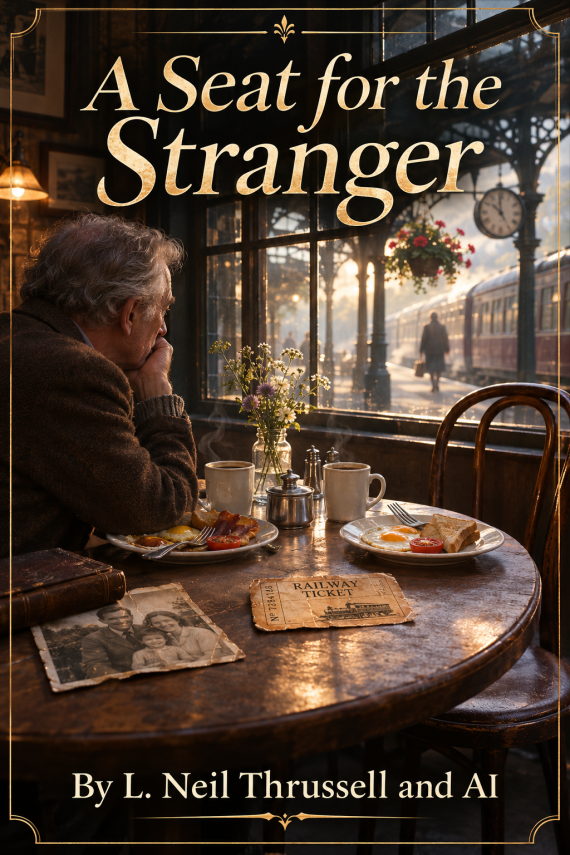
A Seat for the Stranger
By L. Neil Thrussell and AI
1. The Thursday Table
At seventy-six, Jose Rodrigues had learned that there were three things a man could count on: the rising sun, the government’s ability to find new ways to collect taxes, and the fact that Elsie Morgan would tell him he needed to eat more vegetables.
The first two were beyond his control. The third he had been resisting for twenty-three years.
“Two eggs, over easy. Bacon crisp. Toast lightly buttered. Coffee black,” Elsie recited as she approached his table.
“And?”
“Another one exactly the same.”
“You’re getting good at this.”
“Twenty-three years, Jose. I should hope so.”
He folded his newspaper and smiled.
The railway café at Bracken Junction had changed considerably since his first visit. The red vinyl stools had been replaced with wooden chairs, the ceiling fans no longer worked, and someone had installed a television above the counter that nobody seemed to watch.
But the clock above the entrance still ran three minutes slow, and the table beside the east-facing window was still his.
Every Thursday at eight fifteen.
Two breakfasts.
Elsie placed his coffee on the table and glanced at the empty chair across from him.
“One of these days, you’re going to tell me who that second breakfast is for.”
“Maybe.”
“You said that twenty years ago.”
“Then you know I’m consistent.”
“You’re impossible.”
“My Teresa used to say the same thing.”
“Your Teresa was a wise woman.”
“She certainly thought so.”
Elsie laughed and returned to the kitchen.
Jose turned toward the window. Beyond the glass, the railway platform stretched into the morning mist. Two maintenance workers stood near the signals, and farther down the tracks, a locomotive waited beneath a grey October sky.
Thirty years.
Sometimes the memory of that September morning was so clear he could hear the conductor calling for passengers. Other mornings, he struggled to remember the sound of his brother’s voice.
That frightened him more than he cared to admit.
He remembered Miguel’s laugh, though. A terrible laugh, loud and wheezing, as though someone had stepped on a bagpipe.
Teresa used to say the Rodrigues brothers laughed like farm animals being chased through a kitchen.
Jose smiled at the memory.
“You’re late again, little brother,” he whispered.
Elsie returned with two plates, setting one before Jose and the other across from him.
“Anything else?”
“No, thank you.”
She hesitated. “Jose, would you mind terribly if I asked you something?”
He raised an eyebrow. “Has that ever stopped you?”
“Not once.”
“Then why start now?”
She glanced at the second plate. “Do you ever think about stopping?”
Jose studied the untouched breakfast.
“Sometimes.”
“And?”
He lifted his coffee. “Not today.”
Elsie nodded. She had learned long ago that some doors opened only from the inside.
“I’ll wrap that one up after your ten minutes.”
“Thank you.”
“Still think you ought to eat a tomato once in a while.”
“Vegetables are what food eats.”
She shook her head and walked away.
Jose picked up his fork. Outside, the station clock struck eight thirty, and the bell above the café door rang.
He didn’t look up immediately. People came and went all morning. Travellers, railway workers, tourists who had taken a wrong turn looking for the highway.
Then someone stopped beside his table.
“Mr. Rodrigues?”
Jose looked up.
A woman stood there, perhaps thirty-five, wearing a dark blue coat and carrying a brown leather satchel. Her dark hair was tied loosely behind her head. Shadows beneath her eyes suggested a restless night.
“Yes?”
“Jose Rodrigues?”
“That’s me.”
She looked at the empty chair. “May I sit down?”
He hesitated. There were six other empty tables.
“Are you selling something?”
The woman managed a faint smile. “No.”
“Good. At my age, I already have enough life insurance.”
She didn’t laugh.
Instead, she opened her satchel and withdrew a yellowed envelope, its corners softened and worn from years of handling.
“My father asked me to give you this.”
Jose stared at it. Something familiar stirred inside him.
“Who’s your father?”
The woman remained standing.
“His name was Miguel Rodrigues.”
The café seemed to lose its sound.
Jose looked at her, then at the envelope.
“Was?”
Her expression softened. “I’m sorry. He died six weeks ago.”
Jose felt the words settle somewhere deep in his chest.
He had imagined someone coming to tell him Miguel was alive and well, that he had grandchildren, that he had built the business he always talked about. He had even imagined his brother walking through the café door himself.
But not this.
The woman reached inside the envelope and placed a railway ticket on the table.
September 18, 1996.
Bracken Junction to Vancouver.
One-way.
On the back, written in handwriting Jose knew almost as well as his own, were the words:
For Jose. In case he changes his mind.
Jose pressed his fingertips against the edge of the ticket.
“I thought he threw it away.”
“He didn’t.”
She glanced at the second plate. “My father told me about this place.”
“He did?”
“Often. He said the two of you had breakfast here before he left.”
Jose nodded. “He liked his bacon crisp.”
“So do I.”
She looked at the plate, then at him.
“May I?”
Jose slid it toward her. “Of course.”
She removed her coat and settled into the chair.
“My name is Sofia.”
“Sofia,” he repeated.
“Miguel’s daughter.”
He stared at her and noticed the eyes. His brother’s eyes. When she smiled uncertainly, he saw Miguel again, thirty years younger, sitting in that very chair.
“Your father showed me your picture once,” Jose said. “You were wearing a yellow dress and holding a stuffed rabbit.”
“Mr. Buttons.”
Jose smiled. “That poor rabbit looked like he’d lost a fight.”
“He had. With our dog.”
Jose laughed softly.
Sofia picked up her fork. For a while, they said nothing.
Then she placed it beside her plate.
“Mr. Rodrigues, there’s something I need to understand.”
Jose heard the formality return to her voice.
“What’s that?”
“Why didn’t you get on the train?”
2. The Train He Never Boarded
Thirty years earlier, Jose Rodrigues was forty-six years old, with strong hands, an aching back, and a conviction that if something needed fixing, he was the man who should fix it.
That belief had made him a good carpenter. It had also made him a difficult husband.
He and Miguel had spent most of their adult lives working in their father’s cabinet shop, a narrow brick building at the edge of Bracken Junction.
Their father, Antonio Rodrigues, had arrived in Canada from Portugal with forty dollars, a suitcase, and the belief that hard work could overcome almost anything.
He had been right about the hard work. Less right about nearly everything else.
Antonio believed praise made workers lazy, affection made boys weak, and an apology was an admission that someone else had won.
Miguel had rebelled against him from the moment he could speak. Jose had learned to keep his head down.
As boys, they became experts at recognizing their father’s footsteps. A slow tread meant he was tired. A quick tread meant he was angry. Silence meant they should leave the room.
Their mother, Rosa, protected them where she could, often at the expense of her own peace.
Jose became the responsible one. Miguel became the dreamer.
At sixteen, Miguel drew pictures of houses he wanted to build. At twenty, he talked about opening his own shop. At thirty, he still talked about leaving Bracken Junction.
Jose listened and smiled.
“One day, little brother.”
Miguel hated those words.
One day.
To him, they had become another way of saying never.
In the spring of 1996, an opportunity arrived. A cabinetmaking business in Vancouver had offered Miguel a partnership. The owner was retiring and wanted someone with experience and ambition.
Miguel had both.
What he lacked was a brother willing to join him.
For three months, he worked on Jose. They could build furniture of their own design, he argued. Work for themselves. Create something that belonged to them rather than their father.
For once, Jose began to imagine it.
A new workshop. A house near the ocean. Sunday afternoons when work could wait.
Teresa encouraged him.
“Go,” she said one evening.
Jose looked up from the kitchen table. “Go where?”
“Vancouver.”
He laughed. “Just like that?”
“Yes. Just like that.”
“Papa would never forgive me.”
Teresa sat across from him.
“Jose, your father has never forgiven you for being born with your own opinions.”
“That’s not fair.”
“Neither is working sixty hours a week for a man who still speaks to you as though you’re twelve.”
Jose looked down at his hands.
Teresa reached across the table. “You’re allowed to have a life of your own.”
He remembered that conversation long afterward. Not because she had convinced him, but because he had almost believed her.
By August, the brothers had made their plans. They would travel west together. Miguel would arrange a place to stay, and Teresa would follow once their house was sold.
Their father would have to find other carpenters.
That was his problem.
For the first time in his adult life, Jose was preparing to leave.
Then, on September 17, the evening before their departure, Antonio suffered a stroke.
Jose found him collapsed behind his workbench, one hand still gripping a measuring tape.
The hospital doctor told them Antonio would survive, but his recovery would take months.
Rosa stood beside the hospital bed, frightened and exhausted. She had never managed the business accounts, could not drive, and had depended on Antonio for nearly every practical decision.
“Jose,” she whispered, “what are we going to do?”
He remembered the trembling in her hands and how easily the old responsibilities settled back onto his shoulders.
“I’ll take care of it, Mama.”
The words came automatically, the way they always had.
That night, he telephoned Miguel.
Their conversation lasted less than three minutes.
“You can’t be serious,” Miguel said.
“Papa needs help.”
“Papa has employees.”
“He needs family.”
“He has family. He has you. He always has you.”
“Miguel.”
“No. Don’t speak to me like I’m a child.”
Jose gripped the receiver.
“Mama’s frightened.”
“And you’re going to spend the rest of your life fixing everything for everyone because you’re frightened too.”
“That’s enough.”
“No, Jose. It hasn’t been enough for years.”
Miguel’s voice cracked.
“We promised each other.”
Jose said nothing.
“Just once, can you choose your own life?”
Jose closed his eyes.
“I can’t leave tomorrow.”
The line went quiet.
Finally, Miguel said, “Then don’t.”
And he hung up.
Jose went to the station the next morning. He told himself he was only going to say goodbye, but he carried his suitcase.
Teresa drove him to the café at seven forty-five.
She looked at the case on the back seat.
“Are you getting on that train?”
“I don’t know.”
“Then perhaps you should ask yourself what you want instead of what everyone else needs.”
Jose stared through the windshield.
“I can’t leave Mama alone.”
“Your mother isn’t alone. There are people who can help her. We can help from Vancouver.”
He shook his head.
“You don’t understand.”
Teresa turned off the engine.
“No, Jose. I understand perfectly. You think being a good son means never disappointing your father.”
“He’s in the hospital.”
“And when he comes home? When he recovers? When the shop needs help? What happens then?”
Jose had no answer.
She reached for his hand.
“I love you. But I can’t make this decision for you.”
He looked at her.
“What would you do?”
“I would get on the train.”
He remembered those words and the sadness in her eyes when he climbed out of the car.
Inside the café, Miguel was waiting.
Two breakfasts sat between them.
Neither man had much appetite.
Miguel wore a brown leather jacket and had combed his hair back with too much water.
“You’re here,” he said.
Jose nodded.
“I wasn’t sure you’d come.”
“I said I’d come.”
Miguel glanced at the suitcase. Hope appeared on his face.
Then Jose spoke.
“I can’t do it.”
The hope disappeared.
“Because of Papa?”
“Because of Mama. Someone has to take responsibility.”
Miguel stared at him.
“You always say that.”
“It’s true.”
“No. It’s what you tell yourself when you’re afraid.”
Jose’s face hardened.
“You don’t know what you’re talking about.”
Miguel leaned forward.
“I know you. I’ve known you my entire life. And if you don’t get on this train, you’ll spend the rest of your life wondering what might have been.”
Jose looked away.
Outside, the conductor called for boarding.
Miguel stood and took his suitcase from beneath the table.
“I love you, big brother.”
Jose looked up. Miguel’s eyes were wet.
“But I can’t spend my whole life waiting for you to be brave.”
He walked toward the door.
Jose remained seated, watching his brother cross the platform, climb aboard, and turn once to search the crowd.
He almost stood.
His hands gripped the edge of the table. All he needed to do was move.
But he thought of his mother sitting alone in the hospital. He thought of the cabinet shop, of his father’s anger, of all the things that would be waiting when he returned.
He remained where he was.
The train pulled away.
Jose sat there until the coffee went cold.
He had barely touched his breakfast. Across from him, Miguel’s eggs had congealed on the plate, a single piece of bacon lying beside the toast.
Jose paid for both meals.
The following Thursday, he returned.
He told himself it was because the café made a good breakfast. He ordered two plates, although he had no convincing explanation for the second.
When the waitress brought the food, he looked toward the door.
What if Miguel came back?
He stayed until the second breakfast went cold.
The next Thursday, he returned again. Then the next.
Eventually, he stopped looking toward the door quite so often.
But he never stopped ordering the second plate.
3. Two Sides of Silence
Jose looked across the café table at Sofia.
“That’s what happened.”
She had listened without interruption, although her expression had changed several times. At first, she seemed angry. Then uncertain.
Now she studied the old ticket.
“My father told the story differently.”
“I expect he did.”
“He said you chose your father.”
“That’s how he saw it.”
“Was he wrong?”
Jose leaned back.
He could have said yes. For thirty years, he had carefully defended his decision. His mother had needed him. His father was ill. The business depended on him.
All of those things were true.
“I was afraid,” he admitted.
“Of leaving?”
“Of being the kind of man who walked away when people needed him.”
Sofia considered that.
“My father said you were afraid of your father.”
Jose gave a short laugh.
“That too.”
She looked surprised.
“I was forty-six years old,” he continued. “Married. Owned my own home. Had a mortgage and a bad knee. And I was still afraid of disappointing a man who hadn’t told me he was proud of me since I was a boy.”
Sofia reached for her coffee.
“My father wasn’t particularly easy to please either.”
“He wasn’t?”
“He could be wonderful. He could also be absolutely impossible.”
“That sounds familiar.”
“He once refused to admit we were lost, even after we drove past the same gas station three times.”
Jose chuckled.
“He did that when we were boys. Got us lost walking to the swimming hole. Insisted we’d found a different creek.”
“He told me about that.”
“He did?”
“He said you carried him home after he stepped on broken glass.”
Jose smiled.
“Mama was furious. He bled all over my shirt.”
“Apparently, you told her it was your fault.”
“He’d been following me. I was supposed to look after him.”
Sofia examined him.
“You did that a lot, didn’t you?”
“What?”
“Take responsibility for everyone.”
Jose looked into his coffee.
“Someone had to.”
She was quiet for a moment before reaching into her satchel.
“I need to show you something.”
She produced a photograph of a large workshop with a wooden sign above the entrance.
Rodrigues Fine Woodworking.
A man stood in front of it, surrounded by several employees.
Jose recognized him immediately.
Miguel.
Older, heavier, silver-haired, but unmistakably Miguel. His brother stood with one arm around a younger man’s shoulders, smiling as though he’d just heard the best joke in the world.
Jose touched the photograph.
“He did it.”
Sofia nodded.
“He built the business.”
“Look at that.”
“He started with almost nothing.”
Jose studied the building.
“The partnership didn’t work out?”
“No. The owner had debts he hadn’t disclosed. Dad ended up buying the equipment and finding another location.”
“That sounds like Miguel.”
“He almost went bankrupt twice.”
“That sounds even more like Miguel.”
Sofia smiled.
“He refused to give up.”
“Stubborn little beggar.”
“He said you taught him to make things properly.”
Jose looked up.
“He said that?”
“Frequently. Usually while complaining that an employee had cut something an eighth of an inch too short.”
Jose laughed.
“His measurements were terrible when he was young.”
“He said yours were perfect.”
“Not perfect. Just better than his.”
Sofia studied the photograph.
“I grew up hearing about you, Uncle Jose.”
The name caught him unexpectedly.
“You did?”
“Mostly good things.”
“Mostly?”
“You should have heard what he said about the time you borrowed his motorcycle.”
Jose groaned.
“Oh, Lord.”
“You crashed it?”
“Into a chicken coop.”
Sofia burst out laughing.
Jose grinned.
“It wasn’t my finest hour.”
“Dad said you tried to convince the farmer his chickens had knocked the motorcycle over.”
“They were very aggressive chickens.”
She laughed harder.
For a moment, the distance between them disappeared.
Then Sofia’s smile faded.
“Those were the stories I heard when I was little. When I got older, I heard other things. About the train. About how much he needed you in Vancouver.”
She turned the photograph over.
“He was angry for a long time.”
“I know.”
“No, I don’t think you do.”
Her voice was firm, though not unkind.
“Sometimes he’d come home after a terrible day at the workshop and talk about how things might have been different if you’d gone with him. He wouldn’t say your name for months, and then suddenly he’d tell us a story about you that made everyone laugh.”
She looked at him.
“I never understood how he could love you and be so angry with you at the same time.”
Jose looked at the photograph.
“Neither did he, I imagine.”
“After he died, I wasn’t sure I wanted to come here.”
That surprised him.
“Why?”
“Because I watched him carry this for years. And I was angry that you never came looking for him.”
Jose had no answer.
He had never gone. Not once.
Sofia looked toward the platform.
“I thought I’d deliver the envelope, get on the afternoon train, and go home.”
“And now?”
She considered the question.
“I don’t know yet.”
“Fair enough.”
She studied him.
“You haven’t asked me to forgive you.”
“Would it help?”
“I don’t know.”
“Then I won’t ask.”
For the first time since arriving, Sofia looked at him without the guarded expression she had carried through the door.
Jose reached for the photograph.
“May I keep this?”
She nodded.
“I brought it for you.”
He held it carefully.
“Thank you for coming, Sofia. Even if it was only to deliver an envelope.”
Her eyes grew moist.
“You’re welcome, Uncle Jose.”
4. The Life Miguel Built
Elsie appeared carrying a fresh pot of coffee.
“Anyone need a refill?”
Jose held out his cup.
“Please.”
She filled it, then looked at Sofia.
“How was breakfast?”
“Excellent, thank you.”
“Good. Because that old fellow has been ordering the same thing for twenty-three years, and I was beginning to think nobody else would ever get to try it.”
Jose rolled his eyes.
“Don’t encourage her, Sofia.”
Elsie winked and walked away.
Sofia watched her go.
“She seems fond of you.”
“That’s the problem. People who like you feel entitled to tell you the truth.”
Sofia smiled.
“My father used to say something similar.”
Jose looked at her.
“Did he have a good life?”
“He did.”
“Was he happy?”
“Mostly.”
He wanted to ask a thousand questions.
Did Miguel ever visit Portugal? Did he learn to play guitar, as he’d once promised? Did he still put too much salt on his potatoes? Did he remember the summer they built a raft and nearly drowned in the creek?
Instead, Jose asked, “Did he marry?”
“Yes. My mother, Elena. They were married thirty-eight years.”
“And your sister?”
“Isabel. She’s a teacher. Married, two children.”
Jose leaned back.
“Good heavens.”
“What?”
“I’m a great-uncle.”
“Twice over through Isabel. And twice through me.”
“Four children?”
Sofia smiled.
“Daniel and Olivia are mine. Isabel has twins.”
“Four. I hadn’t prepared myself to become a great-uncle four times before lunch.”
She laughed.
His brother’s laugh again.
Jose looked away.
Sofia took out her phone and showed him photographs. A boy holding a soccer trophy. A girl standing proudly beside a dog almost as large as she was. Two identical boys wearing matching pirate costumes.
Miguel appeared in several pictures, sometimes smiling at the camera, sometimes unaware he was being photographed.
In one, he sat on a beach with a small girl asleep against his chest.
Jose stared at it.
“I never saw him like that.”
“As a grandfather?”
“As a grown man.”
Sofia was quiet.
Jose handed back the phone.
“I only knew the young fellow who wanted to conquer the world.”
“He never entirely grew out of that.”
“Good.”
Jose smiled.
“He deserved to build something of his own.”
“He did. But I think he always wished you’d been there.”
Jose glanced at the photograph again.
“Did he ever write to me?”
Sofia hesitated.
“I found some letters after he died. They were in a box with the train ticket. Most were never mailed.”
“He wrote letters?”
“Several.”
Jose rubbed his forehead.
“I wrote to him too.”
She looked up.
“You did?”
“Three times. The first Christmas after he left. Again when Papa died. Once after Teresa passed.”
“What happened?”
“The Christmas letter came back. Address unknown. The other two never did.”
Sofia frowned.
“Dad moved twice in those early years.”
“I didn’t know where else to send them.”
“Did you ever try calling the business?”
“Once, years later. I got the number from an advertisement.”
“What happened?”
“A woman answered. I asked for Miguel. She said he was in a meeting and offered to take a message.”
“And?”
“I said I’d call back.”
“Did you?”
“No.”
Sofia took a breath.
“He tried calling you once, shortly after he moved west.”
Jose looked up sharply.
“What?”
“He told my mother about it years later. He phoned the old house, the one on Willow Street.”
“Who answered?”
“Your father.”
Jose went still.
“Papa?”
Sofia nodded.
“Dad said he asked for you. Your father told him you weren’t interested in speaking to him.”
Jose stared at her.
“He never told me.”
“Did you believe he would do that?”
Jose looked toward the window.
Antonio Rodrigues had been dead for twenty-five years. Yet the sound of his voice still seemed to occupy a room inside Jose’s mind.
“He might have,” Jose admitted.
Sofia waited.
“After Papa died, I found Miguel’s business address in a trade magazine. He’d won an award for some furniture he’d made.”
“You knew where he was?”
“Yes.”
“Then why didn’t you go?”
The question wasn’t angry.
That made it worse.
“I told myself he wouldn’t want to see me.”
“Did you know that?”
“No.”
Sofia looked down at the table.
“My father had your address too. He kept a newspaper clipping about an award you won for restoring the old church doors.”
Jose remembered the article. Teresa had insisted on cutting it out.
“He never came,” Sofia said.
“No.”
They sat together in silence.
Jose could imagine Antonio telling Miguel that his older brother wanted nothing to do with him. He could imagine Miguel hanging up and refusing to call again.
But that had been only the beginning.
After their father died, there had been no one standing between them except two men who were too frightened to speak.
Jose picked up Miguel’s photograph.
“Your father could be a stubborn fool.”
Sofia smiled sadly.
“Yes.”
He looked at her.
“So could I.”
“I was beginning to suspect that.”
Jose laughed.
“Teresa tried to get me to call him. Every Christmas, every birthday. She’d put the telephone beside my chair and say, ‘Jose, it’s only a few numbers.'”
“What did you say?”
“‘I’ll do it tomorrow.'”
Sofia waited.
“Tomorrow was always busy.”
She nodded.
“My father was fond of tomorrow too.”
Jose looked toward the platform.
Outside, a railway worker was sweeping leaves from the steps.
He wondered how many ordinary Thursdays he could have used to travel west. How many times he might have opened his front door to find Miguel standing there.
He would never know.
5. The Letter
Sofia reached inside her satchel and withdrew a second envelope.
This one was newer, cream-coloured, with Jose’s name written across the front.
The handwriting was uneven but unmistakable.
“Miguel wrote this about three months before he died,” she said.
Jose took it.
“He knew he was sick?”
“Yes.”
“What happened?”
“Cancer. It was quick near the end.”
He turned the envelope over. It had never been sealed.
“Have you read it?”
“No.”
“You could have.”
“It wasn’t mine.”
Jose looked at her.
“You really are your father’s daughter.”
“That depends on whether you’re complimenting me.”
“Both, probably.”
He unfolded the letter.
Dear Jose,
I’ve written this letter four times.
The first was too angry. The second was too sentimental. The third sounded like something a man might write if he wanted everyone to think he was wiser than he actually was.
So here is the fourth.
I missed you.
Jose stopped reading.
He looked at those three words for a long time.
Then continued.
There. Thirty years, and those are the hardest three words I’ve ever written.
I built the workshop. You would have liked it. You would also have complained about the way I organized my tools, and you would have been right.
I have two daughters. Sofia has your patience. Isabel has my temper. God help the poor man she married.
I’ve wanted to telephone you more times than I can count.
I called the old house once, not long after I moved west. Papa answered. I wish I’d known whether he even told you.
Years later, I dialled again. The telephone rang, someone answered, and I hung up.
I wish I could tell you why.
No, that’s not true. I know why. I was afraid you wouldn’t want to hear my voice.
I was angry when you didn’t board that train. I thought you’d chosen Papa over me. Perhaps I needed to believe that because it was easier than admitting how much I wanted my big brother beside me.
I understand a little more now.
Not everything. I still wish you’d come.
But I understand more.
I kept your ticket all these years. I suppose that tells you something about how good I was at letting go.
If there’s another life after this one, perhaps we’ll get another chance to build that workshop together.
I’ll even let you organize the tools.
But only the first time.
I love you, big brother.
Miguel
Jose lowered the paper.
He read the final line again before folding the letter along its original creases.
His brother hadn’t written that he forgave him or that everything had been all right.
He had written that he missed him.
Jose placed the letter beside the ticket.
“I missed you too, little brother.”
Sofia reached across the table and took his hand.
He held it.
For a long time, neither spoke.
There would be no more chances to argue over measurements, compare their work, or laugh about customers who couldn’t tell oak from pine.
Jose wiped his eyes.
“I’m sorry,” he said.
“For what?”
“Making a mess of your morning.”
“My father would have said the same thing.”
Jose laughed through his tears.
“He probably would.”
Sofia glanced at the letter.
“I wasn’t going to tell you this, but Dad asked me something a few days before he died.”
“What?”
“He asked whether I thought you’d still recognize his voice.”
Jose closed his eyes.
For months, perhaps years, he had worried he was forgetting.
And somewhere far away, Miguel had been wondering the same thing.
“What did you tell him?”
“I said I thought you would.”
Jose nodded.
“I’d know his laugh anywhere.”
Sofia smiled.
“He’d like that.”
She glanced toward the counter, where Elsie had begun clearing tables.
“There’s something else I should tell you.”
Jose waited.
“I didn’t come because I thought you deserved this letter.”
“I know.”
“I came because I promised him.”
“That’s a good reason.”
She shook her head.
“I thought I knew what kind of man you were. Dad had spent years being hurt by what happened, and I was angry on his behalf.”
Jose lowered his eyes.
“But this morning hasn’t been what I expected.”
“No?”
“No.”
She picked up the ticket.
“I thought I’d find a man who didn’t care that he’d lost his brother.”
Jose looked around the café.
The clock. The window. The two coffee cups. The empty plate.
Sofia followed his gaze.
“I think I was wrong.”
Jose squeezed her hand.
Neither tried to explain further.
6. The Journey West
Sofia had planned to leave Bracken Junction that afternoon.
She stayed for three days.
The decision surprised them both.
When she called her husband to explain, he listened for a moment and asked whether she was all right.
“I think so,” she said.
Jose pretended not to hear the conversation from the kitchen, where he was making tea and trying to locate a biscuit tin that had occupied the same cupboard since 1984.
Sofia stayed in Teresa’s old guest room.
Jose apologized for the wallpaper.
“It’s dreadful, I know.”
Sofia looked at the faded yellow roses.
“I like it.”
“Teresa said the flowers were cheerful.”
“They are.”
“She also said they’d never go out of style.”
Sofia smiled.
“Perhaps she was right.”
“Don’t encourage her. I can still hear her arguing with me.”
That evening, they went through old photographs.
There were pictures of Jose and Miguel as boys beside their father’s workshop. Miguel was always grinning. Jose usually looked serious, as though someone had warned him that smiling might cost money.
In one photograph, Miguel stood on a homemade raft.
“Did it float?” Sofia asked.
“For about eleven seconds.”
“What happened?”
“We hadn’t considered the weight of two boys and a toolbox.”
“Why did you take a toolbox onto a raft?”
“In case it needed repairing.”
Sofia laughed until she wiped her eyes.
Jose listened. He hadn’t realized how much he missed being around someone who laughed like his brother.
The following morning, he took her to the old cabinet shop.
The building had been converted into a furniture store years earlier. The new owners had painted the brickwork cream and replaced the wooden doors with glass.
Jose stood on the sidewalk, looking at the place where he’d spent so much of his life.
“Do you miss it?” Sofia asked.
“Sometimes. Not the business. The work.”
He pointed toward the rear.
“Miguel and I used to build our own things after Papa went home. Little tables, picture frames, wooden toys. We’d hide them under the workbench so he wouldn’t complain about wasting materials.”
“What happened to them?”
“We sold some at the Christmas market. Gave most away.”
Sofia smiled.
“Dad kept making toys for children. Every Christmas. Wooden trains, trucks, rocking horses. When Daniel was little, Dad made him a castle with a drawbridge.”
Jose turned toward her.
“A proper drawbridge?”
“With a little chain.”
Jose grinned.
“He stole that idea from me.”
“Then perhaps you should sue him.”
“Too late now.”
They walked together along the sidewalk.
Jose told her about the good things and the difficult ones. How Miguel could argue over the thickness of a board for an entire afternoon. How he sometimes spent more money on tools than he earned in a week. How he could charm almost anyone into helping him, then forget to thank them until Teresa reminded him.
Sofia contributed stories of her own.
Her father insisting on building a backyard deck without consulting the instructions. Her mother quietly paying a contractor to fix it. Miguel attending her school recital and applauding so loudly that the music teacher asked him to settle down.
Between them, they began to assemble a picture of a man neither had known completely.
By the time Sofia left, Jose had given her copies of several photographs, a small wooden jewellery box he’d made for Teresa, and enough homemade cookies to feed a travelling circus.
At the station, she turned toward him.
“Uncle Jose, would you come to Vancouver?”
He looked at her.
“I don’t know.”
She nodded.
“I understand.”
“No. You don’t.”
Sofia waited.
Jose looked toward the railway tracks.
“I want to. But I’m frightened.”
“Of what?”
“Walking into a family that’s already learned to live without me.”
“That’s fair.”
He looked surprised.
“You’re not going to tell me I’m being foolish?”
“No. I think you’re allowed to be frightened.”
Then she smiled.
“But you should come anyway.”
Jose laughed.
“You’re definitely Miguel’s daughter.”
She hugged him.
“Think about it.”
“I will.”
After she left, Jose stood on the platform until the train disappeared beyond the bend.
He looked down at the old ticket in his wallet, then took out his phone.
It was an elderly flip phone that Teresa had purchased years earlier because she worried he’d get lost while driving. He’d resisted replacing it ever since.
Sofia had entered her number before leaving.
Jose found it and pressed the call button.
She answered on the fourth ring.
“Uncle Jose?”
“Hello, Sofia.”
“Is everything okay?”
“Everything’s fine.”
“Did you forget something?”
“No.”
“Then what’s wrong?”
Jose smiled.
“Nothing. I was wondering whether your mother likes Portuguese custard tarts.”
Sofia laughed.
“She loves them.”
“Good.”
“Why?”
“Because I know a bakery that makes excellent ones.”
A pause.
“Uncle Jose, are you coming to Vancouver?”
Jose looked toward the empty tracks.
“I think it’s time.”
Three weeks later, Jose arrived at Vancouver’s Pacific Central Station after a journey involving a train connection and a bus ride he would later describe as unnecessarily educational.
He carried a suitcase and a paper bag containing six slightly battered custard tarts.
Sofia was waiting with a woman he recognized from the photographs.
Elena.
Miguel’s widow.
Her dark hair was threaded with silver. She wore a red scarf and held her hands together as though she wasn’t quite certain what to do with them.
Jose stopped a few feet away.
“Elena?”
She stepped forward.
“Jose.”
For a moment, neither moved.
Then she embraced him.
“I’m sorry,” he whispered.
She stepped back.
“For which part?”
He gave a startled laugh.
“The whole bloody thing, I suppose.”
Elena smiled sadly.
“Miguel could be a difficult man.”
“He learned from the best.”
“He did.”
She took his arm.
“Come. There are people waiting to meet you.”
Outside, the city moved around them in a rush of traffic and voices.
Jose had never been to Vancouver.
Miguel had lived there for thirty years.
Elena seemed to sense what he was thinking. She didn’t tell him everything would be fine. She simply kept her hand on his arm as they walked.
At the house, Sofia’s children met him at the door.
Olivia ran forward first.
“Uncle Jose!”
He staggered backward under the force of her embrace.
“Good heavens!”
She looked up at him.
“Mom says you made furniture with Grandpa.”
“I did.”
“Can you make a dollhouse?”
“I suppose I could.”
“With electricity?”
He blinked.
“That’s a little ambitious.”
“Dad says I should start big.”
Jose laughed.
Daniel emerged from behind his sister, holding a small wooden box.
“Grandpa said you taught him how to make these corners.”
Jose examined it.
Finger joints. Neatly cut, though one corner was slightly uneven.
“Your grandfather taught you this?”
Daniel nodded.
“Before he got sick.”
Jose ran his thumb along the wood.
“He taught you well.”
Daniel looked pleased.
“Could you show me how to make the lid fit better?”
Jose smiled.
“I’d like that.”
Inside, the house was full of movement.
Isabel arrived with her husband and twin boys. Sofia’s husband was busy arranging chairs around the dining table. Elena moved between the kitchen and living room, refusing offers of help while clearly needing several.
Jose stood in the hallway, overwhelmed by names, faces, and children determined to discover whether he could make anything out of wood.
Then he saw the photograph.
Miguel stood beside the fireplace, smiling from a silver frame.
Jose approached it.
His brother looked older than the man who had boarded the train in 1996, but his eyes were the same.
So was the smile.
Jose rested two fingers against the edge of the frame.
“You did well, little brother,” he whispered.
Elena appeared beside him.
“He would have loved having you here.”
Jose nodded.
“I wish I’d come sooner.”
“So do I.”
She looked at the photograph.
“We both tried to make him go back.”
“Both?”
“Teresa and I spoke a few times.”
Jose stared at her.
“You knew Teresa?”
“Only by telephone. She called the workshop years ago. Miguel was away, and we ended up talking.”
“She never told me.”
“She said she was trying to arrange a reunion without either of you knowing.”
Jose laughed softly.
“That sounds like Teresa.”
“She was a lovely woman.”
“She was.”
“She called again after your father died. And once more a few years before she became ill.”
Jose closed his eyes.
Even now, Teresa was finding new ways to surprise him.
“Did Miguel know?”
“Yes. But he always said he’d visit when things settled down.”
Jose shook his head.
“Tomorrow.”
Elena looked at him.
“What?”
“That was our favourite word. Tomorrow.”
She smiled.
“Miguel used it quite often.”
From the dining room came the sound of a chair scraping across the floor.
Olivia appeared in the doorway.
“Uncle Jose, are you coming?”
“Where?”
“To dinner, silly.”
She held out her hand.
“There’s a seat for you.”
Jose glanced once more at Miguel’s photograph.
Then he took her hand and followed her into the room.
7. A Seat for the Stranger
The following spring, Elsie Morgan stood behind the counter of the railway café, watching Jose Rodrigues enter through the front door.
He looked different.
Not younger, exactly.
But lighter.
He’d been travelling more often. Vancouver twice. A family gathering in Kelowna. A weekend in the mountains with his great-nephew.
He’d even purchased a smartphone, although Elsie suspected he still considered it a personal insult whenever it rang unexpectedly.
“Morning, Jose.”
“Morning, Elsie.”
“Your usual?”
“Almost.”
He removed his coat and hung it over the back of his chair.
Elsie approached the table.
“Two eggs, over easy. Bacon crisp. Toast lightly buttered. Coffee black?”
“Yes.”
“And the second breakfast?”
Jose looked across the table.
The chair was empty.
“Not today.”
Elsie studied him.
“Are you sure?”
“Quite.”
She nodded.
“Coming right up.”
Jose took out his phone.
On the screen was a photograph of four children standing beside a wooden workbench.
Daniel held a small box. Olivia displayed a birdhouse painted in colours no self-respecting bird would have chosen. The twins stood behind a wooden wagon, arguing about whose turn it was to pull it.
Jose smiled.
He’d built the workbench during his last visit to Vancouver.
Daniel had insisted they carve both their names beneath it.
Daniel and Jose Rodrigues.
The boy had made the letters himself.
A little crooked.
But good work.
Jose put away the phone and looked toward the window.
The old clock above the station entrance still ran three minutes slow.
The bell above the café door rang.
Jose turned.
Sofia entered, followed by Daniel and Olivia.
“Uncle Jose!”
Olivia hurried toward him.
He rose just in time to receive another enthusiastic embrace.
“Good heavens, girl. Have you grown again?”
“Two centimetres!”
“That’s unacceptable. At this rate, you’ll be taller than me by Christmas.”
Daniel approached carrying a paper bag.
“Mom says you have to see what I made.”
“Is it another wooden box?”
“No.”
“A birdhouse?”
“No.”
“A small wooden elephant?”
Daniel grinned.
“You’re terrible at guessing.”
“I’ve been told.”
Sofia hugged him.
“Good to see you.”
“You too, sweetheart.”
They settled around the table.
Elsie appeared with her order pad.
“Well, this is a surprise.”
Jose smiled.
“Elsie, you remember my niece, Sofia.”
“Of course.”
“And these two troublemakers are Daniel and Olivia.”
Elsie greeted them warmly before looking at Jose.
“How many breakfasts today?”
He glanced around the table.
“Four, please.”
“The usual?”
Jose reached for the menu.
“I think it’s time we tried something different.”
Elsie stared at him.
“You feeling all right?”
“Perfectly.”
“Should I call a doctor?”
Jose laughed.
“Just bring me a menu.”
She shook her head, smiling, and returned to the counter.
Olivia opened her menu.
“Uncle Jose, can I have pancakes?”
“As long as your mother agrees.”
Sofia nodded.
“That’s fine.”
“With strawberries?”
“Yes.”
“And whipped cream?”
Sofia raised an eyebrow.
“Olivia.”
“Just a little?”
Jose leaned toward the girl.
“Your grandfather used to negotiate the same way.”
“Did it work?”
“Sometimes.”
Olivia grinned.
“Then I’ll keep trying.”
Jose laughed.
Outside, a passenger train approached the station, its whistle sounding through the morning air.
For thirty years, that sound had drawn Jose’s attention toward the platform.
He would stop whatever he was doing and watch the train arrive. Then he would watch it leave.
Sometimes he imagined Miguel stepping onto the platform with a suitcase in his hand. Other times, he imagined himself aboard, travelling west toward a life he’d never known.
Now, Daniel was showing him photographs of a wooden sailing ship he wanted to build.
The boy pointed to a complicated arrangement of ropes and pulleys.
“Do you think we could make this?”
Jose examined the picture.
“Of course.”
“Really?”
“Certainly. Mind you, it might take us until you’re thirty.”
Olivia giggled.
Sofia rolled her eyes.
“Please don’t encourage him.”
Jose leaned back in his chair.
“Encouraging young people to do impossible things is one of the privileges of being old.”
The train whistle sounded again.
Jose heard it.
Elsie returned with her pencil poised over the order pad.
“All right, Jose. What will it be?”
He looked at Sofia, Daniel, and Olivia.
“Pancakes for the young lady, with strawberries and a sensible amount of whipped cream. Whatever this growing boy wants. And my niece can order anything she pleases.”
Elsie turned toward him.
“And you?”
Jose studied the menu.
“French toast, I think.”
She lowered her pencil.
“French toast?”
“Is there a problem?”
“Not at all. I just never thought I’d see the day.”
Jose grinned.
“Neither did I.”
Outside, the train pulled away from Bracken Junction.
This time, Jose didn’t turn to watch it leave.
The End
Authorship & AI Acknowledgement
A Seat for the Stranger is a work of fiction presented by L. Neil Thrussell and AI. The author directed the story concept, creative choices, and final presentation. Artificial intelligence assisted in story development, writing or drafting support, editing, and cover artwork. The resulting work was reviewed and guided by the author.