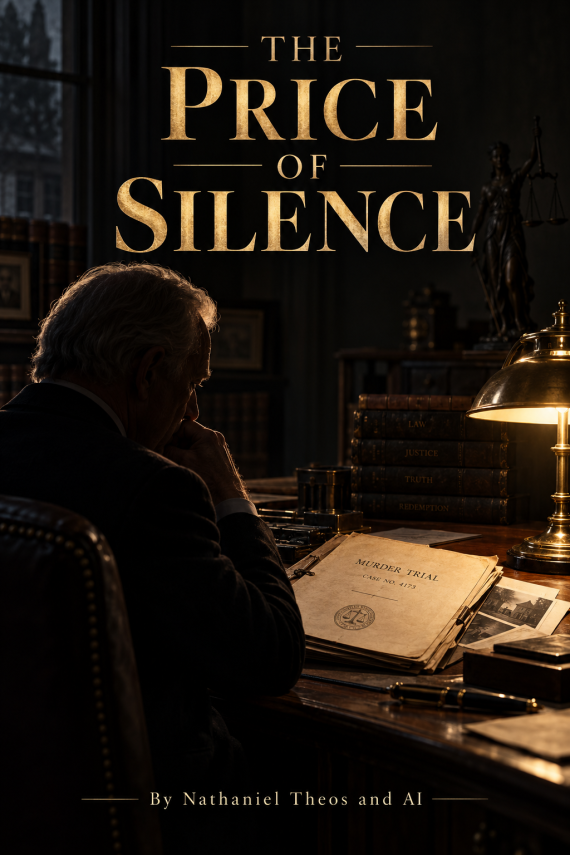
THE PRICE OF SILENCE
By Nathaniel Theos and AI
Chapter One: The Package
The package arrived on a Thursday morning, between the newspaper and the grocery delivery, on a day that had promised nothing worth remembering.
Samuel Meyer was seventy-eight, retired, financially comfortable, and increasingly irritated by the small humiliations of age. His left knee complained before it rained, his reading glasses vanished with alarming regularity, and he could no longer enter a room without occasionally wondering why he had gone there. None of these offended him quite as much as the knowledge that his wife could still beat him at chess.
Eleanor had defeated him the previous evening in twenty-three moves. She celebrated by suggesting that perhaps he should consider retiring from retirement. He kissed her forehead and reminded her that he had once sentenced people to prison for lesser provocations.
Their marriage, now in its fifty-fourth year, had settled into the rhythms of two people who could communicate affection without speaking. She knew precisely how much milk belonged in his coffee. He knew she disliked the kitchen curtains being left open after sunset. Every Sunday they walked through the botanical gardens and argued pleasantly about whether roses were superior to peonies.
Samuel considered himself fortunate. He had enjoyed a distinguished judicial career, raised two children, collected more books than he could finish, and shared his life with a generous woman whose kindness was admired by their friends. He had made mistakes, naturally. Every man did. But he believed he had lived honourably.
That belief survived until eleven seventeen that morning.
The brown envelope lay on the dining table. His name and address were typed on a white label. No return address appeared, and the postmark was blurred. He opened it with the silver letter opener Eleanor had given him when he retired.
Inside were a photograph, two copied pages, and a message.
The photograph showed a younger Samuel on the bench in Courtroom Four, dark-haired and straight-backed beneath his robe. It had appeared in the newspaper during the trial of Peter Cluff.
Samuel felt his fingers tighten. He had not seen the picture in years.
The photocopied statement was dated October 18, 1996. Across the top was the letterhead of Arthur Bell, Attorney at Law. Samuel read the first paragraph, then noticed the signature at the bottom of the second page. The handwriting was familiar because he had received countless birthday cards, notes, and shopping lists written in that same careful script.
Eleanor Meyer.
The separate message contained seven words: You condemned the wrong man. Below them appeared another sentence: Your wife knows why.
Samuel sat. Outside, a lawn mower sputtered into life, an ordinary sound that suddenly seemed to come from a tremendous distance.
He remembered Peter Cluff. The maintenance contractor was thirty-nine when the police arrested him for murdering Miriam Pike, a social worker found dead in a vacant commercial building. Cluff’s fingerprints appeared near the scene; a witness placed his truck outside; fibres on the victim’s clothing were described as consistent with those from his work jacket. The prosecution argued that a robbery had turned violent. Cluff insisted he had found Pike bleeding and tried to help her.
He had maintained his innocence through the entire trial. Samuel could still hear his voice at sentencing. ‘I didn’t kill her, Your Honour. I know you don’t believe me, but I didn’t kill that woman.’
Samuel had replied that the jury had considered the evidence. He had imposed the death sentence the jury recommended. Thirteen years later, after unsuccessful appeals, Peter Cluff was executed.
Samuel unfolded Eleanor’s statement. It described seeing Anthony Harrow, the developer who owned the building, emerge from the service entrance with blood on his shirt and hand. Eleanor wrote that Harrow threatened her when he realized she had seen him. She believed he had killed Miriam Pike. She had told no police officer because she feared for two children.
Samuel read the final paragraph twice. Then he read the date again. The statement had been prepared before Peter Cluff’s trial.
Eleanor came from the kitchen carrying two coffees. ‘There you are. I thought you’d disappeared into your library again.’
She set his mug beside the envelope, glanced at the photograph, and stopped. Samuel had studied thousands of witnesses during his career. He knew the difference between surprise and recognition. What he saw on his wife’s face was terror.
‘Where did you get that?’ she whispered.
Samuel raised the statement. ‘Ellie, what have you done?’
Chapter Two: A Perfect Marriage
Eleanor gripped the chair back, her fingers white against the polished wood. Samuel waited for an explanation that would make the document a forgery, a misunderstanding, anything other than what it appeared to be.
‘Is that your handwriting?’
‘Yes.’
‘Did you make this statement?’
She nodded. Tears formed, but she did not look away.
‘Why did you give it to Arthur Bell instead of the police?’
‘I was frightened. He said he needed time to find a safe way forward.’
‘Safe for whom?’
Eleanor sat carefully. ‘There was a girl named Anna Ruiz. Sixteen years old. Her brother, Luis, was eight. Harrow threatened to kill him if I spoke.’
Samuel studied her face. In fifty-four years he had learned the scar beneath her shoulder blade, the way she folded towels, the song she hummed when she thought nobody was listening. He could not reconcile those intimate certainties with the paper between them.
‘You knew Peter Cluff had been charged?’
‘Yes.’
‘And you knew he might be innocent?’
‘I knew there was another man.’
‘Another man with blood on his hands, coming out of the building where Miriam Pike was murdered.’ Samuel’s voice rose despite his efforts to control it. ‘You sat beside me when the verdict was reported on television. You held my hand when the final appeal was rejected.’
‘I know.’
‘A man died, Eleanor.’
She covered her face, but he could not yet comfort her. Samuel walked to the window, staring without seeing at the flowerbeds she tended. The roses had survived another summer. She had been proud of that, as though coaxing something beautiful out of stubborn ground proved that the world could be persuaded toward goodness.
‘When were the children safe?’ he asked.
Eleanor looked up. ‘What?’
‘Luis and Anna. When did they get away from Harrow?’
‘They were moved to another city within days. Then farther away.’
‘And you still stayed silent.’
She did not deny it.
Samuel felt the first true fracture in his understanding of her. A threat could explain a frightened decision. It could not, by itself, explain thirteen years of silence while a condemned man exhausted his appeals.
He collected the envelope. ‘I’m going to examine the case.’
‘What will you do afterward?’
He looked at the woman he loved and realized he could not answer. He went to his study and closed the door.
He had kept the Cluff trial transcript in a cabinet beneath his desk, ostensibly because the case was significant. Three thick binders contained witness testimony, judicial rulings, motions, and the jury’s verdict. In the final binder, a photograph slipped from a folder: Cluff between two deputies outside the courthouse, with a young woman crying behind the barriers.
Rebecca, his daughter. Samuel remembered her standing in court and shouting that the state was murdering an innocent man. He had ordered her removed for disrupting proceedings. He had thought her grief understandable but her accusation irresponsible.
Now he wondered what it must have taken for her to stand up at all.
He turned the pages until he reached the defence motion seeking to introduce evidence that Miriam Pike had been investigating Tony Harrow’s dealings with vulnerable teenagers. The prosecutor, Richard Sloane, had objected that the proposed testimony was speculative and unfairly prejudicial. Samuel ruled it inadmissible on the record then before him.
‘The court will not permit speculation to substitute for evidence,’ he had said.
He read the sentence again. Eleanor’s statement lay alongside the transcript. Evidence had existed. The court had never seen it.
Further into the binder he found a request for additional time to locate two prospective witnesses, including Anna Ruiz. Samuel had denied the request without prejudice because the defence had not established what those witnesses could offer. It was a ruling he could still explain under the rules as he understood them. He could no longer say with confidence that it had been wise.
He remained in the study long after Eleanor turned off the kitchen lights. When the clock struck ten, Samuel found an old photograph taken at their thirtieth anniversary celebration. Eleanor was laughing, her head thrown back, one hand pressed to his chest. Their children stood on either side, smiling with the distracted confidence of people who assumed their parents had always been happy and always would be.
Samuel remembered that evening. Michael had surprised them with a slideshow of family holidays. Eleanor had cried at a photograph of their children in mismatched winter coats, standing in front of a snow fort that collapsed minutes after the picture was taken. Later, when the guests had gone, she had told Samuel there was no achievement in her life she valued more than the family they had built.
The anniversary had occurred after Peter Cluff’s conviction. Samuel wondered whether she had thought about him during the speeches. Whether she had smiled for photographs while remembering a condemned man in a prison cell. He was furious with her, but even that fury was complicated by the knowledge that most of their happiness had been genuine. One concealed truth had not made every birthday, holiday, and tender exchange a performance. That, somehow, made the betrayal more difficult to understand.
He found himself remembering the first time he had seen her, at a crowded university lecture where she challenged a guest speaker’s argument about charity. She had insisted that helping people meant listening to them rather than deciding what they needed. He had fallen in love with her courage before he understood her gentleness. Now he wondered when she had abandoned that conviction, and whether her own fear had sounded, to her, like a reasonable exception.
From the hallway came a hesitant step. The door opened a few inches. Eleanor stood there with a folded blanket.
‘I thought you might be cold,’ she said.
He accepted it without inviting her inside. She started to speak, stopped, and touched the doorframe as if steadying herself. Samuel wanted to ask whether she had come to confess on some other night, whether there had been a hundred small opportunities in which he might have noticed her struggle. Instead, he thanked her. After she left, he unfolded the blanket across his knees and found that it carried the faint familiar scent of her lavender soap.
From the kitchen came the faint sound of Eleanor washing dishes. Samuel had listened to that sound for half a century. He kept reading until darkness settled at the window.
Chapter Three: The Daughter
Rebecca Cluff lived forty miles north of the city. Samuel telephoned before visiting. When he identified himself, she said, ‘I know who you are.’
He explained that he had received information relevant to her father’s case and asked whether they could meet.
‘Information?’ Her laugh held no amusement. ‘Thirty years I’ve tried to make people listen. Now you’ve got information?’
‘I understand your anger.’
‘No, Judge. You don’t.’ She paused. ‘Tomorrow. Ten. Don’t expect a warm welcome.’
Rebecca opened the door before he reached the porch. At fifty-three, she had short brown hair threaded with grey and the guarded expression of someone who had answered too many foolish questions. Her living room was neat and modest, with a shelf of law books and files on wrongful convictions. On the mantel stood a photograph of Peter Cluff beside a young Rebecca, both smiling broadly.
‘That was my twenty-first birthday,’ she said when she saw Samuel looking. ‘Dad made pancakes shaped like fish because we’d been fishing that morning. They were terrible. He said good fathers were allowed to be bad cooks.’
Samuel had never seen Peter Cluff smile before. In the courtroom photographs, he had looked frightened, angry, or exhausted. Samuel had known him as a defendant, not as the man who made ridiculous pancakes.
He placed copies of the documents on the coffee table. Rebecca read Eleanor’s statement without interruption. When she reached the signature, her face changed.
‘Your wife wrote this?’
‘Yes.’
‘Before the trial?’
‘Yes.’
‘Did she tell you?’
‘Not until yesterday.’
Rebecca read it again. ‘Dad said he saw a car pulling away. He didn’t know who was driving. When he found Miriam, he called for help. They used the blood on his clothes to say he killed her.’
She crossed to a filing cabinet and retrieved a transcript of the emergency call. ‘The recording presented in court started after the dispatcher asked for his name. This copy includes the beginning.’
Samuel read the words. Peter had reported a car driving away, a bleeding woman, and his effort to summon an ambulance. Those words did not prove innocence, but they were plainly relevant. He remembered the prosecution dismissing the reference to the vehicle as an unreliable afterthought. Now he wondered why the full call had not been heard.
‘Where did you obtain this?’
‘Years after the trial. A retired dispatcher found an archived copy and helped my lawyer request it. We sent it to anyone who might listen.’
Samuel recalled receiving letters through official channels, most of them urging a review of evidence he was no longer authorized to revisit. He had referred them elsewhere and told himself the appellate process would deal with their contents.
Rebecca watched him. ‘Do you know what happened after you sentenced him? Mom sold the house to pay lawyers. She worked nights until her knees gave out. She died thinking she’d failed him.’
‘I’m sorry.’
‘I don’t want your sympathy.’ She looked toward the photograph. ‘I watched him executed in 2009. They strapped him down. He was fifty-two. Before they brought him in, he told me to stop fighting. He wanted me to have a life.’
Her voice grew quieter. ‘I tried. For a few months I put the boxes away. I went out with friends. I met someone. But every good thing reminded me that Dad wasn’t there to see it. Eventually I stopped pretending I could leave him behind.’
Samuel had carried the Cluff case as a notable part of his professional history. Rebecca had carried it into every day of her adult life. The difference shamed him more than her anger.
Rebecca went to the kitchen and returned with a cardboard box worn soft at its corners. Inside were letters written in prison, some in Peter’s disciplined block capitals, others slanting as his hands grew stiff. She did not hand them to Samuel immediately.
‘The first year, he wrote about ordinary things,’ she said. ‘He wanted to know whether I had checked the tyres on my car and whether I was still dating a boy he couldn’t stand. He worried that Mom was working too much. He described birds he could see from one particular window. As time passed, he started asking me to send photographs of places he would never see again.’
She unfolded one letter. The paper had been creased and smoothed so often the folds had begun to split. ‘This came after my mother got sick. He wrote that he was sorry he couldn’t be with us and that I shouldn’t confuse his absence with a lack of love.’
Samuel stared at the letter but did not ask to read it. It felt like trespassing. Rebecca seemed to recognize his restraint, because she set the letter between them on the table.
‘I was engaged once,’ she said. ‘He was a decent man. Patient. He wanted children. I wanted them too, until the wedding planning started. The thought of walking down the aisle without my father made me sick. I kept telling my fiancé we should wait until the appeal was resolved. Years passed. Eventually he stopped asking.’
‘I’m sorry,’ Samuel said, knowing how inadequate the words were.
‘Realize something, Judge. I don’t blame every disappointment in my life on what happened. Some choices were mine. But the conviction was always in the room. It sat at our dinner table. It came to work with me. It followed me when I tried to sleep.’
She repacked the letters with care. Samuel looked at the sturdy tabs and numbered labels she had attached to the folders. Her father’s case had become a second occupation she had never wanted. A life that might have included children, travel, a marriage, or merely the freedom to waste a Sunday had been spent in waiting rooms and offices where people explained why they could do nothing more.
‘I think this warrants an independent investigation,’ he said.
She looked at him as though he had missed the point of a conversation conducted in another language. ‘My father doesn’t need another investigation. He needs someone to tell the truth.’
He returned home with copies of everything she offered and a memory of her father’s smiling face that he could not put aside.
Chapter Four: The Confession
Eleanor waited in the living room. She had made tea, but the cup beside her was untouched.
‘You saw her,’ she said.
‘Yes. Her mother died believing she’d failed her husband. Rebecca watched her father executed. She has spent most of her life trying to prove what you knew before the trial.’
Eleanor lowered her eyes. ‘I’ve thought about them every day.’
‘Then tell me why.’
She sat very still. Then she began with the shelter where she had volunteered thirty years before. Anna Ruiz was a quiet sixteen-year-old who helped clean tables after the evening meals. She cared for her little brother, Luis, while their mother worked two jobs. Tony Harrow, a local developer admired for donating to charitable programs, offered Anna part-time office work.
‘At first she was delighted,’ Eleanor said. ‘She could buy shoes for Luis, school things, little presents. Then she stopped coming to the shelter. When I finally found her, she had bruises on her wrists.’
Anna disclosed that Harrow had been sexually abusing and threatening her for months. He knew where her mother worked and where Luis went to school. He warned that reporting him would ruin the family. Eleanor had urged Anna to accept help, consulted the shelter director without naming her, and begun arranging safe accommodation.
‘Miriam Pike was a social worker,’ Eleanor continued. ‘She was gathering statements from several girls. She had documents linking Tony to the programs where he approached them. Anna trusted her.’
‘And Miriam was going to the authorities?’
‘Yes. She rang me on September twenty-ninth and asked me to meet her at the Bellmont Building. She said she had something important.’
Eleanor took a breath. She had told the events to Arthur Bell thirty years earlier. Since then she had rehearsed them alone so often that each detail seemed both unbearably vivid and separated from her by glass.
‘When I arrived, I heard an argument inside. Miriam shouted. Something broke. A minute later Tony came out the service entrance with blood on his hand and shirt. He was carrying something wrapped in a cloth. I never saw what was inside.’
‘What did he say?’
‘He asked what I was doing there. I told him Miriam had called me. He grabbed my arm and said she wouldn’t be meeting anybody.’
Samuel waited.
‘I asked what he’d done. He told me that Luis was walking home from his friend’s house on Pine Street. Blue jacket. Red backpack. Eight years old. He said that if I went to the police, the boy wouldn’t get home.’
Samuel felt cold. ‘He knew where Luis was?’
‘Either he knew or someone was watching. I called Anna. Luis hadn’t come home yet. I told her to get her mother and go straight to the shelter. I drove there. A black car stayed across the street until after midnight.’
‘They were moved?’
‘The next morning. The shelter director helped. I was terrified that Harrow would find them.’ Eleanor rubbed her forehead. ‘I went to Arthur Bell. He wrote my statement and said he’d try to work out how to contact someone trustworthy. He later told me an officer had warned him that Harrow had friends in the department. Arthur said he couldn’t promise the children’s safety.’
‘What did you do when Peter Cluff was arrested?’
‘I told myself the police must have other evidence. I told myself his lawyer would find the truth. I thought we needed a little more time.’
‘And when the jury convicted him?’
Eleanor’s voice broke. ‘I panicked. I knew I should speak. But then I would have to explain why I had waited, why I had kept this from you. I imagined the children being found, your career ruined, our family splintering. Every reason I gave myself sounded sensible for another day.’
‘Thirteen years of other days,’ Samuel said.
She nodded.
‘When did you stop being afraid for Luis, Eleanor, and start being afraid for yourself?’
She looked at her wedding ring. For a long time she did not answer. ‘After the trial,’ she whispered. ‘They were away. I knew they were safer. I was still frightened of Tony, but I was more frightened that you would hate me.’
For several months after Luis and Anna were relocated, Eleanor had slept with the telephone beside her pillow. Every strange vehicle near the house made her stomach twist. When a man knocked at the front door after dark, she stood frozen in the hallway until Samuel answered and discovered that the visitor was a neighbour returning a borrowed ladder.
Arthur Bell assured her that the children were safer away from the city, but he could not promise that Harrow had lost interest in them. He recommended that she document every telephone call and avoid discussing the matter with anyone connected to the investigation. Eleanor treated his caution as instruction, because admitting she needed to choose for herself was terrifying.
Then the weeks became months. At the grocery store she saw Peter Cluff’s photograph on the front page. At home she heard Samuel discussing the trial’s procedural issues with another judge. She tried to ask whether a person could be convicted on circumstantial evidence alone. Samuel explained that such evidence could be powerful when individual facts reinforced each other. His answer was measured and legally sound. It also allowed her to imagine that her testimony might not have changed the outcome.
She attended a charity dinner where Tony Harrow was thanked publicly for his generosity. When he crossed the room and greeted her by name, she could barely lift her hand. He leaned close enough for her to smell the wine on his breath and asked how the children were getting along. He did not mention Anna or Luis. He did not need to. Eleanor returned home and vomited in the downstairs bathroom, then told Samuel that the fish had disagreed with her.
Years later, she received a Christmas card from Anna. The card showed two smiling children standing beside a decorated tree. Anna wrote that Luis was doing well at school and hoped to become an engineer. Eleanor held the card for a long time. She was glad the boy was alive, and she was ashamed by the relief she felt that Anna had not mentioned Peter Cluff. She put the card in the drawer with the others. The following morning she donated money to an organization supporting women leaving abusive relationships, an act of genuine compassion she nevertheless knew could not settle the debt she had refused to face.
Samuel stood. He remembered Eleanor questioning him the night before Cluff’s execution. He had been reading in bed. She had asked whether he was absolutely certain. Tired and impatient, he had spoken about the appeals, the jury, the proper administration of justice. He had told her compassion must not displace evidence.
‘Were you trying to tell me that night?’ he asked.
‘Yes. But I couldn’t make myself say it.’
‘You could have written it down. You could have sent it to the defence anonymously. You could have done a hundred things.’
‘I know.’
He looked at her, the woman who had sat beside him through illnesses and losses, who remembered the birthdays he forgot, who quietly took extra meals to neighbours too proud to ask. He loved her. At that moment he also despised what she had done. The two feelings occupied the same heart without diminishing each other.
For the first time in their marriage, Samuel slept in the guest bedroom.
Chapter Five: What the Court Did Not Hear
Sleep never came. At three in the morning, Samuel carried the transcript back to his desk and set Eleanor’s statement beside it. The case had never troubled him enough to disrupt a night’s rest, but now every ruling seemed to contain the possibility of another life he had refused to see.
He remembered the pressure surrounding the trial. The killing of a well-liked social worker had shocked the city. Newspapers demanded answers. Richard Sloane, the prosecutor, had delivered a clean story about a desperate workman, an attempted robbery, and a murder. The defence’s alternative suspect theory was less tidy, built on missing witnesses and rumours of a wealthy developer. Samuel had insisted on a disciplined trial. He had been proud of his discipline.
He opened a yellow legal pad and wrote: What did I refuse to see? Beneath it he wrote: What did I refuse to hear?
He telephoned Martin Ellis at nine. Martin had practiced criminal defence before becoming a law professor, and he was one of the few people Samuel trusted to offer an unpleasant answer without enjoying it.
Martin listened to the outline, then said, ‘Are you asking for legal advice or absolution?’
‘Legal advice.’
‘Good. I can’t give you the other. Preserve the package. Get counsel. Eleanor needs separate counsel, and Rebecca should have someone independent looking after her interests. Then put the evidence in the hands of investigators who aren’t trying to protect your reputation.’
Samuel rubbed his forehead. ‘I excluded testimony about Harrow.’
‘Was the ruling improper?’
‘I believed it was correct under the evidence before me.’
‘That’s not the same question. Have someone independent examine it.’
‘What if I contributed to an innocent man’s execution?’
Martin was quiet for a moment. ‘Then you’ll have to live knowing that. The question now is what you do with the evidence.’
Samuel spent the next hour reviewing a motion seeking time to locate Anna Ruiz and another witness. The defence had been unable to say precisely what Anna knew. The prosecutor accused them of delaying the trial. Samuel denied the continuance, while leaving open a renewed motion supported by specifics. None came. Legally, he could construct the rationale again. Morally, he could no longer hide behind it.
He called Rebecca to tell her he would preserve the materials and support an independent review. She listened, then said, ‘Don’t turn this into a way for people to say Judge Meyer did the honourable thing.’
‘I won’t.’
‘It’s not your name that needs clearing.’
‘I know.’
He ended the call and made the first appointment with his attorney. Eleanor made one with hers. The next morning, two people who had shared practically everything for fifty-four years left the house in separate cars to begin telling the same terrible story to different lawyers.
Chapter Six: Anna’s Choice
Anna Ruiz had become Anna Castillo, a forty-six-year-old school administrator in another state. Eleanor had exchanged Christmas cards with her for years. Samuel struggled to accept that his wife had known where Anna was, that she had known Luis had grown safely into adulthood, while Rebecca searched for answers.
Anna agreed to speak by video conference, with an attorney present. Samuel appeared in an ordinary grey sweater. Anna’s eyes were wary, her voice measured. She listened as he summarized the documents.
‘I was sixteen,’ she said. ‘People talk about what I should have done, but I was sixteen. Tony knew where my mother worked, what street Luis walked home on, everything. I thought Eleanor saved our lives. Maybe she did.’
Samuel nodded. ‘She may have.’
‘But I didn’t know another man was going to die.’ Anna pressed her lips together. ‘I read about the trial. I wanted to believe the police knew something I didn’t. I didn’t connect everything until after the execution.’
‘What changed?’
‘Arthur Bell contacted me. He was ill. He sent some of his records, including Eleanor’s statement. He told me he was frightened years ago, but afterward he didn’t want to risk his reputation by admitting what he had kept.’
Samuel leaned toward the camera. ‘Did you send the package?’
‘Yes. Arthur died recently. I didn’t know whether you would listen if I signed my name. I wanted you to read it before you knew who had sent it.’
For a moment Samuel could not speak. Another professional who had known, another man who had found a reason to remain quiet.
Anna continued. ‘I will give a statement to investigators. I’ll tell them what Tony did. I’ll testify if I have to, but I want control over how much of my history becomes public. I’ve spent enough of my life with other people making choices for me.’
‘Of course.’
‘And I don’t want anyone saying that my life was worth more than Peter Cluff’s. I never asked anyone to decide that.’
Samuel met her gaze. ‘I won’t say it.’
When the call ended, he found Eleanor in the garden, removing dead leaves from the rosebushes. He told her Anna had agreed to speak.
‘Oh, thank God,’ Eleanor whispered.
‘Anna said you saved her life. She also said Peter Cluff deserved his.’
Eleanor stared at the soil. Samuel knelt beside her. His knee complained, but he stayed there.
‘Do you hate me?’ she asked.
‘No. I hate what you did. I hate that you let me believe that trial was fair. I hate what happened to Rebecca and her father. But I don’t hate you.’
Eleanor’s shoulders shook. He took her hand, unsure whether he was offering comfort, forgiveness, or simply acknowledging that fifty-four years together could not be erased with a gesture.
‘We have to tell all of it,’ he said. ‘There may be consequences for you. There may be consequences for me.’
‘I know.’
‘People may never forgive us.’
She looked at him. ‘Would you?’
Samuel stared at the dark earth beneath the roses. ‘I don’t know.’
She nodded. Neither tried to improve the answer.
Chapter Seven: The Reckoning
The investigation began quietly and did not remain so. Investigators retrieved portions of the original police file and located a report about a dark sedan leaving the Bellmont Building shortly before the emergency call. Further examination raised questions about why that report had not been disclosed to the defence. Financial records suggested payments from businesses linked to Tony Harrow to associates of Richard Sloane. The evidence did not answer every question, but it supported a broader inquiry into misconduct and the killing of Miriam Pike.
Tony denied the allegations through counsel. His lawyers described Eleanor’s account as an unreliable recollection offered by an elderly woman. Then Anna gave her statement. Other former teenagers connected with Harrow’s programs came forward. A former employee described pressure to destroy records and silence complaints.
Samuel submitted a sworn account of his rulings and his subsequent discovery of Eleanor’s statement. He did not pretend he had knowingly sentenced an innocent man. He did not pretend that ignorance excused every mistake. In a public statement, he said he supported a complete examination of the original proceedings and accepted scrutiny of his own decisions.
The response was immediate. Former colleagues called to offer sympathy. Others urged him to stop speaking before he damaged public confidence in the courts. Reporters waited outside his house. His son Michael arrived furious because classmates had told Michael’s daughter that her grandmother had helped execute a man.
‘Do you have any idea what this is doing to our family?’ Michael demanded.
Samuel sat at his study desk. ‘Yes.’
‘Then why couldn’t you leave it alone?’
Samuel looked at the old trial photograph. ‘Because leaving it alone is how we got here.’
Michael sank into a chair. After a while he asked, ‘Do you still love Mom?’
‘Yes.’
‘How?’
‘Because loving someone and believing they did something terribly wrong are not opposites.’ Samuel paused. ‘That doesn’t make living with it easy.’
Eleanor continued cooperating. Her lawyer warned that her conduct could expose her to investigation or charges, depending on the applicable laws and what the evidence established. She surrendered diaries, letters, and every surviving document from Arthur Bell. She made no effort to present her fear as proof that her later decisions had been right.
One evening she came home after a difficult interview and found Samuel making tea. She sat at the kitchen table and watched him pour it into the familiar blue cups.
‘I thought telling the truth would make me feel better,’ she said.
‘Does it?’
‘No. It makes me see how many chances I had. At first I was frightened for Luis. Then Anna. Then our children, your career, our marriage. Every time I chose silence, I found another reason to call it love.’
Samuel sat beside her. ‘It may have been love in the beginning.’
‘And afterward?’
He looked into her tired eyes. ‘Afterward, I think it became fear of losing what you loved.’
She began to cry. He held her but did not tell her everything would be all right. They were too old, and the damage too great, for that particular kindness.
Months later, a court considered a petition to vacate Peter Cluff’s conviction after his death. The newly uncovered material included Eleanor’s account, Anna’s testimony, and serious questions about evidence that had not reached the defence. Samuel and Eleanor sat in the back as the judge reviewed the findings. Rebecca sat in front, gripping the edge of her chair.
The court vacated the conviction. In the reasons read aloud, the judge described grave failures that had denied Cluff a fair determination of guilt and emphasized the substantial evidence pointing away from him. Other inquiries remained open. Tony Harrow’s criminal case had not been tried, and investigations into official wrongdoing were continuing. None of that uncertainty altered what had been done to Peter Cluff.
Outside, reporters surrounded Rebecca. One asked whether she felt justice had finally been served.
‘Justice would have been my father coming home,’ she said.
Samuel watched from beneath the courthouse columns. For decades he had thought of justice as a process defined by verdicts, sentences, and reasoned decisions. Rebecca had reduced the matter to the one outcome no court could now give her.
Chapter Eight: The Price
The cemetery stood on a low hill above the river. Samuel arrived on a cold November morning, the grass silver with frost and the trees nearly bare. He brought no flowers. He had considered them, then feared they would resemble an attempt to buy forgiveness.
Peter James Cluff’s headstone bore the dates 1957 and 2009. Beneath his name were the words Beloved Husband and Father. A final line read: The truth does not die with the innocent.
Samuel removed his hat. He had spoken at conferences and ceremonies, delivered thousands of decisions, and lectured younger judges on the duties of the bench. At this grave he could scarcely assemble a sentence.
‘I believed I was doing my duty,’ he said finally. The words sounded hollow. ‘I was wrong. I should have listened more carefully. I should have asked harder questions. I should have remembered that the man before me was a father, not merely a case.’
He looked at the name cut into stone. ‘Your daughter has spent thirty years fighting for you. You would be proud of her.’
Footsteps sounded behind him. Rebecca approached carrying white chrysanthemums. She stopped when she saw him, then moved past and placed the flowers at the foot of the marker.
‘Dad liked these,’ she said.
Samuel stepped aside. ‘I didn’t know you would be here.’
‘I come every Sunday.’
They stood together. The river moved below the hill, indifferent to the words written on the stone.
‘Why did you come?’ Rebecca asked.
Samuel considered the rehearsed answer, about paying respects and accepting responsibility. ‘I wanted to ask your father for forgiveness,’ he said. ‘And you.’
Rebecca looked at the headstone. ‘Do you know what I miss most? He used to whistle when he fixed things. A chair, a car engine, anything. Always the same tune. I never knew its name.’ A faint smile touched her mouth. ‘After the arrest, the house went quiet. Mom would be cooking, and I’d suddenly realize there was no whistling.’
Samuel felt tears gather.
‘People ask whether I have closure now,’ Rebecca continued. ‘I don’t even know what that is supposed to mean. Dad was innocent when you sentenced him. He was innocent the day they killed him. The court finally agreeing doesn’t bring him back.’
‘No,’ Samuel said.
She turned toward him. ‘I believe you didn’t know what your wife knew. I also believe you were so certain of yourself that you stopped listening. His lawyer raised questions. You decided they weren’t important enough.’
Samuel could have described the standard of admissibility, the limits of judicial knowledge, the decisions the appellate courts had affirmed. Every explanation would contain some truth. None would help Rebecca. ‘Yes,’ he said.
‘So what am I supposed to forgive?’
He looked at the grave. ‘All the ways I failed him.’
Rebecca shook her head. ‘Then I can’t. Maybe one day I’ll wake up without being angry. Maybe I’ll think about him without seeing that courtroom. Today isn’t that day.’
Samuel nodded. ‘You don’t owe me forgiveness.’
‘I know.’
He replaced his hat and stepped back. ‘I am sorry.’
‘I know that too.’
He had started down the path when she called after him. ‘Judge Meyer?’ He turned. ‘Your wife saved a little boy’s life. My father died. I’ve spent months trying to decide whether that makes her a good woman or a terrible one.’ Rebecca looked back at the flowers. ‘Maybe she’s both.’
‘Maybe,’ Samuel said.
He left her there. Halfway to his car, he heard a faint, uneven whistle. He paused but did not turn around. Whatever melody Rebecca had found belonged to her and her father.
Winter came early. Tony Harrow faced criminal proceedings, though Samuel knew accusations were not verdicts. The inquiries into the original prosecution continued. Eleanor remained under legal scrutiny, and no one could promise what consequences she would face. Their grown children were hurt and bewildered. Samuel’s reputation, once so secure, had become a subject of argument among strangers.
The first winter after the investigation opened was particularly hard on Eleanor. She avoided the shops because strangers stared or whispered. At church she sat near the back so she could leave without passing the people who once praised her generosity. Twice she considered staying home permanently. Samuel did not persuade her otherwise. He understood, at last, that she had to decide for herself whether she would stand in the light of what she had done.
One afternoon a woman from the old shelter telephoned to say that the staff still remembered Eleanor’s years of service. Eleanor thanked her and asked that they not defend her publicly. ‘The good work wasn’t a lie,’ she said, ‘but it isn’t an answer to the harm.’ Samuel heard her from the next room and felt a small, painful recognition. She had begun speaking without reaching for excuses.
There were moments when they almost behaved as they once had. Samuel would ask whether she had seen his glasses; Eleanor would point to the top of his head; they would both laugh. Then his smile would fade, and she would see the memory return to him. The worst part was not that they could no longer find happiness. It was that happiness had become something they were afraid to trust.
At home, the marriage had changed. Some mornings Samuel woke beside Eleanor and remembered her secret before remembering that he loved her. There were nights when she cried quietly and thought he slept. They quarrelled about small things because the enormous thing was too painful to discuss every hour. Yet she still prepared his coffee the way he liked it, and he still closed the kitchen curtains when the sun went down.
On the first Sunday in December, they returned to the botanical gardens. Snow lay along the paths. The rosebushes had been cut back for winter, and the pond was edged with thin ice. Eleanor slipped her arm through his.
‘Do you think we’ll ever be happy again?’ she asked.
Samuel considered the question. ‘I don’t know.’
‘I wish I could go back.’
‘So do I.’
‘I would do things differently.’
He stopped. ‘Would you?’
Eleanor studied the falling snow. ‘I would still save Luis. I would still get Anna away from that man.’
‘And Peter?’
‘I would tell the truth while there was still time to save him.’ Her voice faltered. ‘It would have been harder. I think that is what I never understood. I thought doing the right thing should make everything better.’
Samuel took her hand. ‘Sometimes it just means refusing to make things worse.’
They crossed the small stone bridge without knowing what waited around the bend. For most of Samuel’s life, uncertainty had troubled him. He had sought clear rulings, careful reasons, a final answer. Now he understood that the law could be necessary without being sufficient, and that the most consequential choice might arrive long after the danger seemed past.
He did not know whether Rebecca would forgive him, whether Eleanor would face trial, or whether their marriage would recover. He knew only that the truth had finally been spoken. It had wounded their family, destroyed the certainty that had sustained him, and arrived far too late for Peter Cluff.
Silence had never protected them from the truth. It had merely allowed the cost to grow. Some debts, however sincerely acknowledged, could never be repaid.
THE END
AI Collaboration Note
This work was created by Nathaniel Theos with assistance from artificial intelligence. AI contributed to drafting, editing, proofreading, and cover-image generation.