The Pack
By L. Neil Thrussell and AI
Some Things a Man Should Never Have to Carry Alone
Gavin had his daughters for the weekend, and their bags had barely made it through the front door before his fourteen-year-old disappeared into her bedroom, headphones on and phone in hand. His sixteen-year-old lingered in the kitchen while he put away the groceries. That should have warned him. “Dad?” Gavin looked up from the refrigerator.
“Yeah?” “I’m going out tonight.” “Okay.” There was nothing particularly alarming about that. She had friends. She went places. Sixteen-year-olds were supposed to have lives. Gavin put a carton of eggs into the refrigerator and reached for the milk. “Who’s going?” There was a hesitation. Tiny. Barely noticeable. But Gavin was a father, and fathers could detect certain hesitations the way dogs heard frequencies ordinary humans couldn’t.
“Just me and…” She paused. “My boyfriend.” Gavin slowly closed the refrigerator door. “Your what?” She smiled nervously. “My boyfriend.” There are moments in a man’s life when reality divides cleanly into Before and After. This was one of them. Gavin stared at his daughter. Somewhere in his memory she was still six years old, wearing rubber boots on the wrong feet and insisting her stuffed rabbit needed its own seatbelt. Yet standing in his kitchen was a sixteen-year-old young woman calmly informing him that somewhere in the city existed a teenage male who had apparently acquired the title boyfriend without first submitting the appropriate paperwork.
“How long has there been a boyfriend?” “Dad.” “That’s a legitimate question.” “A little while.” A little while. Gavin processed this troubling intelligence. “And I’m finding out now?” She gave him the look teenagers reserved for parents who were clearly several evolutionary stages behind the rest of humanity. “I told Mom.” Of course she had. Divorce had introduced Gavin to realities he hadn’t anticipated. One was discovering that information sometimes travelled through two households at dramatically different speeds. His daughter kissed him on the cheek.
“He’s picking me up at seven.” Then she walked away. Gavin remained beside the refrigerator, still holding the milk. From somewhere down the hallway, his fourteen-year-old called, “Dad, do we have anything to eat?” Gavin looked at the groceries covering the counter. “Apparently not.” “Okay.” Her door closed again. Gavin put the milk away and reached for his phone. There were moments when a man needed wisdom. There were moments when he needed prayer. And there were moments when he needed the Pack. The Pack wasn’t a formal organization.
There were no membership cards, elected officers or monthly dues. Nobody had deliberately created it. The name had simply emerged because nothing else adequately described what these men had become to one another. They had all met in a business development workshop. That was the funny part. They hadn’t entered the room looking for friendship, brotherhood or some sacred place to expose the deepest parts of themselves. They had come to work on their businesses. Revenue. Leadership. Strategy. Growth. Accountability. The practical things men could discuss comfortably without revealing too much about what was happening underneath.
Most had expected spreadsheets, plans, goals and perhaps a few uncomfortable conversations about why their businesses weren’t where they wanted them to be. They hadn’t expected to find one another. Over time, the business conversations exposed something none of them could avoid. A man’s business rarely existed separately from the man running it. Fear followed him into the boardroom. Anger came home with him. Trouble in his marriage affected decisions he made at work. His relationship with money carried old stories about worth and success.
The approval he’d never received from his father could quietly drive an entire company. Soon the conversations weren’t only about business anymore. They were about life. The workshop eventually ended, but the men didn’t. A handful kept talking. Occasional messages became regular conversations. Regular conversations became check-ins. They celebrated wins, challenged excuses and showed up when someone’s life went sideways. Months became years, and the armour came off. They learned one another’s stories, not the polished versions men offered clients, employees or casual acquaintances, but the stories underneath them.
They knew about marriages that had almost collapsed, businesses that had nearly failed, betrayals that still hurt and fathers whose voices continued living inside grown men’s heads decades later. They knew about anger, loneliness, money, sex, failure and shame. They had seen one another cry. They had challenged one another’s bullshit. They had occasionally told one another truths nobody else was willing to say. Somehow, men who had originally gathered to become better businessmen discovered that success wasn’t worth very much if the man achieving it was quietly falling apart.
Along the way, they became better fathers, better husbands, better friends and, hopefully, better men. Somewhere during all of that, they became the Pack. Not because they were predators or because they were trying to prove how tough they were. They became the Pack because they had learned something important about men. A man could survive an extraordinary amount alone, but that didn’t mean he was supposed to. When one of their own disappeared into the wilderness of fear, shame or pain, the others went looking for him.
That was what the Pack did. And, God, they laughed. The darker life became, the darker their humour occasionally became with it. Outsiders might have misunderstood. The Pack didn’t. Humour was sometimes the rope one man threw another when the hole became deep. Which was why Gavin opened the group chat. Gentlemen. We have a situation. Dominic responded first. Define situation. Gavin typed: My sixteen-year-old has a boyfriend. Three dots appeared, disappeared and appeared again. Dominic had an eighteen-year-old daughter. He understood immediately. Oh. Franklin who also had an eighteen-year-old daughter, joined seconds later.
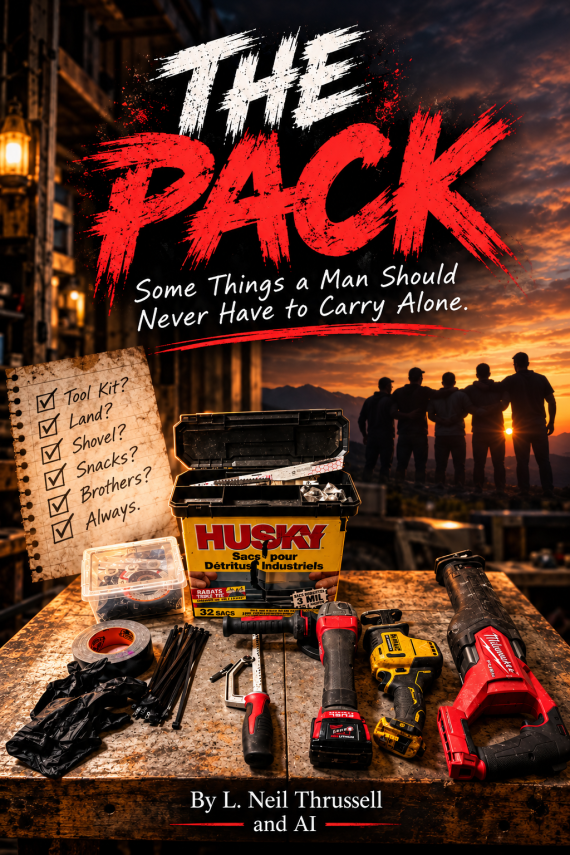
Oh shit. Stefan appeared next. Congratulations. Gavin stared at the screen. Get out. Stefan had a fifteen-year-old son. He was therefore, Gavin decided, temporarily disqualified from offering opinions. The messages began arriving. Franklin offered condolences. Dominic asked whether the young man had been properly vetted. Someone suggested references. Another asked whether Gavin had conducted a background check. Gavin found himself laughing. Then inspiration struck. He walked into the garage. Ten minutes later he returned with a photograph. He had arranged an absurd collection of tools and supplies across his workbench.
There were work gloves, duct tape, zip ties, heavy garbage bags, hand tools and enough power equipment to make the photograph look far more sinister than any individual item had a right to look. He posted the picture. Toolkit assembled. Dominic responded almost immediately. I’ve got land. Gavin burst out laughing. Franklin followed. I’ve got a shovel. Another message appeared. Good shovel, too. Gavin typed: Of course you do. Franklin replied: Man needs a good shovel. Dominic returned. My land’s outside the city. Private. Franklin asked: How’s the soil?
Dominic answered: What kind of question is that? I’m the guy with the shovel. Soil matters. Stefan finally intervened. You people need professional help. Gavin answered: This IS the professional help. Someone volunteered a truck. Someone else offered an alibi so ridiculous that it immediately collapsed under questioning. One of the men volunteered snacks. Gavin stared at that message. Snacks? Could be a long night. For several minutes, the Pack descended into complete foolishness.
Gavin laughed until his stomach hurt, which was precisely what the men intended. They weren’t planning anything. They were standing beside a father whose little girl had suddenly become sixteen. Sometimes brotherhood looked like that. At seven, the doorbell rang. Gavin was ready. He told himself he wasn’t going to be intimidating. He wasn’t going to interrogate the boy. He wasn’t going to become one of those fathers who stood in the doorway trying to terrify a sixteen-year-old kid simply because biology had finally arrived at his house.
Then he opened the door. The boy looked about sixteen. That didn’t help. He was clean-cut, polite and visibly nervous. That helped considerably. “Mr. Gavin ” Gavin almost corrected him but decided Mr. Gavin had a certain authority to it. “That’s me.” The boy offered his hand, and Gavin shook it. Firm handshake. Eye contact. Another point in the kid’s favour. His daughter appeared behind him.
“Dad.” “What?” “You’re doing the thing.” “What thing?” “The dad thing.” “I’m standing.” “You’re standing aggressively.” Gavin heard laughter behind them. His fourteen-year-old had emerged from her room specifically to witness the execution. “He’s totally doing the dad thing.” “Thank you for your support,” Gavin said. “Anytime.” The boyfriend looked uncertain whether he was permitted to laugh. Gavin decided to show mercy.
“What time will you have her home?” His daughter answered before the boy could. “Eleven.” Gavin looked at the young man. “Eleven?” “Yes, sir.” Sir. Another point. “Have fun.” His daughter stared suspiciously at him. “That’s it?” “That’s it.” She kissed him quickly on the cheek. “Love you.” “Love you too.” Then they left. The door closed. Gavin stood looking at it. His fourteen-year-old remained beside him for a moment.
“You okay?” “I’m fine.” “You look weird.” “Thank you.” She shrugged and disappeared back toward her room. Gavin remained by the door a little longer than necessary. His phone vibrated. A private message from Franklin You okay? Gavin smiled. Of course. The Pack could smell blood in the water. He typed Yep, stared at it and deleted it. He tried again. Just being a dad. He deleted that too. Finally, he typed the truth. No. Franklin’s response arrived quickly. Talk. Gavin sat down. For a moment he didn’t know what to write.
Nothing was wrong. His daughter was healthy. She was happy. The boy had been respectful. Nobody had done anything wrong. Yet something inside Gavin hurt. He began typing. She walked out that door tonight and I realized she’s not my little girl anymore. He stopped, stared at the words and added: I swear she was six yesterday. Franklin didn’t answer immediately. When he did, the message surprised Gavin First time my daughter drove somewhere alone, I stood in the garage afterward and cried. Gavin smiled.
Seriously? Yep. Why? There was a pause before Franklin’s answer appeared. Because she didn’t need me sitting beside her anymore. Gavin stared at the words. There it was. The boyfriend wasn’t really the problem. Time was. Gavin returned to the group chat. Serious question. The foolishness stopped almost instantly. Dominic responded. Go. Gavin hesitated before typing. How do you know when to stop protecting them?
The chat went silent. Typing bubbles appeared, disappeared and appeared again. These were men who could talk for hours about business, marriage, masculinity, responsibility, purpose and personal growth, yet Gavin had managed to silence them with nine words.
Finally Franklin responded. I don’t think you stop. I think you change what protecting means. Gavin leaned back. Dominic joined in. When they’re little, you stop them from falling. When they’re older, sometimes you have to let them fall and make sure they know where home is. That one landed. Especially home. Divorce had changed Gavin’s relationship with that word. His daughters had two homes now. Two sets of routines. Two places where clothes accumulated. Two bedrooms. Two refrigerators. Weekends like this mattered to him more than he usually admitted.
Sometimes he hated how quickly Sunday arrived. He had become conscious of time in a way he hadn’t been before the divorce. A weekend could disappear frighteningly fast when you knew exactly when your children were leaving again. Now even the weekends were changing. Boyfriends. Friends. Jobs would eventually come. University. Lives that didn’t organize themselves around time with Dad. The Pack continued talking. One father admitted that whenever his daughter brought him a problem, his instinct was to solve it. He would make a plan and tell her exactly what she should do until one evening she’d stopped him.
“Dad, I don’t need you to fix this. I need you to listen.” It had hurt, not because she’d been disrespectful, but because fixing things was how he’d always understood love. Another man admitted he’d hated his daughter’s first boyfriend even though the kid hadn’t actually done anything wrong. Eventually he realized he didn’t hate the boy. He hated what the boy represented. Change. Then someone wrote: I’m afraid my daughter will someday choose a man like I was at twenty. Nobody joked. The Pack knew his history.
They knew the younger man he was talking about. They knew about the anger, selfishness, drinking and years it had taken him to become someone different. Gavin stared at the screen. Then Stefan appeared. Can I say something from the other side? Gavin replied: You have a son. Your opinion remains suspicious. Stefan ignored him. My boy’s fifteen. In a couple of years some father might be having this exact conversation because my son showed up at his front door. The chat went quiet. Then Stefan wrote: Maybe my job is to raise the kind of young man a father doesn’t need to be afraid of.
Gavin sat very still. The sentence shifted something. All evening they’d been talking about protecting daughters from boys. Stefan reminded them that there was another side of the front door. Somebody had to raise the boys. Stefan’s responsibility was to raise a son who understood boundaries and respect. A young man who knew that strength wasn’t domination, that affection never created entitlement and that another person’s trust was something sacred. A young man who could be trusted when nobody was watching. Perhaps that was part of the bargain fathers made with one another without ever speaking it aloud.
I’ll teach my daughter what she’s worth. You teach your son how to recognize it. Gavin typed: Well, shit, Stefan Stefan responded: That’s the nicest thing you’ve said to me tonight. At ten fifty-three, Gavin heard a car outside. He didn’t move immediately. At ten fifty-five, the front door opened. His daughter stepped inside. “Hey, Dad.” “Hey.” She locked the door behind her. Gavin glanced at the clock. Five minutes early. The boy had just earned several points. His mind immediately produced the questions. Where did you go?
What did you do? Who was there? Did he treat you properly? When are you seeing him again? Instead, Gavin remembered Franklin He remembered Dominic He remembered Stefan “Good night?” His daughter’s face changed. She smiled. “Yeah. Really good.” “Good.” She started toward the hallway, then stopped. “You don’t want to know where we went?” Gavin shrugged.
“I figured you’d tell me if you wanted to.” She narrowed her eyes. “Who are you?” “What?” “And what have you done with my father?” Gavin laughed. She came back and sat beside him. Then she started talking. Gavin listened. Actually listened. He didn’t wait for an opening to offer advice. He didn’t construct solutions in his head. He didn’t examine every sentence for evidence of danger. He simply listened while she told him where they’d eaten, something funny the boy had said, something embarrassing that happened when they ordered, and a movie they wanted to see.
She was happy. That was the hardest part. And the most beautiful. She wasn’t being taken away from him. She was becoming herself. At some point she stopped talking. “What?” Gavin hadn’t realized he was staring. “Nothing.” “Dad.” He smiled. “I’m trying to figure out when you grew up.” She rolled her eyes. “I’m sixteen.” “Exactly. Last Tuesday you were six.” “That’s not how time works.” “That’s exactly how time works when you’re a father.” She shook her head, smiling, then moved closer and rested her head against his shoulder.
Gavin didn’t move. For several seconds neither of them spoke. He remembered a much smaller head resting in exactly the same place. He remembered scraped knees, bedtime stories and small fingers wrapped around his. For those few seconds, she was sixteen and six simultaneously. Then she stood. “Night, Dad.” “Goodnight, sweetheart.” “Love you.” “Love you too.” She disappeared down the hallway. Gavin remained where he was for a while. Then he opened the Pack. Stand down, gentlemen. Boy returned her safely. Five minutes early. Franklin answered immediately.
Shovel returning to shed. Dominic Land remains available. Stefan You guys are disturbed. Gavin smiled. Then he typed something else. I figured out what I’m scared of. The Pack waited. I’m scared she won’t need me anymore. No humour followed. No one tried to rescue him from the vulnerability or bury it beneath advice. They let the truth sit there. Finally Franklin responded. She won’t need you the same way. That’s not the same as not needing you. Gavin read it three times. Maybe protection did change.
When children were little, protection was obvious. Hold their hands crossing the street. Check beneath the bed for monsters. Bandage scraped knees. Carry them from the car when they fell asleep. Stand between them and anything dangerous. Eventually protection had to become something else. He couldn’t choose his daughters’ friends or whom they loved. He couldn’t prevent every broken heart. He couldn’t eliminate every mistake without also eliminating their freedom. He couldn’t demand that they remain little simply because some part of him wasn’t ready for them to grow.
Perhaps protection became teaching them their worth. Giving them somewhere safe to tell the truth. Listening without immediately judging. Being available without controlling. Keeping the light on and making damn sure that wherever life took them, they knew there was a place where they could come home. Gavin understood something else. Fatherhood was a long sequence of letting go. The first day of school. The first sleepover. The first time they crossed the street without his hand. The first time they drove away. The first boyfriend.
Eventually there might be university, careers, homes and families of their own. A thousand tiny departures. If he did his job properly, his daughters would eventually build lives that didn’t require him standing beside them every moment. That wasn’t his failure as a father. That was the assignment. Gavin looked at the Pack’s messages and thought about these ridiculous men. Dominic with his imaginary disposal acreage. Franklin and his damn shovel. Stefan raising the fifteen-year-old boy who would someday stand nervously at another father’s front door.
They had entered a business development workshop hoping to build stronger businesses and somehow ended up building something far more difficult to measure. A place where they didn’t have to perform. A place where the masks could come off. A place where a man could admit that he was frightened without anyone thinking him less of a man. They had watched one another win, and they had watched one another fail. Neither changed the agreement. When one fell, the others came. Gavin typed: Love you, brothers.
The responses arrived. Love you too. Always. We’ve got you. Then Franklin added: Still keeping the shovel handy. Gavin laughed, but his eyes were wet. The shovel had never been about digging anything. Dominic’s land had never been about hiding anything. Even Gavin’s ridiculous toolkit had never really been about his daughter’s boyfriend. It was their language. Crude sometimes. Dark occasionally. Completely inappropriate fairly often. Underneath it was something profoundly simple. They saw him. He could tell the truth here. He didn’t have to pretend he was okay.
If something became too heavy, there were other hands willing to carry part of it. That was the Pack. The next morning, Gavin was making coffee when his fourteen-year-old wandered into the kitchen. Her hair was everywhere, and she wore pyjama pants and one of Gavin’s oversized sweatshirts. “Morning.” “Morning.” She opened the refrigerator and stared into it as though food might spontaneously appear if she waited long enough.
“Dad?” “Yeah?” She continued staring into the refrigerator. “There’s this boy at school…” Gavin stopped pouring coffee. Very slowly, he put the pot down. His daughter looked over. “You okay?” Gavin reached for his phone and opened the Pack. Gentlemen. Three dots appeared almost immediately. Dominic Land’s still available. Franklin Shovel never made it back to the shed. Stefan You people seriously need therapy. Gavin looked at his daughter, then at the phone. He smiled and typed: Stefan this IS our therapy. His daughter stared at him.
“What?” “Nothing, sweetheart.” Gavin put the phone face down on the counter. The joke was finished. The father wasn’t. He pulled out the chair beside him. “Tell me about the boy.” She sat down. Gavin wrapped both hands around his coffee and listened.
AUTHORSHIP & AI ACKNOWLEDGEMENT
The story concept, creative direction, characters, tone, and original writing are by L. Neil Thrussell.
Artificial intelligence was used as a collaborative creative and editorial tool, including story-development suggestions, assistance with the complete editing process, and creation of the visual cover artwork.
The human author guided the story’s intent, humour, emotional balance, revisions, and final creative decisions. AI served as a writing, visual, and editorial assistant in bringing that vision to the page.