
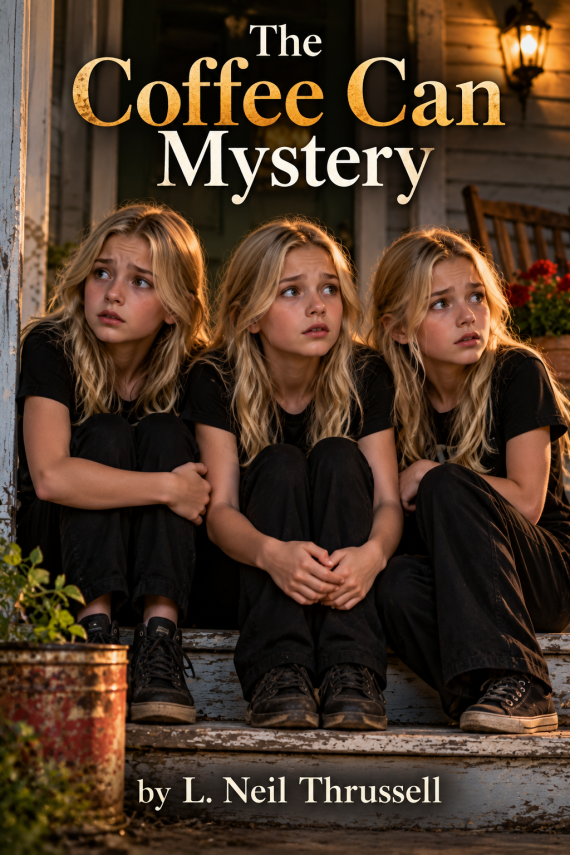
The Coffee Can Mystery
By L. Neil Thrussell and AI
Chapter One: The Book on the Shelf
The rain had been falling since breakfast, the kind of steady summer rain that turned the windows grey and made the world beyond them seem like an unfinished watercolour. For most thirteen-year-olds, a Saturday trapped indoors might have been a disappointment. For Abigail, Alice, and Cassandra Harper, it was an opportunity to spend an entire day doing what they enjoyed most, creating things together.
The girls were identical triplets, born by Caesarean section exactly one minute apart. Abigail, whom everyone called Abby, had arrived first. Alice followed a minute later, and Cassandra, or Cassie, entered the world precisely two minutes after her eldest sister.
Abby occasionally reminded the others that she was the oldest, particularly when she thought her opinion deserved greater consideration.
"Two minutes," Cassie would remind her. "You have exactly two minutes more life experience than I do."
"Experience is experience," Abby would reply.
Alice, who occupied the middle position in both birth order and most arguments, generally suggested they find something more productive to discuss.
Although their faces were almost indistinguishable to strangers, their personalities were remarkably different. Their parents could identify each daughter by the sound of her footsteps, the way she tilted her head, or the particular expression she wore when she was thinking.
Abby was a gifted painter. Her watercolours captured emotions in ways that sometimes surprised the adults who saw them. She had an unusual sensitivity to other people’s feelings and often recognized sadness, embarrassment, or worry before anyone said a word.
Alice was an exceptional sketch artist with a remarkable visual memory. She could glance at a building and later reproduce its proportions, windows, and architectural details with extraordinary accuracy. She noticed things most people overlooked, including small changes in familiar places.
Cassie loved mathematics, technology, and anything involving construction. She created sculptures from discarded materials, built miniature working models, and kept detailed records of her projects. Her bedroom contained enough wires, tools, and mechanical parts that her father occasionally wondered whether she was constructing a small spacecraft.
All three were exceptionally intelligent. They were also naturally, profoundly shy.
Their teachers had learned that the girls’ reluctance to speak in class had nothing to do with their abilities. They simply disliked attention, especially from people they didn’t know well. Large gatherings exhausted them, and the thought of making small talk with strangers could make them uncomfortable for hours beforehand.
There was nothing tragic behind their shyness. Nothing had happened to make them withdraw from the world. They had simply been born with quiet temperaments and were happiest in the company of people they trusted.
Their older brother, seventeen-year-old Matthew Harper, was outgoing, protective, and accustomed to being outnumbered. He worked Saturdays at a sporting goods store and drove a second-hand car. He teased his sisters about their shyness, but he was always the first to stand up for them.
At home, however, they were entirely different. They laughed, debated, teased one another, and sometimes talked so quickly that their father claimed listening to them was like trying to follow three radio stations broadcasting simultaneously.
Their father, Daniel Harper, was forty-nine and approaching his fiftieth birthday with considerably less enthusiasm than his daughters thought appropriate.
Daniel also lived with his ex-wife.
Rachel and Daniel had divorced three years earlier, but neither had moved out of the family home. What began as a temporary arrangement involving finances and the practical challenges of raising four children had gradually become their everyday reality.
They had separate bedrooms, separate routines, and a collection of boundaries that occasionally shifted without warning. Some days they behaved like old friends. Other days, a disagreement about dishes in the sink could reopen an argument that had supposedly ended years earlier.
Their marriage had ended, but their commitment to their daughters had not.
The girls understood that their parents no longer loved each other as husband and wife. They also knew, without question, that both parents loved them.
On that rainy Saturday, the triplets were exploring the bookshelves in their father’s study. Alice was looking for an illustrated book about prairie architecture. Cassie had discovered a broken mechanical pencil and was trying to determine why its internal mechanism no longer worked. Abby sat cross-legged on the carpet, examining a collection of old family photographs.
"Look at Dad," Abby said, holding up a picture. "He had hair."
Cassie glanced over. "He still has hair."
"Not that much."
Alice smiled without looking up from the shelf. "You should see his graduation picture. He looks like a frightened sheep."
The girls laughed.
Their father had grown up near Millhaven, a small prairie community in Alberta. As a teenager, he’d spent his summers working on neighbouring farms, earning money by repairing fences, hauling hay, cleaning equipment, and doing whatever else needed doing.
One of his favourite family stories concerned the summer he turned sixteen and lost nearly every dollar he’d earned. The story always began with a coffee can.
Daniel had saved his wages in an old metal coffee tin because, at sixteen, he believed that hiding money was considerably safer than trusting it to a bank. He had wrapped the money in plastic, placed it inside the can, and buried it on the farm where he worked.
Then his family had moved away unexpectedly. By the time Daniel had an opportunity to return, the farm had changed hands within the Peterson family, and his teenage hiding place had become little more than a vague memory.
Over the years, the story had become a family joke.
"Somewhere in Alberta," Daniel would announce whenever the subject of lost money came up, "there’s a coffee can full of my hard-earned fortune."
"How much?" the girls would ask, although they already knew the answer.
"Three hundred and eighty-six dollars and seventy-five cents."
"And how much would that be today?"
"Enough to make your old father very happy."
He never explained exactly where he’d hidden it. He always said the place had changed so much over the years that finding it would be impossible. Of course, there was also a very good chance he simply couldn’t remember where he’d buried the darn thing, although he was never particularly eager to admit that possibility.
Alice pulled a battered hardcover novel from the bottom shelf. Its spine was cracked, and its pages had yellowed with age. As she opened it, a small folded piece of paper slipped from between the back cover and the final page.
She picked it up and unfolded it carefully. Someone had written an address in faded blue ink.
R.R. 2, Willow Creek Road, near Millhaven.
Beneath it were three words.
Remember the can.
Alice stared at the note before calling softly to her sisters. Within seconds, all three were sitting together on the carpet, studying the handwriting.
"That’s Dad’s writing," Abby said.
Cassie examined the paper. "It looks old enough."
Alice turned it over. There was nothing on the back.
"Remember the can," Abby repeated.
For several moments, nobody spoke. Then Cassie smiled.
"Oh."
Alice looked at her. "Oh, what?"
Cassie tapped the address. "I think we just found the beginning of Dad’s coffee can mystery."
Chapter Two: Operation Coffee Can
The girls spent the next five evenings planning. They waited until their parents had settled into their usual routines before gathering in Cassie’s bedroom, where her computer occupied one corner of a desk otherwise crowded with sculptures, wires, tools, and unfinished inventions.
The address was their starting point, but it presented several problems. Rural route designations had changed over the decades, and Millhaven had lost much of what once made it a thriving little community. The railway station was gone, the grain elevator had been demolished, and the former general store had become a private residence.
Cassie searched historical maps and county records. Alice studied aerial photographs, comparing them with the landmarks their father had described over the years. Abby made a list of people who might remember the farm or the Peterson family.
They discovered that Willow Creek Road still existed, although it was now identified on county maps as Township Road 284. Several farms stood along its length, including one property that appeared to match their father’s descriptions.
There was a creek, the remains of an old farmyard, and a large cottonwood tree near what appeared to be an abandoned building foundation.
"That’s it," Alice said, pointing at the screen.
Cassie leaned closer. "You can’t know that for certain."
"Dad said there was a cottonwood with three trunks growing together. Look."
Cassie enlarged the satellite image. Three thick trunks appeared to rise from a single enormous base.
Abby clasped her hands together. "What if it’s still there?"
"The tree?" Cassie asked.
"The can."
Nobody answered immediately. The possibility was almost too wonderful to consider.
Their father had worked hard for that money. Even though three hundred and eighty-six dollars wasn’t a fortune anymore, the idea of returning something he’d lost as a boy filled them with excitement.
The next question was how to get there. Their family lived in a town about forty kilometres away. A regional bus travelled to Millhaven on Saturdays, with one service in the morning and a return trip in the afternoon. From the bus stop, they would have to walk several kilometres along country roads.
Cassie calculated distances, estimated walking times, and prepared a timetable. Alice drew a detailed map, including landmarks that might help them recognize the property. Abby packed a small first-aid kit and insisted they carry extra water and food.
They contributed money from their savings for bus fares and emergencies. Their plan was impressively detailed.
Unfortunately, it was missing one rather important consideration. Their parents had no idea what they were doing. Neither did Matthew. They considered telling him, but knew he would either tell their parents or insist on coming along. They wanted the surprise to belong to the three of them.
"We could tell Mum," Abby suggested one evening.
Cassie shook her head. "Then she’d tell Dad."
"Maybe we could ask her not to."
Alice considered this. "She’d want to know why three thirteen-year-old girls needed to travel forty kilometres into the countryside."
"That’s a reasonable question," Abby admitted.
"And then she’d probably want to come," Cassie added. "Which would ruin the surprise."
They sat quietly for a moment.
"We’re not doing anything dangerous," Alice said eventually. "We’re taking a bus, walking to a farm, asking permission to look around, and coming home."
Abby frowned. "What if nobody’s there?"
"Then we come home."
"What if we can’t find the place?"
"Then we come home."
"What if someone asks why we’re there?"
Cassie looked at her sisters. "Then we tell them the truth."
Abby sighed. "That means talking to people."
All three considered this considerably more troubling than travelling forty kilometres into the countryside.
They practised. Cassie pretended to be a shopkeeper while Abby asked for directions. Alice played a suspicious farmer who wanted to know why three strangers were wandering around his property. They rehearsed introducing themselves, explaining their father’s story, and asking permission to search.
After the fourth attempt, Abby collapsed backward onto the bed.
"I hate this."
"You were very good," Alice assured her.
"I sounded like a frightened mouse."
Cassie smiled. "A very polite frightened mouse."
Abby threw a pillow at her.
They also discussed what could go wrong. Cassie had downloaded maps to her phone in case the mobile signal disappeared. Alice suggested carrying a printed copy as backup. Abby reminded them to stay together and never accept a ride from anyone they didn’t know.
It was a remarkably sensible plan for three thirteen-year-olds. Except for the part where they were sneaking away without permission.
Cassie was particularly confident about their return journey. Her spreadsheet allowed nearly an hour between their expected arrival back in Millhaven and the afternoon bus.
Alice pointed out that an hour could disappear quickly if they got lost. Cassie insisted that was why she’d included extra time.
Abby looked at the schedule and wondered whether they were making a mistake. But the thought of presenting their father with his long-lost money pushed the worry aside.
By Friday evening, everything was ready. Three backpacks stood beneath Cassie’s desk. Three lunches were packed. Three water bottles waited in the refrigerator.
And three thirteen-year-old girls went to bed imagining the look on their father’s face when they returned with his childhood treasure.
Chapter Three: The Great Adventure
Saturday arrived bright and warm. Daniel was working in the garage, repairing a lawn mower that had developed a stubborn refusal to start. Rachel had left early to visit her sister and wasn’t expected home until late afternoon. Matthew was working at the sporting goods store.
The girls ate breakfast together, trying to appear as ordinary as possible. Daniel barely noticed their unusual enthusiasm.
"What’s everyone doing today?" he asked.
"Art," Alice answered.
"Reading," said Abby.
"Research," Cassie added.
Daniel smiled. "Sounds like a typical Saturday."
Cassie decided that none of them had technically lied. They had certainly done research, Alice had brought her sketchbook, and Abby had a novel in her backpack.
At nine fifteen, while their father was struggling with a spark plug, the sisters slipped out through the back door. They walked quickly toward the bus stop, their backpacks bouncing against their shoulders.
For the first several blocks, nobody spoke. Then Abby began giggling.
Cassie looked at her. "What?"
"We’re actually doing it."
Alice smiled. "We’re actually doing it."
The bus arrived six minutes late. The driver, a cheerful woman with silver hair, studied the three identical faces as they climbed aboard.
"Well, aren’t you three a sight."
All three girls blushed.
"Triplets?" she asked.
They nodded.
"Going somewhere exciting?"
Cassie looked at Alice. Alice looked at Abby. Abby stared at the floor.
Finally, Cassie managed, "Millhaven, please."
The driver accepted their fares and smiled. "Well, enjoy your adventure."
They found seats near the back.
Abby leaned toward her sisters. "That was awful."
"You said two words," Alice whispered.
"Exactly."
The journey took forty-five minutes. The girls watched familiar neighbourhoods give way to open fields, scattered farmhouses, and long stretches of prairie.
Alice sketched a weathered barn they passed. Cassie checked their location on her phone. Abby watched clouds drifting above the fields.
For the first time in their lives, they were travelling somewhere entirely on their own. It felt wonderful. And slightly terrifying.
At Millhaven, they stepped off the bus beside a small convenience store and watched it disappear down the highway.
The town was quieter than they’d expected. Several buildings stood empty, their windows dusty and their paint peeling. A faded sign advertised a café that had closed years earlier.
Cassie checked her map.
"We need to go north."
Alice pointed toward a gravel road. "That way."
They began walking. Twenty minutes later, they reached an intersection that didn’t appear on Cassie’s printed map.
Cassie checked her phone. The signal had disappeared, although her downloaded map was still available. Unfortunately, it showed two roads that looked almost identical, and neither was labelled clearly.
"That’s inconvenient," she said.
Alice studied the landscape.
"We should have turned at the old school."
"There wasn’t an old school."
"There was a building that used to be a school."
Cassie frowned. "How do you know?"
"Because it had a bell tower."
"Lots of buildings have bell towers."
"Not usually with a playground behind them."
Abby looked from one sister to the other. "Are we lost?"
Cassie considered the question. "Not exactly."
"What does that mean?"
"It means we know where we are. We just don’t know where we’re supposed to go."
Abby sighed. "That sounds exactly like lost."
A pickup truck approached, slowing as it reached the intersection. An elderly man rolled down his window.
"You girls all right?"
The sisters froze. Three intelligent minds, capable of solving complex problems, suddenly became incapable of producing a simple sentence.
The man waited patiently. Finally, Alice held up her map.
"We’re looking for Willow Creek Road."
He leaned out to examine it.
"Well, you’re a little turned around. You want the next road east, then north past the old Peterson place."
Alice nodded. "Thank you."
The man smiled. "You’re welcome. Be careful walking out here. Folks aren’t expecting pedestrians."
He drove away. For several seconds, the girls stood silently.
Then Cassie whispered, "That went well."
Abby stared at her. "You didn’t say anything."
"I was providing moral support."
"From behind me?"
"Strategically positioned moral support."
Alice laughed, and the tension dissolved.
They followed the man’s directions, but the distance proved greater than Cassie had estimated. The gravel road stretched ahead through open farmland, and the afternoon sun grew warmer. Twice they stopped to rest and drink water.
By the time the Peterson farmhouse came into view, they were more than an hour behind schedule. Cassie checked her watch and frowned. They would have to be quick.
Chapter Four: The Empty House
Back home, Daniel finally persuaded the lawn mower to start. He checked his watch. Almost noon.
He switched off the engine, wiped his hands on a rag, and walked into the house.
"Girls! Lunch!"
No answer.
He opened the refrigerator, took out sandwich ingredients, and called again.
"Abby? Alice? Cassie?"
The house remained silent. He climbed the stairs and checked their rooms. Their beds were made, their art supplies were scattered across their desks, and the usual collection of books lay open on various surfaces.
But the girls were nowhere to be found.
Daniel checked the backyard, basement, and garage. Their bicycles were still hanging on the wall.
He called Rachel.
"Are the girls with you?"
"No. Why?"
"I can’t find them."
"Have you checked their rooms?"
"Of course I’ve checked their rooms."
Rachel heard something in his voice.
"Daniel, what’s wrong?"
"I don’t know."
There was a pause.
"You were home with them, Daniel."
"I was working in the garage."
"For how long?"
"I don’t know. A couple of hours."
"Three thirteen-year-old girls walked out of this house, and you didn’t notice?"
"Rachel, they’re thirteen, not three."
"They’re our daughters!"
"I know exactly who they are!"
The words came out sharper than he’d intended. For a moment, neither spoke.
Then Rachel said, "I’m coming home."
She ended the call. Daniel stood in the kitchen, staring at his phone.
Their marriage had ended partly because of conversations like that. Rachel worried, Daniel withdrew, Rachel pushed harder, and Daniel became defensive. Somewhere along the way, they’d stopped hearing what the other was actually saying.
He tried calling Abby’s phone. No answer. Alice’s went straight to voicemail. Cassie’s call failed to connect.
He checked their shared family location app, but all three phones showed outdated locations near home. Whatever information the app had was hours old.
Daniel stood looking at the three untouched lunch plates. A cold thread of fear tightened around his chest.
He called Matthew at work. His son answered cheerfully, but the cheer vanished as soon as Daniel asked if he knew where his sisters were.
"Not since breakfast," Matthew said. "Why?"
"They’re gone, Matt. Their phones aren’t answering. I’ve looked everywhere."
"Gone? What do you mean, gone?" Matthew asked, his voice rising. "Did you check the library?"
"Yes."
"The park?"
"Yes."
Matthew fell silent. "Dad, they wouldn’t leave without telling someone."
"I know, son."
"I’m coming home."
Daniel told him to drive carefully. After he hung up, he found that his hands were shaking.
He called their closest neighbours. Nobody had seen them. He checked the park, the library, and the little art supply shop where they occasionally spent their allowance.
Nothing.
By one o’clock, Daniel was driving through the neighbourhood, searching sidewalks and playgrounds. By one thirty, Rachel had returned home. Matthew arrived shortly afterward, pale and still wearing his work shirt.
She met him in the driveway.
"Anything?"
He shook his head. "Nothing."
"Did you call their friends?"
"They don’t really have friends they visit, Rachel. You know that."
"Don’t snap at me."
"I’m not snapping."
"You are."
Daniel opened his mouth, then closed it. There was no point arguing. Not now.
Inside, Rachel began searching the girls’ rooms herself. Daniel followed her upstairs as she opened drawers, checked closets, and looked beneath beds.
"Rachel, I’ve already done all this."
"Then let me do it again."
He stepped back. He understood. Searching gave her something to do.
They checked the girls’ school contacts, called the library again, and asked a neighbour to look around the nearby park. Rachel phoned the regional bus service, but the dispatcher couldn’t immediately confirm whether the girls had boarded a bus.
At two o’clock, they contacted the police.
The officer who arrived listened carefully as Daniel explained that his daughters were thirteen, exceptionally shy, and had never travelled anywhere significant without telling their parents.
"All three are missing?" the officer asked.
Daniel nodded.
"Together?"
"Yes."
The officer made notes.
"Do they have friends they might visit?"
"Not really. They’re close to each other. They don’t usually go out."
Rachel sat beside Daniel, holding a photograph of the girls. Daniel stared at their smiling faces.
His mind had begun producing possibilities he couldn’t bear to consider. A vehicle, an accident, someone offering them a ride.
He stood abruptly.
"I need to keep looking."
The officer spoke gently.
"We’re taking this seriously, Mr. Harper. We’re checking the information you’ve given us, including the bus route. Please stay available in case someone contacts you."
Daniel sat down again. For the first time in years, he felt utterly helpless. Rachel stared at the photograph in her lap and traced the girls’ faces with her finger. Matthew stood near the doorway, watching the street as if he could bring his sisters home simply by refusing to look away.
Daniel remembered breakfast. Three girls at the table. Their ordinary voices. He couldn’t remember whether he’d kissed them goodbye. He could remember every detail of the lawn mower he’d spent the morning fixing, and the uselessness of that memory made him feel sick.
"What if one of them is hurt?" Rachel whispered. "What if the others won’t leave her?" Her voice collapsed. Daniel reached for her hand, but he had no reassurance to offer.
After the officer stepped outside to make a call, Rachel found Daniel sitting on the edge of the couch, staring at the photograph. She sat beside him.
For several minutes, neither spoke.
Then Daniel said quietly, "I keep thinking about the last thing I said to them."
Rachel turned toward him. "What was it?"
"I asked them what they were doing today."
"And?"
"They told me. I just didn’t really listen."
Rachel looked at the photograph.
"We both know those girls. They wouldn’t deliberately hurt us."
"I know."
He rubbed his face. "But what if something happened?"
Rachel reached across the space between them and took his hand. It was the first time she’d done that in months.
It wasn’t a sign that their marriage was being repaired. Neither of them was thinking about their relationship. For that moment, they were simply two frightened parents who needed each other.
Chapter Five: The Farmer
The girls reached the Peterson farm shortly after one thirty. By then, their shoes were dusty, their water bottles nearly empty, and Abby had developed a blister on her heel.
The farmhouse stood behind a row of tall poplars. Its white paint had faded, and an enormous red tractor rested beside a machine shed.
An elderly man was working near the shed when the girls approached. He straightened and looked at them with obvious curiosity.
"Well, hello there. Can I help you?"
The sisters stopped several metres away. Alice swallowed. Cassie adjusted her backpack straps. Abby stared at the ground.
Finally, Alice stepped forward.
"Excuse me, sir. Did a boy named Daniel Harper work here about thirty-three years ago?"
The farmer’s eyebrows rose.
"Daniel Harper?"
She nodded.
The man studied her face. "Well, I’ll be."
He removed his cap.
"You’re not his daughters, are you?"
All three nodded.
The farmer began laughing.
"Good heavens. You look just like him. Except there’s three of you."
He introduced himself as Walter Peterson and invited them to sit on the porch while he fetched lemonade.
Within minutes, they were listening to stories about their father as a teenager.
"He was a good worker," Walter told them. "Quiet boy. Didn’t say much. Always saving his money. My father liked him."
The girls exchanged delighted glances.
"That’s still Dad," Abby said softly.
Walter chuckled.
"So what brings you three all the way out here?"
Alice took the folded paper from her pocket.
"We think he left something here."
Walter examined the note. Then he laughed again.
"That old coffee can?"
The sisters stared at him.
"You know about it?" Cassie asked.
"Of course I do. Your father was convinced somebody was going to steal his wages. Buried that ridiculous thing somewhere near the old barn."
"Do you know where?" Abby asked.
Walter shook his head.
"Afraid not. He wouldn’t tell anybody. Said it was safer that way."
Alice stood and looked toward the fields.
"Where was the barn?"
Walter pointed.
"Over by the creek. Tore it down twenty years ago. The foundation’s still there, though."
Alice followed his gesture. There, rising above the surrounding trees, stood an enormous cottonwood. Three trunks grew from a single base.
Her heart quickened.
"That’s the tree."
Walter looked at her. "What tree?"
"The one Dad always talked about."
Cassie was already unfolding her map.
Walter studied the girls for a moment.
"Before we go wandering around the property, do your parents know you’re here?"
The three sisters exchanged a glance.
"We’re surprising Dad," Abby said.
Walter’s expression became more serious.
"That’s a pretty long trip for three young girls."
"We took the bus," Cassie explained. "And we have a return ticket."
Walter looked at the clock through the kitchen window.
"Well, we’d better not waste time. But we’ll have a conversation about that bus before you leave."
He collected a shovel and accompanied them toward the old barn site.
Alice studied the landscape, comparing it with the descriptions she’d memorized. Cassie measured distances using a length of string she’d packed. Abby searched the ground, looking for anything unusual.
Walter watched them with growing amusement.
"You girls certainly came prepared."
Cassie nodded.
"We made a spreadsheet."
"Did you now?"
"Three, actually."
Walter laughed.
"Your father used to count every penny twice. I see some things run in the family."
The search proved more difficult than they’d expected. The old fence had disappeared, the barn foundation was partly buried beneath weeds, and several decades of prairie weather had changed the ground considerably.
Alice identified what she believed had once been the barn entrance. Cassie calculated the likely position of the old fence line. Walter explained how the property had been laid out when Daniel worked there.
Abby wandered slowly along the edge of the foundation. She wasn’t particularly interested in measurements. She was trying to imagine her father at sixteen, standing beside the barn with a coffee can in his hands.
Would he have chosen a place that was easy to remember? Somewhere he could see from the barn? Somewhere nobody would think to look?
Near a weathered fence post, she noticed a shallow depression partly concealed by grass.
"Alice?"
Her sister hurried over.
"What?"
Abby pointed.
"Doesn’t that look like something was buried there?"
Cassie knelt beside the depression and examined the ground. Walter fetched the shovel.
"Well, let’s see what we’ve got."
He dug carefully, removing small amounts of soil at a time. Six inches down, the shovel struck something solid.
All three girls gasped.
Walter knelt and brushed away the dirt. A rusted metal lid appeared. Then the curved side of a container.
An old coffee can.
For several seconds, nobody moved. Then Abby let out a joyful scream.
"We found it!"
Cassie grabbed Alice’s hand. Alice threw her arms around Abby, and all three began laughing and hugging one another.
Walter watched with a broad smile.
"Well, I’ll be darned."
The can was badly rusted, but its lid remained in place. Walter carried it back to the porch, where they carefully worked it open.
Inside was a thick bundle wrapped in layers of old plastic. The wrapping had become brittle, but it had protected the contents surprisingly well.
Cassie carefully separated the banknotes and coins. Some of the paper money was discoloured, and the coins had tarnished, but the amount was unmistakable.
Three hundred and eighty-six dollars and seventy-five cents.
Exactly what their father had always claimed.
Alice found an envelope tucked inside the wrapping. Written across the front, in the awkward handwriting of a sixteen-year-old boy, were four words.
To My Future Self.
Abby wiped tears from her cheeks.
"Dad’s going to be so happy."
They spent several more minutes examining the contents, asking Walter questions, and listening as he remembered the summer Daniel had worked on the farm.
By the time Cassie checked her watch, the afternoon had slipped away. Her smile vanished.
"Oh, no."
"What?" Alice asked.
"It’s three forty-five."
Alice stared at her.
"The bus."
Cassie nodded.
"The last bus left twenty minutes ago."
Chapter Six: The Phone Call
Walter listened as the girls explained their predicament. He had suspected they were travelling without adult supervision, but he’d been so caught up in the excitement of finding the can that he’d allowed the afternoon to pass without pressing the matter.
Now he looked at three frightened thirteen-year-olds who were stranded more than forty kilometres from home.
"Does your father know you’re here?"
Silence. The girls looked at one another.
Walter sighed. "Oh, girls."
Abby’s eyes filled with tears.
"We wanted to surprise him."
Walter’s expression softened.
"Well, I imagine you’ve succeeded. But I suspect he’s going to be considerably more worried than surprised."
He took out his phone.
"What’s his number?"
Cassie recited it. Walter dialled.
Back home, Daniel was standing beside the kitchen window when his phone rang. An unfamiliar number appeared on the screen.
He answered immediately.
"Hello?"
"Is this Daniel Harper?"
"Yes."
"My name’s Walter Peterson. I believe we knew each other a long time ago."
Daniel frowned.
"Walter?"
"That’s right."
"What’s going on?"
Walter glanced toward the porch, where three girls sat close together, suddenly looking very small.
"Daniel, I’ve got three young ladies here who I believe belong to you."
Daniel gripped the phone.
"What?"
"Your daughters. They’re safe."
For a moment, Daniel couldn’t speak. His knees weakened, and he lowered himself into a chair. He tried to speak but could manage only a broken sound. Rachel hurried to him.
"Daniel, please. What is it?"
He covered the phone. "They’re alive, Rach. All three. They’re safe."
Rachel folded over the kitchen counter, crying with the force of everything she’d been holding back. Matthew pressed both hands over his face and sank onto the stairs.
"Are they hurt?"
"No. Just tired and a little dusty."
Daniel closed his eyes. Behind him, Rachel was already reaching for the phone.
"Where are they?" she asked.
"Out at my farm."
Daniel stared at the wall.
"Your farm?"
"Yes."
"Forty kilometres away?"
"Afraid so."
Daniel pressed a hand over his face.
"Why?"
Walter looked toward the porch.
"Well, Daniel, I think you’d better come see for yourself."
Rachel took the phone and asked to speak to the girls.
Abby answered first.
"Mum?"
Rachel closed her eyes.
"Oh, sweetheart."
"We’re sorry."
"I know. Are you all right?"
"Yes."
"Are your sisters with you?"
"Yes."
Rachel swallowed.
"All three of you stay right there. We’re coming to get you."
After ending the call, Daniel contacted the police to explain that the girls had been found safe. Then he and Rachel left for Millhaven, with Matthew following in his own car.
Neither said much as they drove. They were relieved. They were angry. And they were both still frightened by how close they’d come to imagining a life without their daughters.
Chapter Seven: The Longest Drive
Daniel drove faster than he normally would have, although Rachel repeatedly reminded him to slow down.
He couldn’t understand how three girls who were usually reluctant to speak to a cashier had managed to travel forty kilometres into the countryside without telling anyone.
Rachel stared out the passenger window.
"They planned this," she said eventually.
Daniel nodded. "Obviously."
"All three of them."
"Yes."
Rachel shook her head.
"They won’t even order their own food at a restaurant."
Daniel almost smiled.
"Apparently they’ll travel across half the county if they think there’s something worth finding."
The smile faded as quickly as it came.
When they reached the farm, Walter was waiting near the driveway. The girls sat together on the porch.
Three identical faces. Three backpacks. Three pairs of dusty shoes.
Daniel stopped the car. For a moment, he simply stared. Then he climbed out.
The girls stood.
"Dad?"
Abby was the first to run. Alice and Cassie followed.
Daniel dropped to his knees and gathered all three into his arms. For hours he’d imagined terrible explanations for their absence. Now he felt their shoulders beneath his hands and heard Abby sob against his shirt. He held them as if he were afraid the world might take them away again. He held them so tightly that Cassie eventually whispered, "Dad, you’re squishing us."
He didn’t loosen his grip immediately. When he finally pulled back, his eyes were wet.
"Do you have any idea what you’ve put us through?"
The girls stared at him.
"We were worried sick," he continued. "We called the police. We thought something terrible had happened."
Abby’s face crumpled.
"We’re sorry."
Alice began crying. Cassie opened her mouth, then closed it again. For once, the girl who could solve almost any practical problem had no answer.
Rachel knelt beside them.
"You frightened us terribly."
Abby buried her face against her mother’s shoulder.
"We just wanted to do something nice."
Daniel looked at her.
"What?"
Alice turned toward the porch. She picked up the rusty coffee can. Her hands trembled as she carried it toward him.
"We found it, Dad."
Daniel stared. For several seconds, he didn’t seem to understand what he was seeing. Then recognition spread across his face.
"The coffee can?"
Cassie nodded.
"Three hundred and eighty-six dollars and seventy-five cents."
Daniel took the can. He turned it slowly in his hands. The faded red lettering was barely visible beneath the rust.
He remembered buying it. He remembered counting his wages. He remembered digging the hole beside the old fence.
And he remembered the sixteen-year-old boy who had believed that money was the most important thing he owned.
Walter approached quietly.
"Thought you might like to see it again."
Daniel looked up at his old employer.
"After all these years."
Walter smiled.
"Your girls are something else."
Daniel looked at his daughters.
"Yes," he said softly. "They certainly are."
Matthew arrived a few minutes later. He stopped in front of his sisters and stared at each face, as though counting to three might finally convince him they were safe.
"You scared the hell out of me," he said, his voice cracking. Abby hugged him first, and Alice and Cassie joined them. He held all three tightly.
"Next time you go treasure hunting, you take me," he whispered.
"You’d make jokes the whole time," Cassie said.
"Every minute. But I’d know where you were."
For several moments, he examined the can without speaking. Then he placed it on the porch railing and turned back toward the girls.
"I’m glad you found it. I really am. But I need you to understand something."
They looked at him.
"No surprise, no matter how wonderful, is worth making your mother and me think we’ve lost you."
Cassie lowered her head.
"We thought we’d be home before you noticed."
Daniel closed his eyes briefly.
"That’s part of what frightens me."
Rachel placed a hand on Cassie’s shoulder.
"You made a very detailed plan, didn’t you?"
Cassie nodded.
"Three spreadsheets."
Despite everything, Daniel let out a short laugh.
"Of course you did."
Walter chuckled.
"I’ve seen the spreadsheets mentioned. I haven’t had the pleasure of examining them."
The girls smiled faintly.
Then Walter’s expression grew serious.
"Your father and mother are right. You did something remarkable today, but you also took a risk you didn’t fully understand. Those are two different things."
The girls nodded.
Before leaving, Daniel thanked Walter for looking after them. Walter shook his hand.
"Your daughters are good kids, Daniel."
"I know."
"They’ve got some growing up to do."
Daniel looked toward the car, where the girls were climbing into the back seat.
"Don’t we all?"
Chapter Eight: The Letter
That evening, after the tearful apologies, and after a serious family discussion about trust, responsibility, and the importance of telling someone where you were going, all six of them gathered around the kitchen table.
The coffee can sat in the centre. Daniel had washed away some of the dirt, although the rust remained. The banknotes and coins lay on a clean towel beside it.
He carefully unfolded the envelope. The paper inside was yellowed but surprisingly well preserved. He recognized his own handwriting immediately.
He began reading silently. After a few moments, Rachel touched his arm.
"What does it say?"
Daniel swallowed.
"It’s a letter I wrote to myself."
He cleared his throat and began reading aloud.
Dear Future Me,
I hope you have a good job when you read this. Maybe something better than shovelling manure and fixing fences. I hope you have a house that doesn’t leak when it rains, and enough money that you don’t have to worry about every little thing.
I hope you find a girl who likes you and maybe get married. I’d like to have kids someday. Three would be good, I think.
I hope you’re happy.
And if you ever find this letter, don’t forget how hard you worked for this money. It took all summer, and some days I wanted to quit.
I guess that’s all.
Daniel, age sixteen.
The kitchen was silent. Daniel lowered the letter. Rachel wiped her eyes. Matthew leaned forward, resting one hand on the back of Cassie’s chair. Abby reached for Alice’s hand. Cassie stared at the table.
Finally, Alice spoke.
"You wanted three kids?"
Daniel laughed softly.
"Apparently. And I got one more than I asked for," Daniel said, looking at Matthew.
"And you got three," Abby whispered.
He looked at his daughters.
"Yes. I certainly did."
For a long moment, he said nothing. Then he folded the letter carefully and placed it beside the coffee can.
"Girls, when I was sixteen, that money meant everything to me. I worked all summer for it. I thought losing it was the worst thing that could happen."
He paused.
"Today, when I couldn’t find you, I would have given every dollar I’ve ever earned just to know you were safe."
The girls listened quietly.
"I know you wanted to surprise me. And I understand why you thought this was a wonderful idea. But being intelligent doesn’t mean you always understand the consequences of your decisions."
Cassie nodded.
"We know."
"Do you?"
Alice looked up.
"We do now."
Daniel studied their faces. He believed her.
"You’re going to have some restrictions for a while," he said. "And we’re going to have a long conversation about how you plan adventures in the future."
Abby sighed.
"Are we grounded?"
Rachel smiled faintly.
"Let’s just say your next adventure will involve the backyard."
Cassie considered this.
"How long?"
Daniel raised an eyebrow.
"Long enough."
Nobody argued.
After a moment, Daniel reached across the table and took their hands.
"But I want you to know something else."
The girls looked at him.
"I’m proud of you."
Abby’s eyes widened.
"Even though we did something wrong?"
"Yes. I’m proud of how carefully you researched the farm. I’m proud that you worked together. I’m proud that you found the courage to speak to people you didn’t know."
He squeezed their hands.
"And I’m especially proud that you wanted to do something kind for me."
Alice smiled through her tears.
"But next time," Daniel added, "you tell us where you’re going."
All three nodded vigorously.
"Promise," Cassie said.
Rachel looked at Daniel. For a moment, something passed between them.
It wasn’t romance or reconciliation. Their marriage had ended, and neither of them was pretending otherwise.
But they had built a family together, and that family still mattered deeply to both of them.
Daniel looked down at the letter he’d written as a boy. He had hoped for a good job, a comfortable home, and three children.
Life hadn’t unfolded exactly as he’d imagined. His marriage had ended. His hair had thinned. He had bills, responsibilities, and worries that his sixteen-year-old self could never have understood.
But sitting around the kitchen table were four remarkable children, three of whom loved him enough to travel across the countryside in search of an old coffee can.
He smiled. The boy who’d written that letter would have been pleased.
Epilogue: The Painting
Two weeks later, Daniel entered his study and discovered a painting leaning against his desk.
It was a beautiful watercolour of an old prairie farm. A weathered barn stood beside a creek. A great cottonwood tree spread its branches toward a summer sky. Near the fence, three young girls knelt beside a small hole in the earth.
Alice had reconstructed the original farmyard from Walter’s descriptions and the historical photographs they’d found. Cassie had built the frame from reclaimed wood. Abby had painted the scene, giving it the warm colours of a late summer afternoon.
At the bottom, in delicate lettering, were the words:
Some treasures are worth finding. Others are worth coming home to.
Daniel stood looking at the painting for a long time. Then he carried it into the living room and hung it above the fireplace.
The old coffee can sat on the mantel beneath it. The money remained inside.
He never spent a dollar. Not because it was valuable, but because the can had become a reminder of something he didn’t want to forget.
As for Abby, Alice, and Cassie, they returned to their books, their artwork, and their quiet routines.
They were still shy. They still disliked attention. And they still preferred one another’s company to almost anyone else’s.
But something had changed. They had discovered that they could speak to strangers when they needed to, find their way through unfamiliar places, and work together when things didn’t go according to plan.
They had also learned that even the most carefully constructed spreadsheet couldn’t account for everything. Especially worried parents.
Matthew developed a habit of asking where his sisters were going whenever he saw them with backpacks. He made it sound like a joke, but the girls understood why he asked.
Of course, their father insisted that any future adventures begin with one very simple rule.
Tell your parents first.
The girls agreed. Although Cassie did quietly begin researching an old family story about a missing gold watch.
Just in case.
The End
AUTHORSHIP & AI ACKNOWLEDGEMENT
The story concept, creative direction, characters, and original writing are by L. Neil Thrussell.
Artificial intelligence was used as a collaborative creative and editorial tool, including story-development suggestions, assistance with the editing process, and creation of the visual cover artwork.
The human author guided the story’s heart, emotional arc, revisions, and final creative decisions. AI served as a writing, visual, and editorial assistant in bringing that vision to the page.