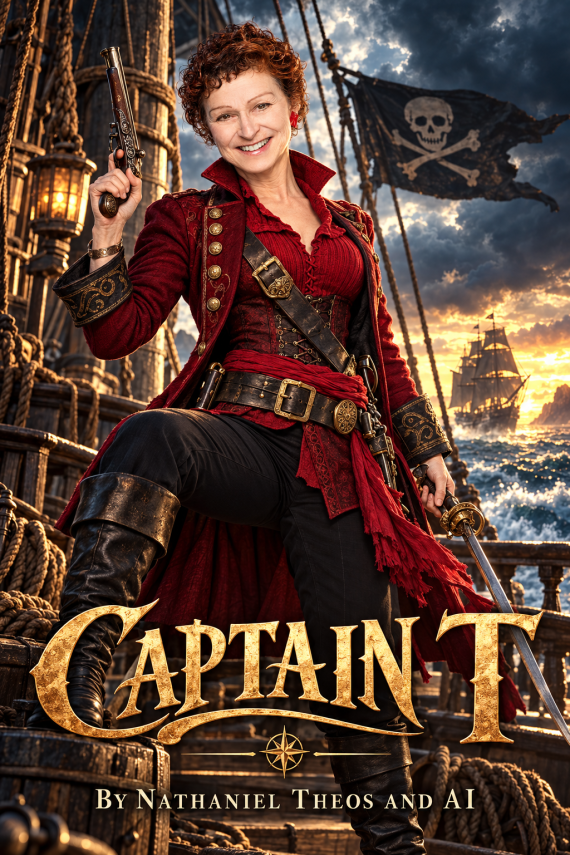
Captain T
By Nathaniel Theos and AI
1. Spanish Town Burns
The first cannonball struck the customs house at six minutes past dawn. The second destroyed the harbour master’s office. The third demolished a tavern Captain T had been rather fond of.
“Bloody waste of a good drinking establishment,” she said.
She stood on the quarterdeck of the Intrepid, her boots planted wide against the recoil of the guns. A red sash crossed her black pantaloons. Two pistols rode at her hips and a longsword hung from a belt far too elaborate for practical seamanship. Her short brown curls escaped a bandana cut from a captured American flag.
The captain was scarcely five feet tall. Her enemies had a regrettable habit of discovering that this made her a smaller target.
“The shore battery’s turning toward us!” Sheila called.
“Then persuade it otherwise. Politely, if you can.”
Forty guns answered. A yellow wall of flame rolled along the starboard side, followed by a thunderclap that shook the entire ship. Through the smoke Captain T watched part of the fort collapse into the harbour.
“There,” she said. “Diplomacy.”
Sheila came up beside her, smelling of tar and powder. The first mate was slight and strong, a sailor who could trim a sail by ear and wield a blade with alarming efficiency. She carried a signal slate.
“The landing party has the cargo. Boats are coming out now.”
“All of it?”
“Not quite.”
Captain T took the glass from her belt. Along the burning waterfront armed sailors were driving a column of chained men toward the boats. There had been one hundred and fourteen on the warehouse register, selected for their pedigree and sold under the euphemism breeding stock. Captain T had waited three months to steal them.
For nine centuries much of the known world had belonged to women. The histories called the revolution justice: men had once treated women as property, and women had repaid the cruelty in kind. Over generations revenge became law and law became ordinary life. In most ports a man could be bought with less paperwork than a horse.
Captain T considered history principally useful for identifying who currently held the money.
“How many aboard?” she asked.
“Seventy-eight. The next boats are loading.”
“Make haste. That smoke will summon every ambitious idiot within twenty miles.”
At the western quay, the shore party had encountered considerably more trouble than planned. A chain stretched across the warehouse gate, and the officer commanding the guards had ordered the keys thrown into the burning customs house. Lieutenant Marisa Fen had solved that problem with a stolen cart and a barrel of powder. Captain T watched the gate come apart through her glass and winced at the unnecessary destruction of perfectly saleable timber.
The longboats emerged from smoke into open water. Each carried armed sailors beside prisoners whose wrists were linked by iron. One boat sat low enough that its gunwale kissed the waves. The coxswain fought to keep its bow toward the Intrepid while men shifted nervously on the thwarts.
“That one’s overloaded,” Sheila said.
“I can see that. Signal her to take water over the stern if she must, but not to turn broadside.”
A bell rang from shore. Then another. The enemy fort had not been entirely silenced, and muskets flashed from a surviving embrasure. The last boat jerked as a ball struck its sternpost. A prisoner fell backward, dragging two companions with him. Sailors threw themselves across the benches to cut the connecting chain. One man vanished beneath the hull before anyone could seize him.
Captain T kept her glass trained on the disturbance. She saw the coxswain haul another prisoner aboard by the collar, then give up searching the wake. Three seconds later the boat pulled away from the quay again.
Sheila lowered her signal slate. “One lost.”
“Mark it in the book,” Captain T said.
Sheila looked at her. “As a casualty?”
“As a loss. You may write whatever word pleases you beside it.”
The first mate did not answer. She crossed to the entry port and supervised the hauling of men aboard, one after another, while the gun crews waited at their pieces. A young prisoner stumbled on the ladder and caught the sleeve of a sailor ordered to keep the men moving with a rope. The sailor steadied him anyway.
Captain T saw that too. She had an eye for every small departure from orders. She noticed, then chose not to comment. There would be ample time later to remind her crew that sentiment was a costly habit.
A mortar shell burst on the far side of the harbour. An answering flash came from the fort, and the air above the Intrepid filled with ragged bits of stone. The captain turned her glass to the headland. There was another reason to hurry, and this one carried enough guns to settle the argument.
A lookout shrieked from the masthead. “Sail northeast! Warship clearing the point!”
Captain T raised her glass. The dark hull and white fighting colours were familiar. The Victory, a vessel of the American Navy, had rounded the headland and was bearing down on them under full sail.
“Admiral Harland,” she said, almost affectionately. “Does that woman never take a holiday?”
America was a male-governed republic and a bitter enemy of the trading states. Harland, one of the few women to hold an American flag command, had made a career of hunting slavers and an obsession of hunting Captain T.
“We can fight,” Sheila said.
“We can. We can also die. The first is more pleasant when it doesn’t require the second.”
The last shore boats pushed away. Twelve men remained on the wharf, trapped behind a tangle of abandoned carts.
“We could send back one boat,” Sheila said.
Captain T watched the Victory turn to bring her guns to bear. “No. Those aboard are worth enough to repair a dozen ships. We leave the rest.”
Sheila’s lips tightened. She gave the orders anyway.
The Victory’s first shot fell short. Its second struck the rail, spraying oak splinters across the deck. A young sailor screamed. Someone called for the surgeon.
“Chain shot to starboard!” Captain T shouted. “Wait for her to close.”
She watched the wind, counted the Victory’s strokes through the swell, and waited until the American warship committed to crossing the harbour mouth. Then she lifted her sword.
“Fire!”
Iron chains screamed across the water. Two struck the Victory’s forward rigging and tore canvas free. The heavy yard swung, fouling the sails. For a few precious moments the American ship lost way.
“Boats secured!” Sheila shouted.
“Cut cable. All plain sail. Take us out!”
The Intrepid surged through the harbour mouth. Harland’s guns cracked behind her, but the range lengthened with every minute. Captain T lifted her hat toward the pursuing warship.
“Send the admiral my apologies,” she told Sheila, “and a bill for the tavern.”
By noon the Victory had vanished astern. Captain T counted her cargo and began calculating the price of freedom, although she did not yet think to call it that.
2. The Price of Cargo
They had brought one hundred and two men aboard. Of the original one hundred and fourteen, eleven had been abandoned on the wharf and one had drowned during the loading. Three Intrepid sailors were injured, and the forward hull needed repair. Captain T wanted the ship in her hidden harbour before the week was out.
In her cabin she found Sheila waiting beside a folded document.
“One of the prisoners concealed this in his coat,” Sheila said.
It was a naval commission bearing an American seal, signed by Admiral Harland, and naming Gabriel Ardent as an intelligence officer.
Captain T inspected the stamp. “Well. A spy. That should increase his resale value.”
“He claims the other men were never destined for the auction block.”
“Everybody claims something when they’re in chains. Bring him.”
Gabriel arrived under guard, tall and bruised, his dark hair still stiff with harbour salt. He regarded the captain without bowing.
“Gabriel Ardent,” she said. “You dress poorly for an officer.”
“I was trying not to be noticed.”
“Then you should have chosen a less conspicuous place than my ship. What were you doing in Spanish Town?”
“Recovering the men you stole.”
She leaned back. “They had already been stolen before I arrived. I merely improved the scenery.”
“You don’t understand what you’ve taken.”
“One hundred and two men worth a fortune. I’m following perfectly well.”
Gabriel glanced toward Sheila. “Seventeen come from influential families. Several were declared dead as children. One is the High Chancellor’s grandson.”
Captain T lowered her cup.
“Explain the dead children.”
“The Chancellor removes potential rivals by taking their sons. They are renamed, hidden in the breeding houses, and forgotten. The paper trail is destroyed. I was sent to bring witnesses out before she shipped them to a place no one could find.”
Captain T considered him. “And Harland?”
“She was to meet us beyond the harbour in two days. Your attack ruined the plan.”
“A recurring complaint about my work.”
“You think the Chancellor will pay ransom? She’ll send ships to destroy every witness. That includes you.”
For the first time that morning, the captain’s amusement slipped. “How many ships?”
“I don’t know.”
“A poor answer from an intelligence officer.”
“I know the squadron’s name. The Black Fleet.”
Sheila looked at her captain. The captain looked at the map.
“Well,” Captain T said, “the cargo appears to have developed a very expensive personality.”
She ordered Gabriel confined separately, not because she trusted him but because a frightened spy might still be useful.
Gabriel had been searched twice, yet the second search yielded something the first had missed: a tiny key stitched inside the cuff of his shirt. Sheila laid it on the captain’s desk beside his commission.
“Not to a cell,” Gabriel said. “To a box.”
“Every thief says the same thing about a key,” Captain T replied.
“Look closely. The teeth are cut for a naval dispatch case. The Chancellor’s people carried one ashore before the raid. I followed it into the warehouse.”
“And failed to take it?”
“I had no way to carry it out without drawing attention.”
Captain T held the key up to the light. The metal was worn where a thumb had rubbed it smooth. She put it down beside the map and asked Sheila to send for Marisa, who had commanded the landing party.
Marisa arrived with soot beneath her eyes and a bandage around her wrist. She reported that her sailors had hauled several locked chests from the customs house, believing them to contain coin. Two had been sent to the purser. One had been left in the afterhold because it was heavier than expected.
“Fetch it,” the captain said.
The chest arrived twenty minutes later. Its iron corners had been scorched by fire, and there was a streak of salt dried white across its lid. The key turned with difficulty. Inside lay no coins, only ledgers, seals, and bundles of correspondence wrapped against damp.
Captain T lifted a register. At first she saw columns of ages, dates, and numbers. Then, beside several numbers, she found entries in a second hand: childhood names, estates, and notices of death entered years before the men had reached maturity.
Gabriel stood back while she read. “I copied what I could,” he said. “Those originals prove who ordered the transfers.”
“They also prove you were on a Chancellor’s ship before you were a prisoner,” Captain T observed.
“Yes.”
“If I throw you overboard, I can still sell these papers.”
“To whom? The Chancellor will kill the buyer to prevent their publication.”
Captain T shut the register. She did not like being told the value of her plunder by the man she had plundered. Nor did she like learning that the most dangerous object aboard was not a cannon or a man, but a box of paper.
“Lock it again,” she told Sheila. “Two guards. Neither from the landing party.”
Gabriel hesitated at the door. “The names are real.”
“So is the price on your head,” she said. “Try to remember that while enjoying my hospitality.” Then she spent an hour with the ledger. Her crew had fought for a promised prize. The wounded required surgeons and the ship required timber. No clever speech would make those debts disappear.
At sunset she visited the lower deck.
As the watch changed, Paula came to the cabin with a report that had nothing to do with charts. Someone had been asking unusual questions of the signal crew: which lanterns were kept ready after dark, where the spare powder was stored, and how the night watch would respond if a boat approached silently from astern.
“Who?” Captain T asked.
“Harriet Dorne.”
“Harriet asks questions about everything. It’s her most disagreeable talent.”
“These weren’t about her duties. She also asked whether the captain kept the prisoner’s papers in her cabin.”
The captain’s fingers stopped on the ledger. Harriet had sailed with them for six years. She was an ugly-tempered bosun and a splendid hand in foul weather. Captain T trusted her with a storm, a watch, and the care of drunken sailors. She had never thought to trust her with a secret worth more than the ship.
“Don’t confront her,” she said. “Watch her. If she speaks to someone on shore, I want the name. If she tries to send a signal at sea, I want the lantern. And if you find I’ve misjudged her, you may lecture me until Christmas.”
Paula looked doubtful. “And if you haven’t?”
“Then I’d prefer to be informed before she shoots me.”
When Paula had gone, the captain unfolded the roster of the missing boys. The Chancellor’s seal appeared again and again. One child had been taken at four. Another was listed as dead of a fever, though the same name appeared in a transfer register dated twenty years later. Captain T found herself remembering her mother’s voice, the way she had once explained that freedom meant choosing one’s own course. She folded the roster sharply and pushed it under a chart. In her world, that memory was an indulgence. In command, indulgences could get a crew killed.
She went below determined to remember the prisoners as merchandise. She was not altogether successful. The prisoners sat under guard in the stuffy heat. A broad-shouldered man offered water to a boy who could not have been more than eighteen. Captain T noticed the bandage around the older man’s arm.
“Your name?”
“Thomas. That’s all I know, Captain.”
“Everyone has another name.”
“Mine was taken when I was six.”
Captain T turned away before he could see the question on her face.
3. Two Cannon Shots
Moonlight stretched across the sea like hammered silver. Captain T hated it. Moonlight made a pirate ship visible to every fool with a spyglass.
Paula, the second mate, had doubled the lookouts and ordered the night watch to work without lanterns. She was practical, patient and much less eager to prove her courage than the captain. These qualities frequently kept the Intrepid afloat.
Just after the third bell, the masthead lookout whistled.
“Sail astern! Coming up fast!”
Paula examined the distant triangle of canvas. “Wake the captain. Set more sail, quietly. Stern gun crews stand ready.”
Captain T appeared on deck in a nightshirt, holding a pistol.
“Someone had better be dead,” she said.
“One ship astern, Captain. Following our course.”
“That is not sufficiently dead.”
She climbed the rigging to take a look. The stranger was lean and quick. Its gun flashed, and the ball landed nowhere near the Intrepid.
A signal, not an attack.
A second gun spoke.
Captain T felt her stomach tighten. A second signal meant there were other ships waiting to hear it. She descended quickly, pulling on the fighting clothes Sheila brought her.
“How many?” Sheila asked.
“We shall know shortly.”
They knew within minutes. A dark sail appeared to port, another ahead and a fourth to starboard. Then two more shapes emerged along the northern horizon.
“Six,” Paula whispered.
“Six we can see,” Captain T corrected. “Which is a wonderfully unpleasant distinction.”
Gabriel was brought onto the quarterdeck. He looked at the vessels, then toward the captain.
“The Black Fleet,” he said.
“You’re certain?”
“Look at the leading ship. Black-and-gold pennant. Commodore Irena Sable.”
Captain T had heard of Sable. Ships that surrendered to her sometimes vanished with every soul aboard.
“She’s not coming for a cargo inspection,” Gabriel said.
“No,” Captain T replied. “I suspect she’s forgotten the forms.”
She examined the chart. To the south lay a maze of reefs and submerged rock called Devil’s Passage. It was not a respectable route for a ship of the Intrepid’s size. Captain T happened to know it because she had once been wrecked nearby and spent eleven days on a sand spit arguing with an ill-tempered parrot.
“Bring her south,” she ordered.
Before the wheel came over, Paula returned with a signal lamp hidden beneath her coat. Its shutters had been packed with a thin strip of cloth to make it open only halfway. The alteration would let someone send brief flashes from the lee side without alerting the quarterdeck.
“Found it beside the after ladder,” Paula said. “Harriet says she’s never seen it.”
“And you believe her?”
“I believe she saw me coming and let it fall.”
Captain T turned the lamp in her hands. The hinge was warm. It had been used recently. She looked toward the pursuing vessel, whose lights had begun to appear below its sails.
“Put two women on Harriet,” she said. “Quietly. I won’t have a fight in the dark while Sable is counting our masts.”
Gabriel was studying the chart in the lantern’s muted glow. “You cannot bring a ship this size through a passage called Devil’s Passage.”
“Its name was given by someone who failed to get through,” Captain T said. “Those who managed it were too busy drinking afterward to correct the maps.”
“The soundings are old.”
“So are my enemies. I intend to outlive both.”
He traced the shoals with a finger. “There is a northern cut across the outer reef. The survey shows less than three fathoms at low water.”
“Then we won’t take it at low water.”
Sheila checked the tide tables. The flood had begun, but the narrow channel would not receive sufficient depth for another hour. Staying in open water that long would allow the Black Fleet to catch them. Captain T studied the time, the wind, and the leadline reports Paula had brought forward.
“Reduce sail just enough to make them think they’ve got us,” she said. “Lead them toward the entrance, then show full canvas when the tide turns.”
“They’ll see what we’re doing,” Sheila said.
“Yes. They must. A trap isn’t much use if the enemy won’t follow.”
Below the quarterdeck a gun carriage groaned as its lashings tightened. Somebody began a nervous song, only to be silenced by the bosun’s whistle. Captain T watched the horizon and tried not to think of how many lives hung upon a tide that would not be hurried. “We’ll enter the passage on the flood tide.”
Sheila studied the line of soundings. “The eastern shoal is less than three fathoms.”
“And our draft is rather more than that. I can read numbers, Sheila.”
“Then you’ll know why I’m concerned.”
“I do. Take the leadline crews forward. Paula, keep the enemy off our stern.”
The crew went to their stations. Powder was distributed, guns secured, buckets filled. Captain T watched the approaching fleet and understood that speed alone could no longer save her.
“Ladies!” she called. “The Chancellor has dispatched a reception committee. She clearly expects us to be flattered.”
The nearest enemy cannon flashed.
“I propose we disappoint her.”
The Intrepid turned toward the reef.
4. The Devil’s Passage
The betrayal was a knife slipped into two boat ropes.
Paula found Bosun Harriet Dorne trying to lower a cutter without orders. A packet of papers bulged beneath her coat.
Paula had approached by the companionway rather than the open deck. For an instant the bosun pretended to be inspecting the tackle, one hand on a block and the other hidden beneath her coat. A small shuttered lantern lay in the cutter. Its wick still glowed.
“Who gave the order?” Paula asked.
“Captain wants the after boat ready.”
“The captain is at the helm. I have just spoken with her.”
Harriet looked toward the rail. The lowering ropes were already slack. Beyond the hull, dark water slapped against the planking. A pursuing ship had come close enough that its bow lantern sometimes showed through the swell.
“Stand aside,” Harriet said.
Paula drew her pistol. “Put your knife on the deck.”
For a heartbeat Harriet seemed willing to obey. Then she sprang forward, seized Paula’s wrist, and slammed it against the rail. The weapon discharged into the night. Two sailors rushed from the main hatch. Harriet struck one with the lantern and twisted toward the boat. Paula managed to wrench her hand free just as the bosun pulled her knife again.
“You sold us,” Paula said.
“I sold a captain who’d sell every one of us for the right price!”
It was not a defence Paula cared to examine during a fight. She raised her pistol again, an empty threat now, and shouted for the sailors to seize the bosun. Harriet swung the knife wildly. One of the women lost her footing against the loose tackle. Paula caught Harriet by the sleeve, but the cloth tore, and the bosun staggered against the rail.
In the sudden silence before the next gunshot, Paula heard the sea below, close and hungry. Harriet looked once at the cutter, at her pistol, and then over the side. There was no safe choice left to her. Paula saw that understanding pass across her face a moment before the women collided again.
Harriet lunged once more. Paula caught her wrist, but a sudden roll pitched them both against the rail. Harriet slipped over, struck the hanging cutter and fell into the dark water. A line was thrown, but a shot from the pursuing vessel landed between them. When the spray settled, the cutter floated empty and Harriet was gone.
Paula recovered the abandoned packet. It contained copied entries from the cargo register and a rough sketch of the Intrepid’s likely hiding places. Harriet had been selling their movements to the Chancellor.
“Six years aboard,” Sheila said when she saw it.
Captain T stared at the pages. “One can never judge a woman’s character by how well she swears.”
There was no time for grief or vengeance. Their pursuers closed while the reef rose ahead in thin white lines of breaking water.
“Eight fathoms!” called the lead sailor.
“Steady,” Captain T said.
“Six fathoms!”
She stood beside the wheel, tracing the colour changes beneath the moon. A patch of black water opened between two coral shelves. She had marked it on her old chart, but storms had shifted the sand since her last visit. She would need soundings, tide and luck.
“Five fathoms!”
“Helm to starboard, two points,” Captain T ordered.
The ship turned. The trailing frigate imitated her movement. Behind it came another enemy vessel, its captain trusting that the pirate would lead both safely through.
Captain T watched the turn. “Too much sail,” she murmured.
The frigate’s bow swung wide. Its keel struck coral with a grinding roar, shuddering so violently that its foretopmast snapped. Sailors scrambled through falling rigging as water began pouring into the hold.
“One,” Paula said.
“Please don’t count aloud,” Sheila told her. “She’ll become unbearable.”
They moved deeper into the maze. A second frigate tried to overtake through a pale channel west of the Intrepid. Paula ordered her stern battery to rake its rigging when it closed within range. The shot disabled its topsail. With steerage lost, it grounded on a sandbar.
Captain T did not cheer. The Intrepid still had to cross the narrowest part of the passage. One mistake would put her own ship beside the wrecks.
“Four fathoms!” the leadswoman called.
“Keep her on the dark water.”
A steep swell lifted the stern. Captain T eased the helm until the ship lay almost parallel to the current. The keel scraped briefly, a sickening vibration travelling through every plank, but the rising tide carried them across the lip of the channel.
Beyond, open water glittered.
So did the gunports of the Victory.
The American warship was waiting beyond the reefs, sails shortened and guns ready.
The passage had given Captain T a precious half-hour but no safety. She had escaped the first pair of frigates by forcing them to follow a line they could not hold, and a third had turned back before entering the worst of the rocks. Now the remaining ships were gathering where the channel narrowed, waiting until the Intrepid had no room to turn.
Sheila brought a fresh sounding: six fathoms in the outer channel, four nearer the ridge, and deeper water to leeward of the Victory. The trouble lay in the turn. To pass the American broadside, the Intrepid would have to carry enough way to keep steerage, yet slow sharply enough not to run her bow beneath the enemy’s guns.
“Harland can end this with a single raking volley,” Sheila said.
“She can. If she wants Gabriel dead as well as Sable’s witnesses.”
“And if she doesn’t know they’re aboard?”
Captain T looked at the improvised signal lantern. “Then perhaps it’s time we introduced them.”
She sent Gabriel to stand where the admiral could see him, and ordered the white flag raised only long enough to bring the Victory’s glass to bear. The Black Fleet was closing from astern. Shot was being carried to the guns. Below, men and women shouted while the carpenters hammered plugs into the loosened seams.
Captain T could hear each blow through the deck. She knew the hull would not endure another long exchange. She also knew that if Harland mistook this manoeuvre for an attack, no amount of cleverness would save them.
“Tell the crew,” she said to Sheila, “that from here onward I am improvising.”
“They’ve assumed that since yesterday.”
Captain T gave her an irritated look, then laughed despite herself. “A wise crew. Pity they chose such a captain.” Captain T lowered her glass.
“Admiral Harland has an irritating gift for arriving at the least convenient moment.”
Gabriel stepped beside her. “She may still be trying to rescue us.”
“In that case,” Captain T said, “she has a remarkably threatening bedside manner.”
5. Blood and Black Powder
The Victory fired one warning shot across the channel. Captain T responded with a white flag and ordered a lantern prepared. Gabriel recognized the signal she flashed: an old American naval code that he thought had been retired years before.
“Where did you learn that?” he asked.
“I’ve had an education, Mr. Ardent. It simply wasn’t respectable.”
Across the water the Victory answered. Harland had understood two things: Gabriel was alive, and the approaching squadron meant to kill the witnesses.
The Black Fleet’s guns opened before the signal could be repeated.
The first enemy shot passed overhead. The next punched a hole low in the Intrepid’s hull, just above the waterline, where a carpenter had finished patching damage from Spanish Town. Water came through the opening in a white rush. Sheila sent the nearest hands to the pumps and ordered spare canvas and oakum carried below. They would have to hold the sea outside with timber and labour while the guns shook loose everything above them.
Paula ran from gun to gun, her voice hoarse from repeating the same orders. The port battery could fire only when the ship rolled toward the target; to discharge too early was to waste powder, too late was to strike the sea. She made each crew wait for the motion of the deck. A gunner with a bleeding scalp tried to wave her away. Paula took his place on the lanyard and fired when the hull rose.
The ball smashed through an enemy gunport. A dark cloud burst from the opening, followed by a shower of broken planks. Paula had no time to see whether the shot had killed anyone. Another gun was ready, and its crew was staring at her for the order.
Below, Thomas and several other prisoners heard the carpenters shouting for hands. They had been ordered to remain behind the barred partition, but one of the hinges had torn free when a cannon struck the deck overhead. Thomas forced the door with his shoulder. He expected the nearest sailor to shoot him. Instead, the woman thrust a bucket into his hands.
“You want to live? Carry water!”
Thomas took the bucket. They formed a line from the hold to the gun deck, passing seawater and sand to the men and women fighting a small fire in the timbers. When Annie collapsed from her wounded arm, he lifted her carefully and carried her toward the surgeon, stepping over a broken rammer and a sailor who had stopped moving.
On the quarterdeck Captain T saw only fragments of what happened below: smoke pouring from a hatch, a carpenter waving for more hands, a stretcher carried past the wheel. For the first time since Spanish Town she understood that the men in her hold might die as members of her crew, yet would still be sold when they reached harbour. She had no time to decide what that meant. A new volley was coming.
A ball burst through the Intrepid’s port battery. Oak splinters ripped across the gun deck. A gun carriage broke loose, crushing a sailor’s leg. Smoke curled through the hatchway, followed by a scream for the surgeon.
“Return fire!” Sheila commanded.
The Intrepid’s broadside rolled across the water. At close range it smashed a frigate’s upper works and sent its sailors scrambling. But another enemy ship closed from astern, and the wounded Intrepid could not both fight and outrun it.
Captain T moved through the gun smoke, checking the damage with her own eyes. Her foreyard had split. Two boats were smashed. Sailors had fallen from the rigging, and the cook’s assistant was binding a boy’s arm in the passageway.
“Get the wrecked spar clear,” she told Sheila. “Use the after sails. We need enough steerage to pass Harland to leeward.”
“If she fires at us?”
“Then I shall be very offended.”
The Victory’s broadside spoke first, not against the pirate but against the Chancellor’s leading frigate. Its rigging collapsed under a storm of shot. The enemy vessel slewed across the channel, fouling the ship behind it.
“Now!” Captain T shouted. “Take us through!”
The Intrepid slipped between the Victory and the breaking surf with scarcely enough water for both hulls. On the American quarterdeck, Harland stood rigid beneath her flag.
“CAPTAIN!” the admiral called through a speaking trumpet. “YOU’RE UNDER ARREST!”
Captain T lifted her hat. “SPLENDID TO SEE YOU TOO!”
The two ships passed. Captain T ordered more canvas spread aft, taking what wind she could. A shot from the Chancellor’s flagship struck the stern rail. The impact flung her across the deck, and something sharp drove into her side.
She found herself on her back, looking at a sky full of smoke.
Sheila knelt beside her. “Don’t move.”
“Ship?” Captain T demanded.
“We’re clear of the passage.”
“Good. Now you may panic.”
Then the deck darkened and she knew nothing.
When she woke, the surgeon had removed a shard of oak from beneath her ribs. Seventeen sailors were dead, twenty-six wounded and four missing. Sheila read their names aloud while the captain stared at the cabin ceiling.
“Double shares to the dead women’s families,” Captain T said.
“That will cost us.”
“I know.”
“The prisoners helped put out the lower-deck fire. One carried Annie to the surgeon.”
“The powder monkey?”
“She’ll keep her arm.”
Captain T closed her eyes. Her crew was alive in part because men she intended to sell had risked their lives for strangers. She found that more troublesome than the wound.
6. The Captain’s Share
Sanctuary Cove hid behind two cliffs on the coast of Hispaniola. It had repair yards, drinking houses, a gambling den and a gallows. Captain T considered it an excellent harbour and a questionable moral influence, which was precisely why she liked it.
The Intrepid limped inside after three days at sea. Carpenters immediately began estimating the work. The sums grew with every damaged spar they inspected.
“Twenty-three thousand five hundred crowns before wages,” Sheila announced.
Captain T stared at the ledger. “Did we bring the whole sea home with us?”
“You brought most of its artillery.”
Gabriel arrived while they were calculating shares. He asked again for the prisoners’ release. The American admiral, he said, could guarantee safe passage and legal protection, but he had no authority to promise compensation.
“Then she asks me to surrender a fortune for a good intention,” Captain T replied.
“Those men saved your sailors.”
“My sailors are owed wages. My dead are owed remembrance. My wounded are owed treatment. Shall I pay them in noble speeches?”
Gabriel studied the open ledger. “I can’t tell you how to command your crew.”
“At last, we agree.”
“But you know what it means to be free.”
He left before she could answer.
That evening Captain T went to the warehouse where the men were held. Thomas sat near the open shutters, his injured arm in a sling. He had helped carry Annie from the fire.
“Why did you stay aboard?” Captain T asked him. “You could have taken a boat.”
“Not everyone could swim. The ship was burning. It didn’t seem right to leave them.”
“They are not your family.”
“Neither was I theirs.”
Captain T sat opposite him. “Where would you go if you could choose?”
Thomas looked toward the harbour. “Somewhere no one can sell my name.”
The answer followed her back to the ship.
She spent the night with ledgers spread across her cabin floor. At midnight Sheila brought the purser, who arrived with ink-stained fingers and a face set in patient misery. They counted the reserve twice. Gemstones seized at Spanish Town, prize money from older voyages, and Captain T’s savings would cover repairs and the families of the dead. They would not cover the expected bounty, and nobody aboard would be fooled by a stirring speech about good intentions.
“If we sell them, everyone gets rich,” the purser said.
“And the Chancellor finds the buyer,” Sheila replied. “Then us.”
“You think she won’t hunt us after we release them?”
“She will,” Captain T said. “But the Americans will have the witnesses and the registers. She cannot make the whole affair vanish quite so easily.”
The purser shut her book. “That isn’t a financial plan.”
“No. It’s a way of making our enemy spend more money than we do.”
“I should charge extra for this meeting,” the purser said. “I’ve never been asked to calculate the value of my captain’s conscience before.”
“Don’t flatter it. You’ll make it expensive.”
Once the purser had gone, Sheila studied her captain across the table. “You’re not doing this only because the men are dangerous cargo.”
“It’s a splendid reason. Why search for another?”
“Because you went to speak with Thomas again.”
Captain T folded the manifest. “He carried Annie.”
“Yes.”
“He gave her the last of his drinking water. His own water, Sheila.”
“Yes.”
“If you’re about to say something noble, do it quickly. My head hurts.”
Sheila did not smile. “You’re allowed to change your mind, Captain. You’re also allowed to admit it.”
“I’ve changed my mind about these men. Not necessarily about the world.” Captain T glanced at the list of names. “If I live long enough, perhaps I’ll manage both.”
Sheila nodded once. Neither woman pretended that a single decision could wash clean the voyages behind them. Outside, the harbour clock sounded one. They worked until dawn.
By morning the entire crew knew she intended to release the men. They gathered on the quarterdeck under a grey sky, angry voices rising above the sound of hammers from the repair yard.
Martha, a gunner who had lost three comrades, held the cargo manifest in one fist. “Four hundred thousand crowns, Captain. Are you giving it away?”
“Releasing it,” Captain T said.
“That’s the same bloody thing!”
“Not to the men.”
Nobody laughed. Even Sheila remained silent.
Martha stepped forward. “We fought for them. Seventeen of us died. What happens to our shares?”
“You will be paid from my reserve. The stones I took in Spanish Town, my accumulated prize money, and the gold I intended to spend on a comfortable old age.”
“It won’t be enough.”
“Not for what I promised. Enough for repairs, care for the wounded, full shares to the families of the dead, and smaller shares for the rest. I’ve had the figures checked.”
“You changed our bargain.”
Captain T put her hand on the sword hilt. “I did. If you wish to challenge my command under the articles, now is your opportunity.”
The deck became still. Martha looked at Sheila, then Paula, and finally at the sailors gathered behind her. No one drew a weapon. No one offered support.
“You’re a damned fool,” Martha said at last.
“That is the most generous assessment I’ve received today.”
Martha walked back toward the gun deck. The others followed, not cheerfully, but without mutiny.
When the last of them had gone, Sheila stepped closer. “You could have lost the ship.”
“Still might.”
“Was it worth it?”
Captain T stared at her bandaged side. “I haven’t decided.”
The men departed the following morning aboard two American boats. Gabriel carried the papers guaranteeing their freedom. Thomas was among the last to step aboard.
He offered his hand. Captain T took it.
“Thank you,” he said.
“Don’t make me regret it.”
He smiled. “I’ll try.”
Gabriel lingered beside the gangway. “Harland says she won’t forget what you’ve done.”
“Excellent. Tell her I haven’t forgotten what she did to my rigging.”
“She also says you’re still wanted for piracy.”
“Well, of course. We cannot have her losing all sense of purpose.”
After the American boats disappeared beyond the headland, Captain T returned to her battered ship. Sailors were already fitting a new spar. The damaged guns lay in neat rows beside the dock. From the galley came the smell of scorched porridge.
Sheila joined her at the rail. “What now?”
Captain T studied the horizon. “Repairs. Supplies. A crew who will forgive me when they’re rich again.”
“And then?”
The captain produced a creased letter. It described a Portuguese convoy carrying gold, gemstones and chests of coin along the African coast.
Sheila scanned the page. “Six escorts.”
“Possibly eight.”
“You cannot be serious.”
“Sheila, for once in your life, try to greet good news properly.”
“One day you’re going to get us all killed.”
Captain T looked at the men rowing toward freedom, now only distant specks on the morning sea. Then she looked at the Intrepid, the vessel she had nearly lost and could not imagine leaving.
“Perhaps,” she said. “But not today.”
She turned toward the galley.
“And tell the cook I want breakfast that doesn’t taste like punishment!”
The crew laughed. The hammers resumed. Beyond the harbour, the wind freshened over the open sea.
Captain T smiled and went back to work.
THE END
AUTHORSHIP & AI ACKNOWLEDGEMENT
Captain T is a work of fiction presented by Nathaniel Theos and AI. The author directed the story concept, creative choices, and final presentation. Artificial intelligence assisted in story development, writing or drafting support, editing, and cover artwork. The resulting work was reviewed and guided by the author.