
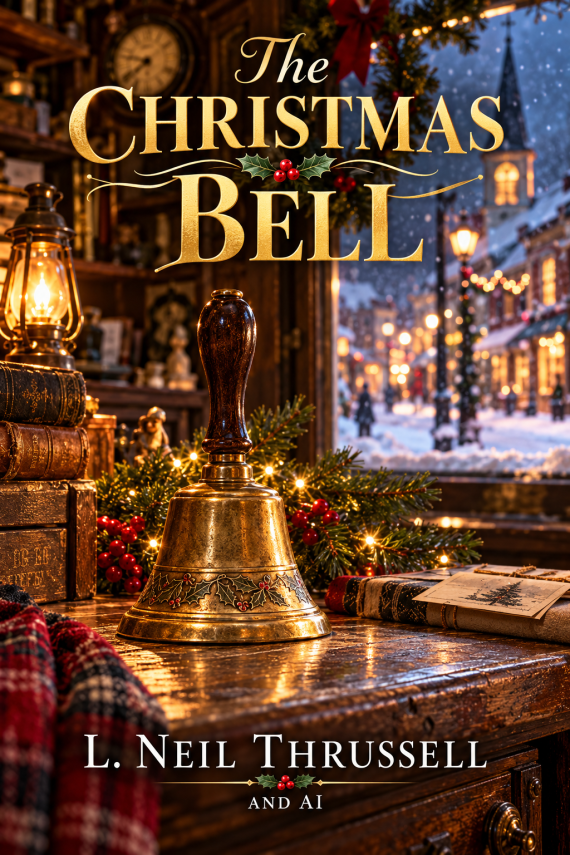
The Christmas Bell
By L. Neil Thrussell and AI
Some bells announce the arrival of Christmas. Others awaken the hearts of those who have forgotten how to listen.
Chapter One: Yesterday’s Treasures
Samuel Finch had never trusted anything that claimed to be magical.
At seventy-eight, he had lived long enough to know that most miracles could be explained by faulty wiring, fortunate timing, or someone failing to tell the entire truth. He had seen supposed healing crystals turn out to be coloured glass, ancient coins manufactured in modern factories, and a woman who claimed to speak with the dead become remarkably silent when asked to contact his Uncle Harold about the twenty dollars he still owed him.
Magic, Samuel believed, was simply another word for something people had not yet bothered to understand.
His late wife, Rose, had disagreed. Rose had disagreed with Samuel about a great many things during their forty-seven years of marriage, including the proper way to load a dishwasher, whether tomatoes belonged in fruit salad, and the existence of miracles. They had been happily married anyway.
On December 24, Samuel stood behind the counter of Yesterday’s Treasures, his antique shop in Willowbrook, watching snow settle against the windows. Outside, the town was enjoying the sort of Christmas Eve that appeared on greeting cards and caused considerable inconvenience to anyone who had to drive through it. Coloured lights hung from lampposts, and somewhere nearby a group of carollers was attempting a particularly ambitious rendition of O Holy Night.
Samuel considered calling the authorities.
The shop smelled of polished wood, leather, dust, and cinnamon. The cinnamon came from a candle Rose had insisted they burn every Christmas. He had continued the tradition after her death, although he maintained it was an inappropriate smell for a business selling furniture older than most customers.
On the counter sat a brass handbell, six inches tall, with an engraved band of holly leaves and a dark wooden handle. Beneath it lay a faded burgundy velvet pad Rose had sewn herself. She had purchased the bell at an estate auction forty-three years earlier. Its seller claimed that it rang whenever someone nearby faced a moment that could change their life.
For thirteen years, the bell had occasionally rung without anyone touching it. Samuel investigated passing trucks, temperature changes, mischievous customers, and concealed mechanisms. He even dismantled it. He found nothing.
Thirty years ago, it stopped ringing. Rose occasionally polished it and spoke to it like a stubborn relative. Samuel suggested she take up knitting. Rose suggested he take up believing in something.
Four Christmases had passed since Rose died. Four without her terrible singing, questionable fruitcake, and handwritten notes tucked into his coat pockets. Four without anyone telling him he was turning into a grumpy old man, although several people had volunteered that information lately.
He glanced at the clock. Nine seventeen.
“Another Christmas Eve,” he muttered. “Another day of people buying things nobody needs for people who already have too much.”
He sipped his tea.
The bell rang.
Samuel froze. A bright, delicate note lingered among the ticking clocks. The bell sat motionless. A delivery truck passed outside.
“Vibration,” he announced.
He lifted the bell, examined its underside, and shook it. It rang normally. He set it back on the velvet pad.
“Thirty years, and you decide to start making noise today.” He looked around the empty shop. “Rose, if this is your doing, something practical would be nice. Winning lottery numbers, perhaps.”
He remembered Rose’s advice: When the bell rings, Samuel, don’t stare at the bell. Look for the person.
He put on his winter coat and stepped outside. He could not explain why. That irritated him considerably.
Chapter Two: The Forgotten Woman
The Cinnamon Spoon café was three doors away. It served excellent coffee, enormous muffins, and sandwiches containing more mayonnaise than Samuel believed medically advisable.
Through the window he saw Elsie Palmer, a widow since February, alone at a corner table with an untouched coffee and yesterday’s newspaper. George Palmer had been a pleasant acquaintance, the sort of man with whom Samuel had discussed the weather and municipal taxes for decades.
“Morning, Samuel,” called Leah, the café owner. “Usual?”
“Only if you’ve learned to make coffee without burning it.”
“Wonderful to see you too.”
He sat opposite Elsie. “That newspaper any good?”
“Oh, Samuel. Merry Christmas.”
“Debatable.” He lowered himself carefully. “Any plans for tomorrow?”
“A quiet day. My daughter is spending Christmas with her husband’s family in Vancouver. She invited me, but travelling at my age…”
Her carefully arranged smile made Samuel uncomfortable. Across the room, families laughed and children argued over pastries.
“George used to put the decorations up in November,” Elsie said. “Drove me absolutely mad. Then he’d make pancakes on Christmas morning. Burned every one.”
“You ate them?”
“Every year.”
“Why?”
She looked through the window. “Because he made them.”
Samuel remembered Rose humming while preparing Christmas breakfast, flour on her cheek. He could still hear himself joking that a clean frying pan would qualify as a miracle. He wished he remembered whether he had kissed her afterward.
“Elsie, I need help with my Christmas window display. Rose used to arrange a village of little wooden houses.”
“I haven’t worked in a shop for forty years.”
“Excellent. No bad habits.”
“Why ask me?”
He considered joking, but her expression stopped him. “Because Rose would have asked you herself.”
An hour later, miniature houses and snowy trees crowded the shop window. Elsie told stories about George; Samuel complained about the inaccuracies of miniature architecture. By the time they finished, she was laughing properly.
“Thank you,” she said.
“For what?”
“For not letting me spend the whole day pretending to read a newspaper.”
He mentioned the church’s Christmas lunch. Elsie admitted that she and George used to volunteer but she had not dared return alone.
“Perhaps this is the year,” Samuel said.
When she left, he noticed one little house illuminated from within. Rose always placed it at the centre. He adjusted it, turning the warm window toward the street.
The bell rang again.
Chapter Three: The Exhausted Nurse
“Fine, Rose. But if this is a plumbing problem, you’re paying for it.”
Across the street, Maya Chen, a nurse at Willowbrook Community Hospital, struggled with a frozen car door. She wore scrubs beneath her coat and carried groceries and two small presents.
“Frozen,” Samuel diagnosed.
“I’d noticed.”
“No need to be sarcastic.”
He produced lock de-icer from his pocket. Maya stared.
“You carry that around?”
“I live in Canada.”
When the latch released, she laughed in relief. Her children, Lily and Ben, were eight and five. They were staying with their grandmother because Maya had another shift that night.
“I promised we’d decorate cookies,” she said. “Ben asked if Santa knows where the hospital is, because he thinks that’s where I live.”
“Bright lad.”
Her smile faded. “I feel like I’m failing them.”
Samuel thought before answering. Rose had always been better at listening. He usually offered solutions and irritated people.
“Do they know what it means to be a nurse? That you sit with frightened people and hold hands when nobody else is there?”
“They know I help people.”
“That’s something worth being proud of.”
“It doesn’t replace cookies.”
“No. It doesn’t.” He thought of the old oven in the back room, bought because Rose refused to trust the antique cooking equipment they sold. “Bring them here tomorrow afternoon. You can make your cookies.”
“I couldn’t impose.”
“I’m inviting you to bake, not move into my house.”
Maya laughed. Before leaving, she handed him a red paper star Lily had made for someone who needed cheering up. On its back were four uneven purple words: You are not alone.
Samuel turned it over several times. The message disturbed him, not because it was untrue but because he had spent four years pretending it was. He hung it on the shop’s little tree, straightened it once, and imagined Rose adjusting it twice more.
Chapter Four: The Boy Nobody Notices
The third ring came after noon. Through the window Samuel saw a teenager on a snowy park bench, wearing a jacket too thin for the weather. Noah Price was quiet, seventeen or eighteen, and usually alone.
“You’re going to freeze,” Samuel told him.
“I’m fine.”
“Excellent. Help me move a cabinet.”
Noah eyed him suspiciously. “Can’t you ask somebody else?”
“I could, but then I’d miss your charming company.”
Inside, Noah moved a small cabinet in two minutes. Samuel handed him twenty dollars.
“I didn’t do twenty dollars of work.”
“An excellent hourly rate, then.”
“I don’t need charity.”
“Neither do I. I need somebody who can lift furniture without sounding like an injured farm animal.”
Samuel offered hot chocolate. Noah declined tea and coffee, but accepted the chocolate. He examined a broken 1940s valve radio with interest and began discussing circuits, wiring, and transformers. Samuel fetched tools.
“Last time I fixed a radio, I nearly electrocuted myself and frightened an innocent cat.”
“You have a cat?”
“Not anymore. Fortunately, neither does the radio.”
After they worked awhile, Samuel asked why Noah was outside rather than at home. Noah described his mother’s boyfriend, who called him lazy and useless for spending time repairing electronics.
“Old junk, eh?” Samuel glanced around his shop. “You’ve insulted my entire livelihood.”
Noah smiled, then grew quiet. “Sometimes I think everyone would be better off if I wasn’t around.”
Samuel put down the screwdriver. “When you say that, Noah, are you thinking about hurting yourself?”
“Sometimes I think about disappearing. I don’t know.”
“I’m glad you told me.” Samuel pulled out a chair. “You don’t have to solve your life today, and you don’t have to face this alone. Is there someone you trust who could help keep you safe?”
“My aunt Ruth.”
“Could we call her?”
Noah hesitated, then dialled. Ruth agreed to collect him and let him stay with her. She arrived twenty minutes later, frightened but attentive. Samuel made certain she understood the seriousness of what Noah had shared. She promised to stay with him and help arrange professional support.
Before leaving, Noah glanced at the radio.
“Could I come back?”
“Of course. Someone needs to repair these things. Apparently, the proprietor is incompetent.”
“You’d pay me?”
“Provided you don’t electrocute the cat.”
“You said you don’t have one.”
“Then we’re already ahead.”
After they left, Samuel stared at the empty workbench. He thought about how easily he might have passed the boy without looking. The bell remained silent, and he was grateful.
Chapter Five: The Unspoken Apology
By two o’clock Samuel had begun to suspect the bell was taking a personal interest in him. It rang a fourth time as a grey-haired man outside the shop paced between his car and the corner.
“Either you’re lost,” Samuel called, “or you’re rehearsing a peculiar dance.”
The man held a gift bag and a folded address. He was Peter Dawson, and he had driven three hours to visit the daughter he had not spoken to for six years.
“I don’t know where to begin,” Peter admitted.
Samuel leaned against the doorway. Peter described telling his daughter she was wrong to leave her husband. He had refused to hear her reasons. Later he learned how unhappy and unsafe the marriage had been, but by then she no longer wanted him in her life.
“I’ve brought her an old photograph album,” Peter said. “All the birthdays and Christmases. Her mother died ten years ago.”
“Why bring it now?”
Peter looked at the gift bag. “In every photograph when she was little, she looked at me as though I could do anything. Somewhere along the way, I stopped being the father she could trust.”
Samuel thought of Hannah. Thirty years earlier, she had chosen music school over the accounting program he favoured. He had insisted she was throwing away her future. When she returned home for Christmas after her first term, he had resumed the argument, and she had left in tears. Years of cautious, abbreviated calls followed.
“Then tell your daughter what you’ve just told me,” Samuel said.
“What if she doesn’t forgive me?”
“She might not.”
“What if she won’t open the door?”
Samuel thought of all the invitations from Hannah he had rejected after Rose’s death. “Then you’ll still have done something worth doing.”
Peter inhaled, thanked him, and drove toward Maple Crescent.
Inside the shop, Samuel opened his phone to Hannah’s number. He typed I hope you’re having a nice Christmas Eve, deleted it, then typed I’ve been thinking about you and deleted that too.
“Not yet,” he whispered.
He could almost hear Rose laughing.
Chapter Six: The Empty Wallet
The fifth ring came at half past three. A young mother and two children were leaving the department store across the street. The four-year-old boy was crying about a toy train. His older sister held their mother’s hand and watched her with the grave concern children sometimes acquire too young.
Samuel crossed over and invited them to see a vintage train in his display window. The mother’s name was Anna. Her children were Sophie and Max.
As Max watched the green engine circle Elsie’s miniature village, Sophie announced, “Mummy says we’ll have a better Christmas next year.”
Anna flushed. Later, quietly, she told Samuel she had returned gifts to buy groceries after her work hours were cut and the heating bill arrived. Max had loved trains since his grandfather took him to the railway museum. His grandfather died in May.
Samuel looked at the model train. Rose had purchased it years earlier. It was beautifully restored and priced at three hundred and fifty dollars.
“Anna, I have a problem. This train needs a home.”
“Oh, we couldn’t.”
“I haven’t offered anything yet.”
He proposed that she take the train and do something kind for someone else when circumstances allowed. Anna objected to accepting such an expensive gift.
“My knees hurt when it snows,” he told her. “I have three pairs of spectacles and can never find the right ones, and I own more furniture than any reasonable man should. Do I need another train?”
Anna laughed through her tears. “No.”
“Then we’ve settled it.”
As they packed the train, Anna mentioned that her mother used to volunteer at the community Christmas dinner. She had stopped going after her father died, but perhaps tomorrow she and the children could help serve lunch.
“That sounds excellent,” Samuel said.
Sophie spotted Lily’s red star. Samuel read its message aloud: You are not alone.
“That’s a nice thing to tell somebody,” Sophie said.
Samuel watched the family disappear into the snow. Then he regarded the empty display shelf and smiled.
Chapter Seven: The Man Who Forgot Christmas
The sixth ring arrived at five fifteen. Samuel was exhausted, physically and in a more private way. He had allowed himself to feel more in one day than in several years.
“No,” he told the bell. “I’ve listened, helped people, and given away a perfectly good train. I’m going home.”
Someone pounded on the door.
A businessman named Graham Ellis stood outside beside a luxury car with flashing hazard lights. His vehicle would not start. Every garage in Willowbrook seemed to be closed, and he had a flight the next morning.
“Christmas Day?” Samuel asked.
“Yes.”
“Unusual hobby.”
Graham did not appreciate this. Samuel offered tea, coffee, then whisky. When Graham hesitated, Samuel confessed he did not have any whisky. Against his better judgment, Graham laughed.
A mechanic agreed to inspect the car the following morning. Graham complained about meetings, deadlines, and employees depending on him. Samuel asked what the company manufactured.
“Industrial equipment.”
“Will the world end if the equipment waits two days?”
Graham stared into his tea. His gaze drifted to a photograph of Samuel and Rose, taken outside the shop when they were young. Rose was laughing. Samuel held an enormous wreath and looked as though he had lost an argument.
“Your wife?”
“Rose. Gone four years.”
Graham admitted his wife had left because he was married to his company. His son Michael, now twenty-six, had invited him to spend Christmas with him and his partner. Graham had declined because he was busy.
“When did you last ask him how he was feeling?” Samuel asked.
Graham opened his mouth, then closed it. He remembered missing Michael’s graduation for a conference in Germany.
“Important conference?” Samuel asked.
“It seemed so at the time.”
Eventually Graham called his son. Samuel pretended to study invoices while a stiff conversation softened, broke into laughter, and ended with Michael agreeing to collect his father.
Before leaving, Graham saw the empty train display and learned Samuel had given the train away. He offered money to support whatever charitable work Samuel was doing.
“This is an antique shop,” Samuel protested, “not a charity.”
Still, he mentioned the community Christmas dinner, which was short of funds and volunteers. Graham covered the outstanding food costs and promised his company would sponsor the following year’s meal.
When Michael arrived, father and son hesitated only a moment before embracing. Samuel turned discreetly toward the till, which required absolutely no attention.
“Thank you,” Graham said on his way out.
“For the tea?”
“For reminding me I have somewhere I belong.”
At six twenty-eight, Samuel locked the door. Six rings. Six people. One remarkable day.
He opened Hannah’s contact again and typed without deleting: I’ve been thinking about you today. I know I’ve been stubborn and hurt you. I don’t expect you to forget that. But I’d like us to talk, if you’re willing. I miss you. Love, Dad.
He pressed Send. There was no reply. He set the phone down.
“Well, Rose,” he whispered. “I knocked.”
Chapter Eight: The People We Carry
Samuel sat in the back room with cold tea, thinking about the six people he had met. Elsie pretending to read yesterday’s newspaper. Maya believing her work made her a disappointing mother. Noah wondering whether he mattered. Peter standing a few streets from his daughter, unable to knock. Anna choosing groceries over gifts. Graham building a successful life without finding time to live it.
He remembered the Christmas thirty years earlier when Hannah came home from music school. He had tried again to persuade her that accounting offered security while music offered disappointment. What began as a question became an argument. Hannah left the table in tears.
That night the bell rang. Rose asked him to talk to their daughter.
“I already talked to her,” Samuel had snapped.
“No, darling. You spoke at her. That’s not the same.”
He had dismissed the bell as superstition and refused another conversation. Rose looked at him a long time before speaking.
“Samuel, one day you may discover that being right is a very lonely place to live.”
He refused to answer. The bell did not ring again for thirty years.
Samuel had believed loving Hannah meant protecting her from mistakes. Rose had believed it also meant letting Hannah choose her own way and standing beside her if she fell.
Sitting alone now, he covered his face with his hands. He cried for Rose, for Hannah, and for the years he had spent pretending he needed no one. When he stood again, he felt neither healed nor absolved, but a little less determined to hide.
His phone glowed with a message.
Dad, I got your message. I need some time to think about what you said. I love you too. Hannah.
Samuel read it twice. It was not forgiveness, nor the reconciliation he might have wished for. But it was a door not quite closed.
“That’s enough for tonight,” he whispered.
Chapter Nine: The Seventh Ring
At eleven forty-seven, Samuel returned to the shop. He had gone home, eaten half a bowl of soup, and stared at Rose’s empty chair until he could bear it no longer. The shop still held her scarf, her handwritten labels, and the little Christmas village glowing in the window.
“Well,” he told the bell, “you’ve had quite a day. I suppose I should thank you.”
The bell rang.
He checked the street, the café, and the empty bench. Snow lay untouched beneath the lamps. No one appeared to need him.
Don’t stare at the bell. Look for the person.
He turned toward the shop window. His own reflection looked back: white hair, tired eyes, and a face softened by tears.
For a long moment, he stood still. Then he laughed with the helpless joy of someone finally understanding a joke told decades ago.
“Oh, Rose. You clever woman.”
Back at the counter, he lifted the bell. A loose seam showed at one corner of its velvet pad. He ran a thumb along the stitching and felt something stiff inside. Carefully, he opened the seam and withdrew a small envelope, yellowed and pressed flat.
Two words appeared in handwriting he knew better than his own: My Samuel.
He sat before opening it.
My dearest Samuel,
If you’re reading this, I hope it means you’ve finally stopped arguing with that poor bell.
He laughed softly.
I don’t know whether our bell is magical. I never have. I only know that whenever it rang, you noticed someone. You noticed the frightened woman who needed directions, the child who had lost his mother in the shop, and the man whose broken car brought him here on the worst day of his life. You listened to their troubles. You gave them a place to rest.
Samuel remembered those faces. He had almost forgotten how many people had passed through Yesterday’s Treasures and left him changed.
I love your practical mind. I love that you repair almost anything, that you remember to lock the back door, and that you’ve never purchased a Christmas gift without first checking whether it was on sale. But sometimes you become so busy understanding the world that you forget to experience it.
I watched you with Hannah tonight. I know your anger comes from fear, and that you want to protect her. But love is not protection from life, Samuel. Sometimes it is the courage to let someone choose, knowing they may fall, and trusting they can rise again. Please talk to her. Not as the man who knows the answers. As the father who loves her.
Samuel lowered the paper. Rose had written those words thirty years earlier.
Someday one of us will leave the world before the other. That’s the arrangement life makes with everyone who dares to love. When that day comes, promise me something. Do not turn our love into a locked room. Do not honour my memory by refusing to make new ones. Invite people in. Laugh when something is funny. Cry when something hurts. Accept help when you need it. And for heaven’s sake, stop pretending you don’t like Christmas.
He wiped his cheeks and read on.
There is magic in this world, my love. Not always the kind that changes stars or makes bells ring. Sometimes it is a chair pulled out for someone lonely, a hand held when words are useless, an apology offered without knowing whether it will be accepted, or a gift given without expecting anything back. If you remember those things, everything we loved together will continue through everything you choose to love afterward.
Forever yours, Rose.
P.S. If you still don’t believe in miracles, explain how I managed to stay married to you for so many years.
Samuel’s laughter echoed through the empty shop. He pressed the letter to his chest.
“Oh, Rosie.”
He wondered why she had hidden it and why he had discovered it tonight. Perhaps she had forgotten where she put it; perhaps she trusted him to find it when he was ready. There were questions he would never be able to ask her. For once, he allowed them to remain unanswered.
Chapter Ten: The Christmas Invitation
At eleven fifty-eight came a knock at the door. Elsie stood in the snow carrying shortbread, with Maya beside her in her nursing coat.
“What are you doing here at midnight?” Samuel asked.
“We came from the church service,” Elsie said. “And we’re making certain you come to Christmas lunch.”
“You walked through the snow to bully an elderly shopkeeper?”
“Someone has to,” Elsie replied.
They had been helping prepare the community meal. Anna and her children planned to serve, Leah was bringing food, and Noah’s aunt Ruth said he might help set up the sound system if he felt ready. Graham and Michael also hoped to attend. Samuel heard that several people had been asking after him.
“Me? Why?”
Elsie smiled. “You’re not nearly as difficult to like as you seem determined to be.”
“I’ve worked very hard at that reputation.”
“We’re ruining it.”
He looked toward Rose’s letter. Do not turn our love into a locked room.
“What time?” he asked.
“One o’clock.”
“Will there be proper gravy?”
Maya laughed. “Yes, Samuel.”
“Not that watery nonsense? These are important questions.”
Elsie shook her head. “You really are impossible.”
“That’s what Rose used to say.”
Maya noticed Lily’s paper star on the tree. Elsie read its four words: You are not alone. She touched Samuel’s arm before they went.
After locking the door, he folded Rose’s letter and slipped it into his breast pocket. Outside, church bells announced midnight.
“Merry Christmas, Rosie,” he whispered.
His phone vibrated. Hannah had written again.
Dad, I’ve been thinking too. I don’t want to pretend we can fix thirty years in one conversation, but I’d like to try. Emma and I are making Christmas dinner tomorrow. No pressure. Just dinner. Maybe we could start there.
Emma. His fourteen-year-old granddaughter. He scarcely knew her.
Samuel typed, I’d love to come. What time?
Five o’clock. And Dad? I’m glad you wrote.
He stood among Rose’s decorations and thought of the people who had visited the shop that day. He would attend lunch at one, then Hannah’s dinner at five. Perhaps he could bring the old guitar Rose had bought for Hannah years ago. Perhaps Emma played too. He did not know, but he could ask.
Outside, snowflakes drifted beneath the streetlights. He looked back through the window. The bell sat still. Nothing glowed. No mysterious music sounded. By every reasonable measure, it was an ordinary antique bell.
“Goodnight, Rosie.”
He walked home looking forward to Christmas morning for the first time in four years.
Epilogue: A Bell for Tomorrow
The following Christmas Eve, Yesterday’s Treasures was busier than it had been in decades.
Noah worked there repairing electronics, with encouragement and support from his aunt and others who cared for him. Elsie arranged displays three mornings a week and made sure Samuel did not become excessively unpleasant. Maya’s children visited often, looking for something to paint or dismantle. Anna had started a small baking business, and Max still said his green train was the greatest gift ever made.
Graham kept his promise to support the Christmas dinner and, more importantly, kept making time for Michael. Peter and his daughter were rebuilding their relationship, slowly, with difficult conversations and occasional awkward silences.
Samuel understood that kind of progress. He and Hannah had spent the year learning how to talk. Sometimes they succeeded. Sometimes Samuel offered advice nobody had requested. But he had learned to apologize.
Emma, now a frequent visitor, played guitar. Badly, according to Samuel. Beautifully, according to Hannah. Rose would have sided with Hannah.
On Christmas Eve, Emma studied the brass bell on the counter.
“Grandpa, does it really ring by itself?”
“That’s what your grandmother claimed.”
“Did you believe her?”
“Not particularly.”
Emma lifted it. Its bright note filled the shop.
“Sounds normal to me.”
“Most extraordinary things do.”
She examined the engraved holly. “Do you think it’s magical?”
Samuel looked around. Noah was laughing with Elsie. Maya helped Ben choose a present for his sister. Anna had brought gingerbread, and Graham was telling Peter a fishing story. Hannah spoke with Leah beneath the Christmas lights.
“Your grandmother was right about something,” Samuel said.
“What?”
“Sometimes magic doesn’t change the world. It changes the way we see it.”
Emma considered that and returned the bell to its velvet pad.
“Grandma Rose sounds pretty smart.”
“She was, sweetheart. She certainly was.”
Hannah called from the Christmas tree. “Dad, family picture!”
Samuel set down his tea and moved toward them. As he passed the counter, his coat brushed the bell. It swayed and released one clear note.
He stopped, looked at it, then toward the smiling faces waiting for him. For a moment he considered investigating.
Instead, he laughed.
“All right, Rosie. I hear you.”
He joined his family beneath the lights, and the bell grew still.
The End
Authorship & AI Acknowledgement
This work was created by L. Neil Thrussell with assistance from artificial intelligence. AI contributed to story development, drafting, editing, proofreading, and cover-image generation.