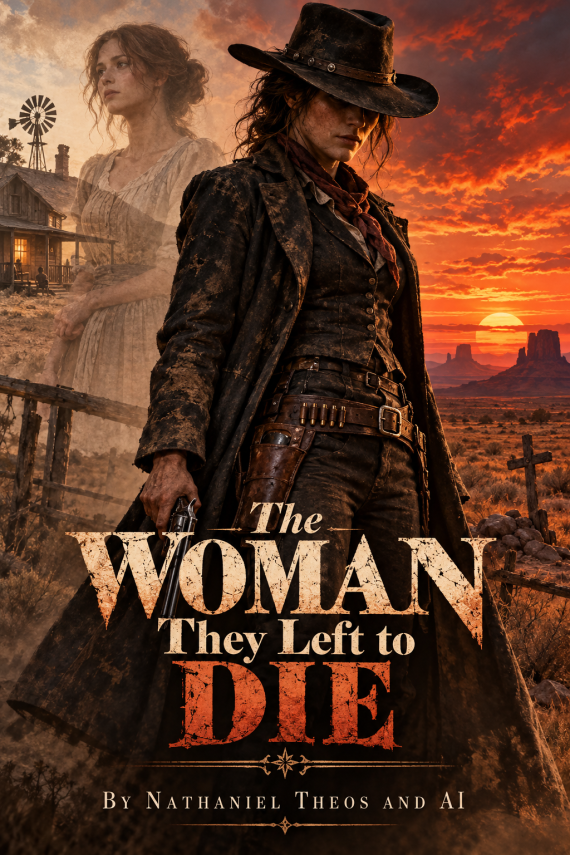
The Woman They Left to Die
By Nathaniel Theos and AI
Arizona Territory, 1884
Jonah Reed noticed the horse because it had no rider. It stood beneath the poor shade of a mesquite tree, reins hanging loose, flanks dark with sweat. The animal raised its head when Jonah approached, watched him for several seconds, then lowered its muzzle again. Jonah stopped his mule and studied the country around him. Nothing moved. The afternoon heat pressed against the desert until even the distant mountains appeared tired. Creosote, cactus and stone stretched toward a white horizon. No road crossed this part of the territory, only old trails used by prospectors, cattlemen and men who preferred not to be noticed.
The horse was saddled. A Winchester remained in the scabbard. That troubled him. Men abandoned horses for plenty of reasons in Arizona Territory, but few willingly walked into the desert while leaving behind water and a perfectly good rifle. Jonah dismounted. He had gone perhaps fifty yards when he saw the vultures. Three circled above a dry wash.
“Damn.”
He took his rifle from the saddle. Old habits returned easily. For eight years Jonah had scouted for the Army, following trails other men couldn’t see and finding people who had every reason not to be found. He had learned that the desert kept secrets badly if a man knew how to read what it left behind. Boot prints led away from the horse. There was blood on the stones.
Not much at first. Then more. Jonah followed. The prints staggered toward the wash, disappeared over the edge, then reappeared below. Whoever had made them had fallen at least twice. He found the man beneath an overhang of rock. At least Jonah thought it was a man. Black trousers. Boots. Gun belt. Dark shirt. A battered hat lay several feet away. The stranger’s hair had been cut short and unevenly, as if done with a knife and without the benefit of a mirror.
One revolver remained holstered. The other was gone. Jonah approached carefully. The stranger didn’t move.
“Picked a poor place to die.”
He lowered his rifle and crouched. The face beneath the dust was younger than he’d expected, perhaps thirty, maybe a few years less. Blood had dried along the right side of the shirt. Jonah placed two fingers against the neck. Nothing. He shifted them. Then he felt it. A pulse. Weak, but there.
“Well, I’ll be damned.”
The stranger moved. A hand dropped toward the revolver. Jonah caught the wrist before the gun cleared leather. The stranger’s eyes opened. Grey. Hard. Not frightened. Those eyes belonged to somebody calculating whether there was enough life left to kill him.
“Easy,” Jonah said. “You pull that gun, you’ll likely finish yourself before you get around to me.”
The stranger tried anyway. Jonah removed the revolver and stepped away.
“You can have it back when you’re less determined to die.”
The eyes closed. Jonah looked toward the sky.
“You couldn’t have been a small fellow.”
He slung the rifle over his shoulder, crouched and worked one arm beneath the stranger’s knees and the other beneath the shoulders. The body came up easier than expected. Too easy. Jonah frowned. The head rolled against his chest. Something about the weight didn’t fit the clothes or the gun belt. He carried the stranger toward the horses. His cabin sat against a low ridge several miles away, close enough to his silver claim that he could convince himself the mine was worth working and far enough from San Pedro that visitors were rare.
He liked visitors that way. Rare. The place was not much to look at. An adobe cabin, a small shed, a corral, four horses, two mules, a goat and several chickens that seemed personally offended by his existence. Six years earlier there had been curtains in the windows. Abigail had insisted. Jonah had complained about curtains in a desert where the nearest neighbour was miles away. She had put them up anyway.
After she died, Jonah took them down. He carried the stranger inside and laid him on the heavy wooden table. The wound had opened again. Blood soaked the shirt.
“Let’s see what foolishness you’ve managed.”
Jonah filled a basin with water, then retrieved clean cloth, whiskey, scissors and the small medical kit he had kept from his scouting years. The bullet had entered high along the stranger’s side. Jonah began cutting the shirt. The stranger stirred but did not wake. He pulled the cloth apart. Then stopped. Jonah stared. The stranger was not a man. He looked toward the door, half expecting somebody to walk in and explain what he was seeing.
Nobody did.
“Well,” he whispered.
Bandages had been wrapped tightly around her chest beneath the shirt, flattening what the coat and trousers already concealed. Jonah turned away. He rubbed both hands over his face. He had carried her through the desert, put her across his horse and brought her inside thinking she was some half-dead young gunman. Now he had to remove enough clothing to reach the wound. He poured himself whiskey. He drank it.
Then poured some over his instruments.
“You’ll forgive me,” he said without looking at her, “or you’ll shoot me when you wake up. Either seems fair.”
He went back to work. The bullet had passed through. That was good. It had missed anything likely to kill her quickly. That was better. The wound itself was swollen and angry. That was not. She had spent most of a day in the desert, perhaps longer. Jonah washed blood and dirt from her side as carefully as he could. Every touch made him conscious of his hands. He had not touched a woman in six years.
Not skin beneath his fingers. Not the curve of a shoulder. Not the weight of another human being forced to trust him. His hands remembered before he wanted them to. Abigail laughing while he tried to braid her hair. Abigail leaning against him during their journey west. Abigail taking his hand when the labour became difficult. Abigail whispering that she was frightened. The midwife had been two days away. The baby had been turned wrong.
Jonah had done everything he knew. It had not been enough. He still remembered Abigail’s fingers growing colder inside his. The child never cried. Jonah closed his eyes.
“This isn’t Abigail.”
The woman groaned. Jonah opened his eyes again.
“No,” he said softly. “You’re considerably more troublesome.”
He cleaned the wound, packed it and wrapped fresh cloth around her. Getting her to the bedroom was worse. He had not slept there since Abigail died. A narrow cot beside the stove had served him well enough. Abigail’s quilt still covered the bed, faded but clean. In the corner beneath a blanket sat the cradle Jonah had built during the months when they believed they were preparing for a different life.
He lifted the unconscious woman from the table. Then stopped at the bedroom door. He had not carried a woman into that room since Abigail. His arms remembered that too. For several seconds he could not move. Finally, he crossed the room and lowered the stranger onto the bed. He pulled the quilt over her and stepped back. She slept almost eighteen hours. When she woke, she tried to kill him.
Jonah was stirring coffee when he heard movement behind him. He turned. She stood in the bedroom doorway wearing one of his shirts and holding his revolver. Her face was white from pain. The barrel trembled. Only slightly. Jonah looked at the gun. Then at her.
“Morning.”
“Where are my clothes?”
“Drying.”
“My guns?”
“Safe.”
“You undressed me.”
“Enough to keep you alive.”
The revolver steadied. Jonah set the spoon down.
“If I meant you harm, yesterday provided considerable opportunity.”
Her jaw tightened.
“Where are we?”
“My claim.”
“Where?”
“Twenty miles or so from San Pedro.”
She looked toward the window. Jonah watched her calculating direction, distance and probably how long a horse could travel before dark.
“Sit down.”
“I’ll stand.”
“You’ll fall.”
“I said I’ll stand.”
Jonah shrugged.
“Suit yourself.”
She lasted perhaps twelve seconds. Her knees buckled. Jonah moved automatically, then stopped before touching her. She caught the doorframe and held herself upright. For several breaths neither moved.
“I’m going to help you,” Jonah said.
Her eyes sharpened.
“I don’t need help.”
“Your knees appear to disagree.”
He waited. She looked at his hands. Slowly, she nodded. Jonah placed one arm behind her and the other beneath her elbow. Her entire body became rigid. Not pain. Fear. He felt it immediately. Jonah loosened his grip.
“I’m only getting you to the chair.”
She said nothing. He moved slowly until she was seated, then stepped away. The gun remained in her hand. He didn’t ask for it. Jonah poured coffee into two tin cups.
“Name?”
She hesitated.
“Eli Quinn.”
Jonah looked at her. She stared back. He nodded.
“All right, Eli Quinn.”
“You don’t believe me.”
“I didn’t say that.”
“You know I’m a woman.”
“That particular mystery solved itself.”
Her fingers tightened around the revolver.
“My name is Eli Quinn.”
“Then that’s what I’ll call you.”
She searched his face. Jonah pushed the second cup toward her.
“Water first.”
“I want my horse.”
“Outside.”
“My clothes.”
“Drying.”
“My guns.”
“One’s on the shelf. The other appears to have been lost somewhere in the desert.”
Her eyes dropped to the revolver she held.
“And yours?”
“You’ve got it.”
Something almost changed at the corner of her mouth. Almost. She placed the revolver on the table but kept it within easy reach. For the next two days Jonah learned almost nothing. Eli Quinn spoke little, slept lightly and woke whenever he entered the room. She watched doors. She watched windows. She watched his hands. Even fever did not entirely loosen whatever grip she maintained on herself. But fever spoke when she did not.
Jonah heard names. Sarah. William. Thomas. Those names came softly. Then others. Franklin Shaw. Jud Rainer. Caleb Moss. Elias Dobb. Amos Rusk. Those names came differently. She spoke each one like a promise. On the third morning, the fever finally broke. Jonah changed the bandage while she sat on the edge of the bed.
“I need to remove the old cloth.”
She nodded. He waited until she lifted her shirt enough to give him access to the wound. Jonah worked without unnecessary touch. She watched him. When he finished, her eyes shifted toward the corner. The blanket had slipped partly from the cradle. She stared at it. Jonah followed her gaze.
“My wife.”
She looked at him.
“Abigail.”
Her eyes returned to the cradle.
“Child?”
“Neither made it.”
Something in her expression changed.
“How long?”
“Six years.”
“I’m sorry.”
“So am I.”
Jonah gathered the old bandage. She continued watching him.
“You always tell me before you touch me.”
Jonah stopped.
“Yes.”
“Why?”
He considered giving her an easy answer. He had never been especially talented at easy answers.
“Because every time I come near you without warning, you look like you’re deciding whether to fight me.”
“I don’t run.”
“I’ve noticed.”
For the first time she looked almost embarrassed. Jonah continued.
“I don’t know what happened to you, Eli. Ain’t my business unless you decide it is. But I won’t give you reason to think you’re not safe here.”
Her face closed again.
“My name isn’t Eli.”
Jonah waited.
“Mara.”
He nodded.
“Mara Quinn.”
“Good to meet you.”
She almost laughed.
“You’ve known me three days.”
“I’ve known Eli three days. Mara just introduced herself.”
She looked away. Jonah carried the basin outside. He considered the exchange more important than she probably did. The following afternoon, Mara dressed in her own clothes. The transformation unsettled Jonah. The trousers, vest and gun belt seemed to change the way she occupied a room. Her shoulders broadened. Her walk altered. Even her voice dropped slightly. He understood then that Eli Quinn was not merely a name. Eli was armour.
Mara stepped outside and strapped on her revolver. Jonah watched from the porch.
“You can’t ride yet.”
“I can.”
“Different question.”
She ignored him and walked toward her horse. The animal recognized her immediately. Mara placed one boot in the stirrup. Pain folded her. Jonah started forward, then stopped. She remained bent against the saddle. After several breaths, she straightened.
“Say it,” she muttered.
Jonah leaned against the porch post.
“I’ve learned marriage teaches a man there are moments when silence is preferable.”
Mara gave him a murderous look.
“Wise.”
“So Abigail claimed.”
Mara led the horse back toward the corral herself. That evening she told him what happened. Not because Jonah asked. Because he didn’t. They sat outside after sunset while the heat slowly bled from the ground. Mara held a cup of coffee between both hands.
“They came to our ranch seven years ago.”
Jonah looked toward her.
“There were five.”
He said nothing.
“My father thought they wanted horses. Rusk wanted money. He’d heard my father had sold cattle.”
She stared into the darkness beyond the porch.
“There wasn’t much money. My father had already paid what he owed.”
Her voice remained level.
“Rusk didn’t believe him.”
Jonah waited.
“They shot my father.”
A pause.
“My mother tried to get Thomas inside. He was fourteen.”
Another pause.
“They killed them both.”
Jonah lowered his gaze. Mara’s hands remained steady around the cup.
“I tried to fight.”
The silence after those words said more than the words themselves. Jonah did not interrupt it.
“They took turns.”
Her voice changed slightly.
“They laughed about it.”
Jonah’s jaw tightened.
“When they were finished, Rusk told Dobb there shouldn’t be witnesses.”
She looked toward him.
“Dobb put a gun against my side and fired.”
Jonah glanced toward the wound he had treated.
“Same man?”
“No. This one was different.”
She looked back toward the darkness.
“They left me lying beside my family.”
Jonah said nothing for a long time.
“I should have died.”
“But you didn’t.”
“No.”
Mara’s fingers tightened around the cup.
“For months I wished I had.”
Jonah listened.
“Then something changed.”
“What?”
“I heard Franklin Shaw was working cattle near Bisbee.”
Jonah understood.
“You went looking.”
“I couldn’t walk into a saloon asking about him as Mara Quinn. Men remembered women. They asked questions. They watched.”
She touched her short hair.
“So Mara disappeared.”
“Eli.”
She nodded.
“A widow taught me to shoot first. Her husband had been a deputy. After that, I learned from anybody willing to teach a boy with a little money.”
Jonah could see it. Years compressed into a single purpose. Learning to ride harder. Learning cards. Learning how men stood, how they spoke and how they entered a room as though it belonged to them.
“What happened to Shaw?”
“I killed him.”
“Gunfight?”
“No.”
The answer surprised him.
“He begged.”
Jonah said nothing.
“I killed him anyway.”
Mara looked directly at him.
“Does that bother you?”
Jonah considered the question.
“Would it matter if it did?”
“No.”
“Then I won’t waste either of our time pretending I’m your judge.”
She looked away.
“Jud Rainer was next. Took almost two years to find him. Caleb Moss took another.”
“And Dobb?”
“Found him outside Benson.”
She touched her bandaged side.
“I got careless.”
“Because you were close?”
“Because I hated him most.”
Jonah understood that too.
“He shot you.”
“I shot him first.”
“Then how did you end up in the desert?”
“Dobb wasn’t alone. Another man came from behind me. I managed to get away.”
Jonah thought of the tracks near the wash.
“Then they know you’re alive.”
Mara looked toward him.
“They knew I rode away.”
“Difference.”
“They’ll look.”
“Yes.”
Jonah leaned back.
“How many left?”
“Dobb and Rusk.”
“And then?”
Her eyes narrowed.
“What?”
“When they’re dead.”
“Then it’s finished.”
“What’s finished?”
“The reason I’m doing this.”
Jonah shook his head slightly.
“Wasn’t what I asked.”
Mara’s expression cooled. Jonah continued.
“You know where men drink. How they lie. Where they hide money. How to follow tracks. How long to wait outside a saloon without being noticed. You changed your clothes. Your name. Your voice. Probably the way you walk.”
Mara stared at him.
“You became Eli Quinn because Eli could find them.”
“Yes.”
“What does Mara Quinn do?”
The question landed harder than Jonah expected. Her eyes moved away.
“I don’t know.”
He let the silence sit.
Finally, she said, “You think revenge is wrong.”
“No.”
That brought her eyes back. Jonah nodded toward the dark desert.
“Five men rode onto your family’s land, murdered people you loved and did what they did to you. I’m not going to sit here pretending I’d have wished them well.”
She almost smiled.
“But?”
“But I wonder if killing them stopped being something you’re doing and became the only thing you are.”
Her face hardened.
“You don’t know me.”
“No.”
“Then don’t tell me what I am.”
Jonah nodded.
“Fair.”
She stood. Jonah watched her walk toward the corral. He did not follow. Later that night, he found her awake beside the table, cleaning her revolver.
“You think you’re different?” she asked.
Jonah paused.
“From what?”
“Me.”
“No.”
She frowned. Jonah looked toward the bedroom.
“You want to know why that cradle is still there?”
Mara said nothing.
“Because moving it felt like admitting Abigail and that baby weren’t coming back.”
He sat across from her.
“So I left it. Then I stopped sleeping in that room. Then I stopped going to town unless I needed supplies. Started spending more time at the claim.”
“You had grief.”
“So do you.”
“They aren’t the same.”
“Never said they were.”
Jonah leaned back.
“You turned yours into a gun. I turned mine into a wall.”
Mara looked at him.
“Neither seems especially clever from where I’m sitting.”
For several seconds she said nothing. Then she went back to cleaning the revolver. The riders came two days later. Jonah saw dust across the flats shortly before sundown. Two horses. Mara was beside the corral. She saw them too. Her posture changed before Jonah could say anything.
“Elias.”
Jonah took his rifle from beside the door.
“You sure?”
“I know the way he rides.”
The men approached slowly. The one on the left had a sling supporting his right arm. Dobb. Jonah understood how they had found her. Mara’s horse had left a clear trail from the wash to his cabin. Dobb had simply been too wounded to follow immediately. The riders stopped forty yards away. Dobb looked at Mara. Then at Jonah. His mouth curled.
“Knew you couldn’t have gone far.”
Mara stepped away from the corral. The second man rested one hand near his revolver. Jonah moved onto the porch.
“That’s close enough.”
Dobb glanced toward him.
“This don’t concern you.”
“You’re on my claim. That makes you mistaken.”
Dobb smiled.
“You know what she is?”
Jonah looked at Mara.
“I know her name.”
Dobb laughed.
“Which one?”
Mara’s hand hung beside her revolver. Dobb shook his head.
“Seven years you’ve been chasing ghosts.”
“Four ghosts,” Mara said.
Dobb’s smile vanished.
“Frank?”
“Dead.”
“Jud?”
“Dead.”
Dobb looked at her.
“Caleb?”
Mara nodded. Dobb shifted in the saddle. For the first time Jonah saw fear.
“You’ve caused enough trouble,” Dobb said.
Mara stared at him.
“So did you.”
“That was seven years ago.”
“Not to me.”
The second rider drew. Jonah fired. The man toppled from the saddle before his revolver cleared leather. Dobb reached left-handed. Mara was faster. Her shot knocked him backward. He struck the ground hard. His revolver landed several feet away. The horses scattered. Dust drifted across the yard. Jonah kept his rifle trained on the second man until he was certain the fellow wasn’t getting up. Then he looked toward Mara.
She was walking toward Dobb. Jonah did not stop her. Dobb rolled onto his back. Blood spread across his shirt high near the shoulder. Mara stood above him. He looked at the revolver in her hand. Then at her face.
“Wait.”
Mara said nothing.
“It wasn’t my idea.”
Her expression went still. Dobb raised his good hand.
“Rusk wanted the money.”
“Stop talking.”
“Rusk killed your father.”
“I said stop.”
“I didn’t kill your mother.”
Mara raised the revolver. Dobb’s voice grew desperate.
“I didn’t touch you first.”
Everything stopped. Jonah saw something change in Mara’s face. Dobb saw it too, but misunderstood.
“I wasn’t first,” he repeated. “Rusk was.”
Mara cocked the revolver. Dobb began begging. Jonah stayed where he was. This belonged to her. Still, he spoke.
“Mara.”
She looked over her shoulder. Jonah did not tell her to lower the gun. He did not tell her to forgive. He did not tell her Dobb deserved mercy.
“If you pull that trigger,” Jonah said, “make sure you’re the one choosing.”
Her eyes narrowed. Jonah held her gaze.
“Not him. Not Rusk. Not Eli.”
Dobb crawled backward. Mara looked down at him again. Her revolver remained pointed at his chest. Seven years had brought her here. Every mile. Every lesson. Every lie. Every night sleeping in trousers with a revolver beneath her hand. Every man who had looked at Eli Quinn and never imagined Mara existed beneath the hat. Dobb stared up at her.
“You came all this way.”
Mara’s hand trembled. Then steadied. She lowered the revolver. Dobb exhaled. Relief crossed his face. Mara kicked his gun away.
“You’ll face a judge.”
Dobb laughed weakly.
“For something seven years ago? Your word against mine?”
Mara glanced toward the man Jonah had shot.
“No.”
She looked back at Dobb.
“For today.”
His laughter died. The marshal from San Pedro arrived the next afternoon after Jonah rode into town. Dobb left tied across his saddle. Before they departed, the marshal asked Mara several questions about the shootings. Then he asked about the three dead men whose names had begun appearing in stories from Bisbee to Tucson. Mara looked at Jonah. He said nothing. She turned back to the marshal.
“My name is Mara Quinn.”
That was all she gave him. For the next week she healed. Something subtle changed. She still wore the gun belt. Still slept lightly. Still watched strangers from beneath the brim of her hat. But Eli Quinn no longer occupied every moment. She helped Jonah repair a section of corral fence. She fed the horses despite his complaints about her wound. She even went with him to his claim one morning and informed him that after six years of digging, he had accumulated an impressive collection of worthless rock.
Jonah told her he appreciated professional encouragement. She laughed. The sound startled both of them. Mara stopped. Jonah pretended to be deeply interested in a shovel. On the ninth morning, she saddled her horse. Jonah stood on the porch.
“Where will you go?”
“Tucson.”
“Rusk there?”
“No.”
Jonah waited.
“I don’t know where he is.”
“That bother you?”
“Yes.”
Jonah nodded. Mara looked toward him.
“What?”
“Nothing.”
“You’ve got that look.”
“What look?”
“The one where you think you’re wise.”
“I am wise.”
“You’re a prospector who’s been digging the same hole for six years.”
Jonah considered that.
“Occasionally wise.”
She tightened the cinch.
“I may look for Rusk again.”
“I know.”
“I may find him.”
“I expect you will.”
“I may kill him.”
Jonah nodded.
“That’s between you and him.”
“You think I shouldn’t.”
“I think you’ve spent seven years being told what other men decided for you.”
He shook his head.
“I won’t join the list.”
Mara stared at him. Then she placed her boot in the stirrup and mounted. She gathered the reins. Jonah expected her to leave. Instead, she dismounted. She walked toward him. Jonah frowned. Mara stopped close enough that he could see the faint scar near her temple. For several seconds neither spoke. Then she reached out. Her hand closed around his forearm. Jonah looked down. It was the first time she had touched him simply because she wanted to.
He did not move. Mara looked at him.
“Thank you.”
“For what?”
“For asking.”
Jonah understood. Not one question. Every time. Every touch. Every choice. He placed his hand over hers. Carefully. She did not flinch. He had forgotten how much could be said by the simple warmth of another person’s hand. So had she. They stood together beneath the Arizona sun, two people who had spent years turning grief into something they could survive. Then Mara stepped back. She climbed into the saddle.
Jonah looked up at her.
“What name are you riding under?”
She considered the question. For seven years Eli Quinn had crossed Arizona Territory. Eli frightened men. Eli drank alone. Eli slept with a revolver beneath his pillow. Eli hunted. Eli killed. Eli survived. Mara looked toward the western trail.
“Mara.”
Jonah smiled.
“Good name.”
“It was always mine.”
She touched two fingers to the brim of her hat. Then she rode west. Jonah watched until the desert swallowed her. He expected the old silence to return. It didn’t. He went inside. The cradle still sat beneath the blanket. Jonah stopped beside it. For six years he had walked past that corner without touching it. He lifted the blanket. Dust covered the wood. He carried the cradle outside. He did not burn it.
He did not break it apart. He spent an hour cleaning it. When he finished, he carried it to the shed and placed it beside Abigail’s old trunk. Then Jonah returned to the cabin. Mara’s tracks still crossed the desert beyond his porch. They headed west. Not toward Amos Rusk. Not today. For seven years Mara Quinn had awakened each morning knowing exactly who she intended to kill. That morning, for the first time, she had ridden away without knowing what came next.
The uncertainty frightened her. It also felt strangely like freedom. Back at the claim, Jonah Reed opened every window in the house.
AUTHORSHIP & AI ACKNOWLEDGEMENT
The Woman They Left to Die is a short story by Nathaniel Theos and AI. The story concept, creative direction, characters, tone, and core storyline were developed by Nathaniel Theos.
Artificial intelligence was used as a collaborative creative tool to help explore story ideas, develop scenes, create the visual cover artwork, and assist with the complete four-stage editing process.
The human author guided the story’s intent, emotional balance, revisions, and final creative decisions. AI served as a writing, visual, and editorial assistant in bringing that vision to the page.