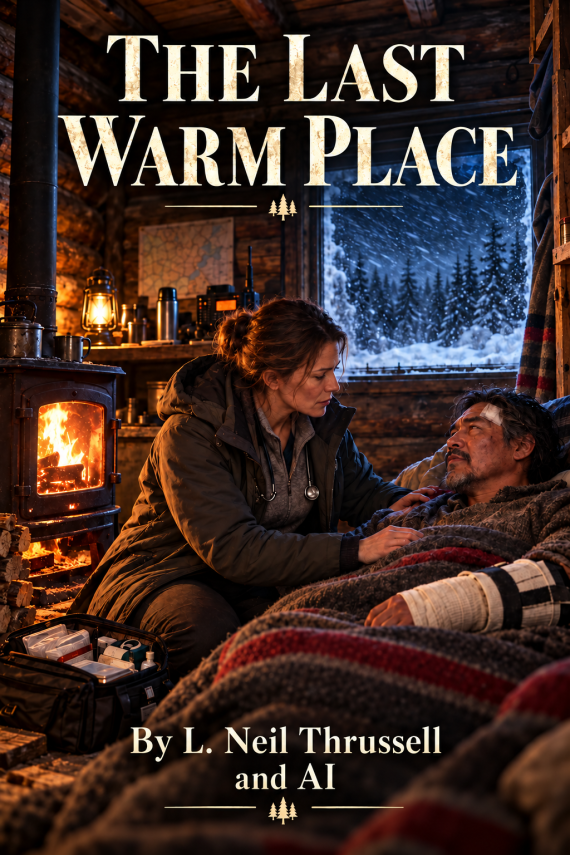
The Last Warm Place
By L. Neil Thrussell and AI
The heater stopped working one hundred kilometres south of Eagle Plains. Eliza Henley noticed because frost began forming along the windshield’s inside edges. She increased the fan speed, but the air flowing from the vents remained cold. A battery warning appeared on the dashboard.
“No,” she whispered. The government SUV continued climbing through the darkness. Snow swept across the Dempster Highway, filling the beam of her headlights with streaks of white. The road had almost vanished beneath it.
Eliza turned off the heated seat, radio and rear defroster. She dimmed the dashboard and reduced the fan. None of it helped. The headlights weakened.
The engine hesitated, recovered and then lost power. Eliza guided the SUV onto what she hoped was the shoulder. The tires sank into loose snow before coming to a stop. She tried the ignition.
The engine clicked but did not turn. For several seconds, Eliza sat with both hands wrapped around the steering wheel. She could hear the wind striking the vehicle. “Think,” she told herself.
Eliza was thirty-eight, a nurse practitioner with more than twelve years of experience in northern and rural medicine. She had stabilized patients after snowmobile crashes, delivered a baby during a road closure and kept a logger alive for ninety minutes while waiting for an air ambulance. She knew how quickly a minor problem became fatal in the Yukon. The dashboard temperature read minus thirty-one degrees Celsius.
The forecast predicted minus thirty-seven overnight, without accounting for the wind. Her patient was waiting at Eagle Plains. Thomas Linklater, a fifty-six-year-old snowplow operator, had reported tightness in his chest and numbness in his left arm that morning. He refused an evacuation, insisting it was indigestion.
Eliza had agreed to examine him at the temporary clinic before deciding whether to call for an aircraft. That decision now felt foolish. She checked the time. Four seventeen in the afternoon.
Darkness had already settled over the highway. Eliza had not seen another vehicle in almost two hours. She reached for the satellite communicator secured to the centre console. The screen illuminated, showing less than ten percent power.
It should have been fully charged. Eliza remembered that the SUV had been assigned to another department the previous week. Someone had apparently returned the communicator without charging it, and she hadn’t checked. She cursed, then pressed the emergency button.
The device searched for a satellite. Eliza placed it against the windshield and waited. The screen displayed a message. SENDING LOCATION.
A progress symbol turned slowly. The battery indicator changed from red to empty. “Come on.” The display flickered.
MESSAGE SENT appeared for less than a second before the screen went black. Eliza pressed the power button. Nothing happened. She did not know whether the complete message had transmitted or whether anyone had received it.
Her office knew her route and expected her to arrive at Eagle Plains by five thirty. If she missed her scheduled check-in, they would begin trying to contact her. It might be seven before someone officially reported her overdue. Even then, rescuers would have to reach her through the storm.
Eliza opened the government emergency kit in the cargo area. Two insulated blankets, chemical hand warmers, high-calorie food bars, candles, matches, flares, a folding shovel and a compact sleeping bag. A handwritten checklist also reminded government employees to inspect the kit before every winter journey. Eliza stared at it.
“Very helpful.” She put on her insulated snow pants, heavier parka and mittens while the interior still held some warmth. She pulled a wool toque over her ears and wrapped a scarf around her face. The medical cases in the back contained more supplies, including thermal blankets, dressings, intravenous fluids and portable oxygen.
The fluids could freeze. Eliza placed them inside the sleeping bag with several activated hand warmers. She attached a flashing emergency beacon to the roof and tied fluorescent survey tape to the antenna. Then she used the folding shovel to clear snow away from the exhaust pipe.
Only after completing those tasks did she allow herself to consider what might happen. The SUV would lose its remaining warmth quickly. She could survive inside it for hours if she stayed dry, insulated herself and remained calm. Leaving the vehicle would be far more dangerous.
Eliza returned to the driver’s seat and wrote the time of the breakdown on the back of Thomas’s medical file. 4:17 p.m. Approximately 100 kilometres south of Eagle Plains. Electrical failure. Emergency message possibly transmitted.
She checked her telephone. No cellular service. The battery showed sixty-two percent. She switched it to airplane mode and placed it inside an inner pocket where her body heat would protect it.
At five fifteen, the temperature inside the SUV fell below freezing. At six, Eliza ate half an energy bar. At six thirty, she began talking aloud simply to hear a human voice. She described her surroundings as if dictating patient notes.
“Visibility poor. Heavy snow. Wind increasing. No passing traffic.
Patient is cold, irritated and reconsidering several career choices.” Her laugh sounded unnatural inside the frozen vehicle. At seven, the windshield was almost completely buried. Eliza climbed into the sleeping bag in the rear seat and pulled one insulated blanket over her head.
She had just closed her eyes when something struck the side of the SUV. She froze. The sound came again. Three dull knocks against the rear passenger window.
Eliza lowered the blanket. A shape stood outside. She reached for the heavy flashlight beside her medical case. The beam illuminated a man’s face beyond the glass.
Snow covered his beard and eyebrows. Blood stained one side of his face. He raised a gloved hand and struck the window again. Eliza unlocked the door.
The wind tore it open. The man fell forward into the vehicle. Eliza grabbed his coat and pulled while he pushed weakly with his boots. Together, they managed to get him across the rear floor.
She forced the door shut. For several seconds, neither moved. “Can you hear me?” Eliza asked.
The man nodded. “What’s your name?” “Joseph Semple. Everyone calls me Joe.”
His speech was slow but clear. He appeared to be in his mid-forties. His outer clothing was appropriate for the North, but his right sleeve was torn and his coat was crusted with snow.
“How long were you outside?” “I don’t know.” “Where did you come from?” He pointed toward the darkness behind the SUV.
Eliza turned on a battery lantern and began examining him. A deep laceration crossed his scalp above the left temple. The bleeding had slowed, but dried blood covered his cheek and neck. His right forearm bent at an unnatural angle beneath his sleeve.
When Eliza touched his ribs, Joe inhaled sharply. “How many?” “How many what?” “Ribs do you think you broke?”
“Three. Maybe four.” “You diagnose yourself often?” “Only when I crash.”
Eliza checked his pupils. They were equal and reactive, but his eyes struggled to follow her finger. She suspected a concussion. His right forearm was clearly fractured, and the way he guarded his side suggested damaged ribs.
His breathing was shallow, although she could still hear air moving through both lungs. She touched the skin beneath his collar. It was frighteningly cold. “Joe, were you travelling in a vehicle?”
“Snowmobile.” “Where is it?” “East of here. I came over a ridge too fast and hit something buried beneath the snow.
The machine rolled down the bank and threw me into the trees.” “Were you unconscious?” “I must have been. It was dark when I woke up.”
“How long ago?” “I don’t know.” “Why did you leave the snowmobile?” “It was on its side at the bottom of the ravine.
I couldn’t lift it with this arm, and the emergency beacon was destroyed in the crash.” He nodded weakly toward the rear window. “Then I saw your light flashing through the snow.”
“How far did you walk?” “Two kilometres. Maybe more.” Eliza stared at him.
With a broken arm, injured ribs, a head wound and advancing hypothermia, he should not have been capable of walking that distance through a blizzard.
“You should not have been able to make it this far.” Joe gave her a weary smile.
“I complained most of the way.” Eliza wrapped him in the second insulated blanket. She removed his wet outer layers carefully, cutting the right sleeve rather than moving the broken arm unnecessarily.
“I’m Eliza. I’m a nurse practitioner.” “Of course you are.” “What does that mean?”
“I crawl through a blizzard with half my bones broken and find a nurse.” “Nurse practitioner.” “Even better.” She cleaned and dressed the wound on his head.
Using a padded aluminum splint, she immobilized his arm. Joe clenched his teeth but did not cry out. “You can swear,” Eliza said. “I already used all the good ones.”
She examined his chest again. His oxygen level was low but not yet catastrophic. His pulse was rapid, partly from pain and partly from cold. “We need to keep you still and warm.”
“We can’t stay here.” “The vehicle is our best chance of being found.” “Not in this wind.” “The emergency beacon is running.”
“It’ll be buried within an hour.” “Someone knows I’m overdue.” “Do they know exactly where you are?” “I sent an emergency message.”
“Did you receive confirmation?” Eliza did not answer. Joe looked toward the snow-covered windows. “There’s a shelter east of the highway.”
“What kind of shelter?” “Old maintenance cabin. Wood stove, emergency supplies and a radio if nobody stole it.” “How far?”
“About a kilometre.” “You walked more than a kilometre with those injuries. You are not doing it again.” “Then we freeze here.”
“We can survive in the vehicle.” “For how long?” “Long enough to be found.” “Road crews won’t run this stretch until the wind drops.
Could be morning. Could be tomorrow afternoon.” “And you expect to walk through a blizzard with a broken arm and fractured ribs?” “No.
I expect you to help me.” Eliza stared at him. “Staying with the vehicle is standard survival protocol.” “Usually.”
“What makes this different?” “We’re parked below a cutbank. Wind comes over that ridge and drops snow right here. I’ve pulled vehicles out of this section before.”
“You work on the highway?” “Twenty years.” Joe nodded toward the rear window. Snow covered more than half of it.
“By morning, this vehicle could be invisible.” Eliza considered his condition. Moving him could worsen internal bleeding, aggravate his fractured ribs or turn a stable injury into a life-threatening one. Remaining inside the SUV might kill them both.
“Does the cabin definitely have firewood?” “I stocked it in September.” “You stocked an abandoned shelter?” “A warm cabin doesn’t care whose name is on the deed.”
Eliza looked at her supplies. “How do we find it with no visibility?” “There are marker poles east of the highway. Red reflective tape every fifty metres.”
“Can you walk?” “I made it here.” “That was not my question.” Joe shifted upright.
Pain crossed his face. “I can walk.” Eliza tightened the splint around his arm and secured it against his chest. She considered wrapping his ribs but decided against it.
Restricting his breathing in the cold could create more problems. She gave him a measured dose of pain medication from her field kit. “We move slowly,” she said. “If you become dizzy, confused or more short of breath, you tell me immediately.”
“You always this bossy?” “Yes.” “Good. We might live.”
Eliza packed only what they could carry: medical supplies, the sleeping bag, thermal blankets, food, water, flares, a flashlight and the powerless satellite communicator. She left a note on the dashboard describing their destination. Joe studied her handwritten directions.
“The cabin isn’t southeast.” “You said east.” “East from the highway. Northeast from here.”
Eliza corrected the note. “Concussion test,” he said. “You passed.” She did not smile.
Eliza tied a rope around her waist and looped the other end through Joe’s belt. If one of them fell or disappeared in the blowing snow, they would remain connected. When she opened the door, the cold struck with physical force. The wind took Eliza’s breath away.
Joe stepped down first. His knees buckled, but she caught him beneath his uninjured arm. The SUV’s headlights were gone. Only the roof beacon remained, flashing weakly beneath accumulating snow.
Joe led her toward the highway. Visibility had fallen to less than ten metres. Snow erased the distinction between road and ditch. Eliza kept one hand on Joe while sweeping the flashlight beam across the darkness.
“There,” he called. A wooden pole appeared beside the road. Red reflective tape glowed in the flashlight. Joe turned away from the SUV.
Within twenty steps, it disappeared. Eliza resisted the urge to go back. They followed the marker poles eastward. At each one, Joe stopped and searched for the next.
Some leaned beneath the snow. Others had fallen and were nearly buried. After five minutes, Eliza could no longer feel her cheeks. After ten, Joe stumbled.
She pulled him upright. “Talk to me.” “About what?” “Anything.
Tell me about the cabin.” “One room. Green door.” “How much wood?”
“Enough.” “What kind of radio?” “Old VHF.” “Does it work?”
“Worked in September.” “That was not encouraging.” “You wanted conversation.” They continued.
Joe’s breathing became harsher. He pressed his uninjured arm against his side. “How bad is the pain?” Eliza asked.
“Five.” “You’re lying.” “Seven.” “Still lying.”
“Nine.” They reached another marker. No reflective tape appeared beyond it. Joe turned in a slow circle.
“The next one should be there.” Eliza swept the flashlight through the snow. Nothing. “Could it have fallen?”
“Yes.” “Which direction?” Joe closed his eyes. Eliza grabbed his shoulder.
“Do not close your eyes.” “I’m thinking.” “Think with them open.” He looked toward the wind.
“North.” They moved north, searching for the missing pole. Twenty metres passed. Then thirty.
Eliza looked back. Their footprints had already vanished. “We’ve lost the line.” Joe shook his head.
“Keep going.” “Based on what?” “The wind.” “The wind changes.”
“Not tonight.” “How do you know?” “I’m Tr’ondëk Hwëch’in. My family has lived around Dawson longer than Dawson has been called Dawson.
I worked highway maintenance along the Dempster for twenty years.” Eliza heard herself becoming angry. Anger felt warmer than fear. “If you are wrong, we die.”
“If we turn back, we might not find the highway.” That silenced her. The road, the SUV and the last marker had disappeared. They were committed.
Joe pointed ahead. “The cabin is protected by spruce. Listen.” “For what?”
“For less wind.” It sounded ridiculous, but Eliza listened. The storm roared around them. Beneath it, she detected subtle rises and falls in the wind.
Joe adjusted their direction whenever the pressure changed against his face. A dark shape appeared. Eliza aimed her flashlight. Spruce trees emerged from the snow.
“There,” Joe said. They entered the trees. The wind weakened immediately. Beyond them stood a small log cabin with a steep metal roof.
Snow covered the lower half of its green door. Eliza laughed in disbelief. Joe leaned heavily against her. “Celebrate inside.”
They cleared the doorway and stumbled into the cabin. It was almost as cold inside as outside, but the walls stopped the wind. Eliza lowered Joe onto a wooden bunk. He appeared grey beneath his beard.
“Stay awake.” She found split wood stacked beside an iron stove. Joe talked her through opening the damper while she built a small fire. The first match failed.
The second produced a flame. Eliza watched it catch beneath the kindling. Fire had never looked so alive. She fed the stove slowly.
Heating the cabin too quickly would create heavy condensation and could complicate Joe’s rewarming. She removed their snow-covered outer layers, wrapped him in the sleeping bag and placed warm packs near his chest, armpits and groin. The cabin contained tins of food, candles, a kettle, snowshoes and an old VHF radio mounted on a shelf. Eliza switched on the radio.
Nothing happened. “Battery under the table,” Joe murmured. She found a marine battery connected to the radio. The voltage gauge sat at zero.
“Dead.” “Solar panel outside.” “There is no sun.” “Backup hand crank.”
Eliza searched beneath the table and found a small emergency generator with a folding handle. “You could have mentioned that first.” “I wanted to see if you’d find it.” “I may let you die.”
“You’re a terrible nurse.” “Nurse practitioner.” Eliza turned the handle. A small indicator light appeared on the radio.
It faded when she stopped cranking. She tried again, faster this time. The radio came alive with static. Eliza selected the highway-maintenance frequency and pressed the transmit button.
“This is Eliza Henley, Yukon health services. Emergency at the maintenance shelter near kilometre marker three hundred and fifty. Two people injured or stranded. Do you copy?”
Only static answered. She repeated the message. Nothing. Joe struggled to sit upright.
“Antenna cable.” Eliza followed the wire from the radio to the wall. It had pulled loose from the connector. She reattached it and turned the generator again.
“This is Eliza Henley. Emergency at the maintenance shelter near kilometre marker three hundred and fifty. Do you copy?” A voice broke through the static.
“Station calling, repeat your location.” Relief nearly weakened her knees. Eliza repeated the message. The reply was fragmented, but she understood enough.
Her emergency transmission from the SUV had been received. A road crew and paramedics had left Eagle Plains, but the storm had forced them to stop twenty kilometres north of her vehicle. They knew approximately where she was. They did not know she had left the SUV.
“Two persons now at the eastern maintenance shelter,” Eliza said. “One male with hypothermia, head injury, fractured right forearm and suspected rib fractures.” “We copy eastern shelter. Remain in place.
Rescue will proceed when visibility allows.” “How long?” Static swallowed part of the answer. Then Eliza heard, “Three to four hours.”
The radio died when her arms gave out. She looked at Joe. “Three to four hours.” “I heard.”
“You also heard the part where I was right. They were looking for the vehicle.” “And by morning they would have found a snowbank.” Neither had enough energy to argue.
Eliza checked Joe again. His body temperature was slowly improving, but his breathing concerned her. It had become more rapid, and the left side of his chest was not rising as fully as the right.
“Joe, is the pain worse?” “Yes.” “Any pressure in your chest?” He nodded.
“Can you take a deep breath?” He tried and stopped with a gasp. Eliza listened to his lungs. Breath sounds on the left side were weaker than before.
A broken rib may have damaged the lung. Air could be accumulating inside his chest, compressing it with every breath. Eliza attached the portable oxygen and placed the mask over his face.
“What’s happening?” he asked. “One of your lungs may be partially collapsed.” “Can you fix it?” “I can keep you alive until the paramedics arrive.”
“That wasn’t what I asked.” Eliza looked through her medical supplies. She carried equipment for relieving pressure around a collapsed lung, but performing the procedure in a frozen cabin carried risks. If she acted too early, she could cause the very injury she feared.
If she waited too long, Joe could die. She monitored him closely. Minutes passed. Joe’s pulse grew weaker and faster.
His lips developed a blue tint despite the oxygen. The veins in his neck became more prominent. Eliza made the decision. “I need to release the pressure in your chest.”
“Do it.” “It will hurt.” He managed a faint smile. “This day has established a theme.”
Eliza removed enough of his clothing to expose the side of his chest. She cleaned the area and prepared the equipment. “Look at me,” she said. Joe focused on her.
“Tell me about something warm.” “What?” “Anything. A place.
A memory.” He closed his eyes, and this time she allowed it. “My grandfather’s cabin near Dawson,” he said. “Wood stove in the middle.
Coffee always boiling. Too hot inside, even in January.” “Who was there?” “My grandfather.
My sister. Half the neighbours, usually.” Eliza located the correct position. “What did it smell like?”
“Spruce smoke. Wet mittens.” She performed the procedure. Joe cried out and gripped the edge of the bunk.
A faint rush of trapped air escaped. Within moments, his breathing began to ease. Eliza secured the device and covered him again. “That was unpleasant,” he whispered.
“You can file a complaint.” “With whom?” “I am currently the entire medical department.” Joe laughed once, regretted it and became quiet.
Eliza sat on the floor beside the bunk. Her hands were shaking. Joe opened his eyes. “You were scared.”
“Of course I was scared.” “You didn’t look scared.” “That’s because patients find it unsettling when their medical provider screams.” “You saved my life.”
“We are not finished yet.” Eliza fed another piece of wood into the stove. After a while, Joe asked why she had been driving the Dempster alone in a storm. “I was going to see a patient.”
“Must be important.” “They all are.” “That sounds like something printed on a government poster.” Eliza considered the question.
“Thomas Linklater. Chest pain. Stubborn. Refusing evacuation.”
“I know Thomas.” “Everyone knows everyone up here.” “His chest always hurts when his ex-wife visits.” “She isn’t visiting.”
“Then you should probably check him.” “I was trying.” “You drove into bad weather for one man who wouldn’t listen.” “I thought I could reach Eagle Plains before the storm.”
“People who know the North still make bad decisions.” Eliza looked at him. “Is that supposed to make me feel better?” “No.
It’s supposed to keep you humble.” She almost told him that she did not need a lecture from a man who had driven a snowmobile alone and crashed into a ravine. Instead, she said, “Why were you out there?” Joe watched the fire.
“My daughter.” Eliza waited. “She left Dawson yesterday morning. Told her mother she was visiting a friend near Eagle Plains.
She never arrived.” “How old?” “Nineteen.” “Did you call the police?”
“She isn’t officially missing. She sent a message last night saying she needed time alone.” “Then why were you searching?” “Because she used to hide in my workshop when she was frightened.
She would say she wanted to be alone, but she always left the light on so I could find her.” Joe nodded toward the storm. “She took my old trapping cabin key. I thought she might be heading there.”
“Is the cabin near where you crashed?” “Another fifteen kilometres east.” “You were riding alone because your daughter might be in danger.” “Yes.”
Eliza understood more than she wanted to. “You criticized me for driving alone.” “I never claimed to be sensible.” “Did you find any sign of her?”
“Snowmobile tracks leaving the highway. Too old to follow in this storm.” “Could she be at the cabin?” “If she made it there.”
Eliza looked at the radio. “When we contact rescue again, we tell them.” “They’ll say they cannot search until the weather improves.” “That does not mean we remain silent.”
Joe nodded. An hour later, Eliza cranked the generator while Joe called for the road crew. He reported his daughter’s name, clothing, vehicle and possible destination. The dispatcher confirmed that RCMP had received a report from the young woman’s mother.
A search would begin as soon as conditions allowed. Joe lowered the microphone. “She could be freezing.” “So could the people searching for her if they leave too soon.”
“I should be out there.” “You can barely sit up.” “I know the route.” “And because of that, rescuers will know where to look.”
He turned his face away. Eliza recognized helplessness. She had seen it in parents waiting outside emergency rooms and spouses watching air ambulances disappear into the night. Knowledge did not always create control.
Sometimes it only clarified how little control existed. “Her name?” Eliza asked. “Tessa.”
“Tell me about her.” “She hates being told what to do.” “Apparently hereditary.” Joe ignored that.
“She repairs snowmobiles. Better than I do, although I’ve never admitted it. She wants to leave the Yukon.” “How do you feel about that?”
“I told her she wouldn’t last six months in Vancouver.” “What did you mean?” “That I’m afraid she’ll leave and discover she doesn’t need me.” Eliza looked toward the fire.
“What did she hear?” “That I don’t believe in her.” Joe closed his eyes. “Our last conversation was a fight.”
“That doesn’t make it your final conversation.” “You can’t promise that.” “No. But I can promise that lying here blaming yourself will not help her.”
He looked at Eliza. “You say that to families?” “Sometimes.” “Does it work?”
“Rarely.” The storm continued through the night. Eliza checked Joe every fifteen minutes. His breathing stabilized, but he remained dangerously cold and exhausted.
She kept the stove burning while rationing their wood. At eleven thirty, the radio crackled. The road crew had resumed moving south. A plow was clearing the highway while a second vehicle followed with paramedics.
They expected to reach the abandoned SUV within ninety minutes, then locate the shelter. Eliza transmitted updated medical information. Before ending the call, the dispatcher added something else. RCMP had located Tessa’s pickup at a pullout north of Eagle Plains.
It was empty, but there were tracks leading east. Joe sat upright too quickly. “They found her truck?” Eliza pushed him back.
“They found the truck. That’s progress.” “She’s out there.” “And they know where she began.”
Joe’s face tightened with pain. “I left her.” “You went looking for her.” “I should have listened before she left.”
“Yes,” Eliza said. He stared at her, surprised. “You want me to tell you it wasn’t your fault. I don’t know enough to say that.
Maybe you should have listened. Maybe you should have said something different.” Eliza pulled the blanket higher around him. “But if Tessa is found, you will have another chance.
What you do with it will matter more than what you wish you had done yesterday.” Joe remained silent. “You’re direct,” he finally said. “People complain.”
“I imagine they do.” At one in the morning, they heard a distant mechanical rumble. Eliza opened the door. Wind drove snow into the cabin.
Beyond the trees, an amber light flashed and disappeared. She lit a flare and stepped outside. The red flame hissed in her hand. The amber light turned toward her.
Minutes later, two paramedics entered the cabin carrying equipment. They examined Joe, secured him to a stretcher and prepared him for transport. One of them looked at the equipment in his chest.
“You did this here?” “He was deteriorating.” “You made the right call.” Only then did Eliza allow herself to feel the full weight of the night.
Her knees weakened. She sat on the bunk after they carried Joe outside. A highway-maintenance supervisor entered behind them. “Eliza Henley?”
“Yes.” “We found your SUV. Another hour and it would have been completely buried.” Eliza thought about the standard survival instruction to remain with the vehicle.
Joe had been right. “Any word about Tessa Semple?” The supervisor removed his hat. Eliza prepared herself for the worst.
“They found her.” Eliza stood. “Alive?” “Cold and scared, but alive.
She reached the trapping cabin before the storm closed in. Search crew picked up the chimney smoke.” Eliza ran outside. Joe’s stretcher had been loaded into the rescue vehicle.
She climbed inside and leaned close to him. “They found Tessa.” His eyes opened. “Alive?”
“She made it to the cabin.” Joe released a breath that became a sob. Eliza held his uninjured hand until the paramedic signalled that they needed to leave. “What about you?”
Joe asked. “I’ll follow with the road crew.” “You still have a patient in Eagle Plains.” Eliza had almost forgotten Thomas.
“So I do.” Joe smiled weakly beneath the oxygen mask. “Try not to break down again.” “Try not to crash into another ravine.”
“No promises.” Thomas Linklater was waiting in the hotel lobby when Eliza finally reached Eagle Plains shortly before dawn. He stood when she entered. “You’re late.”
Eliza stared at him. Thomas reconsidered his greeting. “I heard you had trouble.” “Sit down.”
“I’m feeling better.” “Sit.” Something in her voice ended the discussion. Eliza examined him in a room converted into a temporary clinic.
His heart rhythm was abnormal, and his symptoms suggested that the chest pain was not indigestion. She arranged an emergency evacuation. Thomas objected until Eliza leaned close and said, “I have already crossed a blizzard, abandoned a government vehicle, walked through waist-deep snow and treated a collapsed lung tonight. You are getting on that aircraft if I have to carry you there.”
Thomas looked toward the door. “Is there another medical opinion available?” “No.” He agreed to go.
Eliza slept for fourteen hours in a room at Eagle Plains. When she woke, a message waited on her telephone. Joe had reached the hospital in Whitehorse. His arm required surgery, but his lung had reinflated and his head injury was not severe.
Tessa had been treated for mild hypothermia. She was already demanding to see her father. Eliza returned to Dawson City three days later. Her supervisor met her at the health centre and began discussing reports, equipment failures and travel policies.
Eliza listened until he suggested that her decision to leave the SUV required formal review. “It should,” she said. He appeared surprised. “Emergency protocols save lives,” Eliza continued.
“But protocols cannot see a snowbank forming over a vehicle. Joe could.” She placed the dead satellite communicator on his desk. “And equipment only saves lives when someone checks it.”
Eliza completed every report. She accepted responsibility for failing to inspect the communicator before leaving Dawson. She also recommended that every government vehicle carry an independent battery pack, that survival shelters be added to official route maps and that local highway workers participate in future emergency-planning meetings. A month later, Joe entered the health centre with his arm in a cast.
Tessa walked beside him. She had her father’s dark eyes and stubborn expression. “This is the nurse practitioner who stabbed me in the chest,” Joe told her. Eliza looked at Tessa.
“Your father complains when receiving excellent medical care.” “He complains when receiving any kind of care,” Tessa said. “I like her,” Eliza replied. Joe placed a small wooden box on Eliza’s desk.
Inside was an old brass compass. Its casing was scratched and darkened with age. “My grandfather carried it on his trapline,” he said. “I can’t accept this.”
“You can. It has been sitting in a drawer for twenty years.” “It belongs in your family.” “Tessa has his other one.”
Eliza looked at the young woman. Tessa nodded. “Dad says a compass should belong to someone willing to change direction.” Eliza closed the box.
“How are things between you?” Joe and Tessa exchanged a glance. “We’re talking,” Tessa said. “That is not the same as agreeing,” Joe added.
“It’s a start,” Eliza said. Tessa looked toward her father’s cast. “He told me what happened in the cabin.” “He left out the part where he argued with every medical decision.”
“No, he included that.” Joe shifted uncomfortably. “We should go.” At the door, he stopped.
“There’s something I’ve been wondering.” “What?” “If my beacon led me to your vehicle and I led you to the shelter, which one of us rescued the other?” Eliza opened the wooden box and studied the compass.
“Neither.” Joe raised an eyebrow. “We made it because both of us stopped trying to survive alone.” He considered her answer, then smiled.
Outside, snow had begun falling over Dawson City. Eliza stood at the window and watched Joe and Tessa cross the parking lot together. They were arguing about who would drive, but neither walked away. The brass compass rested in Eliza’s hand.
Its needle trembled briefly before finding north. Eliza understood now that surviving the wilderness was not always about knowing where safety waited. Sometimes survival meant trusting another person when every frightened part of you wanted to remain exactly where you were. Sometimes the last warm place was not a cabin, a fire or a vehicle buried beneath the snow.
Sometimes it was the space between two people who refused to leave each other behind.
AUTHORSHIP & AI ACKNOWLEDGEMENT
The story concept, creative direction, characters, and original writing are by L. Neil Thrussell.
Artificial intelligence was used as a collaborative creative and editorial tool, including story-development suggestions, assistance with the editing process, and creation of the visual cover artwork.
The human author guided the story’s intent, emotional arc, revisions, and final creative decisions. AI served as a writing, visual, and editorial assistant in bringing that vision to the page.