The Man Who Returned the Light
By L. Neil Thrussell and AI
Arthur Bennett had rehearsed what he would say to Ruth Calder, but none of it survived the sight of her waiting inside the church door.
She knew his son.
That was the trouble. Before she knew anything else about Arthur—his forty-seven years in the electrical trade, his bad knee, the wife he still reached for on certain mornings—she knew the man who had stopped speaking to him.
He sat in his van with the work order on his lap. Through the glass, Ruth lifted a hand. He pretended to be checking an address.
The invitation lay beside him.
David knows I have asked you. I have told him I would write. Neither of you owes me an answer you do not wish to give.
He had read the last sentence more often than the rest.
At home, declining had seemed straightforward. He had written that he could undertake the electrical work but would not stay for supper. He had even thanked her for thinking of him, a phrase that now struck him as absurd. She had been thinking of David.
Perhaps David had shown her the last letter.
Arthur folded the work order, got out, and took his tool bag from behind the seat.
“Mr. Bennett?”
“Arthur.”
“Ruth.” She held the door against the wind. “Come in before I lose this.”
He took its weight. She was smaller than he had expected, with white hair cut close to her head and a green cardigan buttoned crookedly at the waist.
“Thank you for the invitation,” he said. “I’m sorry I can’t stay.”
“Yes. You said.”
There was no disappointment in her voice that he could detect. This should have made things easier.
“I wasn’t sure,” he began, then stopped.
Ruth waited.
“How much you knew.”
“Enough to ask David before I wrote to you.”
His grip tightened on the bag.
“And enough to leave the rest for him to tell, if he chooses.” She turned towards a passage. “The panel’s down here. I’ll show you where we keep the key.”
The arrangements were all in Dennis’s email. Arthur had checked them twice before leaving Calgary.
The church board had hired the company. It still owned the building, though the sale closed Friday; a farmer named Ellis was buying it for salvage. Tonight the remaining congregation could use the hall for one last gathering. Tomorrow, Thursday, the electrical company would prepare the building for the utility’s permanent disconnection.
Dennis owned the company now. Arthur came in when there was an awkward old installation or Dennis wanted a second opinion. This job required an afternoon inspection and an early return, so the company had booked him a room at Bellwether’s motel.
Ruth was the board’s keyholder and access contact. She had asked Dennis whether Arthur still worked.
Dennis had passed along her number and left the decision to him.
When Arthur called, Ruth explained the job, then told him that David lived beside her.
For a moment Arthur thought he had misheard.
“He’s been my neighbour for twelve years,” she said. “He knows I’ve asked about you. I wouldn’t have called otherwise.”
“Is something wrong?”
“No. He’s well.”
Arthur sat down at his kitchen table.
She explained about the supper. It would have been her sixtieth wedding anniversary. The hall was closing. She wanted to mark both things while there was still a place to do it.
“David is bringing the hot food. He’ll be here from four. If you take the work, you should know that.”
“Has he asked you to do this?”
“No.”
“Then why?”
“Because I’d like you to come. I asked him first. He said it was up to you.”
Arthur had nearly refused. Instead he asked about the building’s service entrance, and she let him.
The invitation arrived three days later. He accepted the job the following morning.
Now Ruth handed him a key with a wooden tag.
“You’ll need this tomorrow. Leave it with me when you’re finished. The board chair collects it at noon.”
He underlined the collection time on his work order.
In the hall, six tables stood beneath tired fluorescent fittings. Only the row nearest the kitchen was lit.
“Those out?” he asked.
“Since spring. We stopped spending money once we voted to sell.”
At the far end, two tables disappeared into shadow. Ruth had put candles beside a stack of paper napkins.
“I can bring in temporary lights,” he said. “I’ve got a couple in the van.”
“We haven’t budgeted for repairs.”
“They’re mine. They go home with me tomorrow.”
“How much?”
“Nothing.”
She studied him long enough that he looked back at the fittings.
“All right,” she said. “Thank you. Some of us like to see what we’re spilling.”
On a side table stood a wedding photograph. A young man in a dark suit leaned towards a woman whose veil had caught across her mouth. Both were laughing.
“Peter,” Ruth said when she saw him looking. “The suit was his brother’s. He couldn’t raise his arms.”
“How long has he been gone?”
“Eleven years.”
“My wife, nineteen.”
Ruth adjusted the photograph, bringing it a little nearer the edge.
“You can put your coat in the kitchen.”
He was grateful she did not say anything else.
By three, Arthur had finished the inspection. The next morning’s work was straightforward. He could have gone to the motel, eaten somewhere along the highway, and come back after breakfast.
Instead he carried in the lamps.
They were broad, frosted work lights on adjustable stands. He positioned them against the walls, out of the way, and secured the cables. Their light reached the far tables without shining in anyone’s eyes.
Ruth came from the kitchen carrying a bowl of cutlery.
“Oh,” she said.
He followed her gaze, checking for glare.
“Too bright?”
“No. I’d forgotten the room went all the way to that corner.”
She took two places from the crowded near table and moved them to the far one. Then she moved Peter’s photograph, too.
Arthur packed his tools slowly.
“If I leave now,” he said, “will that upset him?”
Ruth set down the bowl.
“I can’t answer that.”
“I mean, after coming all this way.”
“You came to do a job. That’s what you told us.”
He heard a rebuke, though her voice hadn’t changed.
“I didn’t want to make things difficult.”
“Then don’t make me guess for him.”
He looked at her.
Ruth pulled out a chair and sat, rubbing the side of her hip.
“He’s bringing supper because he promised me he would. He asked that I not put you beside each other. He asked that nobody make a speech about family. I’ve agreed to both.”
Arthur nodded, though his face had grown hot.
“I won’t stop either of you leaving,” she said. “And I won’t carry messages afterwards.”
He had imagined an old woman determined to mend them. He had prepared himself to resist her. Now she wanted him to move a stack of plates within reach. He did.
“What happens after tonight?” he asked.
“They take the tables next week. Some go to the school. The good ones, naturally. The rest are suddenly mine to find homes for.”
“I meant the congregation.”
“Some will drive to Haversham. Some won’t.”
She separated two plates stuck together.
“Marjorie doesn’t drive after dark. Len doesn’t drive at all. Haversham’s forty minutes away. Who’s going to take them every week?”
Arthur glanced at the wedding photograph.
“And you?”
“I haven’t decided.”
He nearly told her she would find something. It was the sort of thing people said when they wanted to finish a conversation kindly.
Instead he picked up the remaining plates.
David arrived at four carrying a stainless-steel pan against his chest.
“Don’t let me forget the other one,” he called. “I’ve parked on a slope, and the gravy’s making a break for it.”
Arthur knew the voice before he saw the face.
Then David came through the kitchen door, and seventeen years were there in the grey at his temples, the crease beside his mouth, the care with which he put down something heavy.
Arthur had last seen him at thirty. This man was forty-seven.
David looked at the lamps, then at him.
“Hello, Dad.”
“David.”
His son’s name barely made it out.
Ruth took the tea towel from David’s shoulder.
“I’ll get the buns. You get your escaping gravy.”
They went outside together. Arthur stood holding three forks.
Through the window he watched David open the passenger door of his truck so Ruth could rest on the seat while he unloaded. There was no discussion. She lowered herself, said something, and David laughed.
Arthur put the forks down.
When David returned, Arthur moved out of his path too quickly and knocked a chair against the wall.
“Sorry.”
“That’s all right.”
David carried the pan past him.
Arthur had imagined anger. He had imagined a turned back, a demand that he leave. He had not prepared for the care one stranger takes not to embarrass another.
He went out to the van and set his tool bag behind the seat. His hand stayed on the door.
At eight, David had ridden beside him to a Saturday repair job, holding a flashlight in red mittens. Afterwards Arthur bought him hot chocolate. The boy fell asleep before they reached home, a small wet ring drying on his coat.
For years Arthur had used that memory as evidence. David had loved going with him. David had wanted to learn.
There had been other Saturdays. A school play. A promised trip to the lake postponed until the boat was sold. David waiting on the front step in a jacket he eventually outgrew.
Arthur shut the van door and went back inside.
David was trying to steady a table with folded cardboard.
“Back left,” Arthur said.
“I know.”
He stopped himself from reaching past his son.
“Would it help if I lifted it?”
David looked up. “A little.”
Arthur lifted. David slid the cardboard underneath.
“There.”
Arthur lowered the table and took his hands away.
By five, the room smelled of roast beef and onions. People arrived carrying pies, flowers, jars they wanted Ruth to take home. A man with two walking sticks complained that nobody had told him the occasion required clean trousers.
David knew where to put his chair. He knew which woman needed a cup with a handle and which man would refuse help unless you asked him to supervise.
Arthur watched him open a milk carton for someone without interrupting their conversation. He had never seen his son doing this work.
“Ruth says you run the lodge kitchen,” he said when David came to refill a jug.
“Nine years now.”
“How many do you cook for?”
“Forty-six residents. Staff as well, depending on the shift.”
Arthur tried to picture forty-six plates lined up on a counter.
“That’s a lot to manage.”
“It can be.”
“Do you still—”
David waited.
Arthur had been about to ask whether he still intended to open a restaurant. It was the last ambition he remembered, and even that he had learned from his sister rather than David.
“Sorry. I don’t know what you do.”
“No.”
The jug was full. David turned off the tap.
“I like it here,” he said.
Arthur nodded. He did not ask whether it paid enough.
At half past five, he put on his coat.
Ruth was at the doorway greeting a woman with a pie balanced on her walker. Arthur waited until the woman had passed.
“Thank you,” he said. “For letting me come.”
Ruth glanced at the clock.
“You’ve time to eat before you go.”
“I said I wouldn’t.”
“There’s still a plate for you.”
Across the room, David was cutting string from a parcel of bread. Arthur crossed to him before he could find a reason not to.
“I’d like to stay for the meal,” he said. “I know I said I wouldn’t. I wanted to tell you first.”
David put the scissors down.
“I’m here for Ruth.”
“I understand.”
“I don’t want to do seventeen years in front of everybody.”
“Neither do I.”
David’s jaw tightened, and Arthur heard how easily he had made their positions sound the same.
“I won’t corner you,” he said.
For a moment David looked as though he might say more. Then he picked up the bread.
“There’s a place beside Len.”
Arthur took off his coat.
Ruth stood behind her chair while the room settled.
“Peter always said a grace should be shorter than the time it takes gravy to set.”
Someone laughed. Ruth looked towards the photograph, and for a second Arthur thought she might sit without saying anything more.
“Thank you for this food,” she said. “For the people who made it and the people who came. For those we miss. Help us make room for one another. Amen.”
There were twenty-three of them. David sat at the other end of the table. Between them, people passed potatoes, corrected one another’s memories, and argued about whether a minister from thirty years earlier had kept chickens in the vestry.
“One chicken,” Len said. “For an afternoon. You people ruin a perfectly good story.”
Arthur laughed with the others.
The beef was tender enough to cut with the side of a fork. He wanted to tell David, but his son was listening to the woman beside him, leaning close so she did not have to raise her voice.
Arthur ate another mouthful.
Elaine used to wait until he sat before serving herself. He had taken this as affection, and sometimes it was. Sometimes it meant everyone had been waiting so long that she wanted to be certain he would not answer another call.
Once David had brought home a loaf from a cooking class. Arthur remembered its split crust on the kitchen counter, a little black at one end. He had come in late and cut two slices standing up.
Only now did he remember David in the doorway.
It’s good, Arthur had said.
Then the telephone rang.
At the far end of the table, David broke a roll and gave half to Ruth.
Arthur put his fork down.
Len asked whether the lights were new. Arthur explained that they were temporary.
“Pity,” Len said. “First time in months I can tell the carrots from the turnip.”
Ruth heard him.
“You complained when I made carrots. You can complain accurately tonight.”
She was enjoying herself. Then someone mentioned the last Christmas concert, and she began folding the edge of her napkin beneath her thumb.
Ruth knew which cupboard held the chipped gravy boat. She knew who needed the chair with arms, who would take cake home, who would be alone once their ride dropped them off. After tomorrow, she would have no reason to unlock this door.
When the plates were cleared, Marjorie tapped her glass.
“We should say something about Ruth.”
“You usually do,” Ruth said.
There was laughter again, but Marjorie kept standing.
“I’m serious.”
She spoke about funeral lunches and concert costumes, about the time the pipes froze and Ruth brought soup from home in a laundry basket. Others added things. Ruth smiled at first. Then her smile became fixed.
“It wasn’t all me,” she said.
They kept thanking her.
Arthur recognised her expression. It was the one he wore when people called him retired and told him he had earned a rest.
Finally Ruth pushed back her chair.
“I was cross with Peter the morning we were married,” she said.
The room quieted.
“He’d volunteered to collect the chairs. Came back with mud on his shoes and no flowers. I’d told him about the flowers three times.”
She touched the photograph beside her.
“My sister picked some from her garden. We managed.”
Arthur watched her thumb travel along the frame.
“We had plenty of bad days. You forget to mention those once somebody dies. People start thinking you spent fifty years smiling in a photograph.”
David looked down at his hands.
“This room helped after he went. There was always something I’d promised to do. Even when I didn’t want to get dressed, somebody needed the key.”
Ruth stopped. From the kitchen came the small, persistent tick of a cooling oven.
“I voted to sell,” she said. “I know why we had to. I’m still angry about it.”
Nobody tried to reassure her.
“And I’ll be taking the good serving spoon. Before any of you start dividing things up.”
Marjorie reached across and squeezed her wrist.
Ruth sat. David passed her a clean napkin without looking directly at her, and she took it.
Arthur looked at his son. For a moment David looked back.
After dessert, Arthur carried plates to the kitchen. David was scraping them into a pail.
“Where do you want me?” Arthur asked.
“Drying, if you don’t mind.”
They worked with the door open. Voices travelled in from the hall. Someone began stacking chairs and was told firmly that people were still using them.
Arthur dried three plates before he spoke.
“The meal was good.”
“Thank you.”
“Your mother would have—”
He stopped.
David kept washing.
“Sorry. I don’t know why I said that.”
Water ran from David’s hands as he reached for another plate.
“She knew,” he said.
“Knew what?”
“That I was saving for school. I told her before she got sick.”
Arthur laid the towel flat on the counter.
“She didn’t tell me.”
“I asked her not to.”
The old offence rose quickly: his wife and son making arrangements without him. He could almost feel the words waiting behind his teeth.
David saw something in his face and set the plate down.
“I’m not doing this if you’re going to be angry with her.”
“I’m not.”
David reached for the tap.
Arthur said, “I was. For a second.”
His son waited with his hand on the handle.
“That’s not your fault.”
David turned off the water.
In the hall, Ruth was laughing at something. The sound made the kitchen feel painfully quiet.
“May I say something?” Arthur asked.
“What?”
“About the day you left.”
David looked towards the doorway. There was room to pass Arthur without touching him. Arthur moved farther from it anyway.
“You can say it,” David said.
Arthur had rehearsed this, too. On the highway. At his kitchen table. Through seventeen years in which he had insisted it was David’s turn to call.
“I thought the company would give you something solid. After your mother died, I couldn’t bear the idea of—”
“Dad.”
Arthur stopped.
“I know why you wanted it. You’ve told me why since I was sixteen.”
“I was trying to explain.”
“I know.”
David picked up the pan and turned it under the light, inspecting the corner where food had caught.
Arthur remembered the workshop. His son standing by a bench, saying he had applied for culinary training. Arthur saying he had built all this for him.
You could have asked me before deciding, David had said.
Arthur remembered what came next because for years he had begun the story there: David swearing, David telling him to keep his company, David walking out.
There had been so much before the part he told.
At nineteen, David had shown him a college brochure. Arthur left it under an invoice and arranged an apprenticeship interview instead. At twenty-four, David tried again. Arthur asked whether he planned to spend his life doing women’s work. He had called it a joke when Elaine objected.
After her death, David stayed two more years.
Arthur had counted those years as agreement.
“I kept telling you what your life was going to be,” he said.
David did not turn around.
“When you said no, I made you pay for saying it.”
He could hear a chair dragging across the floor outside.
“I told you not to come back when it went wrong.”
“Yes.”
“I wanted you frightened enough to stay.”
His son’s shoulders shifted, barely.
Arthur gripped the edge of the counter, then let go.
“I’m sorry. For saying it. For all the times before that, too, when you tried to tell me.”
David put the pan down.
“It wasn’t just that afternoon.”
“I know.”
“Do you?”
Arthur looked at the towel.
“Tell me.”
“I came back in November.”
He remembered. Of course he remembered. He had spent seventeen years finding reasons it did not count.
David had stood in the office wearing a shirt Arthur did not recognise. He had brought photographs of the apartment he was sharing, a meal he had made at school. Arthur asked what he was living on. Then he told him his job was still there, if he stopped wasting time.
“You never looked at the pictures,” David said.
Arthur closed his eyes for a moment.
“No.”
“And when I called at Christmas, you asked if I’d got it out of my system.”
“Yes.”
“Then you wrote that Mum would want me home.”
Arthur looked up.
“She would have.”
David’s face changed.
“I’m going to take these out.”
He picked up a stack of plates.
Arthur stepped back. He wanted to stop him. The need was so strong that he put both hands against his own legs.
David carried the plates into the hall.
Arthur remained beside the sink. He had just done it again. Put Elaine between them and claimed she was on his side.
He dried the pan. He dried the knives separately and set them where nobody would catch a blade. He did not go after his son.
When David returned, Arthur said, “I used her to make you feel guilty. Then, and just now. I’m sorry.”
David stayed by the door.
“I was missing her too.”
Arthur nodded once.
“I couldn’t keep coming home to be told I was letting both of you down.”
“You weren’t.”
“I needed you to say that then.”
There was nothing Arthur could put after that.
David leaned against the doorframe.
“For a while, every white van in Red Deer…” He stopped and rubbed the bridge of his nose. “I thought you might just turn up. I wanted you to. I dreaded it.”
Arthur felt the old urge to explain that he had not known the address.
His sister Jean had known. He had told her not to get involved.
“Then I asked you to leave me alone,” David said. “And I meant it.”
“I kept that letter.”
“It wasn’t a test. I needed you to stop.”
“I understand.”
David looked at him carefully.
“I think I understand,” Arthur said.
For years the letter had been proof that his son had shut him out. He had read its final sentence until he scarcely saw the rest: the visits, the calls, the requests to stop making every conversation an argument about coming back to work.
“I thought giving you the business would make up for the time,” Arthur said.
“I wanted some of the Saturdays.”
Arthur looked through the doorway at Ruth collecting crumbs into her palm.
“I can’t give you those.”
“No.”
“I’d like some time with you now.” He rubbed his hands against his trousers. “But that’s up to you. I know that.”
David lowered his eyes. Arthur could not tell whether he had said the right thing. He would have to leave it said without asking.
At last David picked up a tea towel.
“Ruth needs to sit down,” he said.
They went back into the hall.
Most of the guests had gone. Marjorie sat in her coat while Len searched every pocket for the house keys that turned out to be in his hand.
Ruth was trying to close the legs of a folding table.
“Leave that,” David said.
“It’s always stuck.”
“Which is why you should leave it.”
She let go, but not graciously.
Arthur took one end. David released the catch. Between them they lowered the table and carried it to the wall.
Ruth watched from a chair. Neither man looked to her for approval.
When Marjorie and Len had left, the three of them sat at the one table still standing. There was half a pie beneath a tea towel. Nobody wanted it yet.
“That was a good meal,” Ruth said.
David rubbed his forehead. “You sound surprised.”
“I’m surprised we had enough gravy.”
He smiled, but it faded quickly.
Ruth looked around the room.
“I don’t want to go home.”
Arthur had been thinking of the motel, of being alone at last with everything David had said. Now he leaned back in his chair.
“We can sit a while.”
“You’ll think I’m being foolish.”
“No.”
She pulled a loose thread from the tablecloth.
“On Thursdays I bought the milk and came over to set up. Peter used to say it would be cheaper to keep a cow in the cupboard.”
“Who’s milking it on Sundays?” David asked.
Ruth smiled at him.
“Next Thursday I’ll still wake up thinking I should get milk.”
Arthur looked at the kitchen hatch, the hooks for coats, the worn patches on the floor beneath the chairs.
“Do you want another place to have supper?” he asked.
“Of course I do. Wanting one isn’t the difficult bit.”
“The lodge has a visitors’ room,” David said. “I’ve wondered about asking. People bring birthday meals in there.”
Ruth shook her head. “I can’t start running another kitchen.”
“You shouldn’t have to,” Arthur said.
She gave him a sharp look.
“I didn’t say I was incapable.”
“No. You didn’t.”
He waited until she looked at him again.
“What would you want to do?”
Ruth considered the question.
“Set a decent table. Know who’s coming. Make sure Marjorie gets a ride.”
“I could ask about the room,” David said. “One supper to start. People bring something. We’d have to work out access and cleaning with the manager.”
“And somebody else can do the washing up,” Ruth said.
Arthur nodded. “I can do that.”
“You live nearly three hours away.”
“I know where it is now.”
David looked at him. Arthur resisted adding anything about visiting, about making a habit of it, about all the time he suddenly wanted.
“Pick a date,” he told Ruth. “If I say I’ll come, I’ll come.”
She rubbed the loose thread between her fingers.
“Ask about the room first,” she said to David. “No point planning a wedding before you’ve met the groom.”
They ate the remaining pie, cutting it into three unequal pieces with the edge of a serving spoon.
Outside, the air had turned cold. David carried the pans to his truck, then returned for Ruth’s flowers.
Arthur held the church door. He had meant to ask one more thing, and now they were almost gone.
“David.”
His son stopped on the bottom step.
“Could I write to you?”
David looked at the flowers in his arms.
“I don’t know what happens after that,” he said.
“You wouldn’t have to answer.”
“I might not.”
Arthur pressed his thumb against the cold door handle.
“All right.”
A car moved along the road behind David, washing the steps with light.
“Send it to the house,” he said at last. “Ruth can give you the address. I’ve told her she can.”
Arthur had to swallow before he could speak.
“Thank you.”
“No phone calls yet.”
“No calls.”
David nodded.
Arthur wanted to ask why he had come tonight. Whether Ruth had persuaded him. Whether some part of him had been hoping for this.
Instead he said, “I’ll bring her photograph.”
He fetched it while David helped Ruth into her coat. Then they walked her home, one on either side, with Ruth complaining that they were carrying enough food to survive a siege.
At her door she took the photograph from Arthur.
“Tomorrow,” she said, “I’d like to be there when you finish.”
“You don’t have to watch.”
“I know what I don’t have to do.”
He nodded. “I’ll come for you.”
David waited until Ruth was inside. Then he lifted a hand and crossed to his own house.
Arthur watched the porch light come on. He did not follow.
In the motel, Arthur put the invitation on the desk.
He took out the pad supplied beside the telephone and wrote, Dear David.
Then: I never stopped loving you.
He stared at it for a long time.
Perhaps it was true. It was also the sentence he most wanted David to accept before anything else, and he had already spent enough years insisting they begin with his version.
He crossed it out.
You told me you wanted to cook. I heard that you didn’t want to be me. I punished you for something you hadn’t said.
He put the pen down. There was more to write. He would not finish it tonight.
He left the pad open on the desk.
The next morning, Ruth sat in the hall while Arthur packed his work lights. Without them, the far corner receded into grey.
He unplugged the last one and wound its cable slowly.
“That’s the last of my things,” he said.
She got up and walked to the kitchen. He heard a drawer open, then close.
She returned with the good serving spoon.
“Nearly forgot.”
He carried her remaining boxes to the van. Then, with Ruth beside him, he completed his part of the shutdown. The utility crew would attend later that morning.
At the door she looked back.
Arthur kept still. He had spent much of his life being useful by moving things along.
Eventually she stepped outside.
He locked the door and put the key in her hand.
“Can I take you somewhere for breakfast?” he asked.
“There’s food at my house.”
“Then may I come and eat some?”
Ruth closed her fingers around the wooden tag.
“Yes,” she said. “You may.”
Three weeks later, Ruth sent him another invitation.
The lodge manager had agreed to lend them the visitors’ room for a trial supper. Marjorie had recruited two drivers. There would be twelve people, unless Len brought his cousin, which depended on whether they were speaking.
Thursday. Five o’clock. You offered to wash dishes. I have witnesses.
At the bottom she had written: David is working. This invitation is from me.
Arthur put it on the fridge.
His letter to David had gone into the post six days earlier. There had been no answer. On some mornings he accepted that. On others he found himself assembling a case: he had apologised, he had listened, surely there ought to be something.
Then he remembered the photographs David had brought to his office.
He did not send another letter.
On Thursday, Dennis called just as Arthur was putting his overnight bag in the van. A customer wanted him to look at an old panel.
“Tomorrow afternoon,” Arthur said.
“That’ll do.”
The ease of it hurt.
He reached Ruth’s house at four. She had three bags by the door and was trying to fit the serving spoon into a fourth.
“I thought we said no cooking,” he said.
“It’s a salad. Don’t become difficult.”
At the lodge, they found the room unlocked. It was smaller than the church hall. A television hung on one wall, and a notice asked visitors not to move the armchairs without assistance.
Ruth inspected the tables.
“These will do.”
Arthur took off his coat.
They spread the cloths together. Ruth put Marjorie’s place near the door, where her walker would fit. She gave Arthur a handful of forks and pointed out where she wanted them.
David appeared in the doorway wearing a kitchen apron.
“You’ve found everything?” he asked Ruth.
“Except somebody willing to admit these flowers are plastic.”
“I work with what they give me.”
He looked at Arthur.
“Hello, Dad.”
“Hello, David.”
Neither moved towards the other.
“I got your letter,” David said.
Arthur set the forks down so they would stop rattling.
“All right.”
“I’m still thinking.”
“All right.”
A voice called David from the corridor. He glanced behind him.
“I have to get back.”
Arthur nodded. “Thank you for arranging the room.”
“Ruth did most of it.”
“Of course I did,” she said. “Off you go. We’ll shout if we need anything.”
David left. Arthur listened to his footsteps until they were lost among the other sounds of the building.
Ruth handed him the last place setting.
“Beside me,” she said.
He laid it where she pointed.
When the guests arrived, Ruth greeted each of them by name. Arthur took coats, made room for walkers, fetched the chair Len said was less likely to finish him off.
Then he sat beside Ruth while she passed the bread.
The kitchen doors opened at the end of the corridor. For a moment he looked up.
It was someone else.
Ruth was asking him a question. He turned back, and she asked it again.
“Yes,” Arthur said. “I’d like some.”
She put a piece on his plate, and he stayed for supper.
Books & Other Works
Last-known statuses supplied by the author. Working titles and projects in development may change.
Author / pen name
Title / project Type / series Last-known status
L. Neil Thrussell
A Warrior’s Heart: The Awakening
A Warrior’s Heart – Book 1
Published
L. Neil Thrussell
A Warrior’s Heart: Perseverance
A Warrior’s Heart – Book 2
Published
L. Neil Thrussell
A Warrior’s Heart: Convocation
A Warrior’s Heart – Book 3
Published
L. Neil Thrussell
A Warrior’s Heart: The Promise
A Warrior’s Heart – Book 4
Published
L. Neil Thrussell
Alchemy of the Heart Spiritual fiction Published
L. Neil Thrussell
The 10-Step Playbook for Men
Non-fiction Published
L. Neil Thrussell
Chasing Success Non-fiction Manuscript in development
L. Neil Thrussell
Relationship Survival Guide for Men
Non-fiction; working title
Published
L. Neil Thrussell
Relationship Survival Guide for Women
Non-fiction; working title
Published
L. Neil Thrussell
Short story Published
Nathaniel Theos
An Unregistered Male Dystopian fiction Published
Nathaniel Theos
The Iron North Retitled version of The 51st State
Published
Nathaniel Theos
The Wind Between Us Novel In development
Nathaniel Theos
Bloodline of the Grail The Last Templar’s Oath – Book 1
Manuscript ready for release
Author / pen name
Title / project Type / series Last-known status
Nathaniel Theos
The Western Promise The Last Templar’s Oath – Book 2
Manuscript ready for release
Nathaniel Theos
The Azores Covenant The Last Templar’s Oath – Book 3
Draft available for further editing
Nathaniel Theos
The Canary Seal The Last Templar’s Oath – Book 4
Draft available for further editing
Nathaniel Theos
The Caribbean Reliquary
The Last Templar’s Oath – Book 5
Draft available for further editing
Nathaniel Theos
The Mexican Testament
The Last Templar’s Oath – Book 6
Outline/developmen t; 34 chapters and 280-300 pages discussed
Nathaniel Theos
The Vanishing Name The Last Templar’s Oath – Book 7
Planned/developing ; formerly The Invisible Name
Nathaniel Theos
The Northern Passage The Last Templar’s Oath – Book 8
Planned/developing ; formerly Newfoundland Grail
Nathaniel Theos
Untitled alien/pyramid novel
Science fiction Outline/concept development
Nathaniel Theos & AI
The Saint with Dirty Hands
Short story Published
Nathaniel Theos & AI
The Name Beneath the Sword
Short story Story developed
Nathaniel Theos & AI
The Dark Between Us Short story Published
Nathaniel Theos & AI
The Last Warm Place Short story Published
Nathaniel Theos & AI
The Last Keeper of Greyhaven
Short story Published
Authorship and AI Assistance
Story concept and writing:
L. Neil Thrussell.
AI contributions:
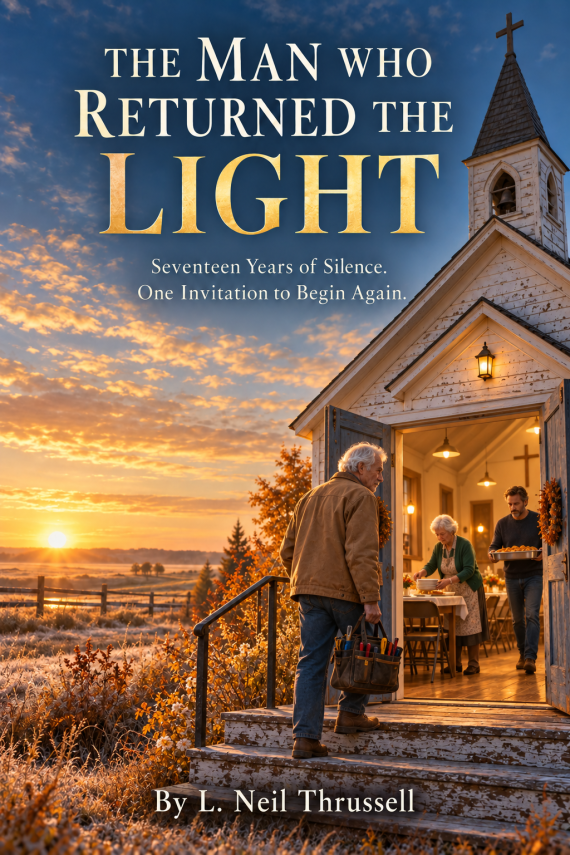
AI created the visual cover graphic, offered story ideas, and carried out the complete four-stage editing process:
developmental editing, line editing, copyediting, and proofreading.