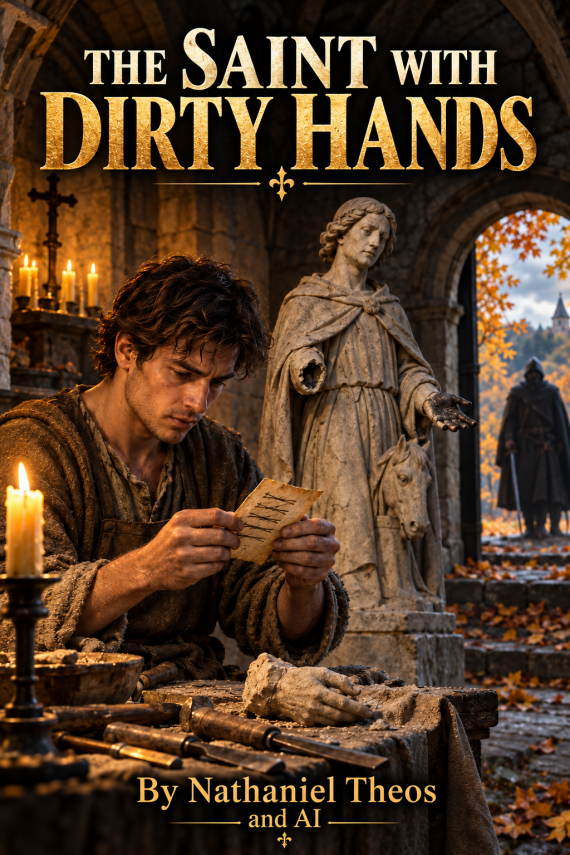
The Saint with Dirty Hands
By Nathaniel Theos and AI
France, autumn 1310
The seventh name belonged to the woman who had given him breakfast. Thomas Perrin read it again, standing beneath the broken hand of Saint Martin. Six names above it had been crossed through with hard strokes of ink. Beside each was a village. Beside the last was the name of the little hospice across the courtyard.
Agnès Bellot. Saint-Martin-des-Ormes. He looked toward the chapel door. Through it, he could see her shaking crumbs from a cloth. A hen hurried between her feet. She scolded it without conviction and went back inside.
The strip of parchment had come out of the saint’s wrist. Someone had repaired the hand long before Thomas was born, securing it to the forearm with an iron pin. Rust had swollen around the metal. When he worked the loose piece free, he found the parchment rolled into the space beside it, wrapped in a scrap of oiled linen.
He knew what belonged inside stonework. Iron, lead, the occasional small coin left by a mason who hoped to be remembered by God. Lists of people with names crossed out were something else.
Outside, a cart creaked along the road. Thomas folded the parchment into his palm.
He was twenty-four, with three good chisels, two worn ones, and a letter that could change his life. The letter lay in his leather satchel beneath a clean shirt. It instructed him to present himself at the works of Hugues de Brévault on Monday, where a place awaited him among the men carving the new hall. Master Aubert had recommended him. A winter under a roof, regular wages, and figures to carve instead of endless blocks to square: he had read the letter so often that the crease was beginning to split.
This small repair was a kindness to his master. The chapel’s priest had asked for someone cheap, and Thomas was passing this way. Restore the saint’s hand, replace two damaged stones around the porch, collect his payment, continue north.
He put the parchment in his sleeve. The statue stood on a low plinth beside the altar. Martin wore a cloak from which a corner had been carved away, the gift forever passing toward a beggar whose face was mostly lost. Red paint remained deep in the cloak’s folds. Both the saint’s hands were dark with years of candle smoke and touches from people who had come asking for things.
Thomas had been told to clean those hands. For now, he left them dirty.
Agnès was kneading bread when he entered the hospice kitchen. She was somewhere near fifty, with a narrow face and a white scar that pulled one eyebrow higher than the other. Flour marked her forearms. A pot simmered over the hearth, and a boy slept on a bench beneath a patched cloak.
“Is he mended?” she asked. “Not yet.” “Then Martin will have to manage with what God left him. Sit. There’s more broth.”
Thomas remained by the door. “Do you read?” She stopped kneading. “Well enough to be overcharged less often.” He held out the parchment. She wiped her hands carefully before taking it. He watched her eyes move down the list. Her expression changed so little that he might have mistaken it for puzzlement, except that she gripped the table with her other hand.
“Where?” “In the statue.” “Who saw you find it?” “No one.” “Are you certain?” He glanced toward the sleeping boy. “He’s feverish,” she said. “His mother will collect him after she finishes at the mill. Did anyone enter the chapel?”
“No.” Agnès pulled out a stool and sat. The dough lay between them, holding the shapes of her fingers.
“Do you know those people?” Thomas asked. “Four of them.” “Why are their names crossed out?” She looked at him. “I don’t know.” It was worse than the answer he expected. “Who put it there?” “A man who stayed here last week. I think. He went into the chapel every morning, though I never heard him pray.”
“What man?” “A clerk. His name was Guillaume.” “Where is he?” “Taken.” The broth bubbled. Agnès rose to move the pot, performed the task with precise attention, then returned to the table.
“Taken by whom?” “Men who said he had stolen something.” “Had he?” “Yes.” Thomas felt the first clean movement of relief. A thief, a list, an explanation that might belong to other people.
“Then you should take this to the priest.” “Father Benoît is at his sister’s burial. He won’t return before tomorrow.” “The prévôt, then.” She ran a finger beside the final name, not touching the ink. “I sent word to him yesterday. His clerk is coming this afternoon, on his way back from the rents at La Fosse. I asked him to hear a complaint and take charge of documents.”
“What documents?” “Those Guillaume stole.” Thomas took a step back. She noticed. “You didn’t come here for this,” she said. “Put your tools away. I’ll pay you for the morning.”
He should have thanked her. Instead he heard himself ask, “What did the others do?”
“The same as I did. Fed people. Let them sleep.” “What people?” “One was a ploughman. One had worked in a kitchen. Two belonged to the Temple.”
Thomas stared at her. He had been in Paris that spring, labouring on a roof, when men hurried through the streets with news of the burning. Fifty-four Templars. By evening, everyone knew why it proved something, though no two men agreed what. His master had told the younger workers to finish their bread and keep their opinions behind their teeth.
“You sheltered Templars?”
“I sheltered hungry men.” “You knew what they were.” “One told me. The other had cut a cross from his clothing and left the marks. He thought nobody would notice.”
Thomas looked at the boy on the bench. “And you let them stay here?” “Yes.” He remembered the broth she had set before him at dawn, the bread she had pushed closer when he pretended not to want another piece.
“I don’t know whether they were innocent,” Agnès said. “If that’s what you’re wondering, I couldn’t tell you.”
“And if they weren’t?” “They were still hungry.” He disliked the simplicity of it. It left him no sensible place to stand. She rose. “Go and pack.” Before he could answer, the hen outside gave a shrill, offended cry. Hooves struck the courtyard stones.
Agnès closed her eyes for one breath. “Too late,” she said.
There were three riders. Two wore swords openly. The third, a broad man in a dark cloak, carried himself as though other men were responsible for any distance between him and what he wanted.
He dismounted beside the well. A small silver fastening held his cloak at the throat. Thomas recognized the design: three hunting dogs beneath a branch of oak. He had copied the same device onto a practice stone two weeks earlier.
The arms of Hugues de Brévault. “Agnès,” the man called. “I hope your hospitality is better today.” She met him on the threshold. “You took everything you asked for last time.”
“Not everything.” His eyes moved to Thomas. “Who’s this?” “A stone carver.” “Does he speak?” “Thomas Perrin,” Thomas said. “Sent by Master Aubert to repair the chapel.”
“Aubert of Provins?” “Yes.” The man’s face warmed with recognition. “I’m Raoul Duret. I oversee matters for Lord de Brévault. We are expecting a young man from Aubert.”
Thomas felt the letter in his satchel as distinctly as if it were pressed against his skin.
“I have instructions to arrive Monday.” “Then make certain you do.” Duret turned back to Agnès. “A valuable object has been stolen from my lord’s chapel. A small reliquary. The man we questioned named this place.”
“I have no reliquary.” “Then you won’t object to a search.” “I object to you frightening the sick.” “That can be avoided.” One rider went toward the stable. The other remained beside the kitchen door. Duret entered without waiting for permission.
Thomas followed because his satchel was inside. It seemed important to give himself that reason.
Duret lifted a pot lid, glanced beneath a folded blanket, and ran his hand along the underside of the table. He ignored the little wooden crucifix above the hearth. Agnès watched from the doorway.
“What did Guillaume say?” she asked. “That you are a charitable woman.” “Where is he?” Duret looked toward the sleeping boy. “It would be unfortunate if charity became carelessness.”
Thomas picked up his satchel. Its buckle made an absurdly loud sound. “You can go, Perrin,” Duret said. “I’ll tell Aubert you were useful.” “I haven’t finished the hand.” “Saint Martin has survived greater inconveniences.” There it was: permission. Thomas could walk past the horses, regain the road, arrive early at the new hall. By next week he could be carving oak leaves for a man rich enough to pay for stone that served no purpose except beauty.
Duret opened a cupboard. He took out a small book and thumbed through it.
“Household accounts?” “Linen. Flour. Oil,” Agnès said.
“Everything costs.” He dropped it onto the table. Thomas stood within reach of the door. Behind Duret, the boy stirred beneath his cloak and whispered for his mother.
Agnès moved toward him. The guard put out an arm. “He needs water,” she said. “Let her,” Duret said, irritated. She knelt beside the bench. Thomas looked at the back of her head, the threadbare seam of her sleeve, her hand steadying the boy’s cup.
“I’ve left the saint’s hand loose,” he said. “Someone could pull it down. I’ll make it safe.”
Duret was examining the hearth now. He scarcely glanced up. “Then do it.” Thomas went back across the courtyard. His legs felt weak with the relief of leaving the room. Halfway to the chapel, he understood that he had not left anything.
In the chapel, he set down his satchel and unrolled his tools. Morning light fell through a narrow window, brightening the limestone dust on the floor. The saint’s detached hand lay on a folded cloth beside the plinth.
Thomas took up his smallest chisel and did nothing with it. He had spent seven years learning how to strike precisely. Too much force, and a thumb became rubble. Too little, and nothing changed. His master could hear a bad stroke from the far end of the yard.
There was no sound that told him what to do now. He could finish the work. Duret might find what he wanted and leave. Agnès might be questioned, then released. The crossed-out names could mean that those people had been found innocent. They could mean anything.
Thomas began to clean the socket around the old pin. A few moments later, Agnès appeared with a basket. “Bread,” she said. “I’ve eaten.” “For your journey.” Behind her, the guard watched from the kitchen door. She set the basket on the plinth and lowered her voice.
“Under the cloth.” Thomas did not look down. “They’ll search my bag.” “Yes. I hadn’t thought they’d let me bring it this far.”
“Why did they?” “He’s watching to see what I do. Now he knows.” Thomas stared at her. Her calm had misled him. Up close, he could see the trembling at the corner of her mouth.
“You’ve brought it to me?” “I brought it out of the kitchen. He had reached the grain chest.” Beneath the loaf lay a thin leather-bound account book, its cover darkened by handling. Several folded sheets had been tucked inside it. There was no jewel, no silver casket, nothing a soldier might mistake for a holy object.
“Guillaume kept the accounts for Brévault,” she whispered. “He was told to make two sets. One for the king’s officers. One for his lord.”
Thomas looked toward the door. “The property taken from the Temple passed through Brévault’s hands here,” she said. “Animals, grain, rents. Guillaume wrote down what arrived and what was declared. The missing part went elsewhere.”
“To Brévault.” “And to the men who helped him. Guillaume kept the payment orders.” “The people on the list?” “They gave shelter to men who saw the carts move. Guillaume found that list among Duret’s papers. He told me there were names, but not where he’d hidden them.”
Thomas lifted the cover. Columns of figures crowded the page. He could read ordinary words, slowly, and had learned enough reckoning to keep his wages. These entries would take longer.
“Why steal it now?” “Because he was ordered to put his own mark beneath the false account. He thought they’d make him answer for all of it.”
“So he saved himself.” “He tried.” Thomas touched one folded sheet. A seal hung from its lower edge. Agnès moved his hand away. “Keep them together.” “Why not take it to the prévôt yourself?” “Duret put a man on the road outside my door after he took Guillaume. That man left yesterday. I gave a message to the miller’s wife when she brought her boy. Now Duret has come back with two more.”
She breathed carefully.
“The royal prévôt has no love for Brévault. He won’t need much encouragement to count the king’s missing money.”
“And the men you sheltered?” “I want their names heard by someone Duret doesn’t employ.” Thomas looked at her. “Why would an officer care about them?” “Perhaps he won’t. But he may care whether they can tell him where the grain went.”
It was a smaller hope than he expected. He found it harder to dismiss. Across the courtyard, Duret came out of the hospice carrying the household book. He paused to speak to his guard.
Agnès followed Thomas’s gaze. “I thought I had until afternoon,” she said. Thomas shut the ledger. “When is the clerk coming?” “He said after the midday meal. Before vespers.” “That could be hours.” “Yes.” “Could the villagers help?” “Against Brévault’s men?” She shook her head. “They have rents to pay. Children.”
“Then what did you intend?” “To be here when the clerk arrived.” The answer made him angry. At her, at Guillaume, at the thin book lying beside his good chisels. At the way a woman with no proper means of protecting herself had continued to open her door.
Duret entered the chapel. “There,” he said, looking at the basket. “That wasn’t so difficult.”
He held out his hand. Agnès stepped in front of the plinth. Duret sighed. “You have mistaken possession for power.” “The king’s clerk is coming,” she said. The change in his face was brief, but Thomas saw it. “Which clerk?” “From the prévôt’s office.” “When?” She did not answer.
Duret called one of his men. “Ride toward La Fosse. Find anyone coming from the prévôt. Tell him the hospice has fever. The woman has gone to fetch medicine and won’t return today.”
The guard glanced toward the kitchen, where the boy slept. “Go,” Duret said. Thomas heard boots crossing the courtyard, then the horse moving out onto the road.
Duret turned back. “There. Now we needn’t hurry.” He opened the household book and laid it on the altar rail. “Your father’s hospice,” he said to Agnès. “Your husband’s before he died. All those little gifts. All that grain you claim to distribute.”
“I distribute it.” “Of course. And nobody has ever asked whether the accounts are correct.” He let the possibility settle. Thomas watched Agnès’s face. “Her husband taught her the accounts,” he said, though he did not know whether that was true.
Duret glanced at him. “Then perhaps you should have him explain them to the prévôt.”
“He’s dead,” Agnès said. “Yes. That is often inconvenient.” Duret stepped closer to Thomas, lowering his voice to something almost friendly.
“You know what this is? A quarrel over property. A clerk stole his master’s records. A charitable woman mistook a thief for a martyr. Now a mason is considering losing good employment over matters he cannot read.”
“I can read.” “Then you know what your letter promises.” Thomas said nothing. “Your master told us about you. A steady hand. Good judgment. He put his name beneath that recommendation.”
Duret looked at the saint. “There will be eight figures over my lord’s new hearth. Aubert thought you might carve two. Have you ever had work of your own on that scale?”
Thomas had imagined those figures at night. Men with faces he would choose. Drapery deep enough to hold shadow. The chance to make something people might look at after he was dead.
“No,” he said.
“Then don’t surrender it for a woman who will still be feeding every vagabond on the road when your hands are too old to earn your bread.”
The offer was not simply money. Duret understood that. It made Thomas hate him more.
Agnès took the ledger from the basket. “He has nothing to do with this,” she said. “Let him leave.” Duret smiled. “I’ve invited him to.” He reached for the book. Agnès drew back. “Where is Guillaume?” “Dead.” The word filled the chapel. Thomas heard the wind catch the outer door, then release it.
“How?” Agnès asked. “He was ill.” “He walked when you took him.” “Many sick men walk.” Duret’s patience ended. He seized her wrist and twisted. The book fell against the plinth. Thomas caught it before it struck the floor.
For one absurd moment, all three of them looked at his hands. “Give it here,” Duret said. Thomas could smell the other man’s wet wool. He could see a small crack in the silver clasp at his throat, badly repaired. His own right thumb rested against the ledger’s worn edge.
“No.” He had not planned the word. Once spoken, it demanded something of him.
Duret released Agnès and struck him across the face. Thomas hit the plinth with his shoulder. Light burst behind his eyes. He kept hold of the book because his fingers had closed on it before his mind understood the blow.
“Do not,” Duret said softly, “confuse my need for craftsmen with a need for you.”
Agnès drove the bread basket into his face. It was not an elegant attack. The loaf flew across the floor. Duret stumbled, swearing, and Thomas grabbed Agnès by the sleeve. They ran through the narrow door behind the altar into the sacristy.
Thomas slammed the door. There was no lock, only an old wooden bar in iron brackets. He dropped it into place as Duret struck the other side.
The impact shook dust from the lintel. Agnès stood gasping among vestments and candle boxes. Thomas wiped blood from his mouth. The ledger was still under his arm.
“Another way out?” he asked. She pointed to a window scarcely wider than his shoulders. Beyond it was the walled burial ground. Iron bars divided the opening.
Thomas looked back at the door. Outside, Duret called for his remaining man.
They had perhaps a few minutes. The door was thick, but its brackets were fixed into old mortar. Each blow made pale dust sift onto the floor.
Thomas tested the window bars. Firm. He could have loosened their sockets with tools and time. His tools lay beside the statue, and time was being measured by the weight of a man against the door.
Agnès was searching a chest. “What are you doing?” “Looking for a knife.” “To fight him?” “To cut the book apart. They can’t burn what they can’t find.” Thomas opened the ledger. Folded orders, figures, names. Divided, it might become worthless. He knew enough about stone to understand what happened when things that supported one another were separated.
“No,” he said. “Together.” The door shook again. “Perrin.” Duret’s voice was close to the wood. “You have frightened yourself. Put the book outside and we can still settle this.”
Thomas found a heavy chest and pushed it against the door. Agnès helped. The iron hinges scraped across the flagstones.
“Can you reach the bell?” he asked. “In the chapel.” He had seen the rope near the entrance. Beyond it, the courtyard, the road, people who would hear but might not come.
“What happens when it rings?” “At this hour? People will think there’s a fire.” The next impact pulled one iron fixing partly out of the wall. Thomas looked at Agnès. “Will they come for that?” “Yes.”
He searched the little room again. A copper basin. Candlesticks. A broom. The chest that now blocked the door. Above the vestment hooks, a narrow loft opening for storing broken furnishings.
A plank ladder stood against the far wall. Thomas climbed, lifted the hatch, and pushed his head into dust and darkness. The roof space continued over the chapel. He could see the pale shapes of the ceiling boards below the rafters, and, near the west end, a square of daylight beside the little bell turret.
He came down two rungs. “Can you climb?” Agnès looked up at him. “I can try.” He tucked the ledger into his tunic and helped her onto the ladder. Behind them, the bracket jerked loose. One end of the bar fell. The chest held the door for a moment, then scraped an inch across the floor.
Thomas pushed Agnès upward. A sword point appeared in the widening gap below.
They crawled onto the loft beams as the door burst open. “On the beams,” Thomas whispered. “Not the boards between.” Agnès nodded. She moved on hands and knees, feeling ahead in the dimness. Dust caught in Thomas’s throat. Beneath him, the chapel floor showed through gaps in the ceiling, impossibly far away.
Duret climbed into the loft behind them. His sword scraped a rafter. He cursed and let it fall through the hatch, then drew the shorter blade at his belt.
“Watch the chapel door,” he called down. “Nobody leaves.” Thomas hurried after Agnès. The roof timbers were old but sound where he could see them. He had worked above larger drops. Never with a man pursuing him. Never with someone ahead whose weight and balance he could not control.
At the west end, light from the turret fell across a beam worn by generations of men attending to the bell. The rope passed through an opening near its edge.
Agnès reached it and pulled. A single note struck the air. Duret quickened his pace. She pulled again, harder. The bell answered unevenly, then began to sound with desperate insistence. Thomas saw people appear on the road through the narrow opening beyond her: a woman carrying a bundle, two men beside a cart. They turned toward the church.
“Fire!” Agnès shouted. “Help us!”
Duret caught Thomas’s ankle. He fell forward across a beam. Pain drove the breath from his chest. He kicked, felt his boot connect with something, then twisted onto his side. The ledger slid out of his tunic and struck the boards between the beams.
Duret lunged for it. Thomas planted his right hand on the timber to rise. The knife came down through his palm.
For a moment he felt pressure rather than pain. His hand belonged to the wood. He stared at the blade, unable to make sense of the fact that he could see it entering him.
Then Duret pulled it free. Thomas screamed. Below, someone shouted from the chapel doorway. Duret reached for the book. Thomas caught its strap with his left hand. The leather stretched between them.
Agnès stopped ringing long enough to swing the loose end of the bell rope across Duret’s face. He flinched, shifting his weight onto a ceiling board.
The wood broke. One leg plunged through. His body turned, and the ledger tore free of his grip. He caught a beam with his forearm, but his lower body hung through the opening over the chapel. The knife fell, striking stone below.
Thomas clutched the ledger to his chest. His right hand burned so fiercely that he could no longer tell where his fingers were.
Duret clawed at the timber. His forearm slipped. Beneath him stood the stone edge of the font.
Thomas saw exactly how he would fall. He could let it happen. Nobody could ask a wounded man to save someone who had tried to kill him. The road to Brévault would still be closed, but Duret would be gone. Agnès would be safe from this man, at least.
Duret’s hand scrabbled against his boot. Thomas threw the ledger toward Agnès and seized the back of Duret’s cloak with his left hand.
The weight nearly pulled him through. “Help,” he gasped. Agnès wedged the book against a rafter and crawled toward them. Together they dragged Duret high enough for him to hook an elbow over the beam. Thomas’s injured hand struck the wood, and the pain made him retch.
Duret lay across the timber, wheezing. Blood ran from his mouth. When he tried to move his leg, he cried out.
“Stay there,” Agnès said.
She took the knife sheath from his belt and tossed it through the broken ceiling. Then she returned to the rope.
The bell began again.
By the time they came down, there were nine people in the chapel. Thomas counted them because counting was easier than thinking about his hand.
The miller’s wife stood near the doorway, holding her feverish boy. The remaining guard was beside the altar. His sword was drawn, but lowered. A man with a fork used for turning hay stood a cautious distance from him.
“She’s harbouring thieves,” the guard said. “Keep back.” “She’s been nursing my boy,” the woman replied. Neither moved. Agnès climbed down first, carrying the ledger. Thomas followed slowly. He had wrapped his hand in a strip torn from his shirt, but blood was already coming through. At the bottom, his knees gave way. He sat against the sacristy wall while the room tilted around him.
“Where’s Duret?” the guard demanded. “Above,” Agnès said. “His leg is hurt.” “Give me the book.” “No.” The guard raised his sword an inch. The man with the hay fork tightened his grip.
Agnès opened the ledger on the altar rail. Her hands shook so badly that the sheets rattled.
“These are accounts of goods taken from the Temple,” she said. “And orders for payments. Your master told you it was a reliquary.”
The guard’s eyes went to the book. From the loft, Duret shouted, “Burn it, you fool!” Nobody spoke. The guard looked up through the hole in the ceiling. Then he looked at the faces around him.
“You heard him,” Agnès said. “All of you heard him.” Thomas pressed his injured hand against his chest. Somewhere beneath the pain was an understanding: the bell had not made these people brave. It had brought enough of them together that each could see the others hesitate.
The guard lowered his sword. Outside, horses entered the courtyard.
For one terrible instant Thomas thought Brévault had sent more men. Then he heard an unfamiliar voice asking who had rung the alarm.
Agnès went toward it. The royal clerk was a lean man in a travel-stained hood, with two mounted sergeants behind him. Duret’s messenger followed at a distance. He had delivered his warning, but the clerk had heard the bell while still on the road and refused to turn aside.
“He said you were away,” the clerk told Agnès. “I was upstairs.” He looked past her at the broken ceiling, the drawn sword, Thomas sitting against the wall.
“So I see.” She put the ledger into his hands. He did not declare them saved. He did not promise justice. He turned the first page, examined one of the sealed orders, and asked for a table and better light.
The ordinariness of it nearly undid Thomas. While one sergeant took charge of the guard, the other went up with the ladder to inspect Duret. The clerk stood near the open doorway, comparing two documents. Once, he asked Agnès where she had obtained them. Once, he looked at Thomas.
“You found a list?” “Agnès has it.” She unfolded the parchment and laid it beside the accounts. The clerk read the seven names. “We’ll need to hear what each of you knows,” he said. “Separately.” “Will you take her?” Thomas asked. “I’ll take statements.” “Duret said—” “I heard what Duret said.” The clerk looked toward the roof. “The man is continuing to say it.”
Above them, Duret was invoking his lord, his authority, and the consequences of putting hands upon him. One of the sergeants told him to hold still unless he wished to arrive downstairs without assistance.
Agnès knelt beside Thomas. “Let me see.” He shook his head. “Thomas.”
Slowly, he gave her his hand. She loosened the cloth. He watched her face instead of the wound. That was a mistake. She had seen injuries before; he could tell by the way she kept her expression still.
“Can you move your fingers?” He tried. His thumb moved. His first finger. The others lay in her palm, belonging to a stranger.
He began to shake. “Send for someone,” she said to the miller’s wife. “The surgeon in town. Tell him it’s a hand wound.”
Thomas turned his face toward the wall. There had been eight figures planned for the hall. He had imagined carving two. He remembered the small block in Master Aubert’s yard on which he had practised a woman’s face, and the first time his master had turned it toward the light without saying anything at all.
He did not feel courageous. He wanted the morning back. Agnès sat beside him while the clerk wrote and the men brought Duret down. She did not tell Thomas he had done the right thing. She held the clean cloth firmly around his hand, and when he began to weep, she stayed.
Winter came before the inquiry finished. Thomas remained at the hospice through the first weeks because he had nowhere he could reach without help. Fever took him for three nights. Afterward, weakness lingered, and he hated the little effort required to exhaust him.
Agnès fed him, changed his dressings, and endured his temper until the day he sent a bowl against the wall.
She looked at the broken pieces, then at him. “You may be angry,” she said. “You may not make more work for the woman who cooks your dinner.”
He stared at her. Then he began to laugh, though it hurt his throat, and the laughter became something less bearable.
She gave him a cloth. Later, when he could bend without dizziness, he picked up the pieces.
The clerk returned twice. Thomas learned that two of the six people whose names had been crossed out were dead. Three had been detained in buildings controlled by Brévault. They were found there and brought before other officers. The sixth, a charcoal burner’s widow, had escaped into the woods and eventually reached her brother’s village.
The strokes of ink had meant that Duret considered each household dealt with. They had never meant that all the people were guilty, or even that all were dead. Thomas remembered how quickly his mind had turned six lines into six graves. The real accounting was bad enough.
Guillaume’s body was found in a disused storehouse. Agnès paid for a Mass, then discovered she did not have enough money for flour. When Thomas complained that the dead clerk would have preferred bread, she said she would thank him to leave the dead clerk’s preferences to God.
Master Aubert sent flour. He came with it, a week before Christmas, bringing Thomas’s wages from the chapel and a bundle of winter clothes. He examined the injured hand without touching it. Two fingers remained curled. The surgeon could say little about what strength might return.
“The hall?” Thomas asked. “Another man has your place.” He nodded. “They arrested Brévault?” “No. The officers have taken his accounts and put men over the disputed property. Rich men don’t travel through trouble at the same speed as the rest of us.”
“And Duret?” “Held. There are more witnesses now.” Aubert sat on the bench beside him. “I put my name to your recommendation,” he said. Thomas stared at the floor. “I know.” “There are people who think I should regret it.” The hearth settled with a soft collapse of ash. “Do you?” Thomas asked. His master picked up the narrow chisel lying beside Thomas’s good hand. He turned it, inspecting the edge.
“Not yet.” It was the nearest thing to comfort he had offered in seven years. Thomas had to look away.
The judgment against Duret came in the spring. He was condemned to hang for killings established by witnesses and supported by the seized papers. Thomas read the clerk’s letter twice, slowly. Agnès asked whether he wished to hear it aloud. He said no.
That night, he lay awake remembering the weight of the man suspended over the font.
He had saved him. Other men had judged him. Knowing the difference did not make the memory easy.
Brévault lost the administration of the seized estates and was made to account for money the king had not received. Whether he surrendered all he owed, Thomas never learned. The hospice recovered part of a grain allowance diverted during the same years. It was enough to replace the roof over the sleeping room and settle the bills Agnès had stopped opening.
No order arrived declaring the two Templars innocent. Their fate lay beyond the little inquiry. But the surviving witnesses were no longer in Brévault’s keeping, and the names on the strip of parchment had become people whose whereabouts an officer had written down.
Thomas thought Guillaume would have understood the value of that. When the weather warmed, Master Aubert offered him work measuring stone and teaching the newest boys to set out their cuts. Less money than carving. Work he could do while discovering what remained possible.
He accepted. Before leaving, he asked Agnès to bring his tools into the chapel.
Saint Martin still had one hand missing. Thomas had shaped its replacement over many slow afternoons, holding the chisel differently, making his left hand learn what his right could no longer tell it. He had spoiled the first piece. The second had a thumb too thick and fingers less graceful than he intended.
He set it in place while Agnès steadied the stool. “Will it hold?” she asked. “Yes.” It was the first answer about his work he had given without hesitation in months.
They stood back. The new stone was pale against the saint’s smokedarkened arm. Martin’s hand extended toward the beggar, broad and slightly awkward. Thomas saw every fault.
“I meant to do better,” he said. “You may yet.” He glanced at her. She was looking at the hand, not at him. “I never cleaned the other one.” “No.” “I was paid to.” “Then I suppose you owe us a little work.”
For once, he did not argue. Outside, the miller’s boy was struggling with a basket of kindling. Thomas heard the wood spill before he heard the child curse. Agnès raised her eyebrows at the language, then smiled to herself and went to stir the pot.
Thomas wrapped his chisels and set them in his satchel beside Aubert’s new letter. He crossed the courtyard and knelt to help gather the sticks. The boy glanced at his injured hand, then quietly took the heavier pieces.
Between them, they filled the basket. Inside the chapel, dust settled on the saint’s open palm.
◆◆◆
Historical note: The persecution of the Knights Templar following the arrests of 1307, and the execution of fifty-four Templars in May 1310, provide the historical backdrop. Thomas Perrin, Agnès Bellot, Raoul Duret, Hugues de Brévault, the hospice, and the crimes and inquiry depicted here are fictional.
Historical chronology: Archives nationales de France, “Les Templiers”.
OTHER BOOKS BY NATHANIEL THEOS
Stories of courage, mystery, survival, and the choices that define us.
An Unregistered Male A dystopian novel about identity, control, and what happens when a man refuses to disappear inside the system.
The Iron North A provocative Canadian political thriller about sovereignty, pressure, and the cost of standing one’s ground.
COMING OCTOBER 7, 2026 Bloodline of the Grail: The Last Templar’s Oath – Book 1 A medieval secret. A bloodline under threat. An oath that refuses to die.
Discover more at neilthrussell.com
A NOTE ON AI
The story concept, creative direction, characters, and original writing are by Nathaniel Theos. AI was used as an editorial and creative-support tool, including story development suggestions, the full editing process, and the creation of the cover artwork.
The human story remains the heart of the work. AI served as a tool in the creative and editorial process.