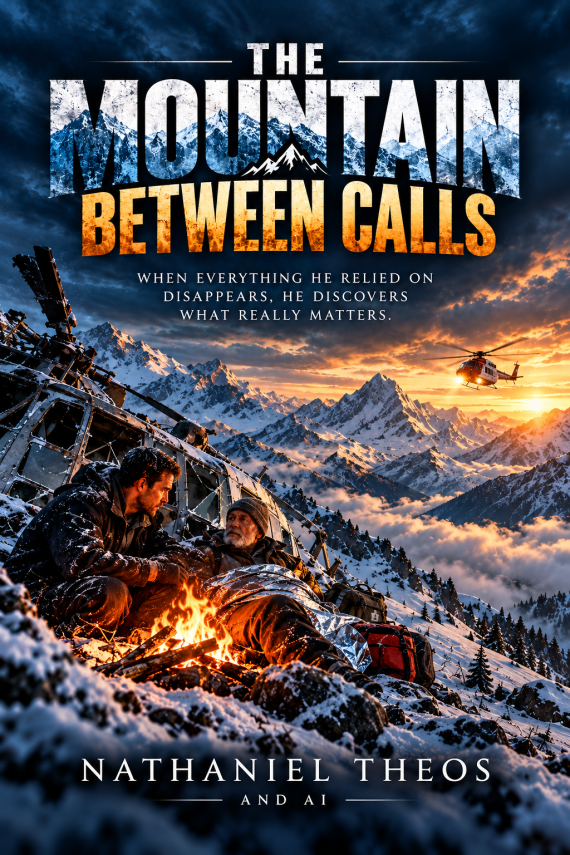
The Mountain Between Calls
By Nathaniel Theos and AI
Adrian Vale checked his phone before the helicopter had cleared the Calgary skyline. Three emails. Two messages from the board. One from his assistant.
None required an immediate response. He answered all six. By the time the city had fallen away behind them and the foothills began rising beneath the aircraft, Adrian had moved on to the quarterly projections. Numbers comforted him.
Numbers behaved. Revenue either increased or it did not. Expenses could be reduced. Problems could be identified, assigned and tracked.
Even uncertainty could usually be translated into percentages. People were considerably less cooperative. “Signal’s going to disappear soon.” Adrian looked up.
The pilot sat slightly ahead of him, hands steady on the controls. Late fifties, perhaps sixty. Weathered face. Grey beard cut close.
The name stitched onto his jacket read CAL ROURKE. Adrian lifted the phone. “I downloaded everything I need.” Cal glanced back.
“That what people come into the mountains for now?” “What?” “To download things.” Adrian smiled politely.
“I’m not really a mountain person.” “I gathered that.” Adrian looked down at himself. Dark wool trousers.
Leather boots. Cashmere sweater beneath an expensive winter jacket. “What gave me away?” “The shoes.”
Adrian looked at Cal’s heavy boots. “They’re waterproof.” “So is my kitchen sink. Doesn’t mean I’d wear it hiking.”
Adrian smiled despite himself. He had met plenty of men like Cal over the years. Men who wore practicality like a badge and regarded wealth with amused suspicion. Normally, Adrian enjoyed them in small doses.
Today he was paying one to fly him into the Rockies. That changed the balance. His phone vibrated again. Sophie.
Adrian stared at his daughter’s name. He let it ring twice before answering. “Hey.” “You actually answered.”
“I usually answer.” “You usually text that you’ll call me back.” “I’m in a helicopter.” There was a pause.
“Of course you are.” Adrian looked through the window. Snow-covered ridges filled the horizon. “I’m going away for a few days.”
“For work?” “No.” Another pause. “Are you sick?”
Adrian laughed. “I’m taking a break.” “You?” “That seems to be everyone’s reaction.”
“Where are you going?” “A lodge.” “What kind of lodge?” “Some executive retreat place.”
Sophie laughed. Adrian frowned. “What?” “You’re going to pay someone to tell you to stop working.”
“That isn’t exactly it.” “That is exactly it.” The helicopter banked gently. Static broke through the call.
“Sophie, I’m losing you.” “Dad, I called because I wanted to ask you about Saturday.” Adrian frowned. “Saturday?”
“My presentation.” The words landed awkwardly. He had forgotten. “Sophie…” “I sent you the details.”
“I know.” “You said you were coming.” “I am.” “You’re in a helicopter.”
“I’ll be back Friday.” The signal crackled. “Unless something comes up,” Sophie said. “What?”
“I said, unless something comes up.” “Sophie.” The call broke apart. “Sophie?”
Nothing. The screen showed NO SERVICE. Adrian stared at it. He would call her when they landed.
He would explain. He meant it. Adrian Vale had built a career out of meaning things. At fifty-one, he was the founder and chief executive of a technology company that employed almost eight hundred people across Canada and the United States.
He had launched it from a rented office with three employees, two folding tables and one investor who wanted his money back within six months.
Now the company occupied three floors of a downtown tower. Business magazines occasionally photographed Adrian against glass walls and mountain views and used words like visionary, relentless and disruptive. Adrian disliked all three.
He preferred effective. His board preferred profitable. His executive coach preferred unsustainable. That was how the retreat had begun.
“You haven’t taken more than four consecutive days off in seven years,” Marlene had told him. “I took nine days last summer.” “You took nine days in Portugal and attended eleven meetings.”
“They were video calls.” She had stared at him. Adrian had eventually agreed to the retreat mostly because refusing had become more work than attending. Three days.
Remote lodge. No scheduled meetings. Limited cellular service. Guided walks.
Good food. Silence. He had nearly cancelled twice. The helicopter crossed another ridge.
Adrian felt his stomach shift. Cloud had begun gathering around the peaks. Nothing dramatic. Thin grey layers brushed the mountainsides.
Cal adjusted something on the instrument panel. Adrian returned to the quarterly report. Five minutes later, the helicopter dropped. Not far.
Perhaps a metre. Enough to make Adrian’s stomach lurch and his hand clamp around the seat. Cal’s posture changed. “What was that?”
“Turbulence.” Adrian watched him. “You don’t sound convinced.” “I don’t get paid to sound convinced.”
The aircraft shook again. Harder. Cal reached for the radio. “Mountain Lodge, Foxtrot Charlie Seven, checking conditions on approach.”
Static. He tried again. No response. Cloud thickened around them.
The clean white peaks disappeared. Adrian put the phone away. “What’s happening?” “Weather moved in faster than forecast.”
“Can we turn around?” “Maybe.” The helicopter jolted. A warning light flashed.
Cal swore quietly. Adrian leaned forward. “What?” “Sit back.”
“What is it?” “Adrian.” It was the first time Cal had used his name. “Sit back and tighten your harness.”
There was something in the pilot’s voice Adrian recognized immediately. Not panic. Urgency. He obeyed.
Cal spoke rapidly into the radio. “Mayday, mayday, mayday. Foxtrot Charlie Seven. Mechanical issue, reduced power.
Approximate position…” The rest disappeared beneath a violent shudder. Adrian grabbed the sides of the seat. The helicopter yawed. For several seconds, there was only noise.
Rotor. Wind. Warning tones. Cal’s voice.
Adrian could not separate one from another. Through the window, grey cloud suddenly opened. Rock appeared below them. Too close.
Cal pulled hard on the controls. “Brace!” Adrian lowered his head. The first impact threw him sideways against the harness.
The second was worse. Metal screamed. Something shattered. The aircraft spun.
Adrian saw sky. Snow. Rock. Sky again.
Then darkness. When Adrian opened his eyes, he did not know how long he had been unconscious. Something warm ran into his eyebrow. He blinked.
His vision doubled, then steadied. The helicopter lay tilted sharply to one side. One window was gone. Snow blew through the opening in thin white streaks.
Adrian tried to move. Pain tore along his left side. He gasped. “Cal?”
No answer. He released his harness and immediately regretted it. Gravity pulled him sideways. He caught the seat before striking the damaged door.
“Cal?” A low groan came from the cockpit. Adrian crawled forward. Cal was slumped against his harness.
Blood ran from a cut near his temple. His left leg was trapped beneath twisted metal. Adrian touched his shoulder. “Cal.”
The pilot opened his eyes. For a moment, they were unfocused. Then they found Adrian. “You alive?”
“I think so.” “That’s useful.” Adrian almost laughed. “What happened?”
“Lost power.” “Can you move?” Cal looked down. “Not all of me.”
Adrian followed his gaze. The lower section of the instrument panel had collapsed around Cal’s leg. Adrian reached for the metal. “Wait.”
“We need to get you out.” “If that’s pinching a vessel, moving it too fast could make things worse.” Adrian froze. “What do I do?”
Cal closed his eyes briefly. “First thing, stop asking what to do every three seconds.” Adrian stared at him. Cal opened his eyes.
“You hurt?” “Ribs. Head.” “Can you breathe?”
“Yes.” “Dizzy?” “A little.” “Throw up?”
“No.” “Good. Check the radio.” Adrian found it crushed beneath the damaged console.
Dead. “What about the emergency beacon?” “Rear compartment.” Adrian climbed toward the back.
The rear storage area had split open. Bags, supplies and fragments of equipment were scattered through the snow outside. He found a bright orange case half buried near the wreck. The casing had cracked.
He carried it back. Cal looked once and swore. “Satellite communicator?” “Side pocket in my bag.”
Adrian found the bag. The communicator’s screen was shattered. He pressed the power button anyway. Nothing.
His phone. Adrian pulled it from his pocket. The screen was cracked but alive. Thirty-eight percent battery.
NO SERVICE. He held it up. Nothing changed. Cal watched him.
“No signal?” “No.” “Turn it off.” “What?”
“Turn it off.” “There might be signal higher up.” “And there might not. You keep checking every thirty seconds, pretty soon you’ll have no phone and no signal.”
Adrian looked at the device in his hand. His first impulse was to argue. Instead, he switched it off. The silence that followed felt enormous.
“What now?” Cal leaned his head back. “Now we solve the problem we actually have.” “Which is?”
“Night.” Adrian looked outside. It was barely after three. “We have hours.”
“Not enough.” Cal pointed toward the rear of the aircraft. “Emergency kit. Red bag.”
Adrian found it partly buried beneath snow. Inside were thermal blankets, fire starter, first-aid supplies, water packets, protein bars, cord, a folding knife, chemical hand warmers and a compact splint. Adrian held up the bag. Cal nodded.
“Good.” “We still need to get you out.” “Yes.” “Tell me how.”
Adrian crouched. Cal’s left leg was pinned below the knee. His boot remained intact. There was some blood but no obvious heavy bleeding.
“Can you feel your foot?” “Yes.” “Move your toes.” Cal did.
“That’s good, right?” “It’s better than bad.” They worked slowly. Adrian used a broken section of seat frame as leverage while Cal guided him.
Twice the metal slipped. The second time, Cal made a sound Adrian would remember long afterward. Not a shout. Something lower.
Animal. Adrian stopped. “I’m sorry.” “Don’t apologize.
Lift.” They tried again. The metal shifted enough for Cal to pull his leg free. He nearly blacked out.
Adrian lowered him onto a thermal blanket spread over the snow. The lower leg bent at an angle that made Adrian’s stomach tighten. “That’s broken.” Cal breathed through clenched teeth.
“Excellent diagnostic work.” “We need help.” “Yes.” Adrian looked toward the ridges.
“I’ll climb until I get service.” “No.” “Why not?” “Because you’re wearing city boots, you don’t know the terrain, cloud’s coming down, and you’ve probably got at least one cracked rib.”
“So we just sit here?” “We stay with the aircraft.” “For how long?” “Until somebody comes looking.”
“Did the mayday transmit?” “Maybe.” Adrian hated the word immediately. “Maybe?”
“That’s what I’ve got.” Adrian stood. The motion sent pain through his ribs. Cal noticed.
“Sit.” “I’m fine.” “You say that a lot?” “What?”
“I’m fine.” Adrian looked at him. Cal nodded toward his side. “Probably cracked.”
“Can’t do much about it.” “No.” “Then I’m fine.” Cal smiled faintly.
“There it is again.” They built shelter against the wreckage. Or rather, Cal explained and Adrian built. He stretched an emergency tarp from the broken fuselage to a cluster of rocks and anchored it with pieces of twisted metal.
He packed snow along the lower edge to block the wind. Beneath Cal, he layered seat cushions and anything else that could separate the injured man from the frozen ground. “Ground steals heat faster than air,” Cal told him.
“I know what conduction is.” “Good. Use that expensive education.” Adrian tried to start a fire.
The first attempt failed. So did the second. On the third, Cal watched him strike the fire starter with growing irritation. “Slow down.”
“I am going slowly.” “You’re attacking it.” “It’s a piece of metal.” “Exactly.
It isn’t impressed by you.” Adrian stopped. He breathed. Tried again.
Sparks caught the tinder. A tiny flame appeared. Adrian stared at it. Cal nodded.
“Congratulations. Civilization.” Adrian fed the flame carefully. Within twenty minutes, they had a small fire protected by rocks.
Adrian sat opposite Cal. Snow moved beyond the shelter. Wind whispered over the ridge. Nothing else.
No traffic. No voices. No sirens. No notification tones.
Adrian reached instinctively toward his pocket. His hand stopped. Cal noticed. “You always do that?”
“What?” “Reach for it.” Adrian looked at his hand. “Probably.”
“Must be exhausting.” “It’s my job.” “No. Your job is running a company.
Touching your phone every minute is something else.” Adrian frowned. “You know a lot about running companies?” “No.”
“Then perhaps we should stick to survival advice.” Cal smiled. “Happy to.” Darkness came quickly.
Temperature fell with it. Adrian had never experienced cold quite like that. Cal explained that mountain cold was less about the number on a thermometer than what wind, exposure and damp clothing did to a body. Adrian put on every spare layer they had.
He wrapped Cal in thermal blankets and kept adding wood to the fire. “What if nobody comes tonight?” “They probably won’t.” Adrian stared at him.
“You could soften that.” “Would it make you warmer?” Cal’s face had gone pale. Adrian noticed his breathing had become shallower.
“You okay?” “Been better.” “You’re getting worse.” “Probably.”
“What does that mean?” “It means stop asking questions you don’t want answered.” Adrian looked toward the blackness beyond the fire. “I hate this.”
“The cold?” “Not knowing.” Cal laughed weakly. “That’s the mountain.”
“I spend my life eliminating uncertainty.” “How’s that working out?” Adrian looked at the wrecked helicopter. “Poorly today.”
For a while, they were silent. The fire snapped. Wind pressed against the tarp. Adrian had never understood silence.
Even at home, there was always something. Television. Podcasts. Music.
Messages. Calls. Silence felt like absence. Tonight it felt like pressure.
He checked Cal’s pulse as instructed. Fast. Too fast. “Talk to me,” Adrian said.
“About what?” “Anything.” Cal opened one eye. “You trying to keep me awake?”
“Yes.” “You’re trying to keep yourself from thinking.” Adrian looked at him. “Both can be true.”
Cal closed his eye again. “Who were you talking to before we lost signal?” “My daughter.” “Got kids?”
“One.” “How old?” “Twenty-six.” “Close?”
Adrian hesitated. “That’s complicated.” “No. Tax law is complicated.
People just don’t like the answers.” Adrian almost told him to mind his own business. Instead, he added another branch to the fire. “Sophie and I used to be close.”
“What happened?” “Work.” “That’s one word.” Adrian watched the flame.
“When her mother and I divorced, I told myself I was building something for Sophie. Security. Opportunity.” “And?”
“Somewhere along the way, the company stopped being the thing I was building for her and became the thing I kept choosing instead of her.” Cal said nothing. Adrian continued. “I didn’t miss everything.
Birthdays. Graduations. I showed up.” “Physically?”
Adrian looked at him. Cal’s eyes remained closed. “You’re irritating even when injured.” “It’s a gift.”
Adrian sighed. “I was there. But there was always a phone on the table. Always something happening.”
“Something always happens.” “Yes.” Adrian stared into the fire. “She stopped getting angry.”
Cal opened his eyes. “That sounds worse.” “It was.” He thought about the call in the helicopter.
Her presentation. Saturday. He had genuinely forgotten. Not because he did not care.
Because caring had never stopped him from putting other things first. Cal shifted and groaned. Adrian moved closer. “You need painkillers?”
“Already took what I can.” “Water?” Cal nodded. Adrian helped him drink.
Afterward, Cal looked toward the darkness. “My wife used to throw my phone in the freezer.” Adrian laughed. “You had a phone?”
“I’m not that old.” “Why the freezer?” “She said if I wanted it during dinner, I could go get it and feel stupid.” “Did it work?”
“No. But the phone was always cold.” They both laughed. The laughter hurt Adrian’s ribs.
He did not mind. Cal slept in short stretches. Adrian did not sleep at all. He kept the fire alive.
Checked Cal. Listened to the wind. Near midnight, the snow stopped. Stars appeared above the basin.
Adrian stepped outside the shelter. He had never seen so many. He knew that was cliché. It did not make the stars less astonishing.
No city glow. No aircraft. No buildings. Nothing but black sky crowded with light.
Adrian stood beneath it and felt small. Not insignificant. There was a difference. For decades, his life had taught him that importance came from being required.
People called because they needed decisions. Investors wanted answers. Employees wanted approval. Boards wanted strategy.
Sophie had once wanted his attention. He wondered when she had stopped asking for it. Behind him, Cal coughed. Adrian returned to the fire.
By dawn, Cal had developed a fever. His leg had swollen badly. Adrian checked his pupils, monitored his breathing and followed instructions he barely understood. “We need rescue today,” Cal said.
“Then I climb.” “No.” “We’ve waited.” “We stay with the wreck.”
“You said the mayday might not have transmitted.” “Yes.” “So nobody may know exactly where we are.” “They know our route.”
“And if weather keeps aircraft out?” Cal looked at him. “That’s possible.” Adrian hated those words.
Possible. Maybe. Probably. He stood.
“I’m going up.” “You don’t know the terrain.” “I know the ridge is higher.” “And you think higher means safer?”
“No. I think higher might mean signal.” Cal closed his eyes. “That phone really owns you.”
“This isn’t about email.” “No.” “It’s about getting you out.” Cal opened his eyes again.
“If you go, mark your route.” “I will.” “Take the emergency blanket.” “Yes.”
“Food.” “Yes.” “Compass.” “Yes.”
“Do not cross anything steep enough to slide.” Adrian frowned. “That sounds less technical than I expected.” “I’m working with what I’ve got.”
Adrian crouched beside him. “You told me to solve the problem I actually have.” “I did.” “The problem is you’re getting worse.”
Cal said nothing. Adrian continued. “I can sit here waiting for certainty, or I can move.” The pilot studied him.
Finally, he nodded toward the emergency bag. “Then at least stop dressing like a banker.” Adrian layered himself in spare gear. The oversized snow pants made him look ridiculous.
Cal gave him the compass and pointed toward the ridge. “If visibility goes, come back.” “I will.” “If you get signal, call emergency services first.”
“Obviously.” Cal looked at him. “I mean first.” Adrian understood.
Not his assistant. Not the board. Not Sophie. Emergency services.
“First.” The climb was worse than Adrian expected. Within ten minutes, his ribs burned. Within twenty, sweat chilled beneath his layers.
His boots slipped constantly. The slope that had looked manageable from below grew steeper with every step. He marked his route with strips torn from a bright emergency cloth. Cal had told him not to trust footprints.
Wind could erase them in minutes. Adrian climbed. Stopped. Breathed.
Climbed again. The phone remained off in his pocket. That required more discipline than he wanted to admit. Halfway up, he reached a rock shelf and looked back.
The helicopter appeared tiny below. A broken shape in a vast white basin. The sight frightened him. Until then, the crash had been the whole world.
From above, it was barely visible. He kept moving. Near the ridge, the snow deepened. His right foot punched through a drift to the knee.
He fell forward. Pain exploded through his ribs. Adrian rolled onto his side and shouted. The sound vanished into open air.
For several minutes, he lay still. He thought about turning back. Cal would understand. Nobody would blame him.
He had already done more than anyone could reasonably expect. The thought annoyed him. For most of his life, reasonable expectations had been something Adrian expected other people to exceed. He pushed himself upright.
“Fine,” he whispered. Then laughed. Cal would have enjoyed that. He continued.
The ridge was another forty metres. Thirty. Twenty. At the top, wind hit hard enough to stagger him.
Adrian crouched behind a rock. His hands shook as he pulled out the phone. He turned it on. The screen lit.
Eighteen percent. Searching. Searching. No service.
Adrian lifted the phone. Nothing. He moved several metres. Nothing.
Another ten. One bar appeared. Then vanished. Adrian froze.
Moved back. One bar. He dialled emergency services. The call failed.
He tried again. Connected. “Emergency. What is your location?”
The voice broke badly. Adrian shouted into the phone. “Helicopter crash. Two survivors.
Rockies. Pilot injured.” “What is your location?” “I don’t know exact coordinates.”
“Can you access your phone’s location?” Adrian opened the map. The screen loaded slowly. A location appeared.
He read the coordinates. The dispatcher repeated them. Then the signal dropped. Adrian stared at the screen.
Twelve percent. He called again. It connected. “We have your coordinates,” the dispatcher said.
“Search and rescue has been notified. Weather may delay air response. Can you return safely to the crash site?” “Yes.”
“Stay with the aircraft. Conserve battery.” The call ended. Adrian looked at the screen.
Nine percent. He should turn it off. Instead, he stared at Sophie’s name. Cal had told him emergency first.
He had done that. Adrian pressed call. Nothing. He tried again.
Ring. Once. Twice. “Dad?”
Adrian closed his eyes. “Sophie.” “Where are you? I’ve been trying to call you.”
“I don’t have long.” “What happened?” “There was a crash.” Silence.
Then her voice changed. “What?” “I’m okay.” “Dad.”
“I’m okay. The pilot’s hurt. Rescue knows where we are.” “Where are you?”
“In the mountains.” “That does not help.” Despite everything, Adrian laughed. Sophie did not.
“Are you hurt?” “Ribs. Nothing serious.” “Are you sure?”
Adrian looked across the basin. “No.” The honesty surprised him. He leaned against the rock.
“Sophie, about Saturday…” There was a pause. “Forget Saturday.” “No.” “Dad, you’re in a helicopter crash.”
“I forgot.” The words were harder than he expected. “I know.” “I’m sorry.”
Static crackled. “I kept thinking there would be time after the next thing.” Sophie was silent. Then she said, “There was always a next thing.”
Adrian closed his eyes. “Yes.” Wind tore across the ridge. “I should have answered you more.”
“You answered.” “Not really.” Neither spoke. The battery indicator flashed.
Three percent. “Sophie.” “I’m here.” “I love you.”
Her breath caught. “I love you too.” “Come home,” she said. The call died.
The screen went black. Adrian sat behind the rock for nearly a minute. Then he put the dead phone into his pocket and began climbing down. The return took longer.
His legs shook. Twice he lost sight of the route markers. Once he slid several metres before stopping against a drift. When the wreck finally came into view, relief weakened him more than fear had.
Cal was awake when Adrian reached the shelter. “You get it?” Adrian collapsed beside the fire. “They have coordinates.”
Cal nodded. “Good.” “They said weather might delay rescue.” “Expected.”
Adrian looked at him. “I called my daughter.” Cal smiled faintly. “After emergency?”
“Yes.” “Then I won’t lecture you.” “Thank you.” “How’d it go?”
Adrian stared at the flames. “I don’t know.” “That’s usually how real conversations go.” Cal’s condition worsened through the afternoon.
He drifted in and out of consciousness. Adrian kept the fire alive and forced him to drink. Cloud returned. Snow followed.
Adrian checked the sky too often. Nothing. By late afternoon, panic began pushing at him again. He had done what he was supposed to do.
Called. Returned. Waited. Still nothing.
Cal opened his eyes. “You’re pacing.” “I’m thinking.” “You pace when you think?”
“I usually have an office.” “Must be hard on the carpet.” Adrian crouched beside him. “You’re getting worse.”
“Probably.” “I hate that word.” “Which one?” “Probably.”
Cal smiled. “You prefer guarantees?” “Yes.” “Mountain doesn’t.”
“I’ve noticed.” Darkness approached again. Adrian looked toward the sky. “Come on.”
Nothing. He added wood to the fire. Then a sound came faintly through the basin. Adrian froze.
Rotor blades. He stood. Cal opened his eyes. “Helicopter?”
“I think so.” Adrian ran into the open. The sound grew louder. A search-and-rescue helicopter appeared over the ridge and circled once.
Adrian waved both arms. The aircraft banked. A crew member saw him. For the first time since the crash, Adrian allowed himself to believe they were leaving.
The rescue team landed several hundred metres away. Four people crossed the snow toward them. After that, everything moved quickly. Medical checks.
Questions. Splinting. A stretcher. Cal was loaded first.
As rescuers prepared Adrian for transport, Cal reached toward him. Adrian took his hand. “You did all right,” Cal said. “High praise.”
“Don’t get used to it.” Adrian smiled. “You owe me a helicopter ride.” Cal laughed, then winced.
“Take the bus.” Three months later, Adrian sat across from Sophie in a small restaurant in Calgary. Not expensive. Not fashionable.
Her choice. His phone rested in his coat pocket. That had taken practice. At first, leaving it there had felt irresponsible.
Then uncomfortable. Then merely unfamiliar. The company had survived. Remarkably, it had survived several dinners, two weekends and an entire Sunday without Adrian personally supervising its existence.
He remained CEO. He had not sold everything. Had not grown a beard. Had not moved into a cabin.
His executive coach seemed almost disappointed. Adrian still worked hard. Still liked winning. Still checked numbers more often than was probably necessary.
But some things had changed. He blocked evenings. Took Saturdays off unless the building was literally burning. His assistant had explicit permission to tell him when he was becoming ridiculous.
She enjoyed this more than he had anticipated. Most importantly, he had attended Sophie’s rescheduled presentation. He had arrived early. Sat in the front row.
Left his phone in the car. Sophie had noticed all three. She had not mentioned any of them. That was fine.
Not everything required acknowledgment to matter. Now she studied him across the restaurant table. “You’re quiet.” “I’m listening.”
“That’s new.” He smiled. “I deserved that.” “Yes.”
The conversation paused. Not awkwardly. Adrian had begun learning that silence did not always mean something had gone wrong. Sometimes silence was where people remained together without needing to fill the space.
His phone vibrated inside his coat. He felt it. Sophie heard it. She looked toward the coat.
“Important?” Adrian considered the question. For most of his life, importance had been determined by urgency. Who needed him.
How quickly. How much money was involved. How many people were waiting. The phone buzzed again.
He left it where it was. “Yes,” he said. Sophie raised an eyebrow. Adrian reached for his coffee.
“But not more important.” She smiled. He did too. Outside the restaurant window, the Rockies were barely visible beyond the city, blue and white beneath the evening sky.
Adrian looked at them for a moment. For most of his life, he had believed silence meant nothing was happening. The mountain had taught him otherwise
AUTHORSHIP & AI ACKNOWLEDGEMENT
The story concept, creative direction, characters, and original writing are by Nathaniel Theos.
Artificial intelligence was used as a collaborative creative and editorial tool, including story-development suggestions, assistance with the editing process, and creation of the visual cover artwork.
The human author guided the story’s emotional arc, themes, revisions, and final creative decisions. AI served as a writing, visual, and editorial assistant in bringing that vision to the page.