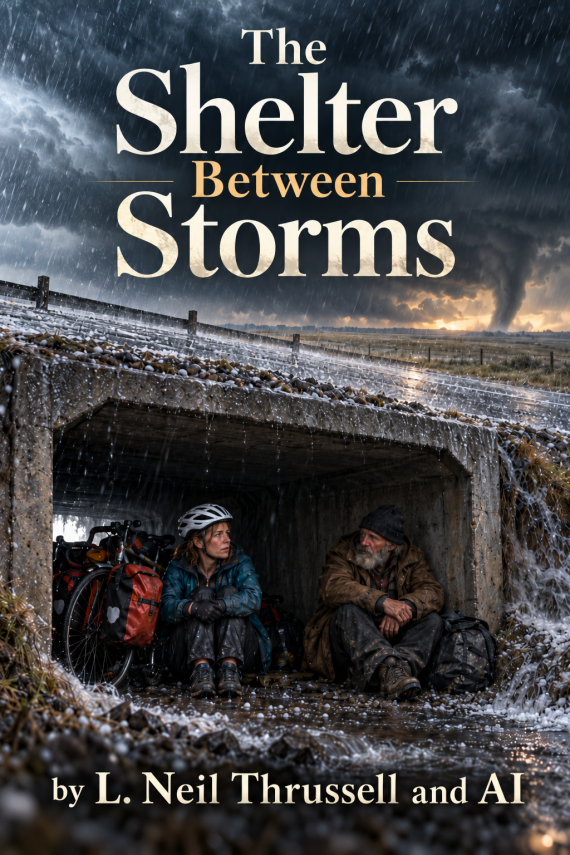
The Shelter Between Storms
By L. Neil Thrussell and AI
1. The Road Across Canada
Sarah Mitchell had discovered three things about Saskatchewan. The wind never seemed to stop blowing, the horizon was considerably farther away than it looked, and whoever described the Prairies as flat had obviously never crossed them on a bicycle.
She shifted into a lower gear and climbed another long, gradual rise. After seventy kilometres of riding into a stubborn headwind, even the smallest incline felt personal. "Come on, Matilda. We’ve climbed the Rockies. This is nothing." Her loaded touring bicycle rattled over a rough patch of pavement, offering what Sarah chose to interpret as disagreement.
At thirty-eight, she was finally doing something she’d talked about for nearly twenty years. She was cycling across Canada, not racing, not raising money, and certainly not attempting to set a record. She was simply riding from the Pacific to the Atlantic, one kilometre at a time, discovering parts of the country she’d previously known only from photographs and maps.
It had been her father’s dream first.
When Sarah was seventeen, he’d spread a map across their kitchen table and traced a finger from Victoria to St. John’s. "Imagine the people you’d meet," he’d said. "The places you’d see. The stories you’d bring home."
Her mother had laughed and asked whether he’d given any thought to the condition of his backside after several thousand kilometres. "That’s why God invented padded cycling shorts," he’d replied, looking entirely too pleased with himself.
Sarah smiled at the memory. Her father had never made the journey. Work, responsibilities, and eventually a failing heart had taken care of that. He died at fifty-nine, leaving behind a garage full of tools, a battered touring bicycle, and a map covered in pencil marks.
Across the top, he’d written three words.
Someday. No excuses.
She carried that map in a waterproof sleeve at the bottom of one of her panniers, along with a small grey stone she’d collected on the morning she began her journey. She’d stood on the shore of the Pacific Ocean, dipped Matilda’s rear tire into the water, and selected a smooth stone from among the thousands scattered along the beach.
She’d held it in her palm and imagined her father standing beside her.
"One ocean to the other, Dad," she’d whispered. "I’m taking you with me."
Her plan was simple. When she reached the Atlantic, she would touch the stone to the water on the opposite side of the country. Somehow, that small ceremony had become as important to her as the journey itself.
Her father had never asked her to finish his dream. She’d chosen that herself, two years after his death, when the ordinary routines of her life had begun to feel strangely empty. Some mornings she rode because she loved the freedom. Other mornings she rode because stopping meant thinking about things she wasn’t ready to face. And sometimes, on the long, quiet stretches of highway, she could almost hear her father riding beside her.
Sarah reached for her water bottle and checked the cycling computer mounted to her handlebars. Seventy-three kilometres. Another twenty would bring her to the campground she’d selected that morning. A hot shower, something resembling dinner, and eight hours inside her little tent sounded wonderful.
She glanced west and noticed the sky had changed. An enormous wall of charcoal-grey clouds was building along the horizon, its upper edge spreading outward like a dark anvil. The brilliant blue sky she’d enjoyed an hour earlier had almost disappeared.
Her phone vibrated inside its waterproof handlebar pouch. She stopped on the gravel shoulder and read the emergency alert warning of damaging winds, large hail, and possible tornadoes.
"Fantastic," she muttered, enlarging the weather radar.
A powerful storm cell was moving northeast, directly across her route. The nearest town was fourteen kilometres ahead, and behind her there was nothing for nearly twenty. She considered turning around, but the storm was too broad, and the wind had already begun shifting. Riding back would probably put her in worse conditions.
She’d experienced bad weather before. Thunderstorms in British Columbia, freezing rain near the mountains, and one miserable afternoon when she’d spent two hours beneath the awning of an abandoned gas station. But something about this storm bothered her. The temperature had dropped noticeably, the insects had disappeared, and across the fields, the canola plants bent beneath the strengthening wind.
The air smelled different, heavy and metallic. Sarah pulled on her rain jacket, tightened her helmet strap, and clipped back into her pedals. She’d find shelter. She always did.
Five minutes later, the first hailstone struck her helmet.
The crack sounded like someone had thrown a rock. Another bounced off her handlebars, followed by three more that struck the pavement. Within seconds, the highway disappeared beneath a curtain of white.
Hail hammered the asphalt, bouncing wildly around her tires. A violent gust struck from the south, nearly pushing her into the traffic lane. Sarah grabbed both brakes and unclipped one foot just as a hailstone the size of a golf ball struck her thigh.
She screamed. The pain was immediate and astonishing, spreading through her leg in a hot, sickening wave. She dismounted, trying to use the bicycle as a shield, but the wind kept twisting the loaded frame sideways.
There were no houses nearby, no substantial trees, and no barn, shed, or abandoned gas station offering refuge. Nothing but fields, ditches, and an empty highway disappearing beneath the storm.
Then she saw it, a large rectangular drainage culvert beneath the raised roadway, perhaps two hundred metres ahead. The dark opening in the concrete embankment wasn’t ideal, but it was the only place she could see that offered any protection from the hail.
Sarah lowered her head and began pushing Matilda toward it. The wind struck her from behind, then changed direction with startling force. Ice hammered her shoulders and legs, and painful welts were already forming beneath her clothing.
Twice, the bicycle nearly toppled. A particularly violent gust caught one of her rear panniers and twisted the handlebars out of her grip. She stumbled after it, fighting to keep the loaded bicycle upright while shouting encouragement that the wind immediately swallowed.
By the time she reached the embankment, she was trembling from pain, exhaustion, and fear. She scrambled down the grassy slope, dragging Matilda behind her. The culvert was larger than she’d expected, a concrete passage beneath the highway with enough clearance for a person to stand slightly bent.
She rushed toward the opening, desperate to escape the hail, and stopped so abruptly that her bicycle bumped against her leg.
Someone was already inside.
2. The Stranger in the Darkness
The man sat several metres back from the entrance, leaning against the concrete wall. He had broad shoulders beneath an old brown work coat, a thick grey beard, and unruly hair poking from beneath a faded baseball cap. Beside him lay a battered backpack, a rolled sleeping bag, and two plastic grocery bags.
Sarah tightened her grip on the handlebars as the man looked up and greeted her with a casual "Afternoon."
For an instant, she almost laughed. The world was apparently coming apart, and this stranger was greeting her as though they’d met in the produce aisle of a grocery store.
"Hi," she answered cautiously.
He glanced toward the opening, where hailstones ricocheted off the concrete. "Better get yourself inside. That’s some nasty weather."
Sarah didn’t move. She was alone, miles from the nearest town, standing at the entrance to a dark concrete passage with a man she didn’t know. She’d spent weeks cycling through unfamiliar places, taking precautions that had become second nature. Never camp somewhere isolated if something felt wrong. Keep her phone accessible. Avoid situations where she couldn’t leave easily.
And now she was considering entering a confined space with a strange man while a violent storm raged outside.
The man watched her for a moment before lowering his eyes. "There’s room," he said. "I don’t own the place."
Sarah pulled Matilda just inside the opening. "Thanks. I’m okay here."
He nodded, telling her to suit herself before returning his attention to a battered paperback. Sarah remained standing, painfully aware of how vulnerable she was.
From where she stood, she could smell damp clothing, stale tobacco, and the unmistakable odour of someone who hadn’t had access to a shower in several days. His boots were heavily worn, and the sleeping bag looked as though it had survived several winters, not all of them kindly. She assumed he was homeless, and the thought made her more uncomfortable than she wanted to admit.
A fresh gust sent hail bouncing across the concrete floor. Several stones struck her bare calves, making her cry out and stumble sideways.
"Miss, you might want to move farther in," the man suggested.
"I’m fine!" Her voice came out sharper than intended, and she immediately regretted it.
He raised both hands. "All right."
Then he gathered his belongings and shifted toward the opposite wall, leaving an open stretch of concrete between them. "There. Plenty of room."
Sarah watched him carefully. He wasn’t approaching her or asking questions. In fact, he appeared determined to make himself as unthreatening as possible, which she found both reassuring and confusing.
Outside, the wind grew stronger. A hailstone struck her helmet hard enough to make her knees buckle. Matilda twisted sideways, and Sarah barely caught the bicycle before it fell. Another blast drove ice through the opening, striking her already bruised legs.
Her fear of the storm was becoming greater than her fear of the stranger, and she hated having to choose between the two.
Something heavy struck the roadway overhead with a tremendous crash. Sarah dropped to one knee, her heart pounding so violently that she could feel it in her throat.
That settled it. She dragged Matilda farther inside and crouched beside the wall, leaving several metres between herself and the man.
He glanced toward her and nodded approvingly. "Better."
Sarah didn’t answer, still keeping one hand wrapped around her bicycle’s handlebars.
After a moment, he introduced himself. "Name’s Gord. Gordon Dawson, technically. But nobody calls me Gordon unless I’ve done something wrong."
Despite herself, Sarah almost smiled. "I’m Sarah."
"Pleasure to meet you, Sarah. Wish the circumstances were a little better."
She nodded, and Gord returned to his paperback. Sarah studied him from the corner of her eye, wondering what kind of man sat reading a mystery novel in a drainage culvert during a violent thunderstorm.
Then she noticed the way he held the book. His thumb marked the page, but he wasn’t reading anymore. He was watching the weather beyond the entrance, and from the tension in his jaw, she suspected he was considerably more worried than he wanted her to know.
A low rumbling began somewhere outside. At first, Sarah thought it was thunder, but it didn’t fade. It grew deeper and louder until she could feel it vibrating through the soles of her cycling shoes.
Gord closed his book and slowly looked toward the opening.
"That’s not good."
3. The Fury Above Them
The noise sounded like a transport truck passing directly overhead. Sarah looked toward the roadway as the rumbling intensified, then realized it wasn’t a truck at all.
The wind was accelerating through the culvert.
Dust, gravel, and bits of dried grass swept along the floor. Hailstones bounced off the walls, and somewhere outside, a metallic object scraped violently across the pavement.
Gord rose and moved cautiously toward the entrance. Sarah watched him, growing increasingly alarmed by his silence.
"What is it?" she asked. When he didn’t answer, she called his name again.
He stared across the fields, his expression changing from concern to unmistakable fear. "Get down, Sarah!"
She crouched instinctively. Through the opening, the rain shifted just enough for her to see a dark column descending from the clouds. It twisted and widened as it approached the ground, throwing dust and debris into the air.
A tornado.
For several seconds, her mind refused to accept what she was seeing. Tornadoes belonged on television, in news footage, and in photographs taken by people who had survived to tell the story. Not here. Not in front of her.
"Oh my God. Is it coming this way?"
Gord studied the sky, struggling to judge the tornado’s direction through the rain. "Can’t tell."
"What do we do?"
He looked toward the drainage ditch beyond the entrance. "Normally, I’d rather be low to the ground and out of a tunnel like this. Wind can get fierce in these things."
Sarah stared at him. "You mean we’re not safe?"
He turned toward her. "No, Sarah. I wouldn’t call this safe."
Her stomach tightened as Gord glanced at the hail hammering the embankment. "But getting out there right now might be worse."
A tremendous crash sounded overhead, making Sarah scream and cover her head. Gord crouched beside his backpack and pulled off his brown coat, folding it before sliding it across the concrete toward her.
"Here. Put this over your head and shoulders."
Sarah looked at the coat. The fabric was filthy, the cuffs were frayed, and one sleeve had been crudely repaired with mismatched thread. She didn’t want to touch it, but a fresh blast of hail struck the wall above her, scattering fragments of ice across her legs.
She grabbed the coat and pulled it over her helmet. "Thank you!"
Gord nodded, then pulled his backpack over his own head.
The noise became unbearable. Wind screamed through the concrete passage, forcing dust and ice into every corner. Sarah curled into herself, pressing Gord’s coat against her shoulders while the roar seemed to reach inside her chest and squeeze the air from her lungs.
She had never been so frightened. Not when she’d fallen on a steep mountain descent in British Columbia or when a transport truck had passed dangerously close outside Kamloops. Not even when she’d received the telephone call telling her that her father had suffered a fatal heart attack.
That fear had been different. Terrible, certainly, but different. This was immediate and physical, with every instinct in her body screaming that she was about to die.
She tried to remember the tornado safety information she’d read before beginning her journey, but her thoughts came in disconnected fragments. Stay low. Protect your head. Avoid overpasses.
Was a drainage culvert any better? Was the concrete strong enough? What if the tornado passed directly over them?
Another deafening impact shook the roadway, and Sarah began crying. She tried to stop, embarrassed by the sound of her own fear, but another gust roared through the passage, and she flinched so violently that her shoulder struck the wall.
Gord moved a little closer, stopping several feet away. He called her name and pointed toward his chest, demonstrating a slow breath followed by another.
Sarah tried to copy him, but her lungs refused to cooperate. He repeated the motion, and she finally managed to inhale and exhale without gasping. Another gust struck, and she lost the rhythm.
Gord said something, but the storm swallowed his words.
Water began flowing along one side of the culvert. He noticed immediately and crawled toward the stream, examining the flow and looking between the two openings. Water was moving steadily toward the far end, but more rain was being driven inside.
He returned to Sarah. "Keep an eye on that water!" he shouted, pointing toward the widening stream. "If it starts rising, we’ll have to move!"
Sarah stared at the water. As if the tornado weren’t enough, now she had to worry about the culvert flooding. She wanted to scream, but instead she began shaking so badly that her teeth chattered.
The roar grew louder, and a sharp cracking sound came from somewhere outside. For one terrible moment, Sarah imagined the entire roadway collapsing on top of them.
She thought of her mother, her little apartment waiting back home, and the map in her pannier, the one her father had spent hours marking with places he wanted to visit.
Then she thought of the small grey stone from the Pacific.
The idea that it might never reach the Atlantic struck her with an almost unbearable sadness. It was such a ridiculous thing to worry about when her life was in danger, but somehow that little stone had become the promise she’d made to herself and to her father.
She had come too far for the journey to end beneath a Saskatchewan highway.
Her breathing became shallow again, and she tried to speak, but nothing came out.
Gord shifted closer, still leaving space between them. He held out one hand, not reaching for her, simply offering it.
Sarah stared at his rough fingers. Twenty minutes earlier, she’d been reluctant to enter the culvert because of this man. Now, with the wind roaring like some furious living creature, she wanted nothing more than the reassurance of another human being.
She reached across the concrete, and their hands met.
Gord’s palm was warm and calloused. He closed his fingers gently around hers, and neither spoke. There was nothing useful left to say.
They crouched together while hail hammered the roadway overhead, water rushed through one side of the culvert, and the wind screamed through the narrow passage. Sarah gripped his hand so tightly that her fingers began to ache, but Gord didn’t pull away.
She closed her eyes and, for a moment, was seventeen again, sitting in her father’s workshop after falling off her bicycle and badly scraping her knees. He’d cleaned the gravel from her skin while she cried, patiently assuring her that she was all right and that he had her.
The memory hurt more than the hail.
Her father wasn’t here. He never would be again. But someone was holding her hand, someone who had absolutely no reason to care whether she lived or died, except that he did.
She began crying harder.
Gord glanced toward her and shouted something. She couldn’t hear every word, but she understood enough. He was telling her to hang on.
And she did.
Time lost its shape. The storm might have lasted five minutes or fifty. Eventually, the terrible roar began to weaken, the concrete stopped vibrating beneath them, and the hail softened to scattered impacts.
Beneath the distant thunder, Sarah realized she could hear herself breathing again.
She opened her eyes. Gord was still holding her hand.
"You okay?" he asked.
Sarah tried to answer, but instead she began to sob. Her whole body shook with the release of fear she’d been holding inside. Gord didn’t tell her to stop, and he didn’t promise that everything was fine. He simply remained beside her until she could breathe without fighting for every mouthful of air.
When she finally loosened her grip, he gently released her hand.
"Well," he said, looking toward the entrance, "that wasn’t much fun."
Sarah gave a broken laugh before starting to cry again.
4. Two People, One Storm
The rain continued for another twenty minutes, though the worst of the wind had passed. Gord kept watching the water flowing through the culvert, twice moving his belongings farther from the shallow stream creeping along the wall.
Sarah noticed and asked whether he thought the culvert might flood.
"Don’t know. Seems to be draining all right," he replied, glancing toward the entrance. "But I don’t trust water any more than I trust politicians. Both can turn on you without much warning."
Sarah laughed, surprising herself with the sound.
Gord smiled. "There she is. Thought that storm had stolen your sense of humour."
She wiped her cheeks with the back of her hand. "That was terrifying. I really thought we were going to die."
"Had the same thought myself."
Sarah studied him. "You were scared?"
Gord looked at her as though she’d asked whether water was wet. "Sarah, I was scared enough to reconsider every bad decision I’ve made since 1978."
She laughed again, and for a few moments, the tension eased.
Sarah reached for her water bottle, drank deeply, and leaned against the wall. Her legs ached where the hail had struck, and her shoulders were stiff from crouching. Gord settled several feet away, nodding toward her bicycle.
"That’s quite the bicycle you’ve got there."
"Her name’s Matilda."
He raised an eyebrow. "You named your bicycle? Does she answer?"
"Only when she’s in a good mood."
"Well, I hope she’s in a better mood than the weather."
Sarah smiled as Gord examined the loaded panniers and asked where she was headed. When she told him Newfoundland, he stared at her as though she’d announced she was cycling to the moon.
"From here?"
"From Vancouver Island, actually."
"On purpose?"
She laughed. "Yes, Gord. On purpose."
He shook his head. "Well, there’s your first mistake."
Sarah leaned her head against the wall and laughed again, then winced when the movement pulled at a sore spot along her ribs.
"Easy there," Gord said. "You took a few good hits."
"I’ll be colourful tomorrow."
"Good thing you weren’t planning on a beauty pageant."
"Thanks for the encouragement."
"Anytime."
He asked how long she’d been riding, and she told him about the weeks on the road and the thousands of kilometres still ahead. Gord whistled softly before suggesting that buying a car might have been a simpler solution.
Sarah laughed so hard she nearly spilled her water, and Gord looked thoroughly pleased with himself.
For the first time, she really studied his face, not the dirty clothes or the beard, but the man himself. Deep lines surrounded his grey-blue eyes, his nose had probably been broken at least once, and a small scar crossed his right eyebrow. His expression was tired, but there was humour in it, a kind of stubborn good nature.
"What made you decide to do it?" he asked.
Sarah glanced toward her handlebar bag. "My dad."
She unzipped the front pocket and removed the laminated photograph she’d carried since leaving Victoria. Gord took it carefully, studying the picture of her father beside his red touring bicycle, smiling beneath a ridiculous helmet.
"Looks like a happy fellow."
"He was."
"What’s his name?"
"Michael."
Gord studied the photograph a moment longer. "Well, Michael had good taste in bicycles. Can’t say much for the shorts."
Sarah smiled. "He loved those shorts."
"That makes one of us."
She laughed, then grew quiet. "He always wanted to ride across Canada. Never got the chance."
Gord looked at her. "He pass away?"
"Three years ago."
"I’m sorry."
Sarah nodded, grateful that he didn’t offer some elaborate explanation about grief or tell her that everything happened for a reason.
She took the photograph back and traced one finger across its edge. "Sometimes I think I’m doing this because he couldn’t. Other times, I think I’m doing it because I don’t know what else to do with missing him."
Gord nodded slowly. "That makes sense. Grief’s a strange thing. Doesn’t always know where to go."
He looked down at his hands before continuing. "Sometimes you’ve got to give it somewhere to travel."
Sarah felt her throat tighten. She studied him for a moment, then smiled faintly.
"My dad would have liked you."
Gord looked away. "That’s kind of you."
They listened to the rain for a while before Sarah asked where he was headed.
"Nowhere in particular," he replied, glancing toward his backpack. "Been working on that destination for a few years."
He smiled, but the humour didn’t quite reach his eyes. Sarah sensed there was more to the answer, and for once, she didn’t feel the need to fill the silence.
5. The Man Behind the Beard
By the time the storm weakened to a steady drizzle, Sarah had begun to relax. She removed Gord’s coat and folded it carefully before handing it back.
"Thank you for this. It kept a lot of the ice off me."
Gord accepted it and examined a fresh tear near the shoulder. "Had that coat fourteen years. Nice to know it’s still earning its keep."
"I’m sorry it got damaged."
"Adds character."
Sarah smiled. "It’s already got plenty."
He laughed. "You’re getting cheeky. Must be feeling better."
She settled against the wall and glanced at his hands. They were large and heavily calloused, with old scars across the knuckles. They reminded her of her father’s hands after a Saturday spent working in the garage.
"What did you do before?" she asked.
"Before what?"
Sarah hesitated, suddenly aware of how the question sounded.
Gord looked at her. "Before I started sleeping in concrete tunnels?"
She flushed. "I’m sorry."
"Don’t be. Fair question."
He leaned against the wall and told her he’d been a heavy-equipment mechanic, working across Western Canada on graders, loaders, and trucks. If something had an engine and somebody had managed to break it, they usually called him.
"Did you like it?"
"Loved it," Gord answered, his face brightening. "Nothing quite like taking a machine everybody’s given up on and hearing it run again."
He glanced toward Matilda and mentioned that her rear wheel might need a little attention. Sarah frowned, explaining that the bicycle had been fine before the storm.
"Storms tend to change things," he replied.
He said it casually, but Sarah wondered whether he meant more than the bicycle.
After a while, she asked how he’d ended up living outdoors.
Gord looked toward the entrance, and for several seconds, she thought he might not answer. Then he rubbed his beard and shifted his legs.
"Wasn’t one big thing. People like to think there’s always one big thing. Got hurt at work, bad back, couldn’t put in the hours I used to. Money got tight. Bills didn’t."
He paused before continuing. A relationship had fallen apart around the same time, and he’d started drinking more than he should have. There were decisions he wasn’t proud of, and eventually he’d lost the house. He’d stayed with friends for a while, but temporary arrangements had a way of becoming permanent problems.
Sarah listened without interrupting.
"Some of it was bad luck," he admitted. "Some of it was me."
He wasn’t asking for sympathy. He was simply telling her what had happened.
When she asked whether he had family, Gord mentioned a sister in Manitoba. They still spoke occasionally, although she didn’t know everything about his circumstances.
"Why not tell her?" Sarah asked.
Gord gave her a thoughtful look. "Ever been the person everybody comes to when something breaks?"
Sarah nodded. "My dad was like that."
"Well, it gets mighty difficult admitting you’re the one who can’t figure out how to put things back together."
The words landed harder than Sarah expected. She remembered the months after her father’s death, when people kept telling her how strong she was, how well she was coping, and how proud her father would have been.
Nobody seemed to understand how badly she wanted someone to tell her she didn’t have to be strong every minute of the day.
"That must get lonely," she said.
Gord looked down. "Sometimes."
For a while, neither spoke. Then he picked up his paperback and turned it over in his hands.
"Mind you, I’ve met some good people too. Folks who’ll give you a meal, a dry pair of socks, or a place to sleep without treating you like you’ve committed some terrible crime. Trouble is, after a while, you get used to people looking straight through you."
Sarah remembered her first reaction when she’d seen him, the fear, the assumptions, and the way she’d moved farther away because of how he smelled.
Her cheeks warmed.
Gord noticed. "Don’t start feeling guilty, Sarah."
She looked up. "How did you know?"
He smiled. "Been around a few years."
Sarah studied him before speaking. "I was scared of you."
"I know."
"I’m sorry."
He shook his head. "You were alone on an empty highway. Didn’t know me from Adam. Being careful doesn’t make you unkind."
"But I judged you."
"Probably."
His honesty startled her, and Gord seemed to recognize it.
"Would’ve been nice if you’d given me the benefit of the doubt," he continued. "But I’ve met enough unpleasant people to understand why someone might be cautious."
Sarah considered that. "Does it bother you? People making assumptions?"
"Sometimes. Depends on the day. Some days I laugh it off. Other days I get pretty damn tired of it."
He looked at her and smiled faintly. "Today wasn’t one of the bad days."
Sarah smiled back. Then, without thinking too much about it, she moved closer and sat beside him.
Not because she felt guilty, but because she wanted to.
Gord glanced at her, and his expression softened. Neither mentioned it.
6. When the Sky Clears
When they finally emerged, the Saskatchewan countryside looked as though it had been attacked. Hail lay in white drifts along the roadside, grass was flattened against the embankment, and shredded leaves covered the ground. Across the highway, a section of fencing had collapsed.
The air smelled of wet earth and crushed vegetation. Sunlight broke through the clouds in the west, turning the remaining hailstones into scattered points of light.
Sarah stood quietly, looking across the fields where she’d seen the tornado. There was no sign of it now, only distant clouds moving east.
"I can’t believe that just happened."
Gord stood beside her. "Prairie weather."
"Is it always like that?"
"Nope," he said, waiting until she looked relieved. "Sometimes it’s worse."
"Gord!"
He grinned, thoroughly enjoying himself.
Then Sarah turned toward Matilda and groaned. Her bicycle stood awkwardly against the concrete wall, the rear wheel appearing slightly crooked. When she pushed it forward, the chain rattled, and the derailleur moved strangely.
Gord crouched beside it. "Mind if I have a look?"
"Please."
He examined the rear derailleur, spinning the wheel slowly while making the thoughtful sounds mechanics seemed universally trained to make.
Sarah winced. "That doesn’t sound promising."
"Well, she’s not dead. Just a little offended."
He pointed toward the rear derailleur and explained that the hanger looked bent, probably from the bicycle falling during the storm. Sarah asked whether he could fix it, and he said he might be able to make it functional enough to reach town.
She opened her repair kit, and Gord examined the contents with obvious approval.
"Well, would you look at that. Better equipped than half the apprentices I trained."
He selected a tool and carefully checked the alignment. Sarah watched his hands, rough and scarred but confident and precise. After several minutes of cautious adjustment, he turned the pedals and tested the shifting.
The chain moved across several gears without catching.
"Not perfect," he said. "You’ll need a proper bike shop. But if you take it easy and don’t force the gears, she should get you to town."
Sarah exhaled. "Thank you."
Gord shrugged. "Been a while since I got to play mechanic."
He rose carefully, wincing as he straightened his back. Sarah noticed a thin line of blood near his temple and immediately reached for her first-aid kit.
"Gord, you’re bleeding."
He touched his forehead. "Huh. Would you look at that."
"Sit down. I’ll clean it."
He raised an eyebrow. "Beg pardon?"
Sarah pointed toward a dry patch of concrete. "Sit. You’re bleeding."
Gord smiled and obeyed with an exaggerated "Yes, ma’am."
Sarah carefully cleaned the small cut and applied a dressing. Gord sat patiently, occasionally making comments about her bedside manner and whether she charged extra for working outdoors.
When she finished, he touched the edge of the dressing and thanked her.
Sarah smiled. "Guess we’re even."
Gord shook his head. "Don’t think kindness works like a bank account, kid."
She considered that before replying. "Maybe not."
He picked up his backpack. "But I sure appreciate the bandage."
They climbed the embankment toward the highway. At the top, Sarah stopped to retrieve her phone. She’d promised herself she’d call her mother as soon as she found service, and the screen now showed two bars.
Before she could dial, Gord paused beside her.
"Mind if I ask you something?"
"Sure."
"Back there, when you first came into the tunnel. Did you think I was going to hurt you?"
Sarah hesitated. She could have softened the answer or claimed she’d simply been frightened by the storm. Instead, she nodded.
"Yes."
Gord absorbed that quietly. "Thought so."
"I wasn’t being fair."
"You were being cautious."
"Maybe both."
He looked at her, then smiled faintly. "Maybe."
Sarah wanted to say something more, but her phone began ringing. Her mother’s name appeared on the screen, and she answered immediately.
7. Kindness Travels Both Ways
"Sarah! Where are you?" Her mother’s voice was tight with worry.
"I’m okay, Mom."
"What do you mean, you’re okay? There are tornado warnings all over Saskatchewan!"
"I know. I was caught in one of the storms."
Silence followed. Then her mother’s voice trembled as she asked whether Sarah was hurt and if she was somewhere safe.
Sarah nearly started crying again. She explained that she had a few bruises, her bicycle needed repairs, and she was with someone who had helped her through the storm.
Her mother exhaled audibly. "Thank God."
They talked for several minutes. Sarah promised to call again from town and assured her mother that she wouldn’t attempt to continue riding that evening.
When she ended the call, Gord was standing a respectful distance away.
"Your mom?"
"Yeah."
"She worried?"
"Apparently cycling across Canada during tornado season wasn’t her favourite idea."
Gord nodded solemnly. "Can’t imagine why."
They began walking east along the shoulder, Sarah pushing Matilda while Gord carried his backpack. The road was littered with small branches and hailstones that hadn’t yet melted, and water pooled in shallow depressions along the pavement.
After several minutes, a pickup appeared in the distance. Sarah watched it approach, and instinctively moved a little closer to Gord.
He noticed. "Everything okay?"
"Yeah. Just being careful."
"Good idea."
The pickup passed without stopping. Sarah relaxed, then realized what she’d done. An hour earlier, she’d been frightened of Gord. Now, when another stranger approached, she’d instinctively moved closer to him.
She almost smiled at the irony.
But another thought occurred to her. She was trusting Gord because she’d spent time with him, not because she’d suddenly learned to trust everyone. The difference mattered. A person could be cautious without being cruel, and kindness didn’t require abandoning good judgment.
They continued walking until Sarah glanced at Gord’s damp sleeping bag.
"Do you have somewhere to stay tonight?"
He shrugged. "Not yet."
Her first impulse was to reach for her wallet, but she stopped herself.
"Can I ask you something?"
"Sure."
"What would help you right now?"
Gord looked at her. "What do you mean?"
"I mean, after all this. What do you need?"
He thought for a moment before glancing at his damp sleeping bag. "Dry place to sleep would be nice."
Sarah nodded. "Let’s see what we can find."
He frowned. "You don’t have to do that. Seriously, Sarah, I didn’t help you so you’d owe me something."
"I know that."
"Then why?"
She glanced back toward the culvert. "Because you made room for me when I needed it."
Gord didn’t answer immediately. Then he shook his head and called her a stubborn woman, which Sarah readily admitted was a familiar accusation.
He smiled, but there was something uncomfortable in his expression. They walked another hundred metres before he spoke again.
"Sarah, I appreciate what you’re trying to do, but I don’t want to be somebody’s charity project."
She stopped walking. "That’s not what this is."
"Maybe not to you."
His response caught her off guard.
Gord shifted his backpack on his shoulder. "I’ve had people hand me money because they felt sorry for me. Had others insist they knew what was best for my life. Some meant well. Some just wanted to feel good about themselves. I don’t need somebody making decisions for me."
Sarah listened carefully before answering.
"Then make this one yourself. You said a dry place to sleep would be nice, and I’m offering to help you find one. You can say yes or no."
Gord studied her face. "And if I say no?"
"Then I’ll respect that."
He looked away toward the fields, and for a while neither spoke. Then he gave a quiet chuckle and asked whether her father had taught her to argue like that.
"Pretty much."
"Must’ve been a frustrating man to live with."
"He had his moments."
Gord looked at her again. "All right. Let’s see what’s available in town."
Sarah nodded, pleased that he’d accepted without feeling pressured.
"But I’m buying my own breakfast tomorrow," he added.
She smiled. "Deal."
A few minutes later, another pickup approached from behind. The driver slowed, lowered his window, and asked whether they were all right.
Sarah explained that her bicycle had taken a beating and that they were heading toward town. The driver glanced at Matilda, then at Gord, before offering them a lift.
Sarah looked at Gord, who smiled.
"See? Not all strangers are trouble."
Together, they loaded Matilda into the truck. The driver introduced himself as Ron, a farmer returning from checking storm damage at a neighbouring property.
As they drove, Ron glanced in the rearview mirror and asked whether they were travelling together. Sarah explained that they’d only met that afternoon.
Ron raised an eyebrow. "Well, that’s one hell of a first date."
Gord burst out laughing, and Sarah nearly choked.
"Not exactly!" she protested.
Ron grinned. "Couldn’t resist."
They laughed for much of the drive into town, occasionally falling silent as they passed damaged fences and scattered branches. Seeing the destruction from the warmth of the pickup made Sarah appreciate how fortunate they had been.
Ron dropped them at a small motel near the highway, waving away their thanks with an easy smile. "Just glad you folks made it through. Storm did some damage south of here."
Inside the motel office, Sarah learned that only two rooms remained. She booked one for herself, then turned to Gord and asked whether he would like the other.
He hesitated immediately.
"Sarah, those things cost money."
"I know."
"I can’t pay you back."
"I’m not asking you to."
He stared at her. "I thought we talked about this."
"We did. I’m asking, not deciding."
Gord looked toward the clerk, then back at Sarah. He asked the price and winced when she told him.
"That’s a lot of money for one night."
"It is."
"I’ve slept in worse places than that culvert, you know. And I don’t need fancy sheets."
Sarah smiled. "Neither do I, but I wouldn’t mind some tonight."
He considered her words, looking toward his damp sleeping bag. For a moment, she thought he would refuse.
"One night?" he asked.
"One night."
"And you’re not going to tell me what to do tomorrow?"
"Not unless you ask."
He sighed. "All right."
Sarah turned to the clerk and requested the second room. Gord muttered something under his breath, and when she asked what he’d said, he admitted he’d called her a stubborn woman again.
"Getting that impression, are you?" she asked.
"Starting to."
After settling into their rooms and taking much-needed showers, they walked to a nearby diner. Gord ordered meatloaf, mashed potatoes, and coffee. Sarah ordered soup, a sandwich, and the largest slice of chocolate cake she could find.
They ate like people who’d narrowly escaped something terrible.
At one point, Gord set down his fork and looked around the restaurant. Warm lights illuminated the clean tables, and people talked quietly in nearby booths. The air smelled of coffee and fresh bread.
"Been a while since I sat down to a meal like this," he said.
Sarah smiled. "Good?"
He looked at his plate. "Best damn meatloaf I’ve had in years."
She laughed.
When the bill arrived, Gord reached for his pocket, but Sarah gently touched the edge of the receipt.
"Can I get this one?"
He looked at her. "Thought I said I was buying breakfast."
"You did. Tomorrow."
He studied her for a moment before pushing the receipt toward her.
"All right. But you’re not getting away with ordering the expensive stuff tomorrow."
Sarah grinned. "Does that include chocolate cake?"
"Especially chocolate cake."
After dinner, they returned to the motel. Outside Gord’s room, Sarah stopped and asked whether he had a phone.
"Old one," he explained. "Prepaid. Don’t always have minutes, but I can get texts when there’s Wi-Fi."
She took out her phone. "Can I have your number?"
He looked surprised. "What for?"
"So I can check in on you."
Gord frowned. "You don’t need to worry about me."
"I know. But I’d like to."
He gave her the number, and Sarah entered it into her contacts under Gord Dawson. Then she sent him a message thanking him for sharing his shelter.
His phone buzzed inside his backpack. He pulled it out, read the message, and smiled.
"Well, would you look at that."
"What?"
"Got myself a friend."
Sarah felt something warm settle in her chest. "Looks that way."
Gord extended his hand, and Sarah looked at it. The same hand she’d reached for during the storm. Rough, weathered, and strong.
She stepped forward and hugged him instead.
For a moment, he seemed uncertain what to do. Then he gently returned the embrace, telling her to take care of herself.
"You too, Gord," she whispered. "And get that cut checked if it starts bothering you."
"Yes, ma’am."
Sarah walked toward her room, then turned halfway there. Gord was still standing outside his door.
"Hey, Gord! Thanks for being there."
He smiled. "Thanks for stopping by."
8. The Other Side of the Country
Seven weeks later, Sarah stood beside the Atlantic Ocean.
The morning was bright and cool, with a gentle breeze carrying the smell of saltwater along the Newfoundland shoreline. Matilda leaned against a wooden railing, her panniers faded and her frame bearing the scratches of several thousand kilometres.
Sarah had reached St. John’s the previous afternoon. That morning, she’d ridden to the ocean to complete the small ceremony she’d imagined since leaving Vancouver Island.
She held her father’s photograph in one hand and the smooth grey stone from the Pacific in the other.
For a long time, she simply stood there, remembering the mountains, the endless highways, the rain, the headwinds, and the people she’d encountered along the way. There had been a woman in Manitoba who’d packed her a lunch, a retired couple in Ontario who’d invited her to pitch her tent in their backyard, and a truck driver who’d stopped in the rain to make sure she was all right.
And Gord.
Especially Gord.
They’d exchanged messages several times during the remainder of her journey. At first, his updates had been brief, usually something along the lines of Doing okay. Still kicking.
Then, a week after they’d met, he’d written to say that someone at the diner knew a fellow who repaired farm equipment and might have some work for him. A few days later, another message arrived.
Got three days’ work helping repair a loader. Back held up better than expected.
Sarah had been thrilled. She’d sent him photographs of lakes, sunsets, and strange roadside attractions. He’d responded with dry comments about how some people clearly had too much time on their hands.
Once, he’d sent her a photograph of a plate of meatloaf.
Not as good as the first one. Still doing research.
She’d laughed so hard she’d nearly spilled her morning coffee.
His life hadn’t magically transformed. He was staying in temporary accommodation arranged through a local community organization, the repair work was occasional, and he still struggled with his back. But he’d begun reconnecting with people, had spoken to his sister, and was making plans he hadn’t considered possible a few months earlier.
And whenever Sarah sent a message, he answered.
Now, standing beside the Atlantic, she asked a passing tourist to photograph her with Matilda and the ocean behind them. She sent the picture to Gord with a short message.
Made it. Pacific to Atlantic. Dad would’ve loved this. Thank you for being there when I needed someone.
She put the phone away and looked at her father’s photograph. He was smiling beneath that ridiculous cycling helmet, looking as though he didn’t have a care in the world.
"You would’ve liked Gord, Dad."
She knelt beside the water, holding the smooth grey stone between her fingers. She remembered picking it up on Vancouver Island, how she’d turned it over in her hand before slipping it into her pocket.
She’d promised herself she’d carry it across the country.
Now, after thousands of kilometres, countless hills, endless headwinds, and one terrifying afternoon beneath a Saskatchewan highway, she had kept that promise.
Sarah lowered the stone into the Atlantic, letting the cold water wash over her fingers.
"Made it, Dad."
For a moment, the grief returned, not as sharply as before, but like an old friend stopping by to remind her how much she’d loved someone.
She stayed there a while, listening to the waves and watching the water move around the small stone in her palm.
Then she stood and carefully tucked the photograph back into its waterproof sleeve. She returned it to her handlebar bag, pressing the zipper closed before looking out across the ocean again.
Her phone vibrated.
Gord.
Hell of a ride, kid. Your dad would’ve been proud.
Sarah smiled through sudden tears. A second message followed almost immediately.
For what it’s worth, I’m glad you showed up at my bridge.
She laughed and typed back that it wasn’t his bridge.
His reply came immediately.
I was there first.
Sarah shook her head, smiling. Then another message appeared.
Seriously, Sarah. Been a long time since somebody asked what I needed and actually wanted to hear the answer. You did me some good that day.
She stared at the words. For a moment, she was back in the culvert, listening to the wind scream through the concrete while her fingers gripped a stranger’s hand.
She remembered how frightened she’d been of him, how she’d hesitated, and how close she’d come to turning away.
She typed her reply.
You did me some good too, Gord. More than you know.
After a moment, she added another message.
When I get back west, how about another meatloaf dinner?
Three dots appeared on the screen, vanished, then appeared again.
Finally, his reply arrived.
Only if they have chocolate cake.
Sarah laughed and agreed.
She slipped the phone into her pocket and looked out across the Atlantic. Thousands of kilometres lay between this place and that concrete culvert beneath a Saskatchewan highway.
She could still remember the hail hammering the road above them, the deafening wind, the darkness, and the rough warmth of Gord’s hand holding hers.
Sarah took one final photograph of the ocean, then turned toward Matilda. Her phone vibrated again with a short message from Gord wishing her safe travels.
She smiled and typed back, You too, Gord.
Before climbing onto her bicycle, Sarah looked down at the smooth grey stone resting in her palm. For weeks, it had travelled with her, a small reminder of her father’s unfinished dream. She’d carried it through mountains, across open plains, through rainstorms and summer heat, always intending to bring it to this ocean.
Now she had.
She walked to the wooden railing and placed the stone on its broad, weathered top, where the morning sunlight caught its damp surface. She considered taking it home, putting it on a shelf beside her father’s photograph, and telling people about the journey whenever they asked.
Instead, she picked it up once more, returned to the water’s edge, and gently placed it among the smooth rocks washed by the Atlantic.
It seemed right to leave it there.
Her father’s dream had crossed the country with her. It no longer needed to travel.
Sarah returned to Matilda and climbed onto the bicycle. As she began pedalling toward town, a gentle Atlantic breeze brushed her face, carrying the smell of saltwater and the distant cries of seabirds.
Behind her, the waves rolled onto the shore, washing over a small grey stone that had travelled all the way from the Pacific.
The End
Authorship & AI Acknowledgement
The Shelter Between Storms is a work of fiction created through a collaborative writing process involving L. Neil Thrussell and artificial intelligence. The author provided the original concept, creative direction, characters, themes, story development, and editorial decisions. AI assisted with drafting, revision, and language refinement under the author’s guidance.
The characters and events in this story are fictional. Any resemblance to actual persons or events is coincidental. The author’s intent is to explore kindness, trust, courage, and human connection through storytelling.