Until Morning
By Nathaniel Theos and AI
Hallu, France August 10, 1918
The first thing Lucien Beaulieu noticed was the silence.
It frightened him more than the guns.
For most of the day, the earth had been roaring.
Artillery had hammered the countryside around Hallu until fields, roads, and farms seemed to lose their shapes. Machine guns had rattled from somewhere ahead. Men had shouted orders Lucien could not hear. Others had screamed words no one wanted to hear.
Then, somewhere between afternoon and evening, Lucien had lost his platoon.
Or they had lost him.
He wasn’t certain which.
Now darkness had settled over the Somme, and for the first time in hours Lucien could hear himself breathe.
He wished he couldn’t.
Each breath came too quickly.
His ears still rang from the shell that had thrown him into the ditch. Sometimes the ringing rose suddenly into a high metallic whine, and Lucien would brace himself for another explosion before realizing the sound existed only inside his head.
His left hand trembled.
He tightened it around the forestock of his Lee-Enfield.
“Arrête,” he whispered.
Stop.
The hand ignored him.
Lucien crouched in the shallow ditch and listened.
Far to the west, artillery muttered against the horizon.
A flare climbed somewhere in the distance, hung briefly beneath the clouds, then died.
Darkness again.
Lucien waited.
Nothing moved.
He forced himself to stand.
His legs worked.
That was something.
His rifle worked.
He had checked it three times.
His water bottle was nearly empty, but he still had it. His haversack contained what remained of the day’s rations.
Everything important was where it belonged.
Except his platoon.
He tried to remember exactly when he had become separated from them.
The attack.
A hedge.
Machine-gun fire.
Corporal Davies shouting something.
Private Arthur Mills beside him.
Then the shell.
Lucien remembered the strange sensation of the ground striking him before he heard the explosion.
Afterward, there had been dirt in his mouth.
Someone lay several yards away.
Another man was calling for a stretcher-bearer.
Lucien had crawled toward the wounded soldier.
That part remained clear.
It had been Mills.
Art Mills from Brandon.
Twenty-three years old.
A farm boy who complained constantly about French cooking despite having eaten almost none of it.
Lucien had pressed a field dressing against the wound.
Mills had looked directly at him.
“Don’t leave me, Lou.”
“I won’t.”
Lucien had stayed.
The platoon continued forward because that was what platoons did during an attack.
Men moved.
Men fell.
The ones still standing moved again.
Lucien remained beside Mills until the young man’s hand stopped clutching his sleeve.
After that, the pieces refused to fit together properly.
Smoke.
A ditch.
A ruined cart.
Two dead horses.
Men moving in the distance.
Canadian?
German?
He couldn’t tell.
Then another barrage.
Lucien had crawled farther into the ditch and stayed there until the sky began to darken.
He remembered seeing haversacks scattered near a bend in the ditch. One had split open. Tins. Biscuits. Something wrapped in cloth.
A ration party, perhaps.
Or equipment abandoned during the advance.
At the time, Lucien had barely noticed.
Food belonged to another world.
Now he moved cautiously along the ditch, following what he believed was east.
The Canadian attack had gone forward.
The question was how far.
A soldier could walk toward friendly lines and stumble into a German position that had been bypassed.
He could return to where his battalion had been and find nothing but dead men.
He could call out and receive a bullet for his trouble.
So Lucien did not call.
Twenty paces.
Stop.
Listen.
Twenty more.
Stop.
Listen.
He had been called brave before.
At Vimy, one of the sergeants had said Beaulieu possessed ice water instead of blood.
At Passchendaele, Davies had laughed after Lucien crawled through shellfire to help drag a wounded man into cover.
“Nothing scares the Frenchman.”
Lucien had laughed with them.
It was easier that way.
The truth was that nearly everything scared him.
The whistle of an incoming shell.
Machine guns.
Night patrols.
The possibility of being buried alive.
The thought of losing a leg.
The thought of dying and his mother receiving a telegram in St. Boniface informing her that her son had been killed somewhere in France.
Sometimes he was afraid before an attack.
Sometimes afterward.
Occasionally both.
But during the fighting, there was rarely time for fear.
There were orders.
There were men depending upon him.
There was the next patch of ground.
The next shell hole.
The next breath.
Tonight there were no orders.
No men.
Only Lucien.
And the fear had finally found enough room inside him to stretch its legs.
His hands began to shake again.
He shoved the left one beneath his armpit.
“Tabarnak.”
His mother’s voice appeared immediately in his memory.
Lucien.
Even in his imagination, she could make one word sound like an entire sermon.
Despite himself, he almost smiled.
“Sorry, Maman.”
He continued walking.
He had gone perhaps another hundred yards when he saw the farmhouse.
Or what remained of one.
Half the roof was gone.
One wall had collapsed outward into what had once been a yard. Roof beams and stones lay scattered among broken furniture. A tree beside the building had been stripped of most of its branches.
One upper window stared toward the road like an empty eye.
Lucien stopped.
No movement.
He studied the ruin for almost a minute.
Nothing.
He began to pass it.
Then he saw the light.
Lucien froze.
A faint yellow glow.
Low.
Too low to be coming from one of the windows.
He crouched.
The light vanished.
Then returned.
A thin line beneath fallen boards near the rear of the house.
His heart began pounding.
German soldiers.
That was his first thought.
Men separated from their unit could be sheltering there.
A machine-gun crew.
Wounded soldiers.
Anything.
Lucien moved away from the road.
Every instinct told him to keep going.
His responsibility was to find his battalion.
He was alone and had only the vaguest idea where the front now lay.
Investigating mysterious lights in ruined houses wasn’t bravery.
It was stupidity.
Then he heard something.
A scrape.
Lucien dropped to one knee and raised his rifle.
Silence.
He waited.
Another sound.
Muffled.
From beneath the house.
Then—
a voice.
Small.
A child.
Lucien lowered the rifle slightly.
The child said something he couldn’t make out.
Another voice answered immediately.
A woman.
French.
Lucien remained perfectly still.
For several seconds, he simply listened.
Not shouted commands.
Not military French.
A mother’s voice.
Suddenly he was seven years old again, standing in his mother’s kitchen in St. Boniface while rain struck the windows.
Lucien, viens manger.
Come eat.
His throat tightened.
He approached the ruined house slowly.
Ten paces.
Eight.
Five.
He found what had once been an outside entrance to the cellar. Rubble partially blocked it. A blanket had been hung across the opening from inside.
The faint light leaked around its edges.
Lucien swallowed.
“Madame?”
Everything below him went silent.
“N’ayez pas peur.”
Do not be afraid.
No answer.
He glanced behind him.
Dark fields.
The distant flicker of artillery.
He looked back toward the cellar.
“Je suis Canadien. Soldat canadien.”
Movement.
Then a woman’s voice.
“Canadien?”
“Oui.”
The blanket shifted slightly.
“Vous parlez français?”
Lucien almost laughed.
The question sounded so ordinary that, for a moment, the entire war felt absurd.
“Oui. Ma mère parle français.”
A face appeared behind the blanket.
A woman perhaps thirty years old.
Dark hair pulled roughly behind her head.
Dust covered one side of her face.
Her eyes moved immediately to Lucien’s rifle.
Then to his uniform.
“You are really Canadian?”
“Yes.”
“Not German?”
“Definitely not German.”
Something changed in her expression.
Not trust.
Not yet.
But enough.
She pulled the blanket farther aside.
Lucien lowered his rifle.
Behind her stood an older man holding an iron poker in both hands.
Beside him were two children.
A girl perhaps nine years old.
A boy no more than five.
All three stared at Lucien.
The little boy spoke first.
“Are Canadians French?”
Lucien looked at him.
“Some of us.”
The girl nudged her brother.
Lucien removed his helmet.
“My name is Lucien Beaulieu.”
The woman watched him for another moment.
“Claire Laurent.”
She indicated the older man.
“My father, Émile.”
Then the children.
“Sophie and Henri.”
Émile lowered the poker.
Not completely.
Lucien respected him for that.
“Are there Germans?” the older man asked.
“I don’t know.”
“French soldiers?”
“I don’t know.”
“Other Canadians?”
Lucien hesitated.
“I don’t know.”
Claire’s expression changed.
“You are alone.”
Lucien hated how simply she said it.
Not accusingly.
Just truthfully.
“For the moment.”
Émile noticed the lie.
Lucien could tell.
But the old man said nothing.
“Come down,” Claire said.
Lucien remained where he was.
Every lesson learned over two years in France told him not to enter a confined space without knowing what waited inside.
Then Henri coughed.
A dry little cough.
Lucien ducked beneath the blanket.
The cellar smelled of earth, smoke, damp stone, and people who had been confined together too long.
One candle burned on a crate.
A second had been extinguished.
There were blankets in one corner, a wooden chair, several jars, and a bucket. A mattress lay directly on the floor.
The children had made themselves a nest from coats and blankets.
“How long have you been here?” Lucien asked.
“Two days,” Claire replied.
Émile shook his head.
“Three.”
“Papa—”
“Three.”
Claire looked exhausted enough to have lost count.
Lucien noticed an empty water pitcher.
Then another.
“You have water?”
“A little.”
Claire lifted a small jar.
There was perhaps a cup remaining.
Lucien removed his water bottle.
Claire immediately shook her head.
“No.”
“For the children.”
“You need it.”
“I can find more.”
Another lie.
He uncorked the bottle and poured some water into a tin cup.
He handed it to Sophie.
She looked at her mother before drinking.
Claire nodded.
Sophie took one careful swallow, then passed the cup to Henri.
The boy drank more quickly.
“Slowly,” Claire said.
Henri obeyed.
Lucien watched him.
Something inside his chest hurt.
Not from the shell.
He opened his haversack.
Biscuits.
A little bread.
Part of a tin of meat.
Jam.
Not enough for five people.
Enough to pretend.
He handed a biscuit to Henri.
Another to Sophie.
Claire shook her head again.
“The children.”
Lucien tore the bread in half and handed one piece to her.
“I said the children.”
“And I heard you.”
For the first time, Claire smiled.
Barely.
But it was there.
Lucien gave Émile some of the meat.
The old man objected.
Lucien ignored him.
They ate slowly.
Lucien didn’t.
He sat against the cellar wall and watched them.
Henri tried to break his biscuit with his fingers.
It was too hard.
Lucien took it, struck it against the heel of his boot, broke it into pieces, and handed them back.
Henri grinned.
“Merci.”
“De rien.”
The boy dipped one piece into the little water left in his cup.
His sister slapped his hand.
“Henri!”
Lucien laughed.
The sound surprised him.
For several seconds everyone looked at him.
Then Sophie laughed.
Claire did too.
Even Émile smiled.
It lasted perhaps five seconds.
Then artillery rumbled in the distance.
Lucien’s body reacted before his mind did.
He flattened himself against the wall.
His hands clamped around his rifle.
His breath stopped.
Everyone became silent.
The explosion was miles away.
Lucien knew that.
His body did not.
Claire watched him.
Lucien slowly released the rifle.
“Sorry.”
“You do not have to apologize.”
“I’m fine.”
Émile studied him from across the cellar.
“No,” the old man said.
Lucien looked at him.
Émile nodded toward the entrance.
“But you are here anyway.”
Neither man spoke again.
Henri finished his biscuit.
Then he looked at Lucien’s haversack.
The boy tried not to.
That made it worse.
Lucien looked down.
Empty.
And then he remembered.
The ditch.
The scattered haversacks.
Tins.
Biscuits.
Supplies.
He saw Art Mills lying there again.
Don’t leave me, Lou.
Lucien stood.
Claire looked up.
“What?”
“There is more food.”
“Where?”
Lucien pointed vaguely into the darkness beyond the cellar.
“Back there.”
“How far?”
“Not far.”
Émile understood immediately.
“No.”
Lucien picked up his helmet.
Claire rose.
“You cannot go out again.”
“I came through a ditch. There were supplies.”
“And soldiers?”
“I didn’t see any.”
“That does not mean there are none.”
“No.”
“Then stay.”
Lucien looked at the children.
Henri was licking crumbs from his fingers.
Sophie had begun pretending she wasn’t hungry anymore.
“I know where the ditch is.”
Claire stepped closer.
“You are already lost.”
“I prefer separated.”
“Whatever word Canadians use for lost, you are it.”
That almost earned another smile.
Almost.
Lucien checked his rifle.
Claire lowered her voice.
“You are afraid.”
The words struck him like an accusation even though she hadn’t meant them that way.
Lucien looked at her.
For two years, he had worked hard to keep anyone from saying those words.
He could have lied.
Instead he said, “Yes.”
Claire looked toward the cellar entrance.
“Then don’t go.”
Lucien glanced at Henri.
“That’s why I have to.”
He climbed out.
The darkness swallowed him almost immediately.
He reached the ruined wall before his knees weakened.
Lucien leaned against the stones.
His hands began trembling violently.
“No.”
He squeezed them together.
“No. No. No.”
His breath came too fast.
He knew what was happening.
He had seen it happen to other men.
Men shaking after bombardments.
Men unable to speak.
Men staring at nothing.
Men who had been soldiers one minute and frightened children the next.
Shell shock.
The words were whispered in billets and trenches.
Sometimes sympathetically.
Sometimes not.
Lucien pressed his forehead against the cold stone.
He could go back.
Tell them the supplies were gone.
Tell them the ditch was too dangerous.
Tell them anything.
Nobody would know.
Nobody except him.
From beneath the house came a faint voice.
Henri.
“Maman, le soldat va revenir?”
Is the soldier coming back?
Lucien closed his eyes.
Claire answered softly.
“Oui.”
Lucien opened his eyes.
She believed it.
Or at least she wanted her son to believe it.
“All right,” Lucien whispered.
He pushed himself away from the wall.
The ditch was farther than he remembered.
Everything was farther in darkness.
Twice he stopped because he thought someone was moving.
Once he threw himself flat as a flare burned above distant fields.
Nobody fired.
He continued.
Eventually, his boot slipped over the edge of the ditch.
Lucien caught himself.
This was it.
He climbed down.
The smell reached him first.
Mud.
Cordite.
Blood.
Death.
Lucien moved carefully.
There.
The damaged ration bag.
One haversack.
Another.
A water bottle.
He lifted it.
Half full.
Another bottle lay several yards away.
Full.
He placed both beside him.
There were tins.
Biscuits wrapped in cloth.
Bread.
Some of it ground into the mud.
Some still usable.
Then Lucien saw the haversack.
He recognized the initials before he touched it.
A.M.
Arthur Mills.
Lucien stared at it.
For several seconds he couldn’t move.
Art had carried that bag that morning.
Probably complained about its weight.
Probably promised himself he’d eat whatever was inside when they reached Hallu.
Lucien knelt.
“I’m sorry, Art.”
His voice broke.
He opened the haversack.
Biscuits.
Jam.
Tea.
Sugar.
More than Lucien had expected.
He placed the food carefully into another bag.
When he finished, he sat in the ditch.
Just for a moment.
He looked toward where he remembered leaving Mills.
Darkness hid everything.
“There’s a little boy,” Lucien whispered.
He didn’t know why he was explaining.
“Five, maybe.”
His throat tightened.
“And his sister.”
The artillery muttered again.
Lucien flinched.
“They need it more than we do.”
He picked up the supplies.
“Merci, mon ami.”
Then he left.
Sophie saw him first.
The blanket shifted and suddenly she was outside.
Claire called after her.
The girl ignored her.
Lucien emerged from the darkness carrying the haversack and two water bottles.
Sophie stopped several feet away.
For a second neither moved.
Then she ran toward him.
Lucien barely had time to lower the bag before she wrapped both arms around his waist.
He froze.
He had been struck, kicked, shelled, buried beneath dirt, and thrown against walls.
Nothing had prepared him for a nine-year-old girl hugging him.
“You came back,” she said.
Lucien rested one hand awkwardly against her hair.
“I said I would.”
“I know.”
That was worse.
She had believed him.
Inside the cellar, they divided the food.
Claire insisted some be kept for morning.
Émile discovered the tea and almost celebrated.
They could not safely make a proper fire, but there were embers in a small brazier and enough warmth to produce something resembling tea.
Lucien poured sugar into Henri’s cup.
Too much.
Claire raised an eyebrow.
“He’s five.”
“Exactly.”
Henri drank it and declared Canadians to be excellent people.
Sophie disagreed.
“One Canadian.”
Henri considered this.
“Then this Canadian.”
Lucien bowed solemnly.
“Merci.”
Later, the children slept.
Émile followed.
Claire remained awake.
Lucien sat near the cellar entrance with his rifle across his knees.
“You should sleep,” she said.
“So should you.”
“This is my house.”
“Half of it.”
She smiled.
“You are not very polite for a rescuer.”
“I’m from Manitoba.”
“Is that an excuse?”
“For many things.”
Claire looked toward her sleeping children.
“My husband is with the French army.”
Lucien said nothing.
“We have not heard from him in three months.”
“He may be all right.”
“He may.”
They both understood the cruelty hidden inside those words.
Claire looked at him.
“Your family?”
“My parents. Two sisters.”
“No wife?”
Lucien shook his head.
“A girl?”
“No.”
“Why not?”
Lucien glanced at her.
“Are all French women this direct?”
“Only those whose houses have been destroyed.”
“Fair enough.”
He smiled.
Then the smile faded.
“My mother wants grandchildren.”
“Good.”
Lucien looked toward the darkness beyond the entrance.
“I keep thinking she’ll get a telegram.”
Claire said nothing.
“I can see it. Someone walking to the door. My mother opening it. She’ll know before they speak.”
His hands trembled again.
Lucien pushed them beneath his arms.
“I’ve seen men die who weren’t afraid.”
“How do you know?”
“They looked calm.”
Claire considered him.
“Perhaps they were pretending.”
Lucien looked at her.
Claire pulled the blanket more tightly around her shoulders.
“My father is terrified.”
Lucien glanced at Émile.
The old man slept with the iron poker beside him.
“He doesn’t look frightened.”
“Exactly.”
Claire settled beside the children.
Before closing her eyes, she said, “Perhaps that is what brave looks like.”
Lucien stared at the floor long after she slept.
The night passed slowly.
He never truly slept.
Every distant gunshot brought him awake, even when he hadn’t realized his eyes had closed.
Once Henri cried out.
Lucien crawled toward him.
The boy opened his eyes.
“Soldat?”
“I’m here.”
Henri looked toward the cellar entrance.
“Are the Germans coming?”
“No.”
Lucien had no way of knowing.
Henri accepted the answer anyway.
“You will stay?”
Lucien hesitated.
“Until morning.”
The boy closed his eyes.
Within moments, he was asleep.
Lucien returned to the doorway.
He sat there until darkness began turning grey.
Morning came quietly.
Mist rested over the fields.
The ruined farmhouse slowly emerged from the darkness.
Broken walls.
Shattered roof.
A chimney standing for no particular reason.
Lucien stepped outside.
Birds were singing.
That offended him somehow.
After everything men had done to the world, birds still sang.
Émile joined him.
The old man carried two cups of weak tea.
He handed one to Lucien.
“You must leave.”
It wasn’t a question.
Lucien nodded.
“My battalion will be somewhere ahead.”
“Or behind.”
“That too.”
Émile looked toward the road.
“You helped us.”
Lucien shook his head.
“I gave you biscuits.”
“You came back.”
Lucien looked at him.
The old man extended his hand.
Lucien took it.
Émile’s grip was surprisingly strong.
“That matters.”
Claire and the children appeared a few minutes later.
Lucien checked his equipment.
Helmet.
Rifle.
A little food Claire had forced him to keep.
One water bottle.
He left the others with the family.
Claire protested.
Lucien refused the argument.
Sophie stood silently.
Henri did not.
“Stay.”
Lucien crouched in front of him.
“I can’t.”
“Why?”
“I have to find my soldiers.”
“They lost you.”
Lucien smiled.
“Yes.”
“So they should find you.”
Claire covered her mouth.
Émile turned away, laughing quietly.
Lucien nodded solemnly.
“You make a very good argument.”
“Then stay.”
Lucien’s smile disappeared.
“I can’t.”
Henri looked down.
Lucien reached into his tunic pocket.
There was almost nothing there.
A pencil stub.
A small notebook.
His mother’s rosary.
He touched the beads but left them where they were.
Instead, he found a brass button hanging loosely from an inner flap of his tunic. It had been nearly torn away during the previous day’s fighting.
Lucien worked it free.
He placed it into Henri’s palm.
“There.”
The boy examined it.
“A Canadian button?”
“Yes.”
“So I remember you?”
Lucien swallowed.
“So you remember Canadians.”
Henri closed his fingers around it.
Sophie approached.
She didn’t ask for anything.
She simply hugged him again.
This time, Lucien hugged her back.
“Merci,” she whispered.
“For what?”
“You were here.”
Lucien closed his eyes.
For one moment, he allowed himself to hold her.
Then he released her.
Claire stood a few feet away.
There were tears in her eyes.
Lucien pretended not to notice.
She stepped forward and kissed him once on each cheek.
“Go home, Lucien Beaulieu.”
“I intend to.”
“No.”
She touched his chest.
“Not to your regiment.”
Lucien understood.
“St. Boniface.”
“Yes.”
He nodded.
“I’ll try.”
Claire shook her head.
“Try harder.”
Lucien laughed softly.
“I told you. French women.”
She smiled through her tears.
Lucien put on his helmet.
Émile raised one hand.
Sophie stood beside him.
Henri held the Canadian button tightly in his fist.
Lucien turned toward the road.
He walked perhaps twenty paces.
Then Henri called after him.
“Monsieur Lucien!”
Lucien stopped.
The boy ran several steps from his mother.
“Are you brave?”
The question hung in the morning air.
Lucien looked at the ruined farmhouse.
At Claire.
At Sophie.
At Émile.
At a five-year-old boy holding a brass button as though it were treasure.
Lucien considered lying.
Instead, he said, “No.”
Henri frowned.
Lucien walked back several steps.
“I was afraid all night.”
The boy stared at him.
“When you went for the food?”
“Especially then.”
“But you went.”
“Yes.”
Henri thought about this with the seriousness available only to children.
Then he said, “I think that counts.”
Something inside Lucien gave way.
Not the broken thing he had feared during the night.
Something harder.
Something he had been carrying for years.
He smiled.
“Maybe it does.”
He turned away before they could see his eyes.
Then Private Lucien Beaulieu of St. Boniface, Manitoba, began walking through the mist toward wherever the 78th Battalion had gone.
His hands still trembled.
His ears still rang.
Every distant gun tightened his shoulders.
He remained afraid of artillery.
Afraid of machine guns.
Afraid of dying.
Afraid his mother would one day hear footsteps approaching the front door and know, before opening it, why someone had come.
None of that had disappeared.
Perhaps it never would.
But as Lucien walked, he finally understood something.
Bravery had never been the absence of fear.
Men liked to pretend it was.
It made better stories.
The brave soldier who charged without hesitation.
The brave man who never trembled.
The brave warrior who stared death in the face and felt nothing.
Lucien knew better.
He had been terrified.
And he had gone back into the darkness anyway.
Not because he was fearless.
Because four frightened people had needed him to become something larger than his fear.
Behind him, somewhere near the remains of a farmhouse outside Hallu, a little boy still held a Canadian button.
Ahead waited his regiment.
Beyond that, if God permitted it, Manitoba.
Lucien walked toward both.
Afraid.
Trembling.
And brave.
A NOTE ON AI
The story concept, creative direction, characters, and original writing are by Nathaniel Theos.
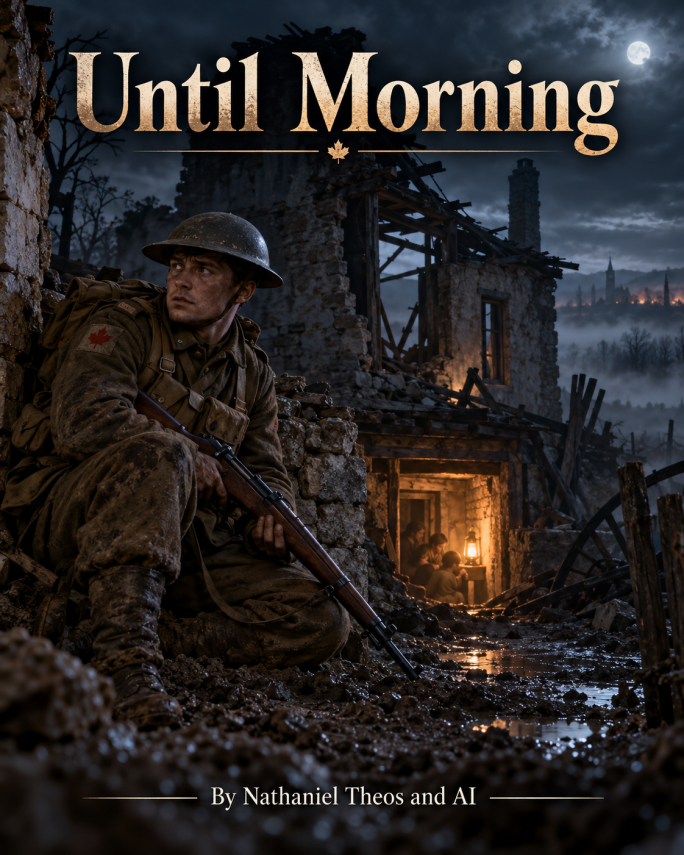
AI was used as an editorial and creative-support tool, including story development suggestions, the full editing process, and the creation of the cover artwork.
The human story remains the heart of the work. AI served as a tool in the creative and editorial process.