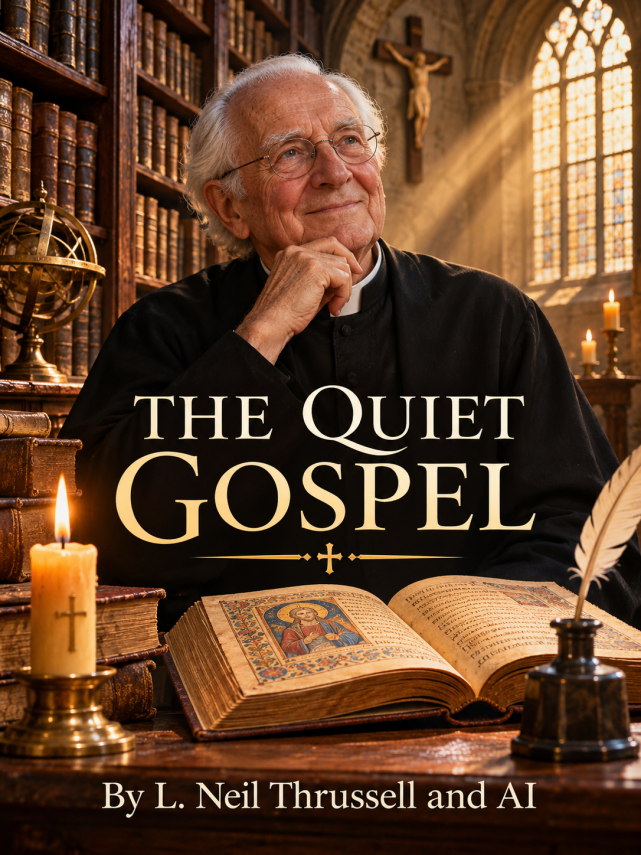
THE QUIET GOSPEL
By L. Neil Thrussell and AI
Chapter One: Fifty-Three Years of Silence
Father Matteo Ricciardi had spent fifty-three years among the words of men who had been dead for centuries. He had always considered this a privilege.
The ancient manuscript library occupied a quiet wing of an ecclesiastical research institute in Rome. Outside, scooters rattled over cobblestones, tourists hurried toward monuments, and church bells marked the hours. Inside, time moved at the pace of turning pages.
At eighty-one, Matteo’s knees complained about the stairs and his spectacles disappeared whenever he needed them. His mind remained fiercely alive. On his desk that morning lay an envelope containing his request to retire from his archival duties. He had written it eleven times. Every version seemed either too solemn or too eager to conceal his real purpose.
After fifty-three years of service, he wished to spend his remaining years in prayer, reflection, and private study. Every word was true. It simply wasn’t the whole truth.
“Well, Lord,” he murmured, picking up the envelope, “I suppose we are finally doing this.” He waited. No heavenly voice answered. “Your silence remains remarkably consistent.”
Monsignor Alessandro Ferraro, his friend for thirty-eight years, read the letter and leaned back in his chair.
“Prayer, reflection, and private study,” Alessandro said. “A remarkable change for a man who has spent fifty-three years doing precisely that.”
“I intend to become better at it.”
“What are you not telling me?”
Matteo watched sunlight move over the office wall. He remembered arriving in Rome at twenty-eight with one battered suitcase and a hunger to understand the Scriptures. He had believed that every ancient word brought him nearer to God. He still believed it, but the years had changed what he hoped to find.
“I have unfinished work.”
“Are you questioning your vocation?”
“No.”
“Your faith?”
“Every day. But not in the way you mean.”
“Then what troubles you?”
Matteo thought of the manuscripts he had preserved, the articles he had written, and the people he had met who believed God was disappointed in them. “I wonder whether I have spent fifty-three years preserving the language of love while forgetting to help people experience it.”
Alessandro’s expression softened. “Whatever this work is, remember you do not have to carry it alone. And retirement from the archives does not mean retirement from being a priest.”
“I know.”
“Good. Try not to start another Reformation.”
“At my age? I should hardly have the stamina.”
That evening Matteo opened a locked drawer and took out a leather journal. Thirty-one years of notes filled its pages. On the inside cover, written by a younger and steadier hand, were three words: The Quiet Gospel.
He laid his palm upon the book. “Lord, if this is what You are asking of me, give me the courage to finish what You have begun.”
For years he had prayed to know what came next. Now he feared not that God had remained silent, but that he had finally understood the invitation and might lack the courage to answer.
Chapter Two: The Words We Inherited
The first entry in Matteo’s journal was dated October 17, 1995. He remembered the day because rain had entered the courtyard chapel through a window no one had closed. But the entry concerned a young father named Pietro, whose seven-year-old daughter had died.
Pietro had been told that God needed another angel, that suffering formed part of God’s plan, and that he must have faith. None of it had comforted him.
“What kind of God needs my little girl more than I do?” he had asked.
Matteo had offered theologically careful explanations. He had spoken of mortality, suffering, mystery, and freedom. When Pietro left, the priest noticed that the man had entered seeking consolation and departed carrying an argument. The memory had stayed with him for thirty-one years.
Now he asked himself what might have happened if he had simply said, “I do not know why your daughter died. But I will sit here with you as long as you need.”
The journal contained hundreds of observations: Hebrew words, Greek phrases, Aramaic traditions, Latin commentaries, passages about mercy and forgiveness, and reflections on Christian contemplation. In recent years, he had also studied New Thought spirituality.
Some claims made him wary. No person’s illness or grief should be treated as proof of defective thinking. He had accompanied too many sick and bereaved people to accept that. Yet he recognized in New Thought’s emphasis on divine presence, prayer, spiritual responsibility, and inner transformation questions that had also animated generations of Christian mystics.
These were not identical traditions. Their differences deserved respect. But why could they not speak to one another?
He reread a line from the First Letter of John: There is no fear in love, but perfect love casts out fear.
How strange, Matteo thought, that so many people lived their religious lives terrified of making a mistake, asking a question, or disappointing God. Sometimes they heard what theologians meant to say. Sometimes their old wounds allowed them to hear only condemnation.
He leaned back. “Fifty-three years.”
As a young man he had imagined old age as the country where all questions found their answers. Instead he had arrived with more questions than he could carry and a persistent sense that his life had been preparing him for something he had not yet done.
He did not claim to hear an audible command from heaven. He distrusted people who received divine instructions as efficiently as train timetables. But he knew the difference between a passing idea and a conviction that would not leave him alone.
The conviction had become impossible to ignore.
He opened his correspondence folder and wrote to four scholars he loved and respected, not because they would agree but because they would tell him when he was wrong. That, Matteo believed, was one of love’s rarer expressions.
“My dear friend,” he began, “I am embarking on a project that may prove either the most meaningful work of my life or an elaborate demonstration that an elderly priest should have retired years ago. I hope you will join me.”
He sent the invitations before he could lose his nerve.
Chapter Three: An Invitation Without an Agenda
Sister Beatrice Laurent answered first. “Matteo, I have known you forty years. You have never invited anyone to a gathering without an agenda. I will come. Please ensure the coffee is drinkable.”
At seventy-four, Beatrice was a brilliant scholar of Greek and Latin, a Catholic sister whose patience with ceremonial fuss was limited. She considered Matteo a gifted man who sometimes needed rescuing from his own enthusiasm.
Dr. Elias Haddad, a sixty-nine-year-old Syriac Christian historian, replied warmly: “You have finally discovered retirement. I suspected you intended to outlive the manuscripts. If Thomas is attending, I am bringing additional coffee.”
Professor Miriam Adler, sixty-six, replied with a question. Was Matteo inviting them to examine historical evidence, or to support conclusions he had already reached? He answered, “Historical evidence, I hope.” She accepted.
Thomas Arnaud, an agnostic textual critic of fifty-eight, set three conditions: no spiritual impressions disguised as linguistic proof, no secret meanings invented for ordinary Greek words, and no one describing coffee as a sacrament.
Matteo laughed so loudly that a junior archivist appeared to check on him.
They would gather at Casa della Quercia, a Catholic retreat house among olive-covered hills outside Rome. Matteo packed clothing, notebooks, reference books, and photocopies of legitimate scholarly materials. Original manuscripts and archival records would remain in their proper collections. He intended to carry away knowledge, not stolen treasures.
On the morning of his departure, Matteo entered the chapel where he had prayed thousands of times. A woman knelt near the front. A young man sat with his head bowed. A caretaker arranged flowers beside a statue of Mary. So many ordinary lives, each carrying sorrows and hopes he could not see.
“Am I doing the right thing?” he whispered.
No answer came, but a memory returned. His first spiritual director had once said, “A calling does not always arrive as a command, Matteo. Sometimes it arrives as a love you can no longer keep to yourself.”
The words struck him with such clarity that his eyes filled. He had forgotten them for almost sixty years. He had been waiting for certainty when perhaps he had already received enough to begin.
That afternoon Beatrice met him on the retreat house terrace, coffee in hand. “You’re late.”
“By seven minutes.”
“At our age, seven minutes matters.”
She embraced him. When she drew back, she saw something unsettled in his face. “What is troubling you?”
“I think God has been asking something of me for a very long time.”
“And?”
“I have spent a great deal of energy pretending not to hear.”
“What is He asking?”
Matteo looked at his leather case. “That is what I hope we can discover together.”
Chapter Four: Five Minds, Five Histories
By Thursday evening the scholars had gathered around the retreat house’s long dining table. Sister Lucia served vegetable soup, bread, roasted chicken, and coffee. Elias regarded the modest dessert with approval; Thomas regarded their conversation with caution.
For an hour they spoke of friends, illnesses, unfinished books, and the indignities of growing old. Then Matteo stood and placed the leather journal at the centre of the table.
“For thirty-one years I have been gathering passages and questions about biblical language, spiritual experience, and the way ordinary people understand their relationship with God.”
“That covers an impressive amount of territory,” Miriam said. “Be specific.”
“I believe certain Christian teachings, the contemplative tradition, and New Thought spirituality have meaningful points of contact. I want to explore those connections honestly, in language people outside a university can understand.”
Thomas folded his arms. “Are you writing scholarship or a spiritual book?”
“I hope both.”
“Then you already have a problem.”
Miriam turned a page. “And you must not take Jesus out of his Jewish historical world merely to justify a modern idea.”
“Agreed,” Matteo said.
“Nor pretend that an ancient word secretly means whatever we would like it to mean,” Thomas added.
“Also agreed.”
Elias smiled. “Five biblical scholars in one room. What could possibly threaten Christian unity?”
Beatrice glanced at him. “You have managed to disagree with yourself in three languages.”
They laughed, but Matteo felt exposed. It was one thing to invite colleagues to read one’s private work; another to watch them question what had become precious over decades.
“Why now?” Beatrice asked.
He hesitated. “Because I am eighty-one. Because I fear I will die with this still inside me, something God intended me to give away.”
Silence settled over the table.
Thomas’s expression changed. “Then let us make it worthy of the people who might read it.”
Together they established three rules. Evidence would never be replaced by wishful interpretation. No tradition would be made smaller to flatter another. And every chapter had to be intelligible to someone who had never studied theology.
Late that night, Beatrice remained behind. “Are you prepared for us to change your life’s work?”
“I hope so.”
“Then perhaps your retirement will be interesting after all.”
As he walked to his room, Matteo felt afraid, but not alone. He had asked for companions. Now he needed the humility to accept what companionship meant.
Chapter Five: Within You or Among You?
The first argument began shortly after breakfast. Matteo placed a passage from Luke before the group, highlighting a disputed Greek expression often translated “within you” or “among you.”
Thomas looked at the page. “Excellent. A small disagreement capable of occupying the next century.”
Matteo explained how deeply he loved the inward spiritual reading of the Kingdom of God: divine presence not merely awaited, but influencing the way a person lived now.
Miriam nodded. “A meaningful reflection. But notice the audience and the historical context. Jesus is speaking in a Jewish world with its own understandings of God’s reign.”
Beatrice emphasized that Christian teachings about the Kingdom included both present and future dimensions. Elias described contemplative readings from Syriac Christian traditions. Thomas reminded them that the range of a Greek expression did not settle the interpretation of an entire passage.
By lunchtime Matteo had grown unusually quiet.
“You’re disappointed,” Beatrice said.
“No.”
“Because the Greek refuses to agree with your heart?”
He laughed despite himself. “Apparently my heart has always been a dreadful linguist.”
“I understand why you want this to be simple,” Miriam said. “People need hope. But hope does not require us to simplify history.”
“Then what can we offer?”
“Honesty. There are ways of reflecting inwardly on the Kingdom without claiming that one translation proves a modern movement.”
Elias leaned toward Matteo. “Perhaps you’re searching the text for permission to speak about spiritual experience. You can honour the text and invite reflection without turning it into evidence for conclusions it cannot establish.”
That afternoon they revised the opening chapter of the manuscript. It no longer announced that Jesus had explicitly taught modern New Thought. It explored ancient context, Christian interpretations, and questions about inward transformation and outward compassion.
The new version was quieter, less sensational, and more careful. Matteo read it aloud. The loss of drama troubled him, yet he sensed that the new pages offered readers something sturdier than novelty.
At dusk Miriam joined him beneath the olive trees.
“Would you be comfortable discussing this with a rabbi, a Catholic priest, and an atheist?” she asked.
“Of course.”
“Even if they disagreed?”
“Yes.”
“Even if they were right?”
Matteo smiled. “That is a less comfortable question.”
She rested a hand on his arm. “Then perhaps that is where your real work begins.”
Chapter Six: The Mind That Must Be Renewed
The next morning they examined Paul’s words about the renewal of the mind. Matteo saw a bridge between Christian spiritual formation and New Thought’s emphasis on conscious thought and transformation.
“Perhaps,” he said, “we can show how our thoughts create our experience of the world.”
Thomas frowned. “That requires considerable qualification.”
“I mean spiritually.”
“Which doesn’t remove the need for accuracy.”
Elias quietly told them about a woman with a serious illness. A spiritual group had helped her find peace through reflection and prayer, but one of its members later suggested that her negative thinking had caused her disease. She began blaming herself for the very suffering she was trying to endure.
Miriam shook her head. “What a terrible burden to place on someone.”
Matteo thought of people he had visited in hospitals and homes. “You’re right. I would never want our book to do that.”
They revised the chapter. Thoughts could influence attitudes, choices, behaviour, resilience, and relationships, but no honest philosophy could promise control over every event. The sick deserved care, not blame. Grieving people needed companionship, not correction.
Matteo wrote in the margin: The purpose of spiritual wisdom is not to explain away another person’s pain. It is to help us meet that pain with love.
The sentence seemed obvious. He wondered why it had taken him eighty-one years to write it.
That afternoon he received a message from Reverend Grace Ellison, a New Thought minister with whom he had been corresponding. She would be honoured to join the retreat. She asked permission to bring a woman who was neither a minister nor a scholar, someone trying to recover a spiritual life that made sense to her.
Matteo looked around at the reference books piled on the table. He had gathered extraordinary minds. But had he invited the people he hoped to reach?
He answered at once: “Please bring her. I suspect she may be the person we most need to hear.”
Chapter Seven: The Woman Who Left the Church
Anna Moretti arrived carrying an overnight bag and the expression of someone who suspected she had come to the wrong address. At forty-three, she had the tired alertness of a person accustomed to guarding her feelings.
“I’m not sure why I’m here,” she said.
“An excellent beginning,” Thomas replied. “Most of us are still asking ourselves.”
The scholars explained their manuscript, one after another. Anna listened politely until she set down her fork.
“Are you writing for people like yourselves?”
“Quite the opposite,” Matteo said.
“Then why are you talking as though everyone has spent fifty years studying the Bible?”
Beatrice smiled. “At last, someone has said it.”
Anna told them about her childhood. Her mother had taken her to Mass each Sunday. She loved the candles, familiar prayers, and the feeling of safety. Later, her marriage broke down amid betrayal and anger. When she sought spiritual guidance, someone she trusted seemed more interested in judging her choices than listening to her pain. She began to believe that God, too, might be disappointed in her.
“I stopped going to Mass because I couldn’t bear feeling that everyone belonged except me.”
Eventually she visited a New Thought community where she was welcomed. She did not agree with every teaching, but people listened. Prayer again became possible. And yet she missed the rituals of her childhood faith.
“I feel like I have two homes,” she said, “and don’t completely belong in either.”
Matteo felt a familiar sorrow. He remembered Pietro, the grieving father who had come to him seeking comfort and received an argument.
Anna touched her forehead. “I know people say God loves me. But sometimes the rest of me hasn’t caught up.”
No one hurried to explain.
Then she asked, “Why does everyone keep telling me where God is supposed to be? Why doesn’t anyone ask where I’ve experienced Him?”
Matteo slowly closed his notebook. There were no Greek verbs to analyse in that question, no historical claims to challenge. There was a woman who wanted to be heard.
“Have I said something wrong?” Anna asked.
“No, my child. I think you have asked the most important question since we arrived. Would you tell us more?”
For two hours they listened. When Anna spoke, Matteo did not interrupt with answers. He simply stayed.
That evening he wrote: Perhaps the bridge does not begin with words. Perhaps it begins when one person finally feels heard.
He bowed his head. “Lord, now I begin to understand.”
Chapter Eight: A Language for Love
Grace Ellison had spent thirty years discovering that people rarely arrived at spiritual gatherings carrying the questions they truly needed answered. Beneath requests for guidance on prayer or purpose, she often heard something simpler: Am I loved? Can I begin again?
She and Matteo sat beneath an olive tree after breakfast.
“What lies at the heart of New Thought for you?” he asked.
“That understanding the Divine can change how we live. That prayer, attention, and conscious choice can help us express more love, wisdom, and compassion.”
“And divine presence?”
“My tradition speaks of it within and around us. I know Catholic theology doesn’t always express that relationship in the same way.”
“The distinction between Creator and creation matters.”
“I respect that. I don’t need Catholics to become New Thought practitioners, nor do I want those who visit my congregation to deny their childhood faith.”
Matteo considered her. “What do you hope people find?”
“A deeper experience of love. More courage. More responsibility for their choices. More willingness to serve.”
“Those are aspirations I recognise.”
“They don’t belong exclusively to my tradition.”
For a moment they sat without speaking. Matteo felt the strange embarrassment of recognizing how little he had understood about the very people with whom he hoped to build a bridge.
“Then tell me something that might be difficult,” he said. “When you speak of the Divine within us, do you mean that God and the human person are the same?”
“Some New Thought teachers use language that approaches that idea,” Grace answered. “In Unity, I speak of each person as an expression of divine life, with a spiritual potential we can awaken to. But I would not pretend all New Thought groups explain it in exactly the same way.”
“Catholic faith asks me to make a distinction,” Matteo said. “God creates us, loves us, and invites us to share in divine life. But the creature does not become the Creator. Even our language of God dwelling within us preserves that relationship.”
Grace did not look disappointed. “I can respect that. When someone sits in my congregation believing they are worthless, I want them to hear that divine love is not somewhere beyond their reach.”
“And when someone comes to me,” Matteo replied, “I want them to know they are loved before they have managed to become perfect. Perhaps the bridge begins there, in what we can offer a frightened human being, even while we explain the mystery differently.”
Grace watched an olive leaf turn in the breeze. “A bridge with two shores,” she said. “Not one shore painted to resemble the other.”
Matteo smiled. “Beatrice will be relieved.”
Later the scholars examined a passage from the First Letter of John about love and fear. Beatrice explained its Christian context, Miriam recalled the deep Jewish roots of love of neighbour, and Grace spoke of the fears that people sometimes carry into prayer.
Anna listened until she asked, “Can someone believe God loves them and still be afraid of Him?”
“Certainly,” Matteo said. “Human beings are remarkably skilled at holding contradictory beliefs.”
“I used to think God was waiting for me to make a mistake.”
“And now?”
“I’m trying to believe God is present even when I make one.”
She gripped the edge of her notebook. “In the church where I grew up, I heard so much about sin. At Grace’s gathering, I heard that I was a spiritual being capable of awakening to something good. Am I supposed to choose between being a sinner and being worthy of love?”
Matteo felt the old impulse to give a tidy answer. He resisted it. “Catholic teaching does speak of sin, Anna. We can wound one another. We can choose selfishness. We need forgiveness and grace. But the Church also teaches that every person has dignity as someone created in God’s image. God’s love is not wages you receive for becoming flawless.”
“And my tradition,” Grace added, “often speaks of mistaken beliefs and of waking up to the divine potential already present. But if I use that language to tell someone they caused their own suffering, I have failed them.”
Anna stared into her cup. “So I don’t have to pretend I’ve never done wrong to believe I can be loved?”
“No,” Matteo said. “You may acknowledge what needs healing without declaring yourself unlovable.”
“I think,” she whispered, “that I’ve spent years confusing those two things.”
Beatrice spoke gently about mercy. Anna nodded but said, “Hearing that I’m loved and believing it are different things.”
Matteo sat still. There it was again: the distance between information and transformation.
He added a paragraph to the book: The study of sacred words is not complete merely because we can explain them. It must also shape the way we offer compassion, justice, humility, and love.
This time Thomas made no correction.
Chapter Nine: Two Prayers, One Silence
After dinner Anna turned to Matteo. “Would you and Grace pray together?”
He glanced toward the minister. “What sort of prayer?”
“I don’t know. I want to know whether I can be with both parts of my spiritual life without feeling that I’m betraying one of them.”
The request was simple and difficult. Matteo could not pretend all theology was interchangeable. But neither did he wish to make Anna’s longing into a dispute.
Grace nodded. “I would be honoured.”
They stood in a loose circle near the fireplace. Nobody was asked to profess a belief they did not hold. Thomas remained a little apart, but stayed.
Matteo prayed in familiar Christian language, thanking God for life, mercy, and the wisdom of those who came before them. “Help us remember that the people before us are not problems to be solved, but lives to be honoured.”
Grace followed with an affirmative prayer about becoming more aware of divine love and expressing that love through kindness, forgiveness, and service.
Then silence filled the room.
Matteo had prayed in cathedrals, chapels, hospital rooms, and beside graves. Yet the stillness now moved him deeply. Not because their prayers were identical, but because each person had entered the moment without being asked to deny who they were.
Anna closed her eyes. A tear moved down her cheek.
When the prayer ended, Thomas cleared his throat. “I regret to report that I experienced no supernatural phenomenon.”
“How disappointing,” Elias said.
“However, I did experience a reduction in irritation.”
“Then we have witnessed a miracle.”
Later Matteo found Anna alone on the terrace. “Do you think I did something wrong?” she asked.
“Why would you?”
“Part of me still feels guilty.”
“I cannot say every teaching agrees with every other. But sincere questions, respectful listening, and a desire to grow in love are not reasons for shame.”
She looked toward the stars. “I miss my mother. She would have wanted me to return to Mass.”
“Perhaps one day you will. You don’t need to come because you fear disappointing me.”
Anna smiled. “You’re different from the priest I spoke to before.”
“Then hearing your story has reminded me what kind of priest I still wish to become.”
“At eighty-one?”
“Especially at eighty-one.”
When Matteo returned to his room, a message awaited him. Monsignor Ferraro had learned of the manuscript and wished to read it before publication. “I trust you understand why,” he wrote.
For the first time since leaving Rome, Matteo wondered whether his long-delayed calling had led him toward a terrible mistake.
Chapter Ten: The Cost of Being Understood
Matteo returned to Rome with the draft and his oldest prayer book. Alessandro received him with two cups of coffee and a concerned expression.
“I have read your manuscript,” Alessandro said. “There is much to admire. There are also passages that trouble me.”
He pointed to a paragraph implying that ancient biblical teachings anticipated modern New Thought doctrine. “You have identified a similarity. You have not proved a historical connection.”
“I believe there are meaningful parallels.”
“Then describe the parallels. Don’t stretch the evidence to make them sound revolutionary.”
Alessandro turned another page. “And here you describe Jesus as a model for spiritual awakening. That may accurately describe how Grace approaches him. But you must make clear that it is not an adequate statement of Catholic Christology.”
Matteo nodded. “For me, he is the Saviour and the incarnate Son of God. Grace and I spoke about that very difference.”
“Good. Then let the reader hear both of you. Your friendship is more convincing when neither of you has to disappear.”
They examined several passages. Alessandro insisted that personal reflections be distinguished from established scholarship and from official Catholic teaching. Matteo became defensive.
“I have spent fifty-three years serving the Church.”
“I know.”
“I have never wanted to undermine it.”
“I know that too. But you asked me to read your work, not to flatter you.”
Matteo fell silent.
Alessandro put the pages aside. “Tell me what this is really about.”
Matteo tried to speak of scholarship, then stopped. He thought of Anna, of Pietro, and of the many faces he could barely remember, people who had approached him with pain that no quotation could erase.
“I am afraid, Alessandro.”
“Of criticism?”
“No. I have survived criticism. I am afraid of dying with something still inside me that God intended me to give away.”
He looked at his hands. They trembled slightly. “For years I prayed for a clear calling. Now I think I understand it, and I find myself wanting another twenty years to prepare.”
His voice broke. “There are people who believe they are beyond love. I know how to explain the language of mercy. I want to help someone believe it. Before I die, I want to do that much.”
Alessandro moved around the desk and rested a hand on his shoulder. He did not rush to comfort him with a promise.
When Matteo was ready, Alessandro said, “That is the first thing you have told me today I would not change. Your manuscript must serve that calling, not hide it behind exaggerated claims.”
Matteo wiped his eyes. “Perhaps I wanted a dramatic discovery to justify leaving the library.”
“Would you still write this book if it changed only one person’s life?”
Matteo saw Anna’s expression the evening she had told them she felt she belonged nowhere. “Yes.”
“Then write it for that person.”
On the journey back, Matteo opened the manuscript again. He crossed out a grand claim and began a humbler sentence. It cost him something to change it. It also felt like freedom.
Chapter Eleven: The Courage to Be Wrong
The scholars were waiting when Matteo returned. Beatrice took one look at him and pointed to a chair.
“Sit.”
“I am capable of standing.”
“That was not a request.”
Matteo told them about his conversation with Alessandro and the weaknesses in the draft. He admitted that he had sometimes confused the importance of his purpose with the strength of particular interpretations.
Thomas folded his arms. “Then we must decide whether this is a book defending your conclusions or a book exploring honest questions.”
“The questions,” Matteo answered.
Miriam opened the manuscript. “Then we begin again.”
Over three days they revised. Historical context was added. Sweeping claims were removed. Catholic teaching and New Thought interpretations were identified distinctly. Anna listened to each section and raised her hand whenever language became inaccessible.
“Would someone explain that to a normal human being?” she asked after one especially tangled paragraph.
Thomas called this the Moretti Test. Every section had to survive it.
One afternoon Anna found Matteo on the terrace. “Why did you want the book to be revolutionary?”
“I wanted people to know it mattered.”
“Wouldn’t they know if it helped them?”
He looked toward the olive trees.
“Grace once told me I didn’t have to become a different person overnight,” Anna said. “I just had to make one different choice. It didn’t feel impressive. I wanted a great breakthrough, but I began by forgiving myself for something I’d carried for years.”
“And it changed your life?”
“Yes.”
“Then perhaps it wasn’t a small thing.”
She smiled. “Maybe you don’t need to discover something nobody knows. Maybe you need to help people remember what they’ve forgotten.”
Matteo closed his eyes. His whole life had been preparation: words, texts, prayers, disappointments, conversations with grieving people. The calling was not to be the scholar who finally proved everyone else wrong. It was to become the man willing to share what he had learned with love.
That evening they wrote a fresh title page: The Quiet Gospel: Ancient Words, Living Wisdom.
Matteo understood that their work was neither a newly discovered Gospel nor a replacement for Scripture. It was an invitation to consider ancient wisdom and its implications for living.
“I think,” he said, “we have finally found our beginning.”
Beatrice glanced at the rewritten pages. “After all this work, I should hope so.”
Chapter Twelve: A Book Without Enemies
The manuscript was completed on a rainy afternoon. Sister Lucia brought tea and almond biscuits. Elias pronounced it an occasion for celebration. Thomas reminded everyone that final revisions remained. Beatrice reminded Thomas that manuscripts always needed revisions.
Anna sat reading the chapter on forgiveness. “Can I say something?”
“The Moretti Test,” Thomas said.
“The chapter explains why forgiveness matters,” Anna told them. “But what about someone who isn’t ready?”
Matteo waited.
“Sometimes people tell you to forgive because they don’t want to hear how badly you’ve been hurt. They make it sound like another thing you’re failing to do.”
Beatrice reached for her hand.
“What if it takes years?” Anna continued. “What if forgiving doesn’t mean letting someone hurt you again?”
Matteo remembered how often he had offered correct answers before hearing the full question. “What would you want us to say?”
“That healing takes time. That boundaries aren’t hatred. That you can be a loving person without pretending something terrible was acceptable.”
They rewrote the chapter. It spoke of forgiveness without excusing harm, without making reconciliation mandatory, and without demanding that someone else’s pain disappear on command.
Anna reread the new passage. “That’s better.”
“Four words,” Thomas remarked. “Forty minutes of rewriting.”
That evening Grace proposed a public gathering at a community centre. Not a grand launch, she said, but a conversation. Open to Catholics, other Christians, New Thought practitioners, people with no formal affiliation, and anyone simply curious.
Matteo hesitated. A manuscript could be revised. A public conversation could not be recalled once the words were spoken.
“How many people?” he asked.
“As many as come.”
“An alarmingly imprecise number.”
Grace smiled. “You said you felt called to share.”
He thought of Anna, Pietro, and the unopened letter that had sat on his desk for too long. “Yes,” he said. “I did.”
“Then begin.”
He nodded, frightened and grateful. “All right.”
Chapter Thirteen: Forty-Seven Chairs
The hall contained folding chairs, tall windows, a small platform, and a table of coffee and biscuits. Matteo arrived early. He counted the chairs, then counted them again. At seven o’clock, forty-seven people had come.
They included Catholics, Protestants, New Thought practitioners, and people who had stepped away from formal religion. Near the back Matteo spotted Alessandro, seated quietly in ordinary clothes.
Grace introduced the evening as a conversation, not a declaration that anyone had solved centuries of theological disagreement.
Matteo approached the microphone. He stood silently for a moment, looking at the faces gathered before him.
“I have spent fifty-three years in a library,” he began. “Which may explain why I am surprised to find so many living people in the same room.”
The laughter loosened his fear.
“When I began studying ancient Scripture, I believed that scholarship meant finding answers. After fifty-three years I have become remarkably skilled at discovering better questions.”
He explained how the Bible’s texts emerged in ancient Hebrew, Aramaic, and Greek, and how translations and interpretations shaped the ways later generations encountered them. He honoured the tradition that had preserved the texts and explained why spiritual readers should be cautious of claims about secret original meanings.
“My friends and I have been exploring connections between Christian teachings and New Thought,” he said. “We have found similarities and important differences. We have not found a lost Bible. We have discovered something less dramatic and perhaps more demanding: spiritual wisdom must change how we treat one another.”
He drew a breath. “We have also spoken about Jesus. For me, as a Catholic priest, Jesus is not simply an inspiring teacher. I confess him as the incarnate Son of God and the Saviour. I cannot discard that confession in order to make an agreement easier.”
He glanced toward Grace, who nodded for him to continue.
“Some New Thought Christians speak of Jesus especially as the great example of awakened Christ consciousness, showing what people may learn to express through their own spiritual lives. That is not the same claim about who Jesus is. We must be honest about that.”
He let the distinction stand without apology. “But we can still ask together what it means to love a neighbour, bless an enemy, forgive, serve the poor, and make peace. A shared commitment to practise compassion does not require a false agreement about every doctrine.”
He thought of the journey that had brought him there.
“We can study love for a lifetime and still fail to be loving. We can quote words about forgiveness while treating ourselves with relentless cruelty. We can become so anxious about another person’s theology that we forget to ask whether that person is hurting.”
As he spoke, he no longer felt he was defending a book. He was sharing the work he had been given to do. Some listeners agreed. Others looked doubtful. Both responses were welcome.
During questions, a man asked if New Thought was compatible with Catholic doctrine. Matteo replied that the answer depended on particular teachings, some of which resonated with Christian contemplative practice while others differed in important ways.
Then Anna stood. Her hands trembled.
“I still feel I have to choose between the faith of my childhood and the community that helped me when I was hurting. One says Jesus saves me. The other asks me to live the love he taught. I know those aren’t exactly the same. Is it wrong to be grateful for both?”
Matteo waited. He could see that she had not finished.
“If I find God somewhere other than the Church,” Anna asked, “does that mean I’ve left Him behind?”
Matteo stepped away from the lectern. He remembered Pietro, the grieving father. This time he would not answer pain with an argument.
“Searching sincerely does not mean that you have stopped longing for God,” he said. “I cannot tell you that every path teaches the same thing. It would be dishonest. But questions are not proof that your heart is closed. Sometimes they are evidence that it is still reaching.”
Anna’s eyes filled.
“Do not stop seeking truth. Do not stop practising love. If you ask me what I believe about Jesus, I will answer as a Catholic priest. If you ask Grace, she will answer from her tradition. Neither of us honours you by hiding the difference.”
His voice softened. “But you are not a prize for one of us to win. You are a person worthy of being heard. And do not mistake another person’s inability to understand your journey for proof that God has abandoned you.”
She whispered, “Thank you.”
Matteo bowed his head. Fifty-three years of words had prepared him for an answer that required so few.
Chapter Fourteen: The Woman Who Came Home
When the gathering ended, people lingered in conversation. Some thanked Matteo, some challenged his interpretations, and others simply stood thinking. His attention kept returning to Anna near the window.
“I didn’t mean to make a spectacle of myself,” she said when he approached.
“You didn’t.”
“I cried in front of forty-seven people.”
“And not one of them had the right to judge you for it.”
Anna looked at him.
“You gave them something more valuable than a perfect speech,” he added.
“What?”
“The courage to be human.”
Her eyes filled again. She spoke about the anger she had carried toward her former husband, the person who had shamed her, and herself. “I thought if I found the right teaching, everything would finally make sense.”
“And now?”
“Now I wonder if I need to solve everything before I can pray.”
She remembered walking into church as a child with her mother, lighting a candle before school, and asking what they were praying for. “She said sometimes we weren’t asking for anything. We were just remembering that God was there.”
Matteo felt moved by the simplicity of it. He had spent thousands of hours studying what such a moment might mean. A mother had given her daughter the experience in a sentence.
“I think I want to visit a church again,” Anna said. “Even with all my questions.”
“I should be disappointed if you arrived without them.”
She laughed, then embraced him. He held her gently, knowing he could not undo every wound or resolve every theological conflict. He could offer compassion without pretending to command her journey.
Across the hall, Alessandro approached after she left.
“You spoke well,” the monsignor said. “I disagreed with parts of it.”
“I would have worried if you hadn’t.”
“But you were honest. I believe a parish meeting room could host another educational conversation, with suitable planning and a clear explanation of its purpose.”
Matteo stared at him. “Are you suggesting another gathering?”
“Yes. And I am not endorsing every conclusion in your manuscript.”
“I know.”
“I trust your heart, Matteo. And I have watched your scholarship become more careful, not less.”
Later, the friends stacked chairs and gathered empty cups. There was no grand proclamation. Only a room to put back in order and people who had listened to one another.
Matteo understood that the work had begun, not because they had settled the mystery of faith, but because they had made space for honest conversation.
Chapter Fifteen: The Quiet Gospel
Six weeks after leaving the library, Matteo returned to the small chapel where he had prayed for most of his adult life. Rome was waking outside. His knees were stiff, his back ached, and he had misplaced his spectacles twice before breakfast.
Retirement had done remarkably little to improve his body. It had made his days considerably busier.
The manuscript was being prepared for publication. Grace had arranged online conversations. Beatrice kept correcting Matteo’s Greek notes. Thomas had sent fourteen revisions overnight. Miriam wanted an additional chapter. Elias was threatening to write a foreword unless someone improved the coffee.
The previous evening Anna had sent him a message.
“Dear Father Matteo, today I went into a church for the first time in six years. I didn’t know what to say, so I lit a candle and sat quietly. I remembered what my mother used to tell me. Sometimes we aren’t asking for anything. We’re just remembering that God is there. I stayed almost an hour. I still have questions. But I wasn’t afraid. I wanted you to know.”
Matteo had read it three times. Then he had wept. Not simply because Anna had entered a church, but because of the sentence that followed: I wasn’t afraid.
He approached the candles. One was already burning. He lit another for Anna, for Pietro, for those who prayed in fear, for those who had stopped praying, and for those still trying to find words for their longing.
He knelt carefully. “Thank You,” he whispered.
He did not know whether ten people would read the book or ten thousand. He did not know how many mornings remained. He knew only that he had been entrusted with something and had finally begun to share it.
He remembered his first spiritual director: A calling does not always arrive as a command. Sometimes it arrives as a love you can no longer keep to yourself.
All those years, Matteo had waited for certainty: the perfect argument, the complete manuscript, the final answer to every objection. But a calling did not demand that he understand the whole path. It asked him to take the next faithful step.
Footsteps sounded behind him. Alessandro entered and sat beside him.
“How is retirement?”
“Exhausting.”
“I hear you have agreed to four more public conversations.”
“Five, counting the online series.”
“You are the least successful retired man I know.”
Matteo smiled. “I seem to have misunderstood the assignment.”
They sat in the silence they had shared for decades.
“Do you think your little book will change the world?” Alessandro finally asked.
“No, my friend.”
“Then why spend your remaining years writing it?”
Matteo handed him Anna’s letter. Alessandro read it slowly and returned it without speaking.
“A woman who believed she no longer belonged anywhere has found the courage to seek again,” Matteo said. “She may worship in a Catholic church, remain close to the New Thought friends who helped her, or walk a path neither of us expects. I cannot control that. I can listen, speak honestly, and offer what I have learned.”
“And that is enough?”
Matteo looked toward the two candles burning side by side. One had been lit before he arrived. The other he had lit himself. Different flames, the same quiet light.
“For today, my friend, it is everything.”
Outside, Rome continued its ordinary morning. People carried their sorrows, celebrated their joys, and searched for answers to questions as old as humanity.
Matteo had once believed his calling was to preserve the words of those who came before him. He understood now that preservation had been only part of his purpose. The words had been entrusted to him not simply to study, but to share. Not as weapons for winning arguments, nor as answers that silenced honest questions, but as invitations to live with greater love and understanding. He did not need Grace to surrender her convictions, or Anna to resolve every uncertainty, for his own faith to become more generous in its expression.
At eighty-one, he did not know how many mornings remained. Yet he no longer feared he had waited too long.
He had answered the invitation.
And tomorrow, God willing, he would answer it again.
THE END
AUTHORSHIP & AI ACKNOWLEDGEMENT
The Quiet Gospel
By L. Neil Thrussell and AI
This story was developed through a creative collaboration between L. Neil Thrussell and artificial intelligence. The author established the original story concept, spiritual themes, narrative direction, character motivations, and editorial priorities. AI assisted in developing, drafting, and refining the fictional narrative under the author’s direction.
The characters and events in this work are fictional. The story draws upon real traditions of biblical scholarship, Christian contemplation, and New Thought spirituality, but the characters’ interpretations and conversations are presented as literary fiction, not as authoritative doctrinal pronouncements.
The story is intended to encourage thoughtful dialogue, compassion, and spiritual reflection while respecting differences between religious traditions.