
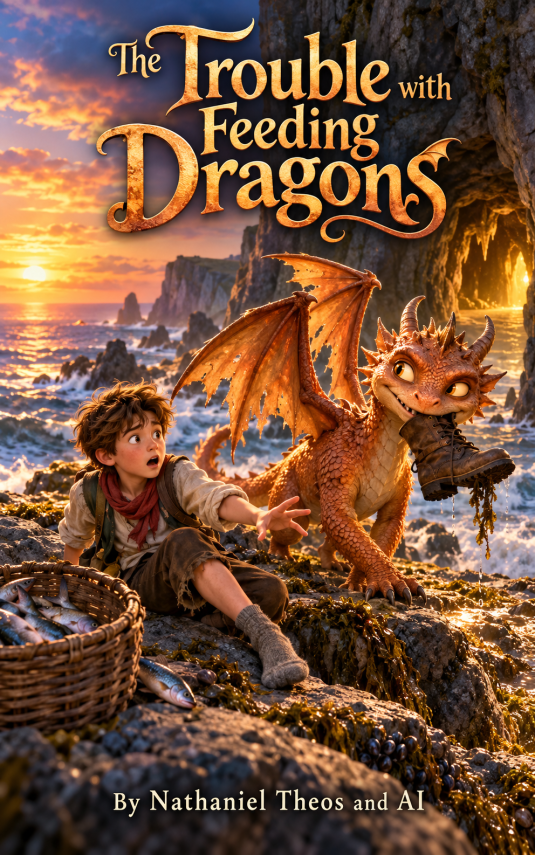
The Trouble with Feeding Dragons
By Nathaniel Theos and AI
Chapter One: The Dragon Who Ate a Boot
The first thing Finn learned about dragons was that they had terrible table manners.
The second was that they could eat leather.
The third, discovered seven seconds later, was that they did not care whether the leather was still attached to someone’s foot.
“Stop that!”
Finn hopped backward on one leg, pulling against the little copper-coloured creature clamped onto his left boot.
The creature growled. Finn tugged harder. The creature sneezed.
Orange sparks sprayed across a clump of seaweed. It began to smoke.
Finn stared. The creature stared back.
“You’re a dragon,” Finn whispered.
It tilted its head.
“A real dragon.”
It bit his boot again.
“Ow! That’s still attached to me!”
This was not how Finn had expected Tuesday afternoon to unfold.
He had left Gullhaven after breakfast with three biscuits, some string, a folding knife, and the firm intention of discovering something extraordinary. At eleven, Finn considered himself an explorer. His mother considered him a walking emergency. His father, who repaired fishing boats, approved of exploration as long as Finn returned before supper and did not require stitches.
So far he had found a perfectly round stone, a crab the size of a dinner plate, and a cave beyond the jagged rocks called Widow’s Teeth.
Now he had found a dragon, which was considerably better than a crab.
“Let’s make a deal,” he said. “You stop eating my boot, and I’ll find you something else.”
The dragon considered him with golden eyes. Then it burped a little cloud of smoke.
Finn grinned. “You’re brilliant.”
The dragon ate his shoelace.
The cave was bigger than it looked from the beach. Sunlight entered through a crack overhead, falling on tide pools and a peculiar collection of objects: shells, driftwood, a bent spoon, half a fishing net, and a brass door handle. The dragon had made a nest from old sailcloth and seaweed in a dry hollow above the high-tide mark.
It was about the size of a terrier, with copper scales, stubby horns, ragged wings, and a tail that ended in a neat triangle. Its ribs showed faintly beneath its scales.
“Where’s your mother?” Finn asked.
The dragon sniffed his pocket.
“No. That’s my biscuit.”
Its nose went deeper.
“My last biscuit.”
There was a brief struggle. Finn lost.
The dragon swallowed the biscuit, wrapper included, and looked expectantly at him.
Perhaps its mother had been driven away by a storm. Perhaps the little creature had hatched alone. Finn didn’t know, but he knew he couldn’t leave it hungry.
“You’ll need a name,” he said.
The dragon sneezed. Sparks scattered harmlessly on damp stone.
“Cinder.”
The creature chirped.
“Your name is Cinder.”
Cinder squeaked with delight and swallowed the brass door handle.
Finn decided not to think too hard about that.
Chapter Two: A Very Expensive Appetite
Keeping a dragon secret was harder than Finn had imagined.
For one thing, dragons were always hungry. For another, Cinder’s definition of food seemed to include everything in the world except rocks. He had tried a rock. Apparently, even dragons had standards.
On Wednesday, Finn brought six pilchards. Cinder ate the fish and the newspaper around them.
On Thursday, Finn brought mackerel and bread. Cinder ate both, followed by the wicker basket.
On Friday, Finn borrowed a wooden bucket of fish scraps from the harbour. Cinder ate the scraps, then the bucket’s iron handle, then most of the bucket.
Finn looked at the splinters. “How can you possibly still be hungry?”
Cinder sniffed Finn’s sleeve.
“Don’t even think about it.”
The trouble wasn’t only his appetite. Cinder was growing.
On Tuesday he had been terrier-sized. By Saturday he was nearly as big as a pony, although his belly accounted for a great deal of the difference. His wings had widened, and a faint warmth now radiated through his scales.
“At this rate,” Finn said, “you’ll be bigger than Father’s boat by Christmas.”
Cinder rolled onto his back and scratched his belly. Sparks crackled from his ears.
Finn sighed. He had always wondered why adults complained about looking after children. He was beginning to understand.
On Saturday morning, while Finn helped his father in the boatyard, Mr. Puddle the fishmonger marched down the harbour.
“THIEVES!” he cried. “ROBBERS! FISH-STEALING SCOUNDRELS!”
Mr. Puddle was a narrow man with an enormous moustache and a voice like a seagull trapped in a kettle.
Finn’s father lowered his hammer. “What happened, Albert?”
“My entire crate of herrings vanished in the night! And my wheelbarrow!”
Finn went cold. He had seen half a wheelbarrow in the cave yesterday. Only half, because Cinder had eaten the other half while Finn was counting fish.
“Could be a seal,” his father offered.
“What kind of seal eats wheelbarrows?”
“A very determined one?”
Finn slipped behind the lobster traps before his face could give him away.
That afternoon, he marched into the cave and pointed at Cinder.
“You’ve been stealing fish.”
Cinder chirped.
“And a wheelbarrow.”
Another chirp.
“And you mustn’t take things that belong to other people.”
Cinder licked his ear.
“Stop that. I’m trying to be serious.”
Cinder sneezed, and Finn’s hair stood on end.
He wrote rules in the wet sand with a stick.
RULES FOR DRAGONS
- Do not eat people.
- Do not eat people’s things.
- Do not steal fish.
- Do not set anything on fire.
- Do not eat the rules.
Cinder inspected the list, then ate the stick.
Finn buried his face in his hands. “It’s going to be a long summer.”
Chapter Three: The Man in the Green Gloves
The stranger arrived on Monday morning.
Finn first saw him beside Mr. Puddle’s stall: tall, thin, dressed in a dark travelling coat and bright green gloves, with a walking stick topped by a silver dragon.
“Any unusual occurrences?” the man asked.
“Unusual?” Mr. Puddle squealed. “Somebody stole my fish and my wheelbarrow!”
“Any unexplained fires? Strange noises from the cliffs? Scorch marks?”
Mr. Puddle squinted. “The cliffs make strange noises every day. Mostly gulls. Vile creatures.”
The stranger wrote in a notebook, then glanced directly at Finn, who was pretending to inspect a barrel.
“You there. Have you noticed anything unusual?”
“Just crabs,” Finn said.
“Crabs?”
“And a jellyfish.”
The man’s smile twitched. “I’m Professor Barnaby Quill. I study unusual creatures. What’s your name?”
“Finn.”
“A pleasure, Finn. Perhaps we’ll meet again.”
Finn hoped not. He had the unpleasant feeling the professor had seen more than he let on.
That afternoon, Finn found Professor Quill standing inside Cinder’s cave. He had entered through a narrow passage at the back that Finn had never noticed.
Cinder crouched between them, wings spread and throat rumbling.
“Get away from him!” Finn shouted.
The professor turned. “Ah, Finn.”
“You’re not taking him!”
“Taking him? Good heavens, no.”
“You’re a dragon hunter.”
Professor Quill laughed, a wheezy sound like someone playing a harmonica underwater.
“A dragon scholar. Hunters kill dragons. Scholars write terribly dull books about them.”
He removed his gloves. Old pale scars crossed his hands.
“Dragon bite?” Finn asked.
“Dragon sneeze. Never examine one’s teeth during a cold.”
Cinder sneezed. The professor ducked as sparks flew overhead.
“Case in point.”
The professor looked at the nest and the scattered metal scraps.
“What have you been feeding him?”
“Fish.”
“And?”
“Bread. A biscuit. Some baskets.”
“Metal?”
Finn considered the door handle, bucket handle, lobster pots, and wheelbarrow.
“A little.”
“How little?”
“Depends how big a lobster pot is.”
Professor Quill sat down hard on a rock.
“Oh, dear.”
Finn’s stomach dropped. “Is Cinder sick?”
“Not ill, exactly. Dragons use certain minerals to make fire. They can swallow bits of metal and pass out what they cannot use. But a young dragon who eats far too much metal can build up more fire than he knows how to control.”
Cinder hiccupped. A bright orange bubble floated from his nose and popped against the ceiling.
The professor stared.
“Has he been doing that often?”
“All morning.”
“And has his belly been glowing?”
“Sometimes.”
“Oh, dear.”
“You keep saying that,” Finn complained.
“I have a remarkably limited vocabulary when frightened.”
Cinder hiccupped again. The glow under his scales brightened.
Professor Quill seized his walking stick. “We need open ground. Now.”
Chapter Four: A Dragon-Sized Problem
They rushed toward the beach. Cinder followed, believing the running to be a splendid game.
He gave an enormous belch.
A fountain of fire shot into the sky. It blackened the tail feathers of a passing gull, which shrieked an opinion unfit for polite company.
Finn stared upward. “Wow.”
“That was a small one,” Professor Quill said grimly.
“A small one?”
“We need to reach the old quarry. Bare rock, plenty of space, nothing wooden to burn.”
The quarry stood beyond the village, on a hill overlooking the sea. Unfortunately, Cinder wanted to go everywhere else.
He wanted to chase butterflies, dig for clams, and eat a rusty sign marked DANGER: FALLING ROCKS.
“No!” Finn yelled, pulling the sign away.
Professor Quill consulted his map. “Keep him moving. And no more metal!”
“I’m trying!”
Then Cinder heard a sound drifting over the hill.
Ding. Ding. Ding.
The church bell.
Cinder’s ears pricked. His eyes widened. He turned toward the village.
“Don’t you dare,” Finn whispered.
Cinder spread his wings.
One flap blew sand across the beach. Another lifted him into the air.
“He’s flying!” Finn cried.
“That,” said Professor Quill, snatching his hat before the wind did, “is precisely the problem!”
Cinder banked toward Gullhaven.
Finn and the professor ran after him.
Again.
Chapter Five: The Day Gullhaven Met a Dragon
Gullhaven had never seen a dragon.
Its last supposed sighting was nearly two hundred years old, when a fisherman claimed to have seen one carry a cow across the moon. Most villagers believed the fisherman had been drinking. Some believed the cow had been drinking, too.
At eleven minutes past noon, everyone became a believer.
A copper dragon swept over the harbour, landed on the church tower, and pulled the great bronze bell from its wooden frame.
DING! DONG! DING! DONG!
He soared across the square with the bell in his jaws, landed beside the fountain, and bit down.
CRUNCH.
Finn arrived in time to see the bell disappear.
“Oh, Cinder.”
People screamed. A horse bolted. Mrs. Bell fainted into a basket of turnips. Mr. Puddle flung up his arms.
“IT’S THE FISH THIEF!”
“Please don’t panic!” Finn shouted.
Cinder hiccupped. A fireball struck the fountain, filling the square with steam.
Naturally, everyone panicked.
Professor Quill staggered into the square. “REMAIN CALM!”
Another fireball arced harmlessly over the roofs and vanished in the harbour with an enormous hiss.
“RELATIVELY CALM!” he amended.
Finn ran to Cinder. The dragon’s belly shone like a lantern, but his eyes were frightened. He whimpered and lowered his head.
“You’re hurting,” Finn said softly.
Cinder pressed his nose against Finn’s shoulder.
The professor arrived. “We must move him to the quarry before he releases all that fire.”
“How?”
A terrible idea occurred to Finn. He turned to Mr. Puddle’s stall.
“I need your fish.”
“MY FISH HAS SUFFERED ENOUGH!”
Cinder hiccupped. A hot spark set Mr. Puddle’s moustache smouldering at one end.
Mr. Puddle slapped it out, grabbed a crate of herrings, and thrust it into Finn’s arms.
“TAKE THEM!”
“Thank you!”
Finn tossed a herring. Cinder caught it. He backed up and tossed another. Step by step, fish by fish, he led the dragon through the street and out toward the hill.
It was the oddest procession Gullhaven had ever witnessed, with the possible exception of the day Mrs. Bell’s goat attended the mayor’s wedding.
The quarry came into view.
Finn reached into the crate.
Empty.
Cinder stopped.
“Where’s the next fish?” asked Professor Quill.
“There isn’t one.”
Cinder’s belly brightened. A low rumble rolled through him. He opened his mouth, and golden light filled his throat.
The professor grabbed Finn by the collar and pulled him behind a low stone wall.
“DOWN!”
Chapter Six: The Greatest Burp in History
First came a squeak, then a whistle, then a noise like a thousand trumpets being played by people who had never seen a trumpet.
Cinder’s cheeks swelled. His eyes crossed. His wings shot wide.
Then he burped.
Fire roared into the open sky above the quarry. It twisted into an enormous orange ribbon and lit the bare rock like a second sunset.
Finn felt the heat even behind the wall.
Then, as suddenly as it began, the flame stopped.
A few sparks drifted down. Somewhere on the hillside, a sheep bleated.
“Is it over?” Finn whispered.
Professor Quill peered above the wall. “I believe so.”
Cinder stood on trembling legs, looking astonished. The glow beneath his scales had faded.
Finn rushed to him and wrapped both arms around his neck.
“You silly, wonderful, horrible, hungry dragon!”
Cinder rubbed his head against him.
The dragon looked smaller now. His swollen belly had settled, and he was closer to a compact pony than the enormous creature who had arrived in the square.
“Did he shrink?” Finn asked.
“His body isn’t swollen with stored fire anymore,” the professor explained. “He will still grow as he gets older. Just not quite so dramatically with a proper diet.”
Cinder coughed.
A bent spoon clattered onto the ground.
He coughed again. A brass door handle followed.
Then a rusty horseshoe, a tin cup, and one extremely battered lobster-pot ring.
“He’s giving everything back!” Finn cried.
“The indigestible pieces, at least,” the professor said. “Though I wouldn’t recommend reusing the cup.”
Cinder opened his mouth very wide.
“Oh, dear,” said the professor.
With a tremendous CLANG, the church bell rolled onto the road, blackened, dented, and covered in dragon slobber.
Finn stared. Then he laughed until his knees wobbled.
“FINN!”
His laughter stopped.
His father stood at the top of the hill with the mayor, Captain Briggs, Mr. Puddle, and half the village behind him.
His father folded his arms. “Would you care to explain why there’s a dragon eating our church bell?”
Finn considered running. He considered hiding. He considered becoming a rock.
Instead he took a breath.
“It started with my boot.”
Chapter Seven: The Village Meeting
Finn’s father listened to the entire tale without interrupting. That was worse than shouting. Finn understood shouting. Silence was terrifying.
“So,” his father said at last, “you sneaked out every afternoon, took fish that weren’t yours, and fed a dragon metal?”
“When you put it that way, it sounds bad.”
“How else would you put it?”
Finn thought about that. “An exciting learning experience?”
His father rubbed his forehead.
The village met that evening in the town hall. Mr. Puddle arrived with seventeen pages of missing-fish calculations, each written in increasingly furious handwriting.
“We cannot keep a dragon here!” cried the baker.
“He might keep the seals away,” Captain Briggs suggested.
“What about the fires?” asked Mrs. Bell.
“What about my herrings?” demanded Mr. Puddle.
“What about the church bell?” asked the mayor.
Finn stood. His legs felt like jelly.
“Father can help me repair the bell support. I’ll work to pay for the fish and everything else. I know I should have told someone. I just thought Cinder needed me.”
His father looked at him, but said nothing.
Professor Quill stepped forward.
“Cinder is a young copper-throated ember dragon. They can be affectionate and intelligent, but they need proper food and training. Most of today’s trouble was not his fault.”
“Then whose fault was it?” asked the mayor.
Finn raised his hand. “Mostly mine.”
That answer seemed to surprise everyone, especially Finn.
The professor described a dragon’s diet: fresh fish, eggs, some meat, and an astonishing range of vegetables. Only carefully measured mineral supplements, supplied by someone who knew what they were doing.
“Vegetables?” Finn asked. “Even cabbage?”
“Especially cabbage.”
Finn stared. “I nearly lost a foot over a creature who likes cabbage?”
The room chuckled.
Then Finn’s father rose.
“My boy made mistakes, and he’ll make them right. But he also saw a hungry creature alone in a cave and tried to help. I won’t punish him for that kindness. I will hold him responsible for what came afterward.”
He rested a hand on Finn’s shoulder.
The mayor sighed. “Thirty days. Cinder stays outside the village unless accompanied. No stealing, no fires, no eating public property. Finn works to repair the damage, and Professor Quill supervises his training.”
Finn could hardly believe it. “Thank you!”
A loud crunch came from outside.
Everyone hurried to the window. Cinder had taken a bite out of the sign above the town hall.
It had once read WELCOME TO GULLHAVEN.
Now it read WELCOME TO GULL.
The mayor shut his eyes.
“Thirty days,” he said. “Starting tomorrow.”
Chapter Eight: How to Train a Dragon Without Losing Your Trousers
Professor Quill rented a room above the bakery and began lessons every morning.
His first rule was simple.
“Never feed a dragon simply because it asks.”
“What if he’s hungry?” asked Finn.
“He will always claim he’s hungry. You must learn the difference between hunger and the desire to eat a park bench.”
Cinder’s new meals included fish, boiled eggs, cabbages, and the occasional pumpkin. He adored cabbage. He rolled onto his back and kicked all four feet in the air when Finn brought him a cartload.
“All that trouble,” Finn said, “and you like cabbage.”
Cinder swallowed one and gave a contented green puff.
“Green fire?” Finn asked.
“Food and minerals can affect the colour of a dragon’s little sparks,” Professor Quill said. “Not in any predictable way. And don’t experiment.”
“Could he make blue fire? Purple? Rainbow fire?”
“This is dragon care, Finn, not a birthday party.”
The second lesson was obedience.
“Sit,” Finn said.
Cinder sat.
“Stay.”
Cinder stayed.
“Come.”
Cinder came.
“Fetch.”
Cinder fetched a wooden post, then swallowed it.
“Perhaps,” said the professor, “we’ll save fetching for later.”
The third lesson was flying.
Cinder could soar and turn beautifully, but landing was another matter. His first attempt ended in a haystack. His second ended in a pond. His third ended in a haystack beside the pond, which was an improvement only because he was already wet.
The fourth lesson was carrying a rope. Finn tied a short practice line to Cinder’s harness and taught him to deliver its free end to the professor on command. Cinder preferred chewing knots, but after several days, and many cabbages, he learned.
“Good,” Professor Quill said. “Dragons have helped people in all kinds of ways. You never know when a skill might matter.”
During the next three weeks, Cinder became a village curiosity. The baker learned that a small dragon flame could toast bread precisely. Fishermen left scraps for him. Children watched his flights from the hill.
Even Mr. Puddle began setting out fish heads each morning.
Cinder ate the heads without eating the bucket.
This was considered enormous progress.
Finn spent every afternoon working off the damage: scrubbing scorch marks from stone, repairing fences, and helping his father rebuild the church bell frame. His hands grew blistered, and he learned how difficult it was to make a straight bench from wood that a dragon had chewed crooked.
“Not bad,” his father said, inspecting the bench.
“Thank you.”
“It’s a little short.”
“For shorter people,” Finn said.
His father laughed.
Finn was beginning to understand what responsibility meant. Loving Cinder didn’t make the trouble disappear. It meant staying to put things right.
Chapter Nine: The Storm at Widow’s Teeth
The storm struck on the twenty-seventh day of Cinder’s trial.
Dark clouds swallowed the horizon. Rain lashed the rooftops, and waves crashed against the harbour wall. By evening, every fishing boat had returned except one.
The Mary Ellen.
Captain Briggs had taken his nine-year-old grandson Toby fishing that morning. Toby collected seashells and believed nearly everything Finn told him. Once, Finn had convinced him that jellyfish were the ghosts of umbrellas. Toby had refused to swim for a week.
Now Toby was somewhere beyond Widow’s Teeth.
Finn stood beside his father on the harbour wall. Through bursts of rain, a tiny light flashed near the jagged rocks.
“They’re there,” his father said, lowering the telescope. “The boat’s trapped beside the headland.”
The harbour master shook his head. “We can’t launch a rescue boat in those breakers. We’d lose another crew.”
Professor Quill peered into the storm. “There may be another way.”
Finn knew what he meant before he said it.
“Cinder can carry a line. He learned how.”
“Not with you on his back,” Finn’s father said at once.
“I wasn’t going to ride him.”
His father held his gaze. “You’re sure?”
Finn looked out at the terrifying sea. “I’m sure.”
They prepared a lightweight floating messenger line, not thick enough to tow a boat but strong enough to pull a heavier rescue rope across. The harbour crew fastened its shore end to a reel and made ready to haul the larger line after it. If Captain Briggs could attach the heavy rope to the boat, the men might help pull it away from the rocks when the waves allowed.
Cinder stood shivering beside the harbour wall. Wind tugged his wings. He had never flown in weather like this.
Finn rested his forehead against the dragon’s warm scales.
“I know you’re frightened. So am I.”
Cinder whimpered.
“Toby’s out there. He needs help. And we can’t get to him.”
He showed Cinder the coil clipped to his harness, then pointed toward the flashing light.
“Take it to Captain Briggs. Just like we practiced.”
Cinder looked at Finn. Then he spread his wings.
“Good dragon,” Finn whispered. “Go.”
Cinder launched into the rain.
Chapter Ten: The Dragon Who Saved the Day
The wind struck Cinder sideways before he cleared the harbour. He fought upward, wings beating hard. Lightning briefly revealed his copper shape against the clouds.
From the wall, Finn watched with both hands clenched.
“Come on, boy.”
Cinder reached the headland. A gust sent him spinning. He vanished behind a wall of spray.
Finn gasped.
Then Cinder climbed again. He circled over the Mary Ellen and landed on a broad shelf of rock beside the stranded boat.
Captain Briggs crawled across the deck and reached for the floating line hanging from the harness. Cinder nudged it closer with his nose, just as Finn had taught him.
The captain caught it.
“HE’S GOT IT!” shouted the harbour master.
The rescue crew reeled in the messenger line’s slack and sent the heavier rope out along it. The captain hauled it aboard and fastened it to the boat’s towing ring. With men pulling from shore and the captain working the engine between waves, the Mary Ellen began moving clear of the rocks.
Then a wave struck her side.
The boat lurched. A rail splintered.
Toby slipped overboard.
Finn saw his little shape disappear into the foam.
“TOBY!”
Cinder was moving before anyone else could shout.
He plunged from the rock, hit the water in a spray of white, and surfaced beside the boy. Toby caught the dragon’s harness with both hands.
Cinder beat his wings, fighting the weight of the soaked child and the gusting wind. For one terrible moment, he could not lift off.
Then he found an updraft curling against the cliff. His wings caught it. He rose with Toby clinging to the straps, his feet swinging above the waves.
“Come on!” Finn shouted into the wind.
Cinder cleared the headland and struggled toward shore. A gold flame burst from his mouth, bright enough for everyone on the harbour wall to see him in the rain.
He landed heavily on a grassy patch inside the harbour, safely away from the crowd. Toby slid down and ran straight into his mother’s arms.
Finn reached Cinder a heartbeat later.
“You did it! You actually did it!”
Cinder was shaking, exhausted and soaked to the scales. He put his head against Finn’s chest. Finn held him there until the trembling eased.
Soon the Mary Ellen was brought into harbour. Captain Briggs climbed onto the quay, bruised and dripping but safe.
He stopped before Cinder and took off his cap.
“Thank you,” he said.
Cinder sniffed his outstretched hand. Then he licked Captain Briggs from wrist to elbow.
The captain examined the slime on his sleeve.
“Well,” he said, “that’s certainly one way to shake hands.”
The whole harbour laughed. Even Mr. Puddle.
Chapter Eleven: A Hero’s Appetite
Three days later, the mayor called a meeting to announce the result of Cinder’s trial.
“Thirty days ago,” he began, “this dragon caused a great deal of damage.”
Mr. Puddle raised his notebook.
“Seventeen pages,” he reminded everyone.
“Yes, Albert. We know.”
The mayor turned to Finn.
“But the same dragon helped save Captain Briggs and his grandson. And the boy who brought him here has worked hard to repair his mistakes.”
Finn stood beside his father, trying not to look too hopeful.
“Therefore, the village council has voted to let Cinder remain in Gullhaven, under Professor Quill’s supervision and Finn’s care.”
The room erupted in cheers.
“On one condition,” the mayor added.
Finn’s smile wavered.
“No more eating church bells.”
Cinder, waiting outside, gave a loud burp.
“I shall take that as agreement,” the mayor said.
That evening, Gullhaven held a feast. The baker supplied loaves, Mrs. Bell brought apple pies, and Captain Briggs provided fish. Mr. Puddle donated three crates of herrings, counting every one before handing them over.
Professor Quill made a speech about dragon biology. It lasted forty-seven minutes. Several people fell asleep. Cinder snored so loudly the windows rattled.
Afterward, Finn’s father presented him with a painted wooden sign.
CINDER’S COVE
DRAGON SANCTUARY
KEEPERS: FINN AND PROFESSOR QUILL
“I made a stronger gate at the cave,” his father said.
“To keep Cinder in?”
“To stop visitors wandering in when he’s having a nap.”
Finn hugged him. “Thanks, Dad.”
His father squeezed his shoulder. “Next time you discover something extraordinary, tell me before it eats the harbour.”
“I will.”
“I mean it.”
“I know.”
Later, when the feast was over, Finn sat beside Cinder in the cave. Sunset filled the tide pools with gold. The little dragon rested his head in Finn’s lap.
“We’ve had quite a month, haven’t we?”
Cinder chirped.
“We also have rules. No stealing fish. No eating boots. No swallowing wheelbarrows. And absolutely no eating church bells.”
Cinder looked mournful.
“I mean it.”
Finn offered him a cabbage leaf.
Cinder took it delicately, chewed, and swallowed. Finn scratched the scales behind his horns.
For one peaceful moment, nothing caught fire.
Then Cinder’s stomach rumbled.
Finn sat up. “What’s that?”
A shimmer passed beneath the dragon’s scales. Not orange or yellow, but purple.
“Cinder?”
The dragon hiccupped. A violet spark escaped his nose. Then a blue one. Then a bright pink one.
Finn backed away. “Oh, no.”
Cinder sneezed.
A ribbon of coloured flame rippled across the empty stone wall: red, orange, yellow, green, blue, violet, and, for reasons nobody would ever adequately explain, pink. The colours faded without scorching a thing.
Finn stared, open-mouthed.
“Rainbow fire.”
Professor Quill had insisted it was impossible.
Finn burst out laughing. “He is never going to believe this!”
Cinder wagged his tail, reached forward, and gently swallowed Finn’s other boot.
“Cinder!”
The dragon burped.
Somewhere inside him, a tiny bell rang.
Ding.
Finn closed his eyes.
“Not again.”
THE END