
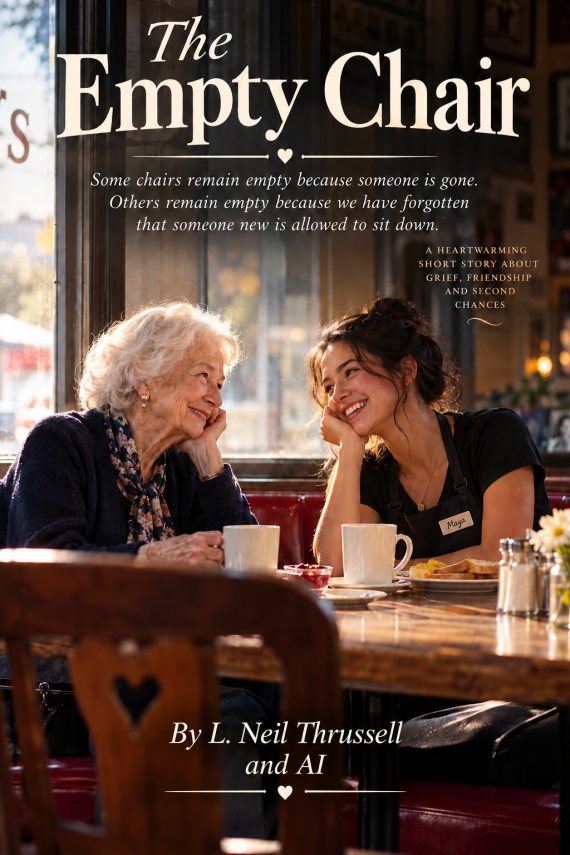
The Empty Chair
By L. Neil Thrussell and AI
Every Sunday at eleven-thirty, Eleanor Hayes walked into Mabel’s Kitchen and sat in the same booth by the window.
She had been doing it for twenty-three years.
For most of those years, Thomas had been with her.
He always sat across from her, never beside her, because he liked to stretch one leg into the aisle and because, according to him, married people who had already spent the entire morning together did not need to sit shoulder-to-shoulder over eggs.
Eleanor used to tell him he only wanted the better view of the front door so he could watch everyone coming in.
Thomas always denied it.
Eleanor never believed him.
Now, at eighty-seven, she still took the same side of the booth.
The seat across from her remained empty.
It had been empty for eleven months.
Mabel’s Kitchen had changed during those twenty-three years. The old wallpaper had been replaced twice. The brass light fixtures disappeared sometime around 2015 and were replaced by black metal ones Thomas had called industrial plumbing. The menus went from laminated pages to leather covers, then back to laminated pages again. Three owners had come and gone, although everyone still called the place Mabel’s because nobody could imagine calling it anything else.
Eleanor had changed too.
Her hair had gone completely white. Her hands had thinned, and the veins beneath the skin were more visible now. Her knees warned her about changes in the weather before the forecasts did, and she no longer wore the small heels Thomas had always liked.
Her Sunday coat was navy blue. Her purse was black. She kept a folded handkerchief in the left pocket because tissues, in her opinion, were one more example of civilization lowering its standards.
The waitress who usually served her was named Maya.
Maya was twenty-four, with dark hair she wore in a loose knot at the back of her head. She had a tiny silver stud in one nostril and a habit of writing orders on the back of her hand whenever the restaurant became too busy.
Eleanor had noticed both things during Maya’s first week.
She had said nothing about either.
At eighty-seven, Eleanor had learned that most things did not require an opinion.
“Morning, Eleanor.”
Maya approached carrying a coffee pot.
“Good morning, dear.”
“Coffee?”
“Please.”
Maya filled the cup.
“Two eggs, soft. Brown toast. Strawberry jam.”
“You remembered.”
“You’ve ordered the same thing every Sunday for nine months.”
“Then I suppose I’ve become predictable.”
Maya smiled.
“At least you make my job easy.”
Eleanor looked across at the empty seat.
“Someone should.”
Maya glanced at the chair but did not ask.
She had learned that too.
There had been a time when Thomas ordered first.
Two eggs over hard. Sausage. Brown toast. Coffee black.
Eleanor would make a face at the sausage because Thomas’s doctor had told him to stop eating it when he turned sixty-three.
Thomas had continued ordering sausage until he was eighty-two.
“A man needs one vice,” he used to say.
“You have several,” Eleanor would reply.
Then he would wink at her.
Those years felt strangely close inside the booth.
Outside it, they felt impossibly far away.
Thomas had died the previous October after seven years with Alzheimer’s disease.
People sometimes called it a long goodbye.
Eleanor hated that phrase.
Goodbye suggested there had been a moment when both people understood that one of them was leaving.
There had been no such moment.
Thomas had disappeared by degrees.
At first, the changes were small enough to dismiss. He forgot appointments, misplaced his keys, and asked the same question twice.
Then five times.
Then ten.
One afternoon, he drove to the hardware store he had visited for thirty years and called Eleanor from a gas station less than four kilometres from home.
“What city am I in?”
Eleanor had laughed.
Thomas had tried to laugh too.
Neither of them found it funny.
A few months later, Eleanor found him standing in the kitchen with the refrigerator door open, staring inside.
“What are you looking for?” she asked.
Thomas frowned.
“I don’t know.”
That was the beginning.
Then came doctors.
Tests.
Appointments.
Words Eleanor did not want to hear.
Progressive.
Cognitive decline.
No cure.
They drove home in silence after the diagnosis.
Thomas stared out the passenger window.
Halfway home, he said, “I suppose I’ll become a burden.”
Eleanor gripped the steering wheel.
“You’ve been a burden for sixty-one years.”
He looked at her.
Then he laughed.
Eleanor laughed too.
For a little while, they pretended that was enough.
It wasn’t.
The disease was patient.
It took what it wanted slowly.
First it stole facts.
Then places.
Then names.
Then dignity.
Thomas forgot grandchildren.
He accused Eleanor of hiding his wallet.
He became frightened in his own bedroom.
Once, at two in the morning, Eleanor woke and found him standing by the front door wearing pyjama pants, winter boots and no shirt.
“Where are you going?”
“To work.”
“You retired eighteen years ago.”
Thomas stared at her.
“No, I didn’t.”
For twenty minutes he argued.
Then he cried.
Eleanor had never seen her husband cry before the disease.
That frightened her more than the argument.
Another time, she found him trying to unlock the front door with the television remote.
She wanted to laugh.
Instead, she sat on the bottom stair and cried after he went to bed.
There were worse nights.
Nights when Thomas became angry because Eleanor would not let him drive.
Nights when he accused her of being a stranger in his home.
Nights when he wet the bed and apologized like a little boy.
Nights when he did not apologize at all because he no longer understood what had happened.
Eleanor learned how to lift him without hurting his shoulder.
How to guide him into the shower.
How to wash his hair while preserving the illusion that he was still doing it himself.
How to hide her fear when he wandered through the house after midnight.
She learned medication schedules, adult briefs and door alarms.
She learned how long she could leave him alone while retrieving the mail.
How quickly a kettle could become dangerous.
She learned that love could look remarkably unromantic.
Sometimes it looked like changing sheets at three in the morning.
Sometimes it looked like wiping food from the chin of a man who had once taught their sons how to shave.
Sometimes it looked like sitting on the bathroom floor with her back against the tub while the man she loved shouted from the hallway because he no longer knew where he was.
People later called Eleanor devoted.
They did not see those moments.
They did not hear her whisper, “I can’t do this anymore.”
They did not see her get up and do it anyway.
Somewhere during the second year, Thomas began forgetting who Eleanor was.
At first, only occasionally.
He would look at her across the room with a puzzled expression and ask, “Are you new here?”
Eleanor would smile.
“No.”
Then, a few minutes later, recognition would return.
“There you are.”
And she would pretend nothing had happened.
Over time, those moments lasted longer.
Recognition returned less often.
By the final five years, it rarely returned at all.
Thomas called her Nurse.
Sometimes Ma’am.
Once he called her Mother.
That one nearly broke her.
But the worst day was an ordinary Tuesday afternoon.
Rain tapped softly against the kitchen window.
Thomas sat at the table drinking tea while Eleanor placed two biscuits beside his cup.
He looked at them.
Then at her.
“Do you know when Eleanor is coming?”
She stood very still.
“Eleanor?”
“My wife.”
His face softened.
“She worries.”
Eleanor felt the room tilt.
“What does she worry about?”
“Everything.”
A faint smile touched his mouth.
“Drives me crazy.”
Eleanor sat across from him.
Thomas looked toward the hallway.
“She’ll probably be here soon.”
“Yes.”
“You know her?”
Eleanor swallowed.
“Yes.”
“She’s a good woman.”
That nearly undid her.
Instead, she reached across the table and placed her hand over his.
“Eleanor loves you very much.”
Thomas relaxed.
“I know.”
That night, Eleanor cried in the bathroom with the taps running so he would not hear.
She cried quietly because even grief had become something she needed to manage.
Then she washed her face and returned to bed beside the man who no longer knew her name.
For five years, Thomas did not know she was his wife.
Eleanor still knew.
That had to be enough.
When he died, it happened quietly.
Too quietly, Eleanor thought.
After seven years of struggle, fear, exhaustion and decline, she expected something larger.
Thunder.
A sudden silence in the world.
Some spiritual announcement that a life had ended.
Instead, there was a nurse checking his pulse, a hand resting gently on Eleanor’s shoulder, and a clock on the wall moving forward.
Thomas took one final breath.
Then no more.
Eleanor held his hand.
She waited for devastation.
What came first was relief.
A deep, physical release.
Like unclenching a muscle she had forgotten was tense.
Then came horror.
Not because Thomas was dead.
Because part of her was glad.
She sat beside him and hated herself for the peace settling into her body.
Everyone told her she had been extraordinary.
Her children said she had given him everything.
Friends told her he was finally at peace.
People hugged her and whispered that she could rest now.
Nobody asked what it felt like to be free.
That was the word Eleanor could not bear.
Free.
As if Thomas had been a prison.
As if loving him had been a sentence.
But some mornings, that was exactly how it had felt.
And she carried shame for that truth.
After the funeral, the house became unbearably still.
For seven years, every sound had mattered.
A door opening.
A floorboard creaking.
Water running.
A cough from the bedroom.
A drawer pulled open.
Then suddenly there was nothing to listen for.
Everyone thought stillness would be peaceful.
Nobody warned Eleanor how loud peace could become.
The first Sunday after the funeral, she woke at seven.
By eleven, she had changed clothes twice.
At eleven-twenty, without making any real decision, she put on her navy coat.
At eleven-thirty, she walked into Mabel’s Kitchen.
She sat in their booth.
The server approached.
“Will someone be joining you?”
Eleanor looked at Thomas’s seat.
“No.”
Her throat tightened.
She almost stood.
Almost walked out.
Instead, she stayed.
Forty-five minutes.
The following Sunday, she returned.
Then the Sunday after that.
Months later, Maya became her regular waitress.
At first, their conversations were practical.
Coffee.
Toast.
Weather.
Then one Sunday, the restaurant was quiet.
Snow fell outside in thick, lazy flakes.
Only three other tables were occupied.
Maya brought Eleanor’s breakfast, topped up her coffee and disappeared toward the kitchen.
Ten minutes later, she returned carrying her own mug.
She looked tired.
Not sleepy.
Tired in the way young people sometimes looked when they believed they were failing at life.
“Break?” Eleanor asked.
“Five whole minutes.”
“A luxury.”
“You have no idea.”
Maya started toward an empty table.
Eleanor looked at the chair across from her.
“You can sit there if you like.”
Maya stopped.
She looked at Eleanor, then at the chair.
“I don’t want to take someone’s seat.”
Eleanor followed her gaze.
For a moment, neither woman spoke.
Then Eleanor gave a small smile.
“Neither do I.”
Maya seemed unsure what that meant.
Still, she sat.
The chair creaked beneath her.
Eleanor felt something tighten in her chest.
It was the first time anyone had sat there since Thomas died.
Maya wrapped both hands around her mug.
“So, what do people talk about when they’re eighty-seven?”
“The same nonsense they talk about at twenty-four. We’re simply more tired of it.”
Maya laughed.
The sound surprised Eleanor.
So did her own laughter a moment later.
They talked about the snow.
Then the music playing through the restaurant speakers.
Maya hated it.
Eleanor agreed.
“What is this supposed to be?”
“Indie folk.”
“It sounds like someone whispering through a sock.”
Maya nearly spit out her coffee.
Eleanor laughed again.
Not politely.
Not the careful social laugh she had given people at church or at the grocery store.
A real laugh.
For several seconds, she forgot she was supposed to be grieving.
That frightened her almost as much as it pleased her.
Five minutes later, Maya stood.
“Duty calls.”
“That was quick.”
“I warned you.”
The following Sunday, Maya sat again.
No invitation was needed.
After that, it became part of the routine.
Eleanor arrived at eleven-thirty.
Maya brought coffee and breakfast.
Sometime between noon and twelve-fifteen, if the restaurant slowed enough, Maya sat across from her.
Five minutes.
Sometimes seven.
Once twelve.
They talked about almost nothing.
That was what made it important.
Maya told Eleanor about customers who snapped their fingers at servers.
Eleanor told Maya that Thomas once tried to repair a washing machine without turning off the water.
Maya told Eleanor her father had remarried and moved to Vancouver.
Eleanor told Maya she had never understood why young people paid six dollars for coffee that tasted burned.
Maya defended expensive coffee.
Eleanor refused to be persuaded.
One Sunday, Maya arrived with purple streaks in her hair.
Eleanor stared at them for several seconds.
“You hate it.”
“I did not say that.”
“You’re thinking it.”
“I’m thinking you have excellent courage.”
“That is not a compliment.”
“It was the best I could do on short notice.”
Maya laughed.
Eleanor found herself laughing too.
The chair slowly stopped feeling forbidden.
Not ordinary.
Not yet.
But less sacred in the painful way grief made objects sacred.
Eventually, the conversations deepened.
One Sunday, Maya asked how long Eleanor and Thomas had been married.
“Sixty-nine years.”
Maya stared at her.
“That’s insane.”
“Thank you.”
“No, I mean…”
“I know what you mean.”
Maya smiled.
“How do you stay married sixty-nine years?”
Eleanor considered the question while spreading strawberry jam across her toast.
“You don’t.”
Maya frowned.
“You stay married today,” Eleanor said. “Then tomorrow you decide again. Eventually, you look up and discover you’ve done it for sixty-nine years.”
“That sounds romantic.”
“It wasn’t.”
Maya laughed.
“Thomas was stubborn, cheap, terrible at apologizing and incapable of putting socks into the laundry basket.”
“Still sounds romantic.”
“He snored.”
“There it is.”
“But he could make me laugh when I wanted to kill him. That helped.”
Another Sunday, Maya asked whether Thomas had been the love of Eleanor’s life.
Eleanor shook her head.
“No.”
Maya blinked.
“No?”
“He was the pain in the ass of my life.”
Maya burst out laughing.
Eleanor continued.
“That is considerably more permanent.”
Those conversations became something Eleanor waited for.
She did not admit that at first.
Then one Sunday, Maya called in sick.
Another waitress served Eleanor.
The woman was perfectly pleasant.
Eleanor disliked her immediately.
The following Sunday, Maya returned.
“You were away.”
“Flu.”
“You could have told me.”
Maya raised an eyebrow.
“I don’t have your number.”
Eleanor opened her mouth.
Then closed it.
That was true.
They knew each other only inside Mabel’s Kitchen.
Five minutes every Sunday.
That was all.
Yet Eleanor had worried about her.
Maya sat down.
“You missed me.”
“Don’t be ridiculous.”
“You absolutely missed me.”
“I noticed your absence.”
“That sounds like missing someone if you’re eighty-seven.”
Eleanor pointed her spoon at her.
“Careful.”
Maya grinned.
Eleanor smiled despite herself.
The truth was that Maya had become important.
Not in the way Thomas had been important.
Nothing could replace sixty-nine years.
Eleanor had no interest in replacing them.
But grief, she was beginning to understand, was not a room that could contain only one person.
Perhaps the heart was larger than that.
Perhaps love did not require vacancies.
One Sunday, Maya arrived unusually quiet.
She sat across from Eleanor and stared into her coffee.
“Something wrong?”
“No.”
Eleanor waited.
At eighty-seven, she had learned that silence often did more work than questions.
Maya sighed.
“My friends are all moving forward.”
“Forward where?”
“Life.”
“That seems vague.”
Maya smiled faintly.
“Careers. Marriage. Houses. Kids. One of my friends just finished nursing school. Another got engaged in Italy.”
“Show-off.”
Maya laughed once.
“I dropped out of university two years ago. I’m serving pancakes.”
“There are worse crimes.”
“My mother wanted me to be a nurse.”
Eleanor looked at her.
“You wanted that?”
“I don’t know.”
“Different question.”
Maya rubbed the side of her mug with one thumb.
“She died when I was nineteen.”
Eleanor remained silent.
Maya continued.
“She always told me I’d be good at nursing. I hated that she kept saying it. I thought she was trying to decide my life for me.”
“She probably was.”
That surprised a laugh out of Maya.
“Now I’d give anything for her to tell me what to do.”
Eleanor recognized that ache immediately.
The impossible hunger for one more conversation.
Not a profound conversation.
Just one more.
Something ordinary.
Did you eat?
Did you sleep?
Are you wearing enough?
You’ll be fine.
“What happened to university?” Eleanor asked.
“Money. Mostly.”
“Mostly?”
Maya stared toward the kitchen.
“My mom got sick during my first year. Cancer.”
Eleanor nodded.
“I kept going for a while. Then I started missing classes because she needed help. After she died, I went back for a semester.”
“But?”
“I hated being there.”
“Why?”
“Everyone’s life kept moving.”
Maya looked down.
“Mine didn’t.”
Eleanor understood that too.
Grief could make the whole world seem rude.
People bought groceries.
Went to work.
Got engaged.
Argued about parking.
All while your universe had ended.
“I left school,” Maya said. “Told everyone I’d go back.”
“Did you?”
“No.”
“What do you want now?”
Maya shook her head.
“I think I want nursing.”
“Because your mother wanted it?”
“I don’t know.”
“Find out.”
“How?”
Eleanor shrugged.
“You’re young. You people have Google.”
Maya laughed.
Then her expression softened.
“I’m scared I’ve waited too long.”
Eleanor stared at her.
“You’re twenty-four.”
“I know.”
“No, you don’t. Nobody who is twenty-four understands how offensively young twenty-four is.”
Maya smiled.
“I’m serious.”
“So am I.”
Eleanor reached across the table.
“Go back.”
Maya looked at her hand.
“You make it sound simple.”
“It isn’t simple.”
Eleanor squeezed her fingers.
“Do it anyway.”
A few weeks later, Maya asked about Thomas’s illness.
Eleanor did not answer immediately.
People often wanted the gentle version.
She had no gentle version.
“He had Alzheimer’s.”
“How long?”
“Seven years.”
Maya’s expression softened.
“That must have been hard.”
“It was ugly.”
Maya waited.
Eleanor appreciated that.
“He stopped knowing me after about two years.”
Maya lowered her eyes.
“For five years?”
“Yes.”
“I’m sorry.”
“So am I.”
Eleanor looked toward the window.
Rain traced uneven lines down the glass.
“He called me Nurse sometimes. Once he asked when his wife was coming home.”
Maya swallowed.
“What did you say?”
“I told him she loved him.”
Maya’s eyes filled.
Eleanor disliked pity, but this did not feel like pity.
It felt like someone standing beside a weight without trying to remove it.
“He didn’t know who you were,” Maya said quietly.
“No.”
“How did you keep doing it?”
Eleanor looked at her.
“Because I knew who he was.”
The words surprised her.
She had never said them aloud.
Maya covered Eleanor’s hand with hers.
For several moments, neither spoke.
Then Eleanor said the thing she had carried for almost a year.
“When he died, I was relieved.”
Maya did not move.
Eleanor stared at their joined hands.
“I loved him. God, I loved that man. But when they told me he was gone, part of me felt relief.”
Her voice cracked.
“I’ve hated myself for that.”
Maya squeezed her hand.
“No.”
Eleanor looked up.
“I think you were tired.”
The sentence was so simple that Eleanor almost dismissed it.
Then something inside her broke.
Not violently.
Quietly.
Like ice giving way beneath warm water.
For eleven months, people had praised her strength.
Called her devoted.
Called her remarkable.
Nobody had told her she had been tired.
Eleanor began to cry.
Maya moved around the table and sat beside her.
She did not offer advice.
She did not say Thomas was in a better place.
She did not say everything happened for a reason.
She simply stayed.
Five minutes became twenty.
The manager saw them and said nothing.
When Eleanor finally stopped crying, Maya handed her three paper napkins.
Eleanor looked at them.
“Paper.”
“It’s all I’ve got.”
Eleanor pulled the handkerchief from her pocket.
“Civilization survives another day.”
Maya laughed.
So did Eleanor.
Then came March.
On a Thursday afternoon, Mabel’s Kitchen closed.
The landlord had raised the rent. The owner was already behind, and the staff received two days’ notice.
Nobody called Eleanor.
Why would they?
She was a customer.
Sunday morning arrived cold and bright.
Eleanor dressed carefully, tucked her handkerchief into her coat pocket and walked the six blocks to Mabel’s Kitchen.
The parking lot was empty.
A handwritten sign had been taped to the door.
CLOSED EFFECTIVE IMMEDIATELY.
THANK YOU FOR TWENTY-SEVEN WONDERFUL YEARS.
Eleanor stood looking through the glass.
Chairs were stacked on tables.
The lights were off.
Her booth was visible near the window.
For one strange moment, she expected Thomas to be sitting there.
He was not.
Then she expected Maya.
She was not there either.
Eleanor remained outside for several minutes.
People passed behind her on the sidewalk.
Someone laughed across the street.
A bus hissed at the corner.
Life continued with astonishing indifference.
Eleanor walked home.
The following Sunday, she woke at seven.
At eleven, she made coffee.
At eleven-fifteen, she toasted two slices of brown bread.
At eleven-thirty, she sat at her kitchen table.
Thomas’s chair was across from her.
The house was quiet.
Eleanor looked at the chair and realized she was not thinking about Thomas.
She was thinking about Maya.
Where was she working?
Had she found another job?
Was she still thinking about nursing school?
Had she changed her mind?
Would Eleanor ever see her again?
The realization hurt.
Then something stranger happened.
She smiled.
For the first time since Thomas died, she had missed someone new.
Her heart had not betrayed him.
It had simply remained alive.
The following Sunday, Eleanor sat at the kitchen table again.
Eleven-thirty passed.
Then eleven-thirty-five.
At eleven-forty, someone knocked.
Eleanor frowned.
Nobody visited without calling anymore.
She walked carefully toward the front door and opened it.
Maya stood on the porch.
She carried two coffees and a paper bag.
Eleanor stared at her.
“Apparently your restaurant closed,” Maya said.
Eleanor’s throat tightened.
“So I heard.”
“I figured you’d need breakfast.”
“How did you find me?”
“You mentioned St. Andrew’s Church once. I asked around.”
“That is mildly disturbing.”
“I prefer determined.”
Eleanor stepped aside.
Maya entered.
She looked around the small house, at the photographs lining the hallway, the framed wedding picture and the wooden clock ticking above the living-room doorway.
Then she followed Eleanor into the kitchen.
Maya stopped.
Two chairs sat at the table.
One on either side.
She looked at the empty one.
“Is anyone sitting there?”
Eleanor followed her gaze.
For years, that chair had belonged to Thomas.
Even after he died.
Perhaps especially after he died.
She looked at it for several seconds.
Then she looked at Maya.
“No, dear.”
Maya hesitated.
Eleanor smiled.
“I think it’s been waiting for you.”
Maya sat.
They opened the paper bag.
Egg sandwiches.
Hash browns.
Maya had also brought strawberry jam packets.
Eleanor held one up.
“You remembered.”
“You’re predictable.”
“Careful.”
Maya laughed.
The following Sunday, she returned.
Then the Sunday after that.
Mabel’s Kitchen was gone, but Sunday breakfast remained.
Over time, the visits stretched beyond five minutes.
They became an hour.
Sometimes two.
Maya began bringing application forms.
Then textbooks.
Eleanor quizzed her.
Mostly badly.
“What does this mean?”
“You’re holding the book upside down.”
“I’m ninety, not blind.”
“You’re eighty-eight.”
“Exactly. Give me time.”
Maya applied to nursing school.
The day the acceptance email arrived, she drove straight to Eleanor’s house before telling anyone else.
Eleanor read it twice.
“I told you.”
“You told me to go back.”
“Same thing.”
“No, it isn’t.”
“At my age, I’m allowed to revise history.”
Two years later, Eleanor sat in the audience at Maya’s nursing-school graduation.
She was ninety years old by then.
Her knees hurt.
Her hearing was worse.
Her navy coat had finally been replaced because Maya insisted the old one made her look like a retired naval officer.
Eleanor considered this an insult to naval officers.
The ceremony was too long.
Thomas would have hated it.
That thought made her smile.
When Maya’s name was called, she crossed the stage and accepted her diploma.
Then she looked into the audience.
Her eyes found Eleanor.
Eleanor stood.
Slowly.
She clapped.
People beside her clapped too.
For one brief second, Eleanor imagined Thomas sitting in the empty chair beside her.
He would complain about the folding seats.
He would ask how much tuition had cost.
He would probably whisper something inappropriate during the speeches.
The image came gently.
Not like a wound.
More like a familiar hand resting briefly against her shoulder.
Then Maya held the diploma high.
Eleanor clapped harder.
Later, outside the hall, Maya found her.
“You stood.”
“Of course I stood.”
“You didn’t have to.”
“Neither did you.”
Maya looked confused.
Eleanor touched the edge of her diploma.
“You didn’t have to go back.”
Maya’s eyes filled.
“You made me.”
“No.”
Eleanor shook her head.
“I only sat with you.”
Maya looked at her.
Then she understood.
She hugged Eleanor.
Eleanor tolerated it for several seconds before muttering that public displays were becoming excessive.
Maya laughed into her shoulder.
On the drive home, Eleanor thought about chairs.
Kitchen chairs.
Restaurant booths.
Hospital chairs.
Funeral chairs.
The chair beside Thomas’s bed during those final months.
The empty chair across from her at Mabel’s.
The chair in her kitchen Maya now occupied every Sunday.
She finally understood that an empty chair could mean many things.
Absence.
Grief.
Waiting.
Fear.
Loyalty.
Sometimes love made us hold a place open so tightly that we forgot a chair was meant to be sat in.
Thomas had not been replaced.
He never would be.
Maya had not filled his chair.
That was never what happened.
The heart was not a room with limited seating.
It did not honour one love by refusing another.
It did not betray the dead by allowing the living to come closer.
Some chairs remain empty because someone is gone.
Others remain empty because we have forgotten that someone new is allowed to sit down.
And sometimes the greatest act of kindness is not rescuing anyone.
It is not changing their life.
It is not finding the perfect words.
Sometimes it is simply noticing someone is alone, pulling out a chair, and sitting down.
Then staying long enough for them to remember that life is not finished with them yet.
AI Acknowledgement and Authorship Notice
This publication was created with the assistance of artificial intelligence.
AI contributed to the project in the following ways:
- AI created the visual cover graphic.
- AI offered story-development support and creative assistance.
- AI assisted with the editing and refinement process.